The Complete Steps to Calories Calculator Guide: Transform Steps into Meaningful Metrics
Introduction: Beyond Just Counting Steps
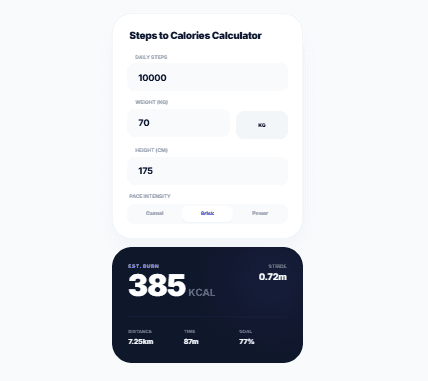
You've been diligently tracking your 10,000 daily steps—but what do those steps actually mean for your health and fitness goals? While step counting has become a universal health metric, understanding the energy expenditure behind those steps is what truly matters for weight management, fitness progress, and meaningful goal setting.
This comprehensive guide will help you:
- Accurately convert steps to calories burned
- Understand how personal factors affect your calorie burn
- Optimize your walking routine for maximum benefit
- Set realistic fitness goals based on your step data
- Use our Steps to Calories Calculator effectively
Ready to convert your steps? Use our Steps to Calories Calculator for instant, personalized calculations.
📖 Table of Contents
- Why Convert Steps to Calories?
- The Science Behind Step-to-Calorie Conversion
- How Our Calculator Works: The Formula Explained
- Stride Length: Your Personal Walking Signature
- Body Weight: The Dominant Factor in Calorie Burn
- Walking Intensity: Casual, Brisk, or Power Walking
- Height's Role in Distance Calculation
- Understanding MET Values for Different Paces
- Time and Distance: Secondary Metrics from Steps
- Accuracy Factors and Margin of Error
- Setting Realistic Step-Based Calorie Goals
- Comparing Different Walking Intensities
- Tracking Progress with Step Calorie Data
- Weight Loss Strategies Using Step Conversion
- Common Mistakes in Step Calorie Estimation
- Fitness Tracker Integration Tips
- Special Considerations and Adjustments
- FAQs: Your Step Conversion Questions Answered
1️⃣ Why Convert Steps to Calories?
The Limitations of Step Counting Alone
While step counting is popular, it has significant limitations:
- Ignores intensity: 10,000 slow steps ≠ 10,000 brisk steps
- Neglects personal factors: Same steps burn different calories for different people
- Lacks context: Doesn't connect to nutrition or energy balance
- Poor for goal setting: Arbitrary round numbers (10,000) without personalization
The Power of Calorie Conversion
Converting steps to calories provides:
- Personalized metrics: Tailored to your body and walking style
- Energy balance awareness: Connects activity to nutrition
- Progress tracking: Quantifiable fitness improvements
- Motivational insights: Shows tangible results from your efforts
- Goal personalization: Realistic targets based on your capacity
Practical Applications
Use step-to-calorie conversion for:
- Weight management: Track calorie deficit/surplus
- Fitness progression: Monitor intensity improvements
- Activity planning: Structure walking workouts
- Health monitoring: Understand activity impact on energy balance
- Goal achievement: Set and reach meaningful targets
2️⃣ The Science Behind Step-to-Calorie Conversion
Energy Expenditure Fundamentals
Calories burned during walking come from:
- Basal Metabolic Rate (BMR): Energy for basic bodily functions
- Thermic Effect of Food (TEF): Energy to digest food
- Physical Activity Energy Expenditure (PAEE): Energy for movement
Walking primarily increases PAEE, which accounts for 15-30% of total daily energy expenditure for most people.
The Physics of Walking
Walking requires energy to:
- Support body weight against gravity
- Accelerate and decelerate limbs
- Overcome friction and air resistance
- Maintain balance and coordination
These energy costs are influenced by your weight, height, and walking speed.
Metabolic Equivalents (METs)
METs measure exercise intensity relative to resting metabolism:
- 1 MET: Resting energy expenditure
- 2.5-3.0 METs: Casual walking
- 3.5-4.0 METs: Brisk walking
- 4.5-5.0+ METs: Power walking
MET values form the basis of most calorie calculation formulas.
3️⃣ How Our Calculator Works: The Formula Explained
Our Calculation Formula
Our calculator uses this comprehensive formula:
Calories = MET × Weight in kg × Time in hours
Where:
- MET: Metabolic equivalent (based on walking intensity)
- Weight: Your body weight in kilograms
- Time: Walking time calculated from steps and speed
Step-by-Step Calculation Process
Step 1: Calculate Stride Length
Stride Length (meters) = Height (cm) × 0.414 / 100
Step 2: Calculate Distance
Distance (km) = (Steps × Stride Length) / 1000
Step 3: Calculate Time
Time (hours) = Distance / Walking Speed
Step 4: Calculate Calories
Calories = MET × Weight (kg) × Time (hours)
Input Requirements
Minimum values for accurate calculation:
- Steps: ≥100 steps
- Weight: ≥10kg (22 lbs)
- Height: ≥50cm (20 inches)
These ensure physiologically plausible calculations.
4️⃣ Stride Length: Your Personal Walking Signature
What Is Stride Length?
Stride length is the distance from heel strike of one foot to the next heel strike of the same foot.
Two important measurements:
- Step length: Distance between consecutive opposite foot strikes
- Stride length: Distance between consecutive same foot strikes (≈2 × step length)
Stride Length Formula
Our calculator uses:
Stride Length = Height (cm) × 0.414
This formula is based on anthropometric research showing stride length is approximately 41.4% of height.
Average Stride Lengths by Height
| Height | Stride Length | Steps per km |
|---|---|---|
| 150 cm (4'11") | 62 cm | ~1,613 steps/km |
| 165 cm (5'5") | 68 cm | ~1,470 steps/km |
| 175 cm (5'9") | 72 cm | ~1,389 steps/km |
| 185 cm (6'1") | 77 cm | ~1,299 steps/km |
| 195 cm (6'5") | 81 cm | ~1,235 steps/km |
Factors Affecting Stride Length
- Height: Primary determinant
- Leg length: Proportion of height
- Walking speed: Faster = longer stride
- Terrain: Hills shorten stride
- Fatigue: Tiredness reduces stride length
- Age: May decrease with aging
- Injuries/pain: Can alter gait pattern
Measuring Your Actual Stride Length
Simple method:
- Walk 10 normal steps
- Measure total distance
- Divide by 10 for average stride
Advanced method:
- Use GPS tracking apps
- Walk measured course
- Calculate over multiple sessions
Why Accurate Stride Length Matters
10% error in stride length creates:
- 10% error in distance calculation
- 10% error in calorie estimation
- Significant impact on goal tracking
5️⃣ Body Weight: The Dominant Factor in Calorie Burn
The Weight-Calorie Relationship
Calories burned during weight-bearing exercise are directly proportional to body weight:
- Simple physics: Moving more mass requires more energy
- Approximate rule: Each kilogram moved burns energy based on distance and speed
- Practical implication: Weight loss reduces calorie burn per step
Weight-Based Calorie Examples
For 10,000 steps at brisk pace (5.0 km/h):
| Weight | Calories Burned |
|---|---|
| 50 kg (110 lbs) | ~285 calories |
| 60 kg (132 lbs) | ~342 calories |
| 70 kg (154 lbs) | ~399 calories |
| 80 kg (176 lbs) | ~456 calories |
| 90 kg (198 lbs) | ~513 calories |
| 100 kg (220 lbs) | ~570 calories |
The Weight Loss Paradox
As you lose weight:
- Calorie burn per step decreases (good for sustainability)
- Walking becomes easier (can walk further/faster)
- Net effect: May need to increase steps to maintain same calorie deficit
Weight Conversion Notes
Our calculator handles both metric and imperial:
- kg to lbs: Multiply by 2.20462
- lbs to kg: Multiply by 0.453592
Always use consistent units for accurate calculations.
6️⃣ Walking Intensity: Casual, Brisk, or Power Walking
Our Three Intensity Categories
Casual Walking (3.5 km/h):
- MET value: 2.8
- Pace: Leisurely, conversational
- Characteristics: Comfortable pace, minimal exertion
- Best for: Beginners, recovery days, active recovery
Brisk Walking (5.0 km/h):
- MET value: 3.8
- Pace: Purposeful, steady
- Characteristics: Elevated heart rate, breathing deeper
- Best for: Daily activity, weight maintenance, general fitness
Power Walking (6.5 km/h):
- MET value: 5.0
- Pace: Fast, vigorous
- Characteristics: Significant exertion, arm pumping
- Best for: Fitness improvement, weight loss, cardiovascular health
Intensity Impact on Calorie Burn
For 70kg person, 10,000 steps:
- Casual: ~315 calories
- Brisk: ~430 calories
- Power: ~565 calories
That's a 79% increase from casual to power walking!
How to Determine Your Intensity
Talk test method:
- Casual: Can sing comfortably
- Brisk: Can talk but not sing
- Power: Can only say short phrases
Heart rate method:
- Casual: 50-60% max heart rate
- Brisk: 60-70% max heart rate
- Power: 70-85% max heart rate
7️⃣ Height's Role in Distance Calculation
Why Height Matters
Height affects:
- Stride length: Taller = longer stride
- Distance covered: More distance per step
- Calorie calculation: More distance = more calories
- Goal setting: Different step targets for same distance
Height-Based Distance Examples
For 10,000 steps at different heights:
| Height | Distance Covered |
|---|---|
| 150 cm (4'11") | ~6.2 km (3.9 miles) |
| 165 cm (5'5") | ~6.8 km (4.2 miles) |
| 175 cm (5'9") | ~7.2 km (4.5 miles) |
| 185 cm (6'1") | ~7.7 km (4.8 miles) |
| 195 cm (6'5") | ~8.1 km (5.0 miles) |
Height Measurement Tips
For most accurate results:
- Measure in morning: Before compression from daily activities
- Stand straight: Against wall, heels together
- Use proper tool: Stadiometer or measuring tape
- Record consistently: Same conditions each time
When Height Changes Matter
Recalculate if:
- Significant weight loss/gain (affects posture)
- Aging (height can decrease)
- Posture improvements
- First accurate measurement
8️⃣ Understanding MET Values for Different Paces
What Are MET Values?
MET (Metabolic Equivalent of Task) values:
- 1 MET: Energy expenditure at rest
- Multiples: How many times resting energy an activity requires
- Standardized: Based on scientific measurement
Walking MET Values
| Pace | Speed | MET Value |
|---|---|---|
| Very slow | 2.0 km/h (1.2 mph) | 2.0 |
| Slow | 3.2 km/h (2.0 mph) | 2.5 |
| Casual | 3.5 km/h (2.2 mph) | 2.8 |
| Moderate | 4.8 km/h (3.0 mph) | 3.5 |
| Brisk | 5.0 km/h (3.1 mph) | 3.8 |
| Very brisk | 6.4 km/h (4.0 mph) | 5.0 |
| Power walking | 6.5+ km/h (4.0+ mph) | 5.0-6.0 |
How MET Values Are Determined
MET values come from:
- Laboratory studies: Measuring oxygen consumption
- Population averages: Large sample sizes
- Activity analysis: Breaking down movement components
- Scientific consensus: Compendium of Physical Activities
Limitations of MET Values
- Population averages: Don't account for individual differences
- Assumed fitness level: Based on "average" fitness
- Environmental factors: Not adjusted for terrain, weather
- Efficiency variations: Fit people may use less energy
9️⃣ Time and Distance: Secondary Metrics from Steps
Distance Calculation
From steps to distance:
Distance (km) = (Steps × Stride Length in meters) / 1000
Example: 10,000 steps × 0.72m stride = 7,200 meters = 7.2 km
Time Estimation
From distance and speed:
Time (minutes) = (Distance in km / Speed in km/h) × 60
Example: 7.2 km ÷ 5.0 km/h = 1.44 hours = 86 minutes
Why These Metrics Matter
Distance helps you:
- Compare to running/cycling distances
- Plan routes effectively
- Track progress in ground covered
- Set geographical goals (walk to next town)
Time helps you:
- Schedule walking sessions
- Track duration for fitness guidelines
- Monitor pace improvements
- Balance with other activities
Real-World Examples
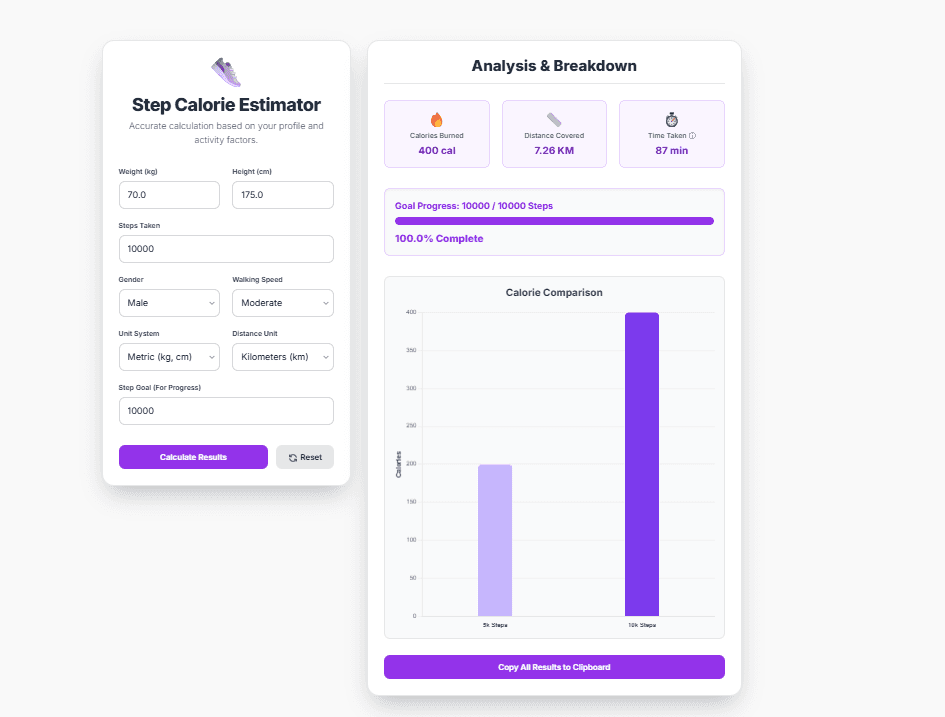
For 10,000 steps (average height, brisk pace):
- Distance: ~7.2 km (4.5 miles)
- Time: ~86 minutes (1 hour 26 minutes)
- Calories: ~400 calories
These metrics provide a complete picture of your walking activity.
🔟 Accuracy Factors and Margin of Error
Sources of Error
Our calculator has potential error from:
- Stride length estimation: Formula vs. actual
- MET value assumptions: Population averages
- Walking efficiency: Individual variations
- Terrain factors: Flat vs. hilly
- Environmental conditions: Wind, temperature
Estimated Accuracy
Under ideal conditions:
- With accurate inputs: ±10-15%
- With estimated inputs: ±20-30%
- Compared to lab measurements: ±15-25%
This is comparable to fitness trackers and better than generic "calories per step" estimates.
Improving Accuracy
- Measure stride length: Don't rely on formula
- Know your true pace: Time yourself
- Use actual weight: Recent, accurate measurement
- Consider terrain: Adjust for hills
- Track consistently: Look at trends, not single data points
When Precision Matters
For weight loss tracking:
- Focus on consistency over precision
- Use same calculation method throughout
- Monitor trends, not absolute numbers
- Adjust based on actual results
For scientific/research purposes:
- Consider lab testing
- Use gold standard methods
- Acknowledge limitations
1️⃣1️⃣ Setting Realistic Step-Based Calorie Goals
From Steps to Calorie Goals
Process for goal setting:
- Determine daily calorie needs (TDEE calculator)
- Set weight management goal (deficit/surplus/maintenance)
- Calculate required calorie burn from walking
- Convert to steps using our calculator
- Adjust based on feasibility
Example Goal Setting
Scenario: 80kg person wants 300-calorie daily deficit from walking
Calculation:
- Use calculator: 80kg, brisk walking
- Find steps for 300 calories: ~6,600 steps
- Set goal: 7,000 steps daily (buffer)
- Track and adjust as needed
Progressive Goal Setting
Week 1-2: Establish baseline Week 3-4: +10% steps Week 5-8: +20% steps Week 9-12: +30% steps After 12 weeks: Maintain or focus on intensity
SMART Step Goals
Specific: Exactly how many steps Measurable: Trackable with device Achievable: Realistic for your life Relevant: Supports your health goals Time-bound: Daily/weekly timeframe
Example SMART goal: "Walk 8,500 steps daily for the next 4 weeks to create a 250-calorie daily deficit."
1️⃣2️⃣ Comparing Different Walking Intensities
Calorie Burn Comparison
For 70kg person, 30 minutes:
| Intensity | Steps | Calories | Efficiency (calories/step) |
|---|---|---|---|
| Casual | ~3,000 | ~105 | 0.035 cal/step |
| Brisk | ~3,800 | ~140 | 0.037 cal/step |
| Power | ~5,000 | ~175 | 0.035 cal/step |
Time Efficiency Comparison
To burn 300 calories:
| Intensity | Time Required | Steps Required |
|---|---|---|
| Casual | ~86 minutes | ~8,600 steps |
| Brisk | ~64 minutes | ~8,100 steps |
| Power | ~51 minutes | ~8,500 steps |
Health Benefit Comparison
Casual walking benefits:
- Low injury risk
- Sustainable daily
- Good for beginners
- Mental health benefits
Brisk walking benefits:
- Cardiovascular improvement
- Weight management
- Bone density maintenance
- Energy boost
Power walking benefits:
- Maximum calorie burn
- Significant fitness gains
- Time efficient
- High intensity training effects
Choosing Your Intensity
Consider:
- Fitness level: Start where you are
- Time available: Higher intensity saves time
- Goals: Weight loss vs. general health
- Enjoyment: Sustainable routine matters
- Injury risk: Higher intensity = higher risk
1️⃣3️⃣ Tracking Progress with Step Calorie Data
What to Track
Daily metrics:
- Total steps
- Estimated calories
- Walking time
- Distance covered
Weekly metrics:
- Average daily steps
- Total weekly calories
- Consistency (days meeting goal)
- Progress toward goals
Tracking Methods
Manual tracking:
- Use our calculator daily
- Record in journal/spreadsheet
- Review weekly
Automatic tracking:
- Fitness tracker syncing
- Health apps
- Automated spreadsheets
Combination approach:
- Use tracker for daily counts
- Use calculator for accurate conversions
- Manual review for adjustments
Progress Indicators
Positive signs:
- Increasing steps at same perceived effort
- Same steps burning more calories (weight gain) or maintained with weight loss
- Easier completion of walking sessions
- Consistent goal achievement
Adjustment needed:
- Plateaus in calorie burn
- Difficulty meeting goals
- Boredom or lack of motivation
- Injury or discomfort
Periodization Strategy
4-week cycles:
- Week 1: Baseline/maintenance
- Week 2: Increase 10%
- Week 3: Increase 10%
- Week 4: Deload/decrease 20%
Repeat with new baseline from week 3.
1️⃣4️⃣ Weight Loss Strategies Using Step Conversion
Calorie Deficit Planning
Step 1: Calculate maintenance calories Step 2: Set deficit target (250-500 calories daily) Step 3: Determine walking contribution Step 4: Convert to steps using calculator Step 5: Implement and monitor
Example Weight Loss Plan
For 85kg person wanting 0.5kg weekly loss:
- Maintenance: ~2,550 calories
- Daily deficit needed: ~550 calories
- From diet: 300 calories
- From walking: 250 calories
- Steps needed: ~6,300 brisk steps daily
Progressive Overload for Walking
Increase calorie burn by:
- More steps: Increase daily total
- Higher intensity: Brisk instead of casual
- Added weight: Weighted vest
- Inclines: Hills or treadmill incline
- Longer sessions: Extended walks
Plateaus and Adjustments
When weight loss stalls:
- Recalculate: Weight changed = different burn
- Increase steps: Add 1,000 daily
- Increase intensity: Move up one level
- Add variety: Include hills or intervals
- Review nutrition: Ensure deficit maintained
Sustainability Focus
Avoid walking burnout:
- Vary routes and scenery
- Walk with friends or podcasts
- Set process goals, not just outcome goals
- Celebrate non-scale victories
- Listen to your body
1️⃣5️⃣ Common Mistakes in Step Calorie Estimation
Mistake 1: Using Generic "Calories per Step"
Problem: Assumes one size fits all Solution: Use personalized calculator
Mistake 2: Ignoring Intensity Differences
Problem: Treats all steps equally Solution: Account for walking pace
Mistake 3: Not Updating Weight
Problem: Using outdated weight Solution: Recalculate with current weight
Mistake 4: Overestimating Calorie Burn
Problem: Assuming walking burns more than it does Solution: Use conservative estimates
Mistake 5: Neglecting Non-Step Activity
Problem: Missing other exercise calories Solution: Track all activity
Mistake 6: Obsessive Precision Seeking
Problem: Stress over exact numbers Solution: Focus on trends and consistency
Mistake 7: Comparing to Others
Problem: Unrealistic expectations Solution: Compare to your own baseline
Mistake 8: Ignoring How You Feel
Problem: Following numbers over intuition Solution: Balance data with body awareness
1️⃣6️⃣ Fitness Tracker Integration Tips
Syncing with Trackers
Most trackers overestimate calories by:
- Wrist-based: 20-30%
- Chest strap: 10-15%
- Phone apps: 25-40%
Calibration Process
Step 1: Use our calculator with accurate inputs Step 2: Compare to tracker estimate for same activity Step 3: Calculate adjustment factor Step 4: Apply factor to future tracker readings Step 5: Recalibrate monthly or with weight changes
Best Practices
- Use for trends, not absolutes
- Combine with manual calculations
- Focus on consistency in measurement
- Don't compare different tracker brands directly
- Trust perceived effort alongside data
When Trackers Are Most Useful
- Daily motivation: Seeing progress
- Habit formation: Streaks and reminders
- Social features: Challenges with friends
- Convenience: Automatic tracking
- Sleep and recovery data: Beyond just steps
1️⃣7️⃣ Special Considerations and Adjustments
Age Adjustments
Older adults may need:
- Shorter stride length estimates
- Lower intensity assumptions
- Longer time estimates
- More recovery between sessions
Our calculator doesn't include age but consider:
- Stride length decreases ~2% per decade after 40
- MET values may be slightly lower
- Recovery needs increase
Pregnancy Considerations
Adjustments for pregnancy:
- Use pre-pregnancy weight early on
- Reduce intensity as pregnancy progresses
- Shorter, more frequent walks
- Listen to body signals
- Always consult healthcare provider
Injury or Disability
Adaptations may include:
- Different stride length calculations
- Modified intensity levels
- Assistive device considerations
- Focus on what's possible, not comparisons
- Professional guidance for safe activity
Extreme Weights
Underweight (<18.5 BMI):
- Calorie burn lower per step
- Focus on health gains, not just calories
- Consider strength training alongside walking
Overweight/Obese (BMI >25):
- Higher calorie burn per step
- Greater joint impact
- May need slower progression
- Celebrate non-weight benefits
❓ Frequently Asked Questions
Q: How accurate is the steps to calories calculator? A: With accurate inputs (weight, height, steps), our calculator provides estimates within 10-15% of actual calorie burn for most people. It's more accurate than generic "calories per step" estimates because it personalizes for your body and walking intensity.
Q: How many calories do 10,000 steps burn? A: It depends on your weight, height, and walking intensity. For an average person (70kg/154lbs, 175cm/5'9", brisk walking):
- Casual pace: ~315 calories
- Brisk pace: ~400 calories
- Power walking: ~525 calories
Use our calculator with your specific stats for personalized results.
Q: Does walking speed affect calories per step? A: Yes, but the relationship isn't linear. Faster walking burns more calories per minute but you also take more steps per minute. Our calculator accounts for this through MET values and speed calculations.
Q: Why does height matter in step calorie calculations? A: Height determines your stride length. Taller people take fewer steps to cover the same distance, which affects both distance calculations and the energy cost of walking (longer legs can be more efficient).
Q: How do I measure my actual stride length? A: Simple method: Walk 10 normal steps, measure the total distance, divide by 10. For better accuracy: Walk a measured course (like a track) and count steps, then divide distance by steps.
Q: Should I use my current weight or goal weight in calculations? A: Always use your current weight. Calorie burn is proportional to the mass you're moving. As you lose weight, recalculate with your new weight.
Q: How does terrain affect calorie burn from steps? A: Hills significantly increase calorie burn—a 10% grade can double calorie expenditure. Our calculator assumes flat terrain. For hilly walks, multiply results by 1.3-2.0 depending on steepness.
Q: Can I use this for running steps? A: No, running has different biomechanics and calorie burn. Our calculator is optimized for walking. Running typically burns about 1.8-2× more calories per distance compared to walking.
Q: How often should I recalculate my step calorie estimates? A: Recalculate when:
- Your weight changes by 2-3kg (5-7lbs)
- You change walking intensity significantly
- You notice your stride length has changed
- Monthly for consistent tracking
Q: Why are my fitness tracker calories different from the calculator? A: Fitness trackers use different algorithms and often overestimate calories by 20-30%. Our calculator uses standardized MET values and personalized inputs for more accurate estimates. Use both for comparison but trust trends over exact numbers.
🚀 Start Converting Your Steps Today
Your Action Plan
Week 1: Baseline Establishment
- Use our calculator with your current stats
- Track steps for 7 days without changes
- Calculate your average daily calorie burn
Week 2-4: Goal Setting
- Set a realistic step-based calorie goal
- Implement walking plan
- Track daily using calculator
Month 2-3: Progression
- Increase goals by 10-20%
- Experiment with intensity variations
- Monitor progress and adjust
Month 4+: Maintenance & Optimization
- Establish sustainable routine
- Use calculator for periodic check-ins
- Adjust for life changes or new goals
Tools for Success
- Steps to Calories Calculator: Your conversion tool
- Step tracker: Phone or wearable device
- Walking journal: Note routes, feelings, progress
- Community support: Walking groups or online challenges
Key Principles
- Consistency matters most – Regular walking beats perfect tracking
- Progress, not perfection – Small increases add up
- Listen to your body – Rest when needed
- Enjoy the process – Sustainable routines are enjoyable ones
- Use data as guide, not master – Numbers inform but don't define success
👣 Ready to Transform Your Steps into Insights?
You now understand:
- How to accurately convert steps to calories
- What factors affect your personal calorie burn
- How to set realistic walking goals
- Strategies for using step data effectively
Take your first step today:
- Convert your steps to calories now
- Set one small walking goal for this week
- Track your progress for 7 days
- Adjust based on what you learn
Remember: Every step tells a story about your health journey. By understanding the energy behind your steps, you can walk smarter, set better goals, and make each step count toward your health and fitness objectives.
Happy stepping! 🚶♀️🚶♂️
Disclaimer: This calculator provides estimates for educational purposes. It is not a substitute for professional medical advice, diagnosis, or treatment. Individual results may vary. Consult with a healthcare provider before beginning any new exercise program, especially if you have health concerns or conditions.