The Complete Ideal Weight Calculator Guide: Finding Your Perfect Weight Balance
Introduction: Beyond the Scale - Understanding Ideal Weight
What does "ideal weight" really mean? It's not about chasing a magazine cover look or an arbitrary number on the scale. Your ideal weight is the weight range where your body functions optimally, your health risks are minimized, and you feel your best. This comprehensive guide will help you discover your personal ideal weight using science-backed formulas and practical considerations.
This guide will teach you:
- The science behind ideal weight calculations
- How different formulas provide different perspectives
- Why body frame and composition matter
- How to interpret your ideal weight range
- Practical steps to reach and maintain your ideal weight
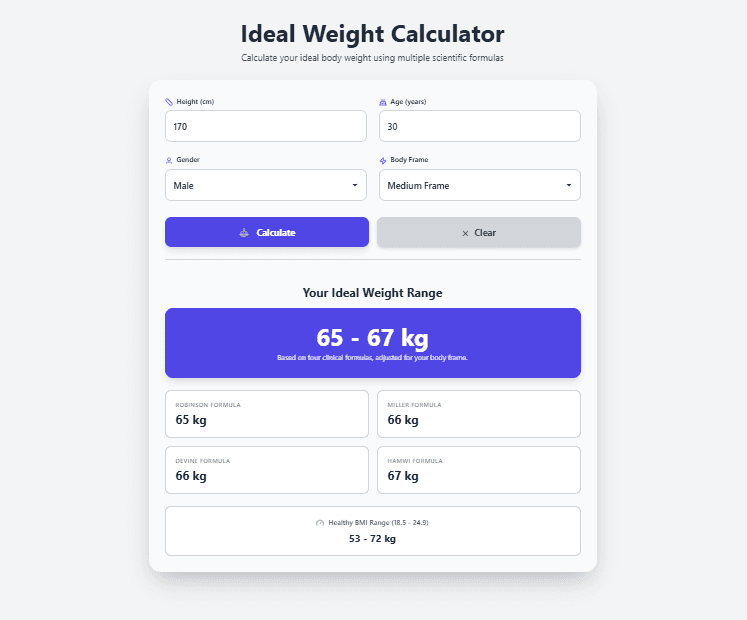
Ready to find your ideal weight? Use our Ideal Weight Calculator for personalized calculations based on multiple scientific formulas.
📖 Table of Contents
- What Is "Ideal Weight" Really?
- The Limitations of BMI Alone
- The Four Major Ideal Weight Formulas
- Robinson Formula: Modern Standard
- Miller Formula: Conservative Approach
- Devine Formula: Historical Standard
- Hamwi Formula: Adjustable Framework
- Body Frame Size: Why It Matters
- Age and Weight Expectations
- Gender Differences in Ideal Weight
- Calculating Your Healthy BMI Range
- Interpreting Your Weight Range Results
- When Formulas Disagree: What It Means
- Muscle Mass vs. Fat Mass Considerations
- Setting Realistic Weight Goals
- Moving Toward Your Ideal Weight
- Maintaining Your Ideal Weight
- Special Considerations and Adjustments
- Common Ideal Weight Misconceptions
- FAQs: Your Ideal Weight Questions Answered
1️⃣ What Is "Ideal Weight" Really?
Defining Ideal Weight
Ideal weight is NOT:
- The lowest weight you can achieve
- A single perfect number
- The same for everyone your height
- Only about appearance
Ideal weight IS:
- A healthy range for your body
- Where health risks are minimized
- Sustainable long-term
- Individualized to your unique characteristics
- Balanced with quality of life
Components of Ideal Weight
Your ideal weight considers:
- Height: Primary determinant
- Gender: Biological differences
- Body frame: Bone structure
- Age: Changing needs over time
- Muscle mass: Functional weight
- Health status: Medical considerations
- Lifestyle: Activity level and preferences
Historical Perspective
The concept of ideal weight has evolved:
- 1950s: Insurance company height-weight tables
- 1970s: Introduction of BMI
- 1980s: Frame size adjustments
- 1990s: Multiple formula approach
- Today: Personalized ranges with health focus
Beyond the Number
Ideal weight should align with:
- Health markers: Blood pressure, cholesterol, blood sugar
- Physical function: Energy, mobility, strength
- Psychological well-being: Body image, eating habits
- Sustainable lifestyle: Maintainable without extreme measures
2️⃣ The Limitations of BMI Alone
What BMI Measures (And Doesn't)
BMI (Body Mass Index) formula:
BMI = Weight (kg) ÷ Height (m)²
BMI categories:
- Underweight: <18.5
- Normal weight: 18.5-24.9
- Overweight: 25-29.9
- Obesity: ≥30
Why BMI Falls Short
BMI doesn't account for:
- Muscle mass: Athletes may be "overweight"
- Body fat distribution: Where fat is located
- Bone density: Heavier bones affect calculation
- Age-related changes: Muscle loss with aging
- Ethnic differences: Different risk thresholds
- Individual variation: Genetic factors
The "Normal Weight Obesity" Problem
People can have:
- Normal BMI but high body fat percentage
- High health risks despite "normal" weight
- Poor metabolic health at any weight
BMI as Starting Point
Use BMI as:
- Population screening tool
- General weight classification
- Starting point for discussion
Don't use BMI as:
- Sole health indicator
- Individual fitness measure
- Goal weight determinant
Our Calculator's Approach
We provide:
- Ideal weight range from multiple formulas
- BMI healthy range as reference
- Frame size adjustments for personalization
- Comprehensive picture beyond single numbers
3️⃣ The Four Major Ideal Weight Formulas
Why Multiple Formulas?
Different formulas provide:
- Different perspectives on ideal weight
- Range rather than single number
- Understanding of calculation variations
- More personalized recommendations
Formula Overview
| Formula | Developed | Basis | Characteristics |
|---|---|---|---|
| Robinson | 1983 | Metropolitan Life data | Modern standard, moderate |
| Miller | 1983 | NHANES data | Conservative, lower range |
| Devine | 1974 | Drug dosing calculations | Historical standard |
| Hamwi | 1964 | Clinical experience | Adjustable, higher range |
How They Differ
For a 175cm (5'9") man:
- Robinson: ~68-72kg
- Miller: ~66-70kg
- Devine: ~71-75kg
- Hamwi: ~73-77kg
Range: 66-77kg (11kg/24lb difference!)
Choosing the Right Formula
Consider:
- Robinson: Good general standard
- Miller: If you prefer conservative target
- Devine: If you have medium frame
- Hamwi: If you have larger frame or more muscle
Better yet: Use the range from all formulas.
Formula Mathematics
All formulas follow pattern:
Ideal Weight = Base Weight + (Height over 5 feet × Increment)
Where base weight and increment vary by formula and gender.
4️⃣ Robinson Formula: Modern Standard
Development and Basis
Created: 1983 by Dr. James D. Robinson Data source: 1983 Metropolitan Life Insurance Company height-weight tables Purpose: Update older formulas with modern population data
Calculation Method
For heights over 60 inches (5 feet):
- Men: 52 kg + 1.9 kg per inch over 60
- Women: 49 kg + 1.7 kg per inch over 60
Formula:
Men: IBW = 52 + 1.9 × (height in inches - 60)
Women: IBW = 49 + 1.7 × (height in inches - 60)
Example Calculations
Man, 175cm (68.9 inches):
68.9 - 60 = 8.9 inches over 5 feet
52 + (1.9 × 8.9) = 52 + 16.91 = 68.91 kg
Woman, 165cm (65.0 inches):
65.0 - 60 = 5 inches over 5 feet
49 + (1.7 × 5) = 49 + 8.5 = 57.5 kg
Characteristics
Robinson formula tends to:
- Be moderate between other formulas
- Align well with BMI healthy range
- Work for average body frames
- Be commonly used in clinical settings
When It Works Best
Consider Robinson if:
- You have average body frame
- You want a balanced approach
- You're seeking general health weight
- You have moderate activity level
5️⃣ Miller Formula: Conservative Approach
Development and Basis
Created: 1983 by Dr. David R. Miller Data source: National Health and Nutrition Examination Survey (NHANES) Purpose: Provide more conservative ideal weight estimates
Calculation Method
For heights over 60 inches (5 feet):
- Men: 56.2 kg + 1.41 kg per inch over 60
- Women: 53.1 kg + 1.36 kg per inch over 60
Formula:
Men: IBW = 56.2 + 1.41 × (height in inches - 60)
Women: IBW = 53.1 + 1.36 × (height in inches - 60)
Example Calculations
Man, 175cm (68.9 inches):
68.9 - 60 = 8.9 inches over 5 feet
56.2 + (1.41 × 8.9) = 56.2 + 12.55 = 68.75 kg
Woman, 165cm (65.0 inches):
65.0 - 60 = 5 inches over 5 feet
53.1 + (1.36 × 5) = 53.1 + 6.8 = 59.9 kg
Characteristics
Miller formula tends to:
- Give lower ideal weights than other formulas
- Be more conservative
- Align with lower end of BMI range
- Work well for smaller frames
When It Works Best
Consider Miller if:
- You have small body frame
- You prefer conservative targets
- You have lower muscle mass
- You're older (accounts for age-related changes)
6️⃣ Devine Formula: Historical Standard
Development and Basis
Created: 1974 by Dr. B.J. Devine Original purpose: Medication dosing calculations Historical significance: Long-used clinical standard
Calculation Method
For heights over 60 inches (5 feet):
- Men: 50 kg + 2.3 kg per inch over 60
- Women: 45.5 kg + 2.3 kg per inch over 60
Formula:
Men: IBW = 50 + 2.3 × (height in inches - 60)
Women: IBW = 45.5 + 2.3 × (height in inches - 60)
Example Calculations
Man, 175cm (68.9 inches):
68.9 - 60 = 8.9 inches over 5 feet
50 + (2.3 × 8.9) = 50 + 20.47 = 70.47 kg
Woman, 165cm (65.0 inches):
65.0 - 60 = 5 inches over 5 feet
45.5 + (2.3 × 5) = 45.5 + 11.5 = 57.0 kg
Characteristics
Devine formula tends to:
- Give mid-to-upper range weights
- Be historically significant
- Work well for medium frames
- Still used in some clinical settings
Limitations
Criticisms include:
- Based on 1970s population
- May overestimate for some
- Doesn't account for modern body compositions
When It Works Best
Consider Devine if:
- You have medium body frame
- You want historical perspective
- You're comparing to older standards
- You have average muscle mass
7️⃣ Hamwi Formula: Adjustable Framework
Development and Basis
Created: 1964 by Dr. G.J. Hamwi Purpose: Clinical assessment tool Key feature: Framework for adjustments
Calculation Method
For heights over 60 inches (5 feet):
- Men: 48 kg + 2.7 kg per inch over 60
- Women: 45.5 kg + 2.2 kg per inch over 60
Formula:
Men: IBW = 48 + 2.7 × (height in inches - 60)
Women: IBW = 45.5 + 2.2 × (height in inches - 60)
Example Calculations
Man, 175cm (68.9 inches):
68.9 - 60 = 8.9 inches over 5 feet
48 + (2.7 × 8.9) = 48 + 24.03 = 72.03 kg
Woman, 165cm (65.0 inches):
65.0 - 60 = 5 inches over 5 feet
45.5 + (2.2 × 5) = 45.5 + 11.0 = 56.5 kg
Characteristics
Hamwi formula tends to:
- Give higher ideal weights
- Allow for frame adjustments
- Work well for larger frames
- Accommodate more muscle mass
Adjustment Framework
Hamwi suggested:
- Small frame: Subtract 10%
- Large frame: Add 10%
Our calculator applies this adjustment automatically.
When It Works Best
Consider Hamwi if:
- You have large body frame
- You have significant muscle mass
- You want upper range perspective
- You're physically active
8️⃣ Body Frame Size: Why It Matters
What Is Body Frame?
Body frame refers to:
- Bone structure size
- Skeletal dimensions
- Natural body build
- Genetic predisposition
NOT the same as:
- Body fat percentage
- Muscle mass
- Weight status
Frame Size Categories
Three categories:
- Small frame: Delicate bone structure
- Medium frame: Average bone structure
- Large frame: Substantial bone structure
Determining Your Frame Size
Wrist measurement method:
- Measure wrist circumference at smallest point
- Calculate ratio: Height ÷ Wrist circumference
- Compare to standards:
For men:
- Small: Ratio > 10.4
- Medium: Ratio 9.6-10.4
- Large: Ratio < 9.6
For women:
- Small: Ratio > 11.0
- Medium: Ratio 10.1-11.0
- Large: Ratio < 10.1
Elbow breadth method:
- Measure elbow breadth
- Compare to height-based charts
Visual Assessment
Small frame characteristics:
- Delicate joints
- Slender wrists/ankles
- Narrow shoulders relative to hips
Large frame characteristics:
- Substantial joints
- Broad shoulders
- Larger bone structure overall
Why Frame Size Affects Ideal Weight
Larger frames:
- Heavier bone mass
- More muscle attachment points
- Naturally carry more weight
- Need higher weight for healthy function
Smaller frames:
- Lighter bone structure
- Less natural muscle mass
- Lower healthy weight range
Frame Size Adjustment
Our calculator adjusts:
- Small frame: -10% from medium frame calculation
- Large frame: +10% from medium frame calculation
- Medium frame: No adjustment (baseline)
This personalizes results to your unique body structure.
9️⃣ Age and Weight Expectations
Weight Changes Through Lifespan
Normal age-related changes:
- 20s-30s: Metabolism peaks, weight stable if active
- 40s-50s: Metabolic slowdown begins, gradual increase common
- 60s+: Muscle loss accelerates, fat redistribution
Age Considerations for Ideal Weight
Older adults may need:
- Different weight ranges
- Focus on body composition
- Less emphasis on scale weight
- More emphasis on function
Research on Age and Weight
Studies show:
- Slightly higher BMI may be protective in older age
- Muscle mass more important than total weight
- Functionality matters more than numbers
- Quality of life primary consideration
Our Calculator's Age Consideration
Minimum age: 18 years Why?
- Formulas developed for adults
- Children/adolescents have different needs
- Growth considerations paramount in youth
Age-Adjusted Thinking
For different life stages:
- Young adults: Focus on establishing healthy patterns
- Middle age: Prevent gradual weight creep
- Older adults: Maintain function and quality of life
Weight goals should be age-appropriate and realistic.
The "Set Point" Theory
Your body may have:
- Natural weight range it defends
- Metabolic adaptations to maintain weight
- Individual "comfort zone"
Consider: Sustainable weight within your set point range.
🔟 Gender Differences in Ideal Weight
Biological Differences
Women typically:
- Have higher body fat percentage (healthy range)
- Store more fat in hips/thighs (gynoid pattern)
- Have different hormone profiles
- Have different muscle mass distribution
Men typically:
- Have more muscle mass
- Store more fat in abdomen (android pattern)
- Different metabolic rates
- Different bone density
Formula Adjustments for Gender
All formulas account for gender:
- Different base weights
- Different increments per inch
- Different healthy ranges
Example difference (175cm height):
- Man: ~68-72kg range
- Woman: ~62-66kg range
Why Different Standards?
Based on:
- Average population differences
- Health risk data
- Biological necessities
- Research on optimal ranges
Not Just About Weight
Also consider:
- Body fat percentage differences
- Muscle mass expectations
- Health risk thresholds
- Performance considerations
Individual Variation
Within each gender:
- Wide variation exists
- Overlap between genders
- Individual factors matter most
- Formulas provide starting points
Avoid strict gender stereotypes about weight.
1️⃣1️⃣ Calculating Your Healthy BMI Range
BMI Basics Review
Formula reminder:
BMI = Weight (kg) ÷ Height (m)²
Healthy range: 18.5 - 24.9
Calculating Weight from BMI
Reverse calculation:
Weight (kg) = BMI × Height (m)²
Healthy weight range:
Minimum = 18.5 × Height (m)²
Maximum = 24.9 × Height (m)²
Example Calculation
For 175cm (1.75m) person:
Height squared = 1.75 × 1.75 = 3.0625
Minimum = 18.5 × 3.0625 = 56.66 kg
Maximum = 24.9 × 3.0625 = 76.26 kg
Range = 56.7 - 76.3 kg
BMI Range vs. Formula Range
Typically:
- Formula ranges within BMI range
- Formula ranges often narrower
- Formula ranges more personalized
Our calculator shows both for complete picture.
Limitations of BMI Range
Remember:
- Doesn't account for frame size
- Doesn't consider muscle mass
- Population average, not individual
- Starting point only
When BMI and Formulas Disagree
If your formula range is:
- Below BMI range: You may have small frame
- Above BMI range: You may have large frame/more muscle
- Discuss with healthcare provider if concerned
1️⃣2️⃣ Interpreting Your Weight Range Results
Understanding the Range
Your results show:
- Overall range: Minimum to maximum from all formulas
- Individual formula results: Four different perspectives
- BMI healthy range: Population-based reference
- Frame-adjusted values: Personalized calculations
What the Range Means
Your ideal weight is NOT:
- The exact middle number
- A single target
- Equally distributed
Your ideal weight IS:
- A healthy zone
- Individual to you
- Where you feel and function best
- Sustainable long-term
Narrow vs. Wide Ranges
Narrow range (e.g., 5kg/11lb spread):
- Formulas agree closely
- Clear target zone
- Less adjustment needed
Wide range (e.g., 15kg/33lb spread):
- Formulas disagree significantly
- More individual judgment needed
- Consider personal factors
Choosing Within Your Range
Consider:
- Your frame size: Small/large adjust up/down
- Muscle mass: More muscle = higher in range
- Age: Older = possibly higher in range
- Health status: Medical considerations
- Personal preference: Where you feel best
The "Sweet Spot"
Often around:
- Middle of your range
- Where energy is optimal
- Where health markers are best
- Sustainable without struggle
Find your personal sweet spot through experience.
1️⃣3️⃣ When Formulas Disagree: What It Means
Common Disagreement Patterns
Formulas may disagree by:
- 5-15kg (11-33lbs) typically
- More for extreme heights
- More with frame size differences
Why Formulas Disagree
Different formulas based on:
- Different population samples
- Different time periods
- Different purposes (clinical vs. insurance)
- Different statistical methods
Which Formula Is "Right"?
Answer: None exclusively Better question: Which aligns with your body and health?
Using Disagreement Productively
Wide disagreement suggests:
- Need for individual judgment
- Consideration of personal factors
- Possible consultation with professional
- Focus on how you feel vs. numbers
Agreement Is Guidance
When formulas agree closely:
- Strong consensus
- Clear target
- Less ambiguity
Still consider personal factors beyond formulas.
Professional Perspective
Healthcare providers consider:
- Multiple formulas
- Clinical judgment
- Individual health status
- Patient preferences
Our calculator provides similar multi-perspective approach.
1️⃣4️⃣ Muscle Mass vs. Fat Mass Considerations
The Scale Doesn't Tell the Whole Story
Two people same weight can have:
- Different body compositions
- Different health profiles
- Different appearances
- Different abilities
Muscle Mass Impact
More muscle means:
- Higher scale weight at same size
- Better metabolic health
- Higher calorie needs
- Different ideal weight range
Body Composition Goals
Better than weight goals:
- Body fat percentage goals
- Muscle mass goals
- Strength goals
- Performance goals
Assessing Body Composition
Methods include:
- Skinfold calipers: Estimate fat percentage
- Bioelectrical impedance: Home scales
- DEXA scan: Gold standard
- Circumference measurements: Waist, hips, etc.
Our calculator doesn't measure but you should consider composition.
Adjusting for Muscle Mass
If you have significant muscle:
- Your ideal weight may be higher
- Focus on body fat percentage
- Use visual and performance cues
- Consider upper end of range
The "Skinny Fat" Phenomenon
Normal weight obesity:
- Normal BMI but high body fat
- Poor metabolic health
- Need for body recomposition
Ideal weight isn't enough - composition matters too.
1️⃣5️⃣ Setting Realistic Weight Goals
SMART Weight Goals
Specific: "Reach 70kg" Measurable: Track with scale Achievable: Based on your range Relevant: Supports health goals Time-bound: "In 6 months"
Process vs. Outcome Goals
Outcome goal: Target weight Process goals: Daily habits
Better focus: Process goals lead to outcomes.
Rate of Weight Change
Healthy rate:
- 0.5-1kg (1-2lb) per week
- 2-4kg (4-8lb) per month
- Sustainable long-term
Too fast risks:
- Muscle loss
- Metabolic slowdown
- Regain
- Health issues
Non-Scale Goals
Also track:
- How clothes fit
- Energy levels
- Exercise performance
- Health markers
- Mood and confidence
Adjusting Goals
Re-evaluate every:
- 4-6 weeks
- After significant life changes
- When plateau occurs
- Based on how you feel
Flexibility is key to sustainable success.
Maintenance Planning
Plan for maintenance:
- Before reaching goal
- With gradual transition
- With continued monitoring
- With lifestyle integration
Maintenance is lifelong practice, not endpoint.
1️⃣6️⃣ Moving Toward Your Ideal Weight
Assessment Phase
Before starting:
- Calculate your ideal range
- Assess current status
- Identify starting point
- Set realistic timeline
Nutrition Strategies
For weight loss:
- Moderate calorie deficit
- Adequate protein
- Whole foods focus
- Sustainable approach
For weight gain:
- Calorie surplus
- Strength training
- Quality foods
- Patience with process
Exercise Approach
Combination works best:
- Cardio: Calorie burn, heart health
- Strength training: Preserve/build muscle
- Flexibility/mobility: Injury prevention
- Consistency: Most important factor
Behavior Changes
Sustainable habits:
- Mindful eating
- Regular movement
- Stress management
- Sleep optimization
- Social support
Monitoring Progress
Track but don't obsess:
- Weekly weigh-ins
- Monthly measurements
- Progress photos
- How you feel
- Performance improvements
Plateaus and Adjustments
Normal plateaus:
- Metabolic adaptation
- Need for program change
- Review and adjust
- Stay patient
Plateau strategies:
- Recalculate calorie needs
- Change exercise routine
- Address stress/sleep
- Consider maintenance break
1️⃣7️⃣ Maintaining Your Ideal Weight
Maintenance Mindset Shift
From: Weight loss focus To: Lifestyle maintenance From: Restriction To: Balance and moderation
Maintenance Strategies
Successful maintainers:
- Continue healthy habits
- Monitor weight regularly
- Adjust quickly to changes
- Have plan for setbacks
- Focus on health, not just weight
Weight Fluctuations
Normal daily fluctuations:
- 0.5-2kg (1-4lb) normal
- Due to water, food, hormones
- Don't panic over daily changes
- Look at weekly trends
Setting Maintenance Range
Instead of single weight:
- Acceptable range (e.g., 3kg/6lb)
- Action points at boundaries
- Flexible approach
- Less stress
Long-Term Monitoring
Regular check-ins:
- Weekly weigh-in
- Monthly measurements
- Quarterly health markers
- Annual comprehensive review
Consistent monitoring prevents gradual drift.
Lifestyle Integration
Make healthy habits:
- Automatic
- Enjoyable
- Social
- Part of identity
Sustainable maintenance integrates into life.
1️⃣8️⃣ Special Considerations and Adjustments
Medical Conditions
Conditions affecting weight:
- Thyroid disorders
- PCOS
- Diabetes
- Heart conditions
- Medications
Always consult healthcare provider.
Pregnancy and Postpartum
Special considerations:
- Different weight goals
- Gradual changes
- Breastfeeding considerations
- Professional guidance
Athletes and Very Active
Different needs:
- Higher muscle mass
- Different body composition
- Performance considerations
- May exceed "ideal" ranges
Older Adults
Age-adjusted thinking:
- Function over numbers
- Muscle preservation
- Quality of life focus
- Different risk profiles
Ethnic Considerations
Population differences:
- Different body compositions
- Different risk thresholds
- Cultural factors
- Genetic predispositions
Individual Variation
Ultimately:
- Your body is unique
- Formulas are guides
- How you feel matters most
- Health is primary goal
1️⃣9️⃣ Common Ideal Weight Misconceptions
Misconception 1: One Perfect Number
Reality: Healthy range, not single number
Misconception 2: Lower Is Always Better
Reality: Too low has health risks
Misconception 3: Same for Everyone Same Height
Reality: Individual factors matter
Misconception 4: Only About Appearance
Reality: Health and function primary
Misconception 5: Static Throughout Life
Reality: Changes with age and circumstances
Misconception 6: Formulas Are Exact Science
Reality: Estimates and guides
Misconception 7: Scale Weight Is Everything
Reality: Body composition matters more
Misconception 8: Quick Fix Possible
Reality: Sustainable changes take time
Avoiding Pitfalls
Focus on:
- Health, not just weight
- Sustainable habits
- Individual needs
- Long-term well-being
❓ Frequently Asked Questions
Q: How accurate are ideal weight calculators? A: Our calculator provides estimates based on established scientific formulas. Individual results may vary by ±5-10% based on unique factors like muscle mass, bone density, and body composition. Use the results as a guide, not an absolute prescription.
Q: Which formula is the most accurate? A: No single formula is "most accurate" for everyone. Different formulas work better for different people. The Robinson formula is often considered a good modern standard, but using multiple formulas (as our calculator does) gives you a more complete picture.
Q: Why do I need to know my body frame size? A: Body frame size accounts for your bone structure, which significantly affects your healthy weight range. People with larger frames naturally carry more weight from bone and muscle mass, while those with smaller frames have lower healthy weight ranges.
Q: What if I'm very muscular? A: If you have significant muscle mass (athlete, regular strength training), your ideal weight may be at the higher end of your calculated range or even slightly above it. Focus more on body fat percentage and how you feel rather than strict adherence to formula results.
Q: How often should I recalculate my ideal weight? A: Recalculate if you experience significant changes in: height (children/teens), body frame (unlikely to change), or if you're reassessing health goals. For most adults, once is sufficient unless pursuing major body composition changes.
Q: What's the difference between ideal weight and BMI? A: BMI is a population screening tool that categorizes weight status based solely on height and weight. Ideal weight formulas provide more personalized ranges that account for gender and can be adjusted for frame size. BMI gives a general range; ideal weight formulas give personalized targets.
Q: Should I aim for the middle of my ideal weight range? A: The middle of your range is often a good starting target, but consider your personal factors. If you have a small frame, aim for the lower end. If you have a large frame or more muscle, aim for the higher end. Where you feel and function best within your range is ideal.
Q: What if my current weight is far from my ideal range? A: First, don't panic. Ideal weight ranges are long-term goals. Focus on gradual, sustainable changes rather than rapid weight loss/gain. Even moving toward your ideal range (rather than reaching it immediately) provides health benefits. Consult a healthcare provider for personalized guidance.
Q: Do these formulas work for older adults? A: The formulas were developed using adult populations but may not account for age-related changes in body composition. For older adults, focus more on function, strength, and quality of life rather than strict adherence to formula results. Slightly higher weights may be acceptable and even protective in older age.
Q: Can children use this calculator? A: No, this calculator is for adults 18+. Children and adolescents have different growth patterns and weight expectations. Pediatric growth charts and professional guidance should be used for determining healthy weight ranges for youth.
🚀 Start Your Ideal Weight Journey Today
Your Action Plan
Week 1: Assessment
- Calculate your ideal weight range
- Measure your current weight
- Assess body frame size
- Set initial understanding
Month 1-3: Foundation
- Choose target within your range
- Implement one nutrition change
- Start consistent exercise
- Track progress weekly
Month 4-6: Building
- Adjust based on progress
- Add healthy habits
- Focus on sustainability
- Celebrate improvements
Month 7+: Maintenance
- Establish maintenance range
- Continue healthy habits
- Regular monitoring
- Lifestyle integration
Tools for Success
- Ideal Weight Calculator: Your personalized guide
- Scale: For tracking (weekly, not daily)
- Measuring tape: For circumference tracking
- Journal or app: For habit tracking
- Support system: Friends, family, or professional
Key Principles to Remember
- Range, not number – Healthy weight is a zone
- Individuality matters – Your body is unique
- Sustainability over speed – Gradual changes last
- Health over appearance – How you function matters most
- Flexibility is strength – Adjust as needed
⚖️ Ready to Find Your Perfect Balance?
You now understand:
- How ideal weight is calculated
- Why multiple formulas provide better guidance
- How to interpret your personal range
- Strategies for reaching and maintaining your ideal weight
Take the first step today:
- Calculate your ideal weight range now
- Note where you are relative to your range
- Set one small, sustainable change to implement this week
- Check in with yourself in one month
Remember: Your ideal weight isn't about reaching someone else's standard—it's about finding the weight where YOUR body functions optimally, YOUR health risks are minimized, and YOU feel your best.
Here's to finding your perfect balance! ⚖️
Disclaimer: This calculator provides estimates for educational purposes. It is not a substitute for professional medical advice, diagnosis, or treatment. Individual weight needs vary based on health conditions, medications, body composition, and other factors. Always consult with a healthcare provider for personalized medical guidance, especially if you have underlying health conditions or are making significant weight changes.