Complete BMR Calculator Guide: Master Your Metabolism
Introduction: Your Body's Metabolic Engine
Ever wonder why some people seem to eat whatever they want without gaining weight, while others struggle despite careful eating? The answer lies in your Basal Metabolic Rate (BMR)—the number of calories your body burns at complete rest. This comprehensive guide will help you understand your metabolism and how to use our BMR Calculator to optimize your nutrition for your goals.
This guide will teach you:
- What BMR is and why it matters
- How TDEE differs from BMR
- How to determine your accurate activity level
- How to use your results for weight management
- Strategies to optimize your metabolism
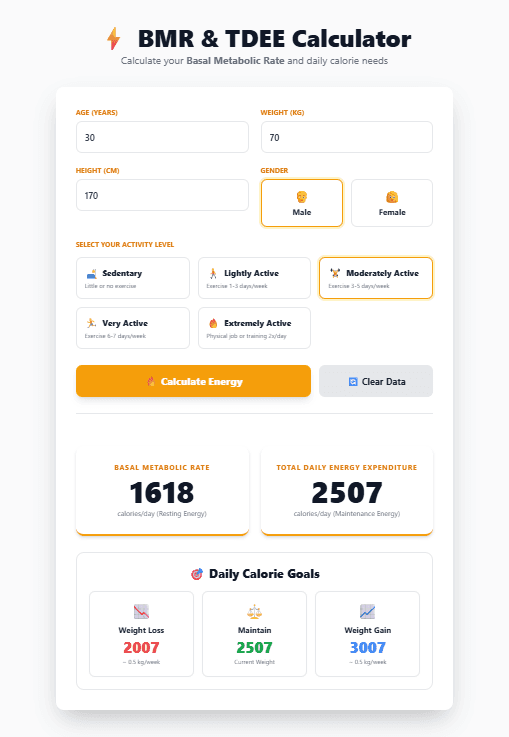
Ready to calculate your metabolic rate? Use our BMR Calculator for personalized calculations based on the scientifically validated Mifflin-St Jeor equation.
📖 Table of Contents
- What Is Basal Metabolic Rate (BMR)?
- Total Daily Energy Expenditure (TDEE) Explained
- The Science Behind the Mifflin-St Jeor Equation
- Understanding Activity Level Multipliers
- How to Use the BMR Calculator Step-by-Step
- Interpreting Your BMR Results
- Understanding Your TDEE Results
- Your Three Calorie Targets Explained
- Setting Realistic Weight Management Goals
- How to Adjust Calories Based on Your Goals
- Factors That Affect Your Metabolism
- Common BMR Calculator Mistakes to Avoid
- How Age Affects Your Metabolism
- Gender Differences in Metabolic Rate
- Can You Change Your BMR?
- Nutrition Strategies for Each Goal
- Exercise's Role in Your TDEE
- Tracking Progress and Making Adjustments
- FAQs: Your Metabolism Questions Answered
- Your Metabolic Optimization Action Plan
1️⃣ What Is Basal Metabolic Rate (BMR)?
The Definition
BMR = The number of calories your body needs to perform basic life-sustaining functions at complete rest.
Think of it as: Your body's "idle speed"—the energy needed just to keep you alive.
What BMR Covers
Your BMR accounts for energy used for:
- Brain function (20% of BMR!)
- Breathing and circulation
- Cell production and repair
- Hormone production
- Temperature regulation
- Organ function (heart, liver, kidneys, etc.)
Why BMR Matters
BMR represents:
- 60-75% of your total daily calorie burn
- Your baseline metabolic needs
- The starting point for all calorie calculations
- Individual metabolic differences
The BMR Range
Typical adult BMRs:
- Women: 1,200-1,800 calories/day
- Men: 1,600-2,400 calories/day
Variation depends on:
- Body size
- Body composition
- Age
- Genetics
- Health status
BMR vs. Resting Metabolic Rate (RMR)
BMR: Measured under strict laboratory conditions RMR: Measured under less strict conditions Practical difference: Minimal (RMR is typically 10% higher) Our calculator uses BMR equations for accuracy.
2️⃣ Total Daily Energy Expenditure (TDEE) Explained
Beyond Basal Metabolism
TDEE = Your total daily calorie burn including ALL activity.
TDEE Formula:
TDEE = BMR × Activity Multiplier
The Four Components of TDEE
- Basal Metabolic Rate (BMR): 60-75% of TDEE
- Thermic Effect of Food (TEF): 10% of TDEE
- Energy used to digest, absorb, process food
- Protein has highest TEF (20-30%)
- Exercise Activity Thermogenesis (EAT): 5-15% of TDEE
- Structured exercise
- Planned physical activity
- Non-Exercise Activity Thermogenesis (NEAT): 15-30% of TDEE
- Daily movement not formal exercise
- Fidgeting, walking, household chores
Why TDEE Matters More Than BMR
TDEE determines:
- Your maintenance calories
- How much you should eat
- Your calorie deficit/surplus needs
- Your weight management strategy
BMR is the foundation, TDEE is the practical application.
Calculating Your TDEE
Our calculator does this automatically using activity multipliers.
Manual calculation example:
BMR = 1,600 calories
Activity Level = Moderately Active (×1.55)
TDEE = 1,600 × 1.55 = 2,480 calories/day
3️⃣ The Science Behind the Mifflin-St Jeor Equation
The Gold Standard
Mifflin-St Jeor Equation (1990):
- Most accurate BMR equation for general population
- Validated against indirect calorimetry
- Accounts for age, gender, weight, height
The Mathematics
For Men:
BMR = (10 × weight in kg) + (6.25 × height in cm) - (5 × age) + 5
For Women:
BMR = (10 × weight in kg) + (6.25 × height in cm) - (5 × age) - 161
Why This Equation Works
Each component matters:
- Weight: Heavier bodies need more energy
- Height: Taller bodies have more surface area
- Age: Metabolism slows with age
- Gender: Biological differences in body composition
Comparison to Other Equations
| Equation | Year | Accuracy | Notes |
|---|---|---|---|
| Mifflin-St Jeor | 1990 | Highest | Our calculator uses this |
| Harris-Benedict | 1919 | Good | Overestimates for obese |
| Katch-McArdle | Good | Requires body fat % | More accurate for lean |
| Cunningham | Good | Requires lean mass | Best for athletes |
Limitations to Consider
The equation estimates based on averages. Individual variation can be ±10-15%. Use as starting point, adjust based on results.
4️⃣ Understanding Activity Level Multipliers
The Multiplier Concept
Activity multipliers account for:
- Your job activity
- Exercise routine
- Daily movement
- Lifestyle factors
The Five Levels
1. Sedentary (×1.2)
Description: Little to no exercise, desk job Daily steps: <5,000 Examples: Office workers, students If this is you: Focus on increasing NEAT
2. Lightly Active (×1.375)
Description: Light exercise 1-3 days/week Daily steps: 5,000-7,000 Examples: Recreational walkers, light gym goers
3. Moderately Active (×1.55)
Description: Moderate exercise 3-5 days/week Daily steps: 7,000-10,000 Examples: Regular exercisers, active hobbies Most common accurate selection
4. Very Active (×1.725)
Description: Hard exercise 6-7 days/week Daily steps: 10,000-15,000 Examples: Serious athletes, physical jobs
5. Extremely Active (×1.9)
Description: Very hard daily exercise/training Daily steps: 15,000+ Examples: Professional athletes, manual labor
Choosing Accurately
Common mistakes:
- Overestimating activity
- Counting exercise only
- Ignoring daily movement
Be honest for accurate results. Better to underestimate than overestimate.
The NEAT Factor
Non-Exercise Activity matters:
- Walking vs. driving
- Standing vs. sitting
- Taking stairs
- Household chores
- Fidgeting
Small changes in NEAT significantly affect TDEE.
5️⃣ How to Use the BMR Calculator Step-by-Step
Step 1: Enter Your Age
Age range: 15-100 years Why it matters: Metabolism slows ~1-2% per decade after 20 Be accurate: Even 5 years makes a difference
Step 2: Select Your Gender
Why gender matters:
- Different body compositions
- Different hormonal profiles
- Different metabolic rates
- Different BMR equations
Select based on biological sex, not gender identity for calculation accuracy.
Step 3: Enter Your Weight
In kilograms (kg) Weigh yourself:
- First thing in morning
- After bathroom
- Before eating/drinking
- Minimal clothing
Accuracy matters: ±1 kg changes BMR by ~10 calories.
Step 4: Enter Your Height
In centimeters (cm) Measure accurately:
- Stand against wall
- Heels together
- Look straight ahead
- No shoes
Taller people have higher BMR due to more surface area.
Step 5: Select Activity Level
Most important step for accurate TDEE. Consider:
- Your average week
- Both exercise and daily movement
- Seasonal variations
- Honest assessment
Step 6: Calculate!
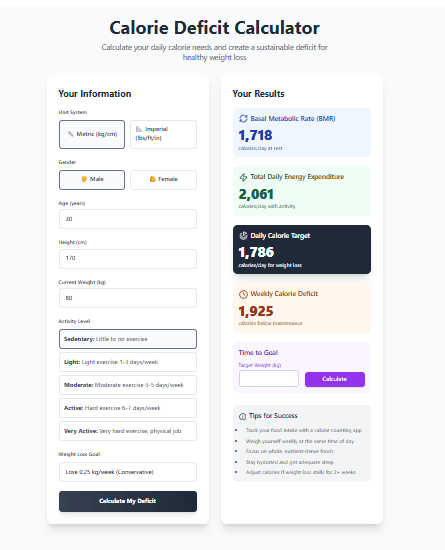
Click "Calculate Energy" to see your personalized results. Our calculator updates automatically as you change inputs.
Step 7: Interpret Results
You'll see:
- Your BMR
- Your TDEE
- Three calorie targets
Use these numbers to guide your nutrition.
6️⃣ Interpreting Your BMR Results
What Your BMR Number Means
Example: BMR = 1,600 calories This means: Your body burns 1,600 calories daily at complete rest.
If You Ate Only Your BMR
You would:
- Lose weight (since TDEE > BMR)
- Feel tired and hungry
- Possibly lose muscle
- Experience metabolic adaptation
Not recommended for long-term.
BMR as Baseline
Use your BMR to understand:
- Your metabolic baseline
- How much you burn doing nothing
- The foundation of your calorie needs
- Individual metabolic differences
Comparing to Averages
Average BMRs by weight:
| Weight (kg) | Women BMR | Men BMR |
|---|---|---|
| 50 | ~1,200 | ~1,400 |
| 70 | ~1,400 | ~1,700 |
| 90 | ~1,600 | ~2,000 |
| 110 | ~1,800 | ~2,300 |
Your number may differ based on body composition.
When BMR Seems "Too High" or "Too Low"
Possible reasons:
- Measurement errors
- Unusual body composition
- Medical conditions
- Normal individual variation
Consult professional if concerned.
7️⃣ Understanding Your TDEE Results
Your Maintenance Calories
TDEE = Calories needed to maintain current weight.
If you eat your TDEE:
- Weight stays stable
- Energy balance achieved
- No fat loss or gain
The Magic Number for Weight Management
Weight loss: Eat below TDEE Weight maintenance: Eat at TDEE Weight gain: Eat above TDEE
How TDEE Changes
TDEE decreases when:
- You lose weight
- You become less active
- You get older
- You lose muscle
TDEE increases when:
- You gain weight
- You become more active
- You gain muscle
Recalculating TDEE
Recalculate when:
- You lose/gain 4-5 kg
- Activity level changes significantly
- Every 3 months for maintenance
Our calculator makes this easy.
TDEE for Different Goals
Our calculator provides three targets:
- Weight Loss: TDEE - 500 calories
- Maintenance: TDEE
- Weight Gain: TDEE + 500 calories
These are starting points—adjust based on results.
8️⃣ Your Three Calorie Targets Explained
The 500-Calorie Rule
500 calories/day =
- 3,500 calories/week
- ~0.5 kg (1 lb) fat loss/gain per week
- Moderate, sustainable rate
Target 1: Weight Loss Calories
Calculation: TDEE - 500 Example: 2,480 - 500 = 1,980 calories/day
This creates a moderate deficit for:
- Steady fat loss
- Preserved muscle mass
- Manageable hunger
- Sustainable long-term
Rate of loss: ~0.5 kg/week
Target 2: Maintenance Calories
Calculation: TDEE Example: 2,480 calories/day
For:
- Maintaining current weight
- Diet breaks
- Metabolic recovery
- Lifestyle maintenance
Target 3: Weight Gain Calories
Calculation: TDEE + 500 Example: 2,480 + 500 = 2,980 calories/day
For:
- Muscle building
- Healthy weight gain
- Performance improvement
- Recovery from underweight
Rate of gain: ~0.5 kg/week (mostly muscle with proper training)
Choosing Your Target
Consider:
- Your primary goal
- Your timeline
- Your experience
- Your lifestyle
- Your preferences
Start with one target, adjust as needed.
9️⃣ Setting Realistic Weight Management Goals
The Mathematics of Weight Change
1 kg body fat = ~7,700 calories 1 lb body fat = ~3,500 calories
Weekly deficit/surplus needed:
- 0.25 kg/week: 1,925 calories (275/day)
- 0.5 kg/week: 3,850 calories (550/day)
- 0.75 kg/week: 5,775 calories (825/day)
- 1 kg/week: 7,700 calories (1,100/day)
Sustainable Rates
Recommended: 0.5-1% of body weight per week
For most people:
- Weight loss: 0.25-0.75 kg/week
- Weight gain: 0.25-0.5 kg/week
Faster rates risk:
- Muscle loss (deficit)
- Fat gain (surplus)
- Metabolic adaptation
- Unsustainability
Goal Setting Framework
SMART Goals:
- Specific: "Lose 5 kg"
- Measurable: Track with scale
- Achievable: Based on calculator
- Relevant: Supports health goals
- Time-bound: "In 10 weeks"
Process vs. Outcome Goals
Outcome goal: Target weight Process goals: Daily calorie target, exercise routine
Focus on process—outcomes follow.
Adjusting Goals
Re-evaluate every:
- 4-6 weeks
- After reaching milestones
- When life circumstances change
- Based on progress rate
Flexibility prevents frustration.
🔟 How to Adjust Calories Based on Your Goals
Starting Your Plan
Week 1-2:
- Eat at your target calories
- Track everything accurately
- Weigh yourself weekly
- Note energy levels and hunger
The Two-Week Test
After 2 weeks, assess:
- Weight trend
- How you feel
- Hunger levels
- Energy for exercise
- Adherence difficulty
Adjusting Your Target
If losing too fast (>1 kg/week):
- Add 100-200 calories
- Monitor for 2 weeks
- Repeat if needed
If losing too slow (<0.25 kg/week):
- Check tracking accuracy
- Reduce calories by 100-200
- Increase activity
- Monitor for 2 weeks
If gaining too much fat:
- Reduce surplus
- Ensure proper training
- Focus on protein
The Minimum Safe Intake
General guidelines:
- Women: Minimum 1,200 calories/day
- Men: Minimum 1,500 calories/day
Never go below without medical supervision.
When to Seek Maintenance
Take diet breaks when:
- Fatigued from deficit
- Hit weight loss plateau
- Social events/holidays
- Need metabolic reset
1-2 weeks at maintenance can help long-term success.
1️⃣1️⃣ Factors That Affect Your Metabolism
Controllable Factors
- Muscle Mass: More muscle = higher BMR
- Activity Level: More movement = higher TDEE
- Diet Composition: Protein increases TEF
- Meal Frequency: Minimal effect on BMR
- Sleep Quality: Poor sleep lowers metabolism
- Stress Management: High cortisol slows metabolism
Uncontrollable Factors
- Age: BMR decreases ~1-2% per decade after 20
- Gender: Men typically have higher BMR
- Genetics: Some inherit faster/slower metabolism
- Height: Taller people have higher BMR
- Body Size: Larger bodies have higher BMR
Medical Conditions
Conditions affecting metabolism:
- Thyroid disorders
- PCOS
- Diabetes
- Hormonal imbalances
- Certain medications
Consult healthcare provider if you suspect medical issues.
The Set Point Theory
Your body may defend a certain weight range. Metabolic adaptation occurs with weight changes. Sustainable approach: Work with your body, not against it.
Individual Variation
Metabolism can vary ±10-15% from predictions. Our calculator provides estimates—adjust based on your results.
1️⃣2️⃣ Common BMR Calculator Mistakes to Avoid
Mistake 1: Overestimating Activity
Most common error Reality check: Most people are less active than they think Solution: Choose conservative level, adjust up if needed
Mistake 2: Inaccurate Measurements
Weight errors: Different scales, different times Height errors: Guessing, not measuring Solution: Measure accurately under consistent conditions
Mistake 3: Expecting Perfection
Formulas estimate based on averages Individual variation normal Solution: Use as starting point, adjust based on results
Mistake 4: Not Adjusting Over Time
As you lose weight:
- BMR decreases
- TDEE decreases
- Same calories = smaller deficit
Solution: Recalculate every 4-5 kg lost
Mistake 5: Ignoring How You Feel
Numbers matter, but so does:
- Energy levels
- Hunger
- Mood
- Sleep quality
- Exercise performance
Solution: Adjust based on both numbers and feelings
Mistake 6: One-Size-Fits-All Thinking
Your optimal calories may differ from calculator Your lifestyle affects needs Your preferences matter for adherence
Solution: Personalize based on your experience
1️⃣3️⃣ How Age Affects Your Metabolism
The Aging Process
After age 20:
- BMR decreases ~1-2% per decade
- Muscle mass decreases (~3-8% per decade after 30)
- Activity often decreases
- Hormonal changes occur
Age-Adjusted Expectations
At 40 vs. 20:
- Same weight/height/activity
- BMR ~100-200 calories lower
- Need slightly fewer calories
Strategies for Every Age
20s-30s:
- Peak metabolic rate
- Build muscle foundation
- Establish healthy habits
40s-50s:
- Prevent muscle loss
- Maintain activity
- Adjust calories gradually
60s+:
- Preserve muscle (priority)
- Focus on function
- Quality over quantity
Calculating for Age
Our calculator accounts for age automatically. Enter accurate age for correct calculation.
Metabolic Maintenance with Age
To maintain metabolism:
- Strength train regularly
- Eat adequate protein
- Stay active daily
- Manage stress and sleep
Aging slows metabolism, but you can minimize the decline.
1️⃣4️⃣ Gender Differences in Metabolic Rate
Biological Differences
Men typically have:
- More muscle mass
- Less body fat
- Different hormones
- Higher BMR at same weight
Women typically have:
- More essential fat
- Different fat distribution
- Different hormonal cycles
- Lower BMR at same weight
The Numbers Difference
At same weight/height/age/activity:
- Man: BMR ~1,700 calories
- Woman: BMR ~1,500 calories
- Difference: ~200 calories/day
Why Different Equations
Mifflin-St Jeor uses different constants:
- Men: +5
- Women: -161
Based on average population differences.
Practical Implications
Women often need:
- Smaller calorie deficits
- More patience with weight loss
- Focus on body composition
- Understanding of menstrual cycle effects
Our calculator adjusts automatically for gender.
Respecting Biological Reality
Different doesn't mean better or worse. Work with your biology, not against it. Comparison between genders is meaningless.
1️⃣5️⃣ Can You Change Your BMR?
What You Can Change
Increase BMR by:
- Building muscle: Most effective
- Adequate protein: Increases TEF
- Staying hydrated: Water supports metabolism
- Managing stress: Cortisol affects metabolism
- Quality sleep: Poor sleep lowers BMR
What You Can't Change Much
Fixed factors:
- Age (can't reverse)
- Height
- Genetics
- Gender
Focus on what you can control.
The Muscle Factor
Each kg of muscle:
- Burns ~13 calories/day at rest
- Increases BMR
- Improves body composition
- Supports long-term metabolism
Strength training is metabolic insurance.
Metabolic Adaptation
With weight loss:
- BMR decreases beyond expected
- Body becomes more efficient
- "Starvation mode" misconception
Prevent excessive adaptation:
- Moderate deficits
- Diet breaks
- Strength training
- Adequate protein
The Reality Check
BMR changes are relatively small. TDEE changes through activity are larger. Focus on total energy balance, not just BMR.
1️⃣6️⃣ Nutrition Strategies for Each Goal
For Weight Loss
Priorities:
- Calorie deficit (moderate)
- High protein (preserves muscle)
- Fiber-rich foods (satiety)
- Volume eating (low calorie density)
- Meal timing (personal preference)
Sample distribution (1,800 calories):
- Protein: 120g (480 calories)
- Carbs: 180g (720 calories)
- Fat: 67g (600 calories)
For Maintenance
Priorities:
- Energy balance
- Nutrient density
- Sustainable habits
- Flexibility
- Enjoyment
Maintenance is practice for lifelong health.
For Weight/Muscle Gain
Priorities:
- Calorie surplus (small)
- High protein (supports muscle)
- Strength training (stimulus)
- Quality foods (not just any calories)
- Patience (slow gains are quality gains)
Sample distribution (2,800 calories):
- Protein: 150g (600 calories)
- Carbs: 350g (1,400 calories)
- Fat: 89g (800 calories)
Macronutrient Guidelines
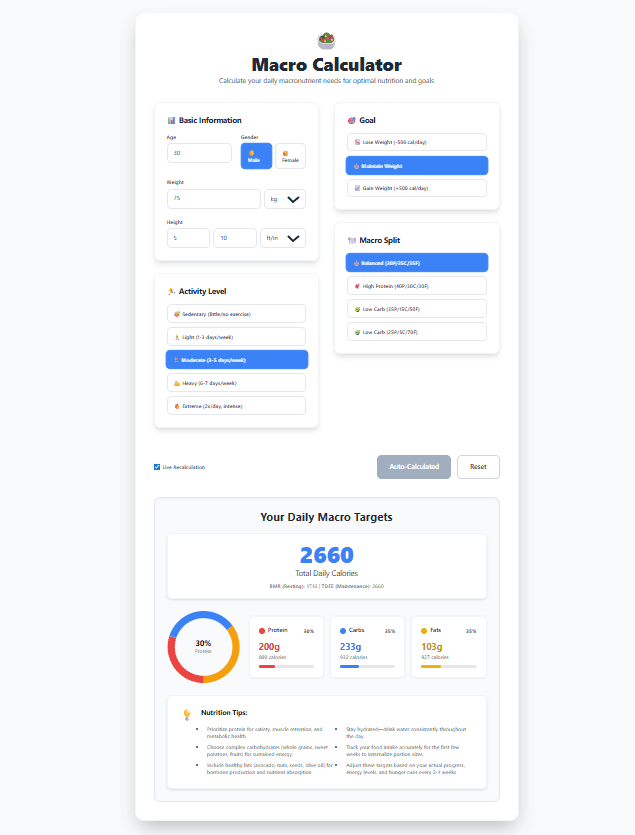
Protein: 1.6-2.2g per kg body weight Fat: 20-35% of calories Carbs: Remainder of calories
Adjust based on:
- Personal preference
- Activity level
- Goals
- How you feel
Food Quality Matters
1,800 calories of junk vs. whole foods:
- Same weight effect
- Different health effects
- Different hunger levels
- Different nutrient status
Focus on nutrient density within your calorie budget.
1️⃣7️⃣ Exercise's Role in Your TDEE
How Exercise Affects TDEE
Direct effect: Burns calories during activity Indirect effects:
- Increases muscle mass (raises BMR)
- Improves metabolic health
- Increases NEAT (some people move more after exercise)
- Creates larger deficit without eating less
Types of Exercise
Strength Training:
- Builds/preserves muscle
- Increases BMR long-term
- Essential for body composition
- 2-4 times weekly recommended
Cardiovascular Exercise:
- Burns calories
- Improves heart health
- Supports fat loss
- 150-300 minutes weekly recommended
NEAT (Non-Exercise Activity):
- Largest variable in TDEE
- Easy to increase
- Sustainable long-term
- Often overlooked
Exercise Calories: To Eat Back or Not?
General advice: Don't eat back all exercise calories.
Reasons:
- Trackers overestimate
- Eating them back reduces deficit
- Can lead to slower progress
Exception: Very high activity days, athletes
Creating an Exercise Plan
For weight loss:
- Strength training (preserve muscle)
- Moderate cardio (create deficit)
- Increase NEAT (easy extra burn)
For maintenance:
- Consistent routine
- Enjoyable activities
- Variety prevents boredom
For muscle gain:
- Progressive strength training
- Adequate recovery
- Cardio for health, not primarily for calories
Exercise and Hunger
Some people experience:
- Increased hunger after exercise
- Compensation by eating more
- Reduced NEAT (move less after exercise)
Be aware of these effects.
1️⃣8️⃣ Tracking Progress and Making Adjustments
Essential Tracking Tools
- Food scale (most accurate)
- Measuring cups/spoons
- Tracking app (Solvezi, MyFitnessPal)
- Body scale (weekly weigh-ins)
- Measuring tape (monthly)
- Progress photos (monthly)
What to Track
Essential:
- Daily calories (during deficit/surplus)
- Weekly weight average
- Monthly measurements
Helpful:
- Macronutrients
- Exercise performance
- Energy levels
- Hunger
- Sleep
The Weekly Weigh-In
Best practices:
- Same day each week
- First thing in morning
- After bathroom
- Before eating/drinking
- Minimal clothing
- Same scale
Track weekly average, not daily fluctuations.
When to Adjust
Adjust calories when:
- Weight change stops for 2+ weeks
- Energy levels consistently poor
- Hunger unmanageable
- Progress too fast/slow
Small adjustments (100-200 calories) work best.
The Two-Week Rule
Try any change for 2 weeks before assessing. Body needs time to adjust. Consistency matters more than perfection.
Beyond the Scale
Also track:
- How clothes fit
- Energy for daily activities
- Exercise performance
- Blood markers (if available)
- Quality of life
Health is multidimensional beyond weight.
❓ Frequently Asked Questions
Q: How accurate is this BMR calculator? A: Our calculator uses the Mifflin-St Jeor equation, which is scientifically validated and considered the most accurate for the general population. However, individual metabolism can vary by ±10-15%. Use the calculated numbers as a starting point and adjust based on your actual results over 2-4 weeks.
Q: What's the difference between BMR and TDEE? A: BMR (Basal Metabolic Rate) is the calories you burn at complete rest for basic bodily functions. TDEE (Total Daily Energy Expenditure) is your BMR plus all activity calories (exercise, daily movement, digesting food). BMR is your metabolic baseline; TDEE is what matters for weight management.
Q: How do I choose the right activity level? A: Consider your average week, not your best week. Include both structured exercise and daily movement. When in doubt, choose a lower level—it's better to underestimate and adjust up than overestimate and wonder why you're not losing weight. Most people are more sedentary than they think.
Q: Why are my maintenance calories different from other calculators? A: Different calculators use different equations (Mifflin-St Jeor vs. Harris-Benedict) and different activity multipliers. Our calculator uses the most accurate equation and standard multipliers. Small differences (100-200 calories) are normal; larger differences may indicate different activity level selections.
Q: How often should I recalculate my BMR/TDEE? A: Recalculate every 4-5 kg (8-11 lbs) of weight change, or if your activity level changes significantly. As you lose weight, your BMR decreases, so the same calorie intake creates a smaller deficit. Regular recalculation ensures continued progress.
Q: Can I build muscle while in a calorie deficit? A: Beginners or those returning to exercise after a break can build some muscle while losing fat, especially with adequate protein and strength training. However, experienced lifters will find it difficult to build significant muscle in a deficit. For maximum muscle gain, a small calorie surplus is more effective.
Q: What if I'm not losing weight on my calculated deficit calories? A: First, ensure you're tracking accurately for at least 2 weeks. Common issues include: underestimating portions, forgetting cooking oils/sauces, overestimating activity level, or metabolic adaptation. Try reducing calories by 100-200 or increasing activity, and consider consulting a professional if issues persist.
Q: Is it safe to eat below 1200 (women) or 1500 (men) calories? A: Generally not without medical supervision. Very low calorie diets can cause nutrient deficiencies, muscle loss, gallstones, and metabolic damage. Our calculator will rarely suggest targets this low unless for very small, sedentary individuals. If you need to go lower for medical reasons, work with a healthcare professional.
Q: How does age affect my metabolism? A: Metabolism slows by about 1-2% per decade after age 20 due to muscle loss and hormonal changes. Our calculator accounts for age automatically. To minimize age-related metabolic decline: strength train regularly, eat adequate protein, and stay active.
Q: Why do men and women have different BMR calculations? A: Biological differences in body composition mean women typically have more essential fat and less muscle than men of the same weight, resulting in a lower BMR. The different equations account for these average population differences to provide accurate estimates for each gender.
🚀 Your Metabolic Optimization Action Plan
Week 1-2: Establishment
- Calculate your BMR/TDEE using our calculator
- Choose your goal (loss, maintenance, gain)
- Start tracking food intake accurately
- Establish baseline weight and measurements
Month 1: Implementation
- Follow your calorie target consistently
- Add strength training 2-3 times weekly
- Increase daily movement (aim for 7,000+ steps)
- Weekly weigh-in and tracking
Month 2-3: Adjustment
- Evaluate progress after 4 weeks
- Adjust calories if needed
- Refine nutrition for satiety and health
- Establish sustainable routines
Month 4-6: Solidification
- Recalculate needs with new weight
- Focus on consistency over perfection
- Incorporate flexibility for life events
- Celebrate non-scale victories
Maintenance Phase
- Find your maintenance range
- Continue healthy habits with less tracking
- Regular check-ins with calculator
- Quick corrections if weight creeps up
Essential Tools
- BMR Calculator - Your metabolic guide
- Food scale - For accurate tracking
- Tracking app - For consistency
- Body scale - For weekly check-ins
- Support system - Friends, family, or community
⚡️ Ready to Master Your Metabolism?
You now understand:
- How to calculate your BMR and TDEE accurately
- What your numbers mean for your health goals
- How to adjust your nutrition based on your metabolism
- Strategies for long-term metabolic health
Take the first step today:
- Calculate your BMR now
- Choose your calorie target based on your goals
- Commit to tracking for 2 weeks
- Schedule monthly recalculations
Remember: Your metabolism is unique to you. These numbers are tools to understand your body better, not rigid rules. Listen to your body, be patient with progress, and focus on sustainable habits over quick fixes.
Here's to understanding and optimizing your metabolic engine! 🔥
Disclaimer: This calculator provides estimates for educational purposes. It is not a substitute for professional medical advice, diagnosis, or treatment. Individual calorie needs vary based on health conditions, medications, body composition, and other factors. Always consult with a healthcare provider before starting any nutrition or exercise program, especially if you have underlying health conditions.