The Complete Pregnancy Due Date Calculator Guide: From Conception to Birth
Introduction: Understanding Your Pregnancy Timeline
Pregnancy is a remarkable journey filled with anticipation, questions, and milestones. One of the first questions expectant parents ask is: "When is my baby due?" While the exact birth date remains one of life's beautiful surprises, calculating an estimated due date (EDD) provides a framework for understanding your pregnancy timeline.
This comprehensive guide will help you understand:
- How due dates are calculated (and why they're estimates)
- Different calculation methods and their accuracy
- What gestational age really means
- Weekly fetal development milestones
- How to use our Pregnancy Due Date Calculator effectively
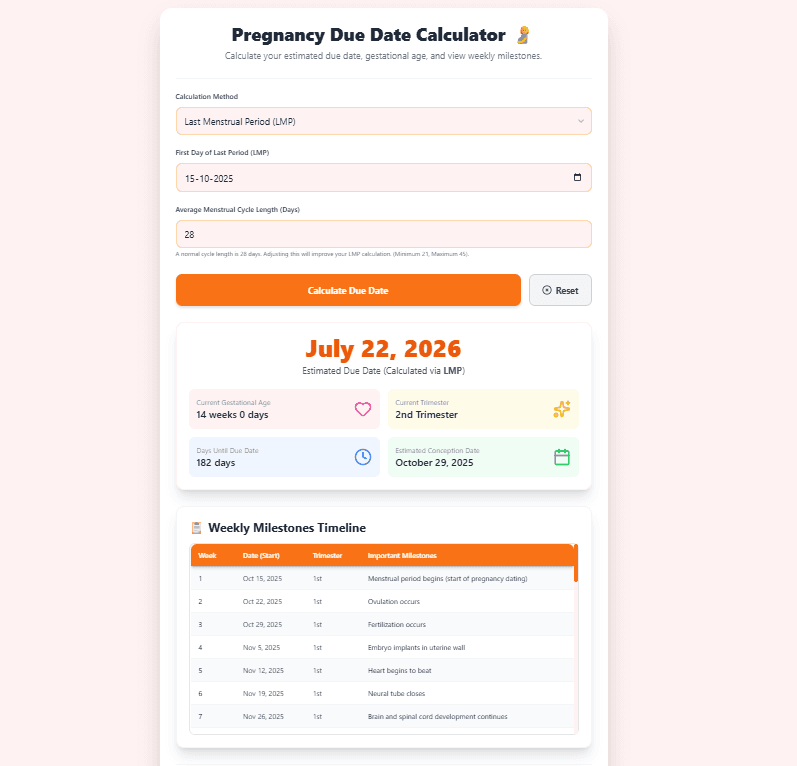
Ready to calculate your due date? Use our Pregnancy Due Date Calculator for personalized results based on your specific information.
📖 Table of Contents
- The Science Behind Due Date Calculation
- Why Due Dates Are Estimates, Not Deadlines
- Method 1: Last Menstrual Period (LMP) Calculation
- Method 2: Conception Date Calculation
- Method 3: IVF/IUI Procedure Date Calculation
- Method 4: Ultrasound Dating (Most Accurate)
- Understanding Gestational Age vs. Fetal Age
- The Three Trimesters: What to Expect
- Weekly Pregnancy Milestones (Week 1-40)
- How to Use the Pregnancy Due Date Calculator
- Calculating for Irregular Cycles
- When Your Dates Don't Match: What It Means
- Important Pregnancy Dating Concepts
- Preparing for Your Due Date: Practical Tips
- When Babies Come Early or Late
- Medical Considerations and Red Flags
- FAQs: Common Questions Answered
1️⃣ The Science Behind Due Date Calculation
The 280-Day Pregnancy Rule
Pregnancy is typically calculated as 280 days (40 weeks) from the first day of your last menstrual period (LMP). This standard is based on:
- Historical observations: Dating back to 19th-century medicine
- Average gestation: Most pregnancies last between 37-42 weeks
- Clinical convenience: Provides a consistent calculation method
Why Count from LMP Instead of Conception?
Most women don't know their exact conception date, but they usually remember their last period. The LMP method assumes:
- A 28-day menstrual cycle
- Ovulation on day 14
- Conception occurring around day 14
This creates a consistent starting point for pregnancy dating.
The Naegele's Rule
Developed by German obstetrician Franz Naegele in the 1800s, this rule forms the basis of most due date calculations:
Formula:
Due Date = LMP + 1 year - 3 months + 7 days
Example: LMP: November 15, 2024 +1 year: November 15, 2025 -3 months: August 15, 2025 +7 days: August 22, 2025
Our calculator uses a modernized version of this rule with adjustable cycle lengths.
2️⃣ Why Due Dates Are Estimates, Not Deadlines
The Statistics of Birth Timing
| Timing | Percentage of Births |
|---|---|
| Before 37 weeks | About 10% |
| 37-38 weeks | About 20% |
| 39-40 weeks | About 50% |
| 41-42 weeks | About 20% |
| After 42 weeks | Less than 1% |
Only about 5% of babies are born on their exact due date!
Factors Affecting Birth Timing
- First-time mothers: Tend to deliver later (average 41 weeks 1 day)
- Previous pregnancies: Often deliver earlier in subsequent pregnancies
- Genetic factors: Family history influences timing
- Baby's development: Each baby has their own schedule
- Maternal health: Conditions like diabetes or hypertension
The "Due Month" Concept
Many healthcare providers now emphasize a "due month" rather than a specific date:
- Early term: 37 weeks 0 days to 38 weeks 6 days
- Full term: 39 weeks 0 days to 40 weeks 6 days
- Late term: 41 weeks 0 days to 41 weeks 6 days
- Post term: 42 weeks and beyond
3️⃣ Method 1: Last Menstrual Period (LMP) Calculation
Standard LMP Calculation
Assumptions:
- 28-day menstrual cycle
- Ovulation on day 14
- Conception around day 14
Calculation:
Due Date = LMP + 280 days
Adjusting for Cycle Length
Our calculator improves accuracy by adjusting for your actual cycle length:
Formula:
Adjusted Due Date = LMP + 280 days + (Your Cycle Length - 28)
Example for 35-day cycle: LMP: January 1 Standard due date: October 8 (280 days) Adjusted due date: October 15 (+7 days for longer cycle)
When LMP Calculation Works Best
- Regular menstrual cycles
- Known LMP date
- No hormonal contraception in previous cycle
- No recent pregnancy loss or breastfeeding
Limitations of LMP Dating
- Irregular cycles lead to inaccurate dates
- Early pregnancy bleeding mistaken for period
- Recent hormonal contraception use
- Conception occurring much earlier or later than day 14
4️⃣ Method 2: Conception Date Calculation
Known Conception Date
If you know your exact conception date (from ovulation tracking, fertility awareness, or known single exposure):
Calculation:
Due Date = Conception Date + 266 days (38 weeks)
How Conception Dating Works
- Ovulation tracking: Temperature charting, ovulation predictor kits
- Single exposure: Known timing of intercourse
- Fertility treatments: Timed intercourse cycles
Accuracy of Conception Dating
- Most accurate: When confirmed with ovulation tracking
- Moderately accurate: Based on menstrual cycle patterns
- Least accurate: Estimating based on one-time exposure
Why 266 Days?
Pregnancy is 38 weeks from conception but 40 weeks from LMP because:
- Week 1-2: Menstrual period and follicular phase
- Week 3: Ovulation and conception
- Week 4-40: Actual fetal development
5️⃣ Method 3: IVF/IUI Procedure Date Calculation
IVF with Fresh Embryo Transfer
Calculation methods:
- Transfer date + 266 days - embryo age
- Specific formulas based on embryo stage
Common IVF due date calculations:
| Embryo Type | Days to Add |
|---|---|
| Day 3 embryo | Transfer date + 263 days |
| Day 5 blastocyst | Transfer date + 261 days |
IUI Procedure Dating
Calculation:
Due Date = IUI Date + 266 days
Note: IUI is typically performed close to ovulation, so this aligns with conception dating.
Frozen Embryo Transfers (FET)
Same calculation as fresh transfers, based on embryo stage at freezing.
Why IVF Dating is More Accurate
- Known fertilization date
- Precise embryo age
- Controlled ovarian stimulation timing
- Documented transfer procedure
6️⃣ Method 4: Ultrasound Dating (Most Accurate)
Why Ultrasound is the Gold Standard
Early pregnancy ultrasound (especially first trimester) is the most accurate method for dating because:
- Fetal measurements are highly consistent in early pregnancy
- Less biological variation in early development
- Objective measurement not dependent on memory or cycle regularity
Crown-Rump Length (CRL) Measurement
The most accurate ultrasound measurement for dating:
When performed: 6-13 weeks gestation Accuracy: ±3-5 days
How it works: Measures the longest length of the embryo/fetus from head to buttocks.
Other Ultrasound Measurements
| Gestational Age | Measurement | Accuracy |
|---|---|---|
| 6-13 weeks | Crown-Rump Length (CRL) | ±3-5 days |
| 14-20 weeks | Biparietal Diameter (BPD) | ±7-10 days |
| 20-30 weeks | Multiple measurements | ±10-14 days |
| 30+ weeks | Estimated fetal weight | ±14-21 days |
When Ultrasound Changes Your Due Date
Healthcare providers may change your due date if:
- Ultrasound dating differs by more than 5 days in first trimester
- Ultrasound dating differs by more than 10 days in second trimester
- Your dates are uncertain or cycles irregular
7️⃣ Understanding Gestational Age vs. Fetal Age
Gestational Age (GA)
- What it is: Time elapsed since the first day of LMP
- How expressed: Weeks and days (e.g., 12w4d)
- Used for: Clinical pregnancy dating
- Total duration: 40 weeks
Fetal Age (Conceptional Age)
- What it is: Time elapsed since actual conception
- How expressed: Weeks since fertilization
- Used for: Embryological development
- Total duration: 38 weeks
The Two-Week Difference
Gestational Age (40 weeks) = Fetal Age (38 weeks) + 2 weeks
Those "extra" two weeks represent the time from your last period to conception.
Why This Confusion Matters
When someone says "I'm 8 weeks pregnant," they mean:
- Gestational age: 8 weeks since LMP
- Fetal development: Actually 6 weeks since conception
- Embryo age: 6-week-old embryo
Our calculator clearly shows both your gestational age and estimated conception date.
8️⃣ The Three Trimesters: What to Expect
First Trimester (Week 1-13)
Key developments:
- Week 1-4: Implantation, positive pregnancy test
- Week 5-8: Major organs form, heart beats
- Week 9-13: Embryo becomes fetus, risk decreases
Common symptoms:
- Morning sickness
- Fatigue
- Breast tenderness
- Frequent urination
Second Trimester (Week 14-27)
Key developments:
- Week 14-18: Gender visible, quickening
- Week 19-23: Hearing develops, regular movement
- Week 24-27: Viability reached, lungs develop
Common symptoms:
- Energy returns
- Baby movements felt
- Growing belly
- Back discomfort
Third Trimester (Week 28-40+)
Key developments:
- Week 28-31: Brain development, eye opening
- Week 32-36: Weight gain, practice breathing
- Week 37-40+: Full term, ready for birth
Common symptoms:
- Shortness of breath
- Heartburn
- Braxton Hicks contractions
- Nesting instinct
9️⃣ Weekly Pregnancy Milestones (Week 1-40)
Early Weeks (1-12)
Week 4:
- Embryo implants in uterine wall
- Pregnancy tests may become positive
Week 5:
- Heart begins to beat (visible on ultrasound)
- Neural tube forms (future brain/spine)
Week 8:
- All major organs beginning to form
- Embryo now called a fetus
Week 12:
- Risk of miscarriage significantly decreases
- Nuchal translucency screening available
Mid Pregnancy (13-27)
Week 16:
- May feel first movements (quickening)
- Gender may be visible on ultrasound
Week 20:
- Anatomy scan (detailed ultrasound)
- Halfway through pregnancy!
Week 24:
- Viability threshold reached
- Baby could survive with intensive care
Late Pregnancy (28-40)
Week 28:
- Third trimester begins
- Eyes open and close
Week 32:
- Baby gains weight rapidly
- Bones fully formed but soft
Week 37:
- Considered full term
- Lungs typically mature
Week 40:
- Estimated due date
- Baby is ready for birth!
Explore all weekly milestones in our calculator's interactive timeline.
🔟 How to Use the Pregnancy Due Date Calculator
Step-by-Step Guide
Select Calculation Method
- Choose from LMP, conception, IVF/IUI, or ultrasound
Enter Your Date
- Based on selected method
- Use calendar picker for accuracy
Provide Additional Information
- Cycle length (for LMP method)
- Gestational age at scan (for ultrasound)
Get Your Results
- Estimated due date
- Current gestational age
- Conception date
- Days until due date
- Weekly milestone timeline
Tips for Best Results
- Be precise: Use exact dates when possible
- Know your cycle: Track your typical cycle length
- Use ultrasound dates: Most accurate if available
- Consult provider: Calculator provides estimates, not medical advice
Understanding Your Results
Our calculator provides:
- Primary due date estimate
- Gestational age in weeks and days
- Trimester information
- Interactive weekly timeline with milestones
- Visual highlighting of your current week
1️⃣1️⃣ Calculating for Irregular Cycles
What Counts as Irregular?
- Cycles varying by 7+ days regularly
- Cycles shorter than 21 days
- Cycles longer than 35 days
- No predictable pattern
Challenges with Irregular Cycles
- Ovulation timing uncertain
- LMP method less accurate
- Need for early ultrasound dating
- Harder to estimate conception date
Calculator Adjustments for Irregular Cycles
For LMP method with irregular cycles:
- Enter your average cycle length
- Understand results are estimates
- Plan for early ultrasound confirmation
Better approach:
- Use conception date if known
- Use ultrasound dating when available
- Work with provider for accurate dating
Conditions Affecting Cycle Regularity
- Polycystic Ovary Syndrome (PCOS)
- Thyroid disorders
- Perimenopause
- Recent childbirth or breastfeeding
- Extreme weight changes
- High stress levels
1️⃣2️⃣ When Your Dates Don't Match: What It Means
Common Scenarios
Ultrasound Shows Earlier Than LMP Dates
Possible reasons:
- Later ovulation than assumed
- Longer than usual cycle
- Implantation bleeding mistaken for period
- Incorrect LMP date remembered
Action: Provider will typically use ultrasound dates if significant difference.
Ultrasound Shows Later Than LMP Dates
Possible reasons:
- Earlier ovulation than assumed
- Shorter than usual cycle
- Irregular bleeding before pregnancy
- Slow early growth (requires monitoring)
Action: May need follow-up ultrasound to confirm growth.
Size-Date Discrepancy Guidelines
| Trimester | Acceptable Difference | Action Needed |
|---|---|---|
| First | > 5 days | Use ultrasound dates |
| Second | > 10-14 days | Investigate cause |
| Third | > 21 days | Monitor growth closely |
When to Be Concerned
- Large discrepancy (>2 weeks in second trimester)
- Decreasing growth on serial ultrasounds
- Fundal height consistently measuring small/large
- Risk factors for growth problems
Always discuss discrepancies with your healthcare provider.
1️⃣3️⃣ Important Pregnancy Dating Concepts
Naegele's Rule
The standard method: LMP + 7 days - 3 months + 1 year
Trimesters
- First: Weeks 1-13
- Second: Weeks 14-27
- Third: Weeks 28-40+
Viability
- Early viability: 24 weeks
- Good survival rates: 28+ weeks
- Excellent outcomes: 34+ weeks
Term Definitions
- Early term: 37 weeks 0 days to 38 weeks 6 days
- Full term: 39 weeks 0 days to 40 weeks 6 days
- Late term: 41 weeks 0 days to 41 weeks 6 days
- Post term: 42 weeks 0 days and beyond
Estimated Date of Delivery (EDD)
Preferred medical term over "due date" to emphasize it's an estimate.
1️⃣4️⃣ Preparing for Your Due Date: Practical Tips
Third Trimester Preparation
8-10 weeks before due date:
- Complete childbirth education classes
- Install car seat
- Pack hospital bag
- Finalize birth plan
4-6 weeks before due date:
- Pre-register at hospital
- Finalize pediatrician choice
- Prepare postpartum supplies
- Freeze meals
2 weeks before due date:
- Last-minute shopping
- Charge electronics
- Confirm support system
- Rest and relax
Signs Labor May Be Approaching
Early signs (weeks to days before):
- Lightening (baby drops)
- Increased Braxton Hicks
- Nesting instinct
- Cervical changes
More immediate signs (days to hours):
- Bloody show
- Rupture of membranes (water breaking)
- Regular contractions
- Back pain or pressure
When to Call Your Provider
- Contractions 5 minutes apart for 1 hour
- Water breaking
- Decreased fetal movement
- Vaginal bleeding
- Severe pain
- Any concerns
1️⃣5️⃣ When Babies Come Early or Late
Premature Birth (Before 37 Weeks)
Causes:
- Medical conditions
- Multiple pregnancy
- Infections
- Cervical issues
- Unknown reasons
Statistics: About 10% of births are premature.
Late-Term and Post-Term Pregnancy
Causes:
- Incorrect dating
- First pregnancy
- Genetic factors
- Maternal obesity
Management:
- Increased monitoring after 40 weeks
- May discuss induction at 41+ weeks
- Regular fetal testing
Induction of Labor
Common reasons:
- Post-term pregnancy (>41 weeks)
- Medical conditions
- Ruptured membranes without labor
- Fetal concerns
- Maternal request (after 39 weeks)
Methods:
- Membrane sweep
- Cervical ripening agents
- Pitocin (oxytocin) infusion
- Artificial rupture of membranes
1️⃣6️⃣ Medical Considerations and Red Flags
When to Seek Immediate Care
Emergency signs:
- Severe abdominal pain
- Heavy vaginal bleeding
- Sudden swelling of face/hands
- Severe headache with vision changes
- Decreased fetal movement
- Fever with pain
High-Risk Pregnancy Factors
Maternal factors:
- Age <17 or >35
- Chronic health conditions
- Previous pregnancy complications
- Underweight or overweight
Pregnancy factors:
- Multiple gestation
- Placental problems
- Fetal anomalies
- Growth restriction
Regular Prenatal Schedule
Typical visit schedule:
- Every 4 weeks until 28 weeks
- Every 2 weeks from 28-36 weeks
- Every week from 36 weeks to delivery
Additional visits if high-risk or complications arise.
❓ Frequently Asked Questions
Q: How accurate is the due date calculator? A: Accuracy depends on your input method:
- Ultrasound dating: Most accurate (±3-5 days in first trimester)
- Known conception date: Very accurate (±1 week)
- LMP with regular cycles: Moderately accurate (±1-2 weeks)
- LMP with irregular cycles: Less accurate
Our calculator adjusts for cycle length to improve LMP accuracy.
Q: What if I don't know my LMP date? A: If you don't know your LMP:
- Use conception date if known
- Use ultrasound dating if available
- Estimate based on when you got positive test
- Early ultrasound is recommended for accurate dating
Q: My ultrasound due date is different from my LMP due date. Which one is correct? A: Healthcare providers typically use ultrasound dates when:
- Difference is >5 days in first trimester
- Difference is >7-10 days in second trimester
- Your cycles are irregular
- LMP date is uncertain
First-trimester ultrasound is considered the most accurate dating method.
Q: Can my due date change? A: Yes, due dates can change based on:
- Early ultrasound measurements
- Multiple ultrasounds showing consistent growth pattern
- Significant discrepancy between dates
- Provider's assessment of all available information
Q: What percentage of babies are born on their due date? A: Only about 5% of babies are born on their exact due date. Most are born within two weeks before or after.
Q: How do I calculate my due date with IVF? A: For IVF pregnancies:
- Day 5 blastocyst: Transfer date + 261 days
- Day 3 embryo: Transfer date + 263 days
- Use our calculator's IVF/IUI method for automatic calculation
Q: What if I have irregular periods? A: With irregular periods:
- Early ultrasound is crucial for accurate dating
- Use conception date if known through tracking
- Enter your average cycle length in calculator
- Understand dates are estimates until confirmed by ultrasound
Q: When will I feel the baby move? A: Typically:
- First-time mothers: 18-22 weeks
- Subsequent pregnancies: 16-18 weeks
- Early movements feel like flutters or gas bubbles
Q: What's the difference between gestational age and fetal age? A: Gestational age is weeks since LMP (40-week pregnancy). Fetal age is weeks since conception (38-week development). There's always a 2-week difference.
Q: When should I tell people I'm pregnant? A: This is personal, but consider:
- Early (before 12 weeks): Close family/support system
- After 12 weeks: When miscarriage risk decreases
- After anatomy scan (20 weeks): When major anomalies ruled out
- Whenever feels right for you
🚀 Your Pregnancy Journey Starts Here
Getting Started with Our Calculator
- Calculate Your Due Date Now
- Save your results for reference
- Share with your partner and healthcare provider
- Use the weekly timeline to follow development
Next Steps After Calculating
- Schedule prenatal care if not already done
- Discuss dates with your provider
- Mark important dates in your calendar
- Begin prenatal education
- Start preparing physically and emotionally
Remember These Key Points
- Due dates are estimates – only 5% of babies arrive exactly on time
- Ultrasound dating is most accurate – especially in first trimester
- Every pregnancy is unique – don't compare too closely with others
- Regular prenatal care is essential for healthy pregnancy
- Trust your body and your healthcare team
Support Resources
- Healthcare provider: Your primary source of medical advice
- Pregnancy apps: For daily tracking and information
- Childbirth classes: For preparation and education
- Support groups: For community and shared experiences
- Books and resources: For comprehensive information
📅 Ready to Begin Your Journey?
Knowing your estimated due date is just the beginning. Our calculator provides:
✅ Personalized due date estimate ✅ Current gestational age ✅ Weekly development milestones ✅ Important pregnancy timeline ✅ Trimester information
Take the first step today:
- Calculate your due date with our tool
- Save or print your results
- Discuss with your healthcare provider
- Begin planning for your baby's arrival
Remember: This is the start of an incredible journey. Whether this is your first pregnancy or you're adding to your family, each day brings new developments and joys.
Click here to calculate your pregnancy due date now!
Disclaimer: This calculator provides estimates based on standard medical formulas. It is not a substitute for professional medical advice, diagnosis, or treatment. Always consult with a qualified healthcare provider for personalized medical guidance. Individual pregnancies may vary, and only your healthcare provider can provide medical advice specific to your situation.