Complete Body Fat Calculator Guide: Master Your Body Composition
Introduction: Beyond the Scale - Understanding Body Fat Percentage
Stepping on a scale only tells you your total weight, but it doesn't reveal what that weight is made of. Two people can weigh exactly the same but have completely different body compositions. This comprehensive guide will help you understand body fat percentage, why it matters more than total weight, and how to use our Body Fat Calculator effectively.
This guide will teach you:
- Why body fat percentage is the real health metric
- How the US Navy Method provides accurate estimates
- How to take proper measurements for accurate results
- What your body fat percentage means for your health
- How to improve your body composition sustainably
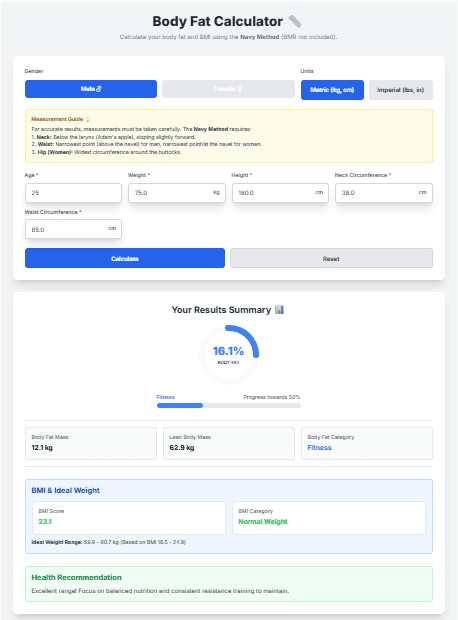
Ready to calculate your body fat percentage? Use our Body Fat Calculator for personalized calculations using the scientifically validated Navy Method.
📖 Table of Contents
- Why Body Fat Percentage Matters More Than Weight
- Understanding Body Composition
- The US Navy Method: How It Works
- Measurement Guide: Getting It Right
- Interpreting Your Body Fat Percentage
- Male vs. Female Body Fat Standards
- BMI vs. Body Fat Percentage
- Your Body Fat Mass & Lean Body Mass
- Health Risks Associated with Different Body Fat Levels
- Setting Realistic Body Composition Goals
- Strategies for Reducing Body Fat Percentage
- Building Lean Muscle Mass
- Nutrition for Body Composition Improvement
- Exercise Strategies for Fat Loss & Muscle Gain
- Common Measurement Mistakes to Avoid
- Tracking Progress Beyond the Calculator
- Special Considerations
- FAQs: Your Body Fat Questions Answered
- Your Body Composition Action Plan
1️⃣ Why Body Fat Percentage Matters More Than Weight
The Scale Deception
Two people, same weight, different health:
- Person A: 180 lbs, 15% body fat (athletic, healthy)
- Person B: 180 lbs, 35% body fat (obese, high health risks)
The scale shows the same number but tells completely different health stories.
What Body Fat Percentage Measures
Body fat percentage = (Fat mass ÷ Total body weight) × 100
This tells you:
- How much of your weight is fat
- How much is lean tissue (muscle, bones, organs, water)
- Your actual body composition
- Your true health status
Health Implications
Excess body fat increases risk of:
- Heart disease
- Type 2 diabetes
- High blood pressure
- Certain cancers
- Metabolic syndrome
- Joint problems
Too little body fat causes:
- Hormonal imbalances
- Immune system issues
- Nutrient deficiencies
- Reproductive problems
- Energy deficiencies
The Goldilocks Zone
Every body needs some fat for:
- Energy storage
- Hormone production
- Organ protection
- Temperature regulation
- Vitamin absorption
Finding your optimal range is key to health and performance.
2️⃣ Understanding Body Composition
The Components of Your Body
Total Body Weight =
- Fat Mass: Essential fat + Storage fat
- Lean Body Mass: Muscle + Bones + Organs + Water
Types of Body Fat
Essential Fat:
- Required for normal physiological function
- Men: 2-5% of body weight
- Women: 10-13% of body weight
- Found in: bone marrow, organs, central nervous system
Storage Fat:
- Energy reserves
- Protection and insulation
- Can be reduced through diet and exercise
Fat Distribution Patterns
Android (Apple-shaped):
- Fat stored around abdomen
- More common in men
- Higher health risks
- Associated with metabolic issues
Gynoid (Pear-shaped):
- Fat stored around hips and thighs
- More common in women
- Lower health risks
- Evolutionarily protective
Subcutaneous vs. Visceral Fat
Subcutaneous Fat:
- Under the skin
- Can be pinched
- Less metabolically active
- Cosmetic concern
Visceral Fat:
- Around internal organs
- Cannot be pinched
- Highly metabolically active
- Major health risk factor
Our calculator estimates total body fat percentage, which includes both types.
3️⃣ The US Navy Method: How It Works
Scientific Foundation
Developed by: US Navy and Marine Corps Purpose: Quickly assess body composition of military personnel Validation: Scientifically validated against more expensive methods Accuracy: ±3-4% compared to DEXA (gold standard)
The Mathematics Behind It
The formula calculates body density, then converts to body fat percentage:
For Men:
Body Density = 1.0324 - 0.19077 × log10(waist - neck) + 0.15456 × log10(height)
Body Fat % = (495 ÷ Body Density) - 450
For Women:
Body Density = 1.29579 - 0.35004 × log10(waist + hip - neck) + 0.22100 × log10(height)
Body Fat % = (495 ÷ Body Density) - 450
Why This Method Works
Circumference measurements correlate with:
- Total body fat
- Fat distribution patterns
- Body size and proportions
The neck measurement serves as a reference for bone structure. The difference between neck and waist/hip indicates fat accumulation.
Limitations and Considerations
The Navy Method may be less accurate for:
- Very muscular individuals
- Those with unusual fat distribution
- Extremely lean or obese individuals
- Elderly populations
Still, it provides excellent estimates for most people.
Comparison to Other Methods
| Method | Cost | Accuracy | Accessibility |
|---|---|---|---|
| Navy Method | Free | Good (±3-4%) | High |
| Skinfold Calipers | Low | Good (with practice) | Medium |
| BIA Scales | Medium | Fair (±5%) | High |
| DEXA Scan | High | Excellent (±1%) | Low |
| Hydrostatic Weighing | Medium | Excellent (±1.5%) | Very Low |
Our calculator provides excellent accuracy for home use.
4️⃣ Measurement Guide: Getting It Right
Essential Tools
You need:
- Flexible measuring tape (non-stretch)
- Assistance for hard-to-reach areas
- Proper technique
- Consistent conditions
When to Measure
Best practices:
- First thing in morning
- Before eating or drinking
- After using bathroom
- Same time each measurement day
- Minimal clothing
Neck Measurement
For men:
- Find Adam's apple
- Place tape just below larynx
- Keep tape horizontal
- Don't pull too tight
- Keep head neutral (don't look up or down)
For women:
- Find narrowest point
- Usually just below larynx
- Same horizontal placement
- Same tension guidelines
Common mistakes:
- Tape angled
- Head tilted
- Too tight/loose
- Including shirt collar
Waist Measurement
For men:
- Find narrowest point between ribs and hips
- Usually at navel level or just above
- Stand relaxed, exhale normally
- Don't suck in stomach
For women:
- Find narrowest point
- Often just above navel
- Same breathing guidelines
- Natural posture
Important: Measure at skin level, not over clothing.
Hip Measurement (Women Only)
Procedure:
- Stand with feet together
- Find widest part of buttocks
- Keep tape parallel to floor
- Don't compress skin
Why women need hip measurement:
- Accounts for different fat distribution
- More accurate calculation
- Reflects gynoid fat patterns
Height Measurement
Tips for accuracy:
- Stand against flat wall
- Heels together
- Look straight ahead
- Use right angle tool if possible
- Measure without shoes
Weight Measurement
For most accurate results:
- Use same scale each time
- Place on hard, flat surface
- Weigh at same time of day
- Minimal clothing
- Empty bladder/bowels
Consistency Is Key
Track measurements:
- Weekly for progress
- Monthly for trends
- Same conditions each time
- Multiple measurements, take average
Small variations are normal - look at trends, not single measurements.
5️⃣ Interpreting Your Body Fat Percentage
Male Body Fat Categories
Essential Fat: 2-5%
- Required for physiological function
- Below this is dangerous
- Not sustainable long-term
Athletes: 6-13%
- Very lean
- Visible muscle definition
- Common in competitive athletes
Fitness: 14-17%
- Lean and healthy
- Some muscle definition
- Ideal for most active men
Average: 18-24%
- Typical for general population
- Some excess fat
- Room for improvement
Obese: 25%+
- Health risks increase
- Action recommended
- Professional guidance suggested
Female Body Fat Categories
Essential Fat: 10-13%
- Required for physiological function
- Below this disrupts hormones
- Not sustainable or healthy
Athletes: 14-20%
- Very lean
- Common in endurance athletes
- May affect menstrual cycle
Fitness: 21-24%
- Lean and healthy
- Ideal for most active women
- Sustainable long-term
Average: 25-31%
- Typical for general population
- Some excess fat
- Improvement beneficial
Obese: 32%+
- Health risks increase
- Action recommended
- Professional guidance suggested
What Your Category Means
Athletes:
- May need to monitor energy intake
- Ensure adequate recovery
- Watch for hormonal issues
Fitness:
- Maintain current habits
- Focus on performance goals
- Optimal health range
Average:
- Room for improvement
- Focus on sustainable changes
- Health benefits achievable
Obese:
- Significant health risks
- Professional guidance recommended
- Focus on gradual, sustainable changes
Individual Variation
Consider your:
- Age
- Genetics
- Activity level
- Health status
- Personal goals
Your optimal percentage may differ from general categories.
6️⃣ Male vs. Female Body Fat Standards
Biological Differences
Women naturally have:
- Higher essential fat requirements
- Different fat distribution
- Reproductive fat stores
- Hormonal influences
Why women need more fat:
- Childbearing capabilities
- Hormone production
- Breast tissue
- Evolutionary adaptations
Different Risk Profiles
Men at same percentage as women have:
- Different health risks
- Different fat distribution
- Different metabolic profiles
Different Measurement Requirements
Women need hip measurement because:
- Fat distribution differs
- Gynoid pattern common
- More accurate calculation
Different Ideal Ranges
What's "fit" for men (14-17%) would be:
- Essential fat range for women
- Unhealthy and unsustainable
Respect biological differences when setting goals.
Age Considerations
Body fat naturally increases with age due to:
- Hormonal changes
- Decreased muscle mass
- Slower metabolism
- Reduced activity
Adjust expectations based on age:
- 20s-30s: Aim for fitness range
- 40s-50s: Average range acceptable
- 60s+: Health and function over numbers
7️⃣ BMI vs. Body Fat Percentage
What BMI Measures
Body Mass Index = Weight (kg) ÷ Height (m)²
BMI tells you:
- Weight relative to height
- General population categories
- Screening tool for health risks
BMI doesn't tell you:
- Body composition
- Muscle vs. fat
- Health status at individual level
The "Skinny Fat" Problem
Normal weight obesity:
- Normal BMI
- High body fat percentage
- Poor metabolic health
- Increased disease risk
Our calculator shows both BMI and body fat percentage for complete picture.
When They Disagree
High BMI, low body fat:
- Common in athletes
- Muscle mass increases weight
- Healthy despite "overweight" BMI
Normal BMI, high body fat:
- "Skinny fat" phenomenon
- Deceptively unhealthy
- Need for body recomposition
Using Both Metrics
Together they provide:
- Complete health picture
- Better risk assessment
- More accurate goal setting
- Progress tracking
Our calculator calculates both automatically.
Limitations of Both
Neither is perfect:
- Both are estimates
- Individual variation exists
- Should inform, not dictate
- Health is multidimensional
Use as tools, not absolutes.
8️⃣ Your Body Fat Mass & Lean Body Mass
Understanding the Numbers
Body Fat Mass = Total weight × (Body fat % ÷ 100)
Lean Body Mass = Total weight - Body fat mass
What Lean Body Mass Includes
- Muscle tissue
- Bones
- Organs
- Connective tissue
- Water
Why Lean Mass Matters
Metabolic rate: Muscle burns more calories at rest Functional ability: Strength for daily activities Bone health: Density and strength Longevity: Associated with longer, healthier life Disease prevention: Lower risk of chronic conditions
Tracking Changes
Ideal scenario:
- Decrease body fat mass
- Maintain or increase lean mass
- Improve body composition
Weight loss without attention to lean mass leads to:
- Muscle loss
- Metabolic slowdown
- Poor body composition
- Higher regain risk
Setting Composition Goals
Instead of "lose 10 pounds":
- "Reduce body fat by 3%"
- "Increase lean mass by 2 kg"
- "Improve body composition"
Our calculator shows both fat mass and lean mass.
9️⃣ Health Risks Associated with Different Body Fat Levels
Too Low Body Fat (<Essential)
Immediate risks:
- Hormonal disruption
- Nutrient deficiencies
- Immune suppression
- Poor temperature regulation
- Fatigue and weakness
Long-term risks:
- Osteoporosis
- Fertility issues
- Organ dysfunction
- Eating disorders
- Increased mortality
Optimal Range (Fitness)
Health benefits:
- Optimal hormone function
- Reduced disease risk
- Better metabolic health
- Improved physical function
- Enhanced mental health
Sustainable long-term with healthy habits.
Above Average (25-31% men, 32-38% women)
Increased risks of:
- Type 2 diabetes
- Heart disease
- High blood pressure
- Certain cancers
- Sleep apnea
- Joint problems
Action recommended for health improvement.
Obese (>32% men, >39% women)
Significant health risks:
- Much higher disease risk
- Reduced life expectancy
- Poor quality of life
- Medical intervention needed
Immediate action with professional guidance.
Visceral Fat Dangers
Higher health risks at same body fat percentage if:
- More visceral fat
- Android fat distribution
- Waist circumference high
Our calculator's waist measurement helps assess this risk.
🔟 Setting Realistic Body Composition Goals
SMART Goal Framework
Specific: "Reduce body fat from 28% to 24%" Measurable: Track with calculator monthly Achievable: 0.5-1% per month realistic Relevant: Improves health markers Time-bound: "In 4 months"
Rate of Change
Sustainable rates:
- Body fat reduction: 0.5-1% per month
- Lean mass gain: 0.25-0.5 kg per month (untrained)
Faster changes often unsustainable or include muscle loss.
Starting Point Matters
More to lose:
- Faster initial progress
- Easier to create deficit
- More room for error
Less to lose:
- Slower progress
- More precision needed
- Plateaus common
Process vs. Outcome Goals
Outcome goal: Target body fat percentage Process goals: Daily habits that get you there
Focus on process - outcomes follow.
Non-Scale Victories
Also track:
- How clothes fit
- Energy levels
- Exercise performance
- Measurements
- Photos
- Health markers
Multiple metrics prevent scale obsession.
Adjusting Goals
Re-evaluate every:
- 4-6 weeks
- After reaching milestones
- When life circumstances change
- Based on how you feel
Flexibility prevents frustration.
1️⃣1️⃣ Strategies for Reducing Body Fat Percentage
The Dual Approach
To reduce body fat percentage:
- Decrease fat mass
- Maintain/increase lean mass
Focus on body recomposition rather than just weight loss.
Nutrition Strategy
Calorie deficit needed but:
- Moderate deficit (300-500 calories)
- High protein intake (1.6-2.2g/kg)
- Nutrient-dense foods
- Sustainable approach
Protein priority preserves lean mass.
Exercise Strategy
Strength training:
- Preserves/builds muscle
- Increases metabolism
- Improves body composition
- 2-4 times per week
Cardio:
- Increases calorie burn
- Improves heart health
- Supports fat loss
- 150-300 minutes weekly
Behavior Changes
Sustainable habits:
- Mindful eating
- Regular movement
- Stress management
- Sleep optimization
- Consistency over perfection
Monitoring Progress
Use our calculator:
- Monthly for trends
- Same conditions each time
- Track multiple metrics
- Adjust based on results
Weekly weigh-ins, monthly body fat measurements.
Plateaus and Adjustments
Normal plateaus occur after 4-8 weeks.
Adjustment strategies:
- Small calorie reduction
- Increase activity
- Change exercise routine
- Diet break (1-2 weeks maintenance)
Patience and persistence beat quick fixes.
1️⃣2️⃣ Building Lean Muscle Mass
Why Muscle Matters
Increases metabolism: Burns more calories at rest Improves body composition: Higher lean mass = lower body fat % Enhances function: Strength for daily life Supports bones: Prevents osteoporosis Improves appearance: Toned, fit look
Nutrition for Muscle Gain
Calorie surplus needed:
- Small surplus (100-300 calories)
- Focus on quality foods
- Adequate protein (1.6-2.2g/kg)
- Timing matters less than total
Protein distribution: 20-40g per meal, 4-5 times daily.
Training for Hypertrophy
Principles:
- Progressive overload
- Compound movements
- Sufficient volume
- Adequate recovery
- Consistency
Sample split:
- Upper/lower 4x weekly
- Full body 3x weekly
- Push/pull/legs
Recovery Essentials
Sleep: 7-9 hours nightly Nutrition: Adequate calories and protein Hydration: Water for all processes Stress management: Cortisol interferes Deload weeks: Every 4-8 weeks
Realistic Expectations
Natural muscle gain:
- Beginners: 1-1.5% body weight monthly
- Intermediate: 0.5-1% monthly
- Advanced: 0.25-0.5% monthly
Genetics, age, training history affect rates.
Tracking Muscle Gain
Indicators:
- Strength increases
- Measurements (arms, chest, legs)
- Body fat calculator (lean mass)
- Photos
- How clothes fit
Scale weight alone misleading.
1️⃣3️⃣ Nutrition for Body Composition Improvement
Protein: The Priority Macronutrient
Functions:
- Builds/repairs muscle
- Increases satiety
- High thermic effect
- Preserves lean mass in deficit
Sources:
- Lean meats
- Fish and seafood
- Eggs and dairy
- Legumes
- Protein supplements if needed
Carbohydrates: Fuel and Function
Needed for:
- Energy for training
- Brain function
- Glycogen stores
- Training performance
Quality sources:
- Whole grains
- Fruits
- Vegetables
- Legumes
Fats: Essential and Functional
Roles:
- Hormone production
- Cell structure
- Vitamin absorption
- Satiety
Quality sources:
- Avocados
- Nuts and seeds
- Olive oil
- Fatty fish
Micronutrients: The Unsung Heroes
Critical for:
- Metabolic processes
- Energy production
- Recovery
- Overall health
Focus on nutrient density in calorie budget.
Meal Timing and Frequency
Less important than:
- Total calories
- Macronutrient totals
- Food quality
- Consistency
Do what works for your schedule and preferences.
Hydration
Water affects:
- Metabolism
- Performance
- Recovery
- Appetite
- Measurements (temporary)
Aim for 30-40ml per kg body weight daily.
1️⃣4️⃣ Exercise Strategies for Fat Loss & Muscle Gain
The Ideal Combination
Strength + Cardio > Either alone Consistency > Perfect program Progressive overload > Same routine forever
Strength Training Programming
Frequency: 2-4 times weekly Volume: 10-20 sets per muscle group weekly Intensity: 60-80% 1RM for hypertrophy Exercises: Compound movements first Progression: Increase weight/reps/sets over time
Cardiovascular Exercise
Options:
- LISS: Walking, cycling (long duration, low intensity)
- MISS: Jogging, swimming (moderate intensity)
- HIIT: Sprints, intervals (high intensity, short duration)
Benefits of each:
- LISS: Easy recovery, high calorie burn
- MISS: Balanced approach
- HIIT: Time efficient, metabolic boost
NEAT: The Secret Weapon
Non-Exercise Activity Thermogenesis:
- Daily movement not formal exercise
- Often largest calorie burner
- Easy to increase
Increase NEAT by:
- Taking stairs
- Walking breaks
- Standing desk
- Fidgeting
- Active hobbies
Recovery: Where Progress Happens
Essential components:
- Sleep (7-9 hours)
- Nutrition (adequate protein/calories)
- Hydration
- Stress management
- Active recovery (light movement)
Overtraining hurts progress.
Periodization
Changing focus over time:
- Fat loss phase (moderate deficit)
- Maintenance phase (energy balance)
- Muscle building phase (small surplus)
Prevents plateaus, maintains motivation.
1️⃣5️⃣ Common Measurement Mistakes to Avoid
Inconsistent Conditions
Measure at different:
- Times of day
- Hydration status
- Clothing
- Post-meal timing
Solution: Standardize conditions.
Improper Tape Placement
Common errors:
- Tape angled
- Wrong anatomical landmark
- Over clothing
- Uneven tension
Solution: Follow guide carefully.
Measurement Technique
Don't:
- Suck in stomach
- Pull tape too tight
- Hold breath
- Stand unnaturally
Solution: Natural posture, normal breathing.
Using Different Tools
Different:
- Measuring tapes
- Scales
- Assistance levels
Solution: Use same tools each time.
Timing Relative to Exercise
Exercise affects:
- Hydration status
- Muscle pump
- Inflammation
Solution: Measure before exercise or consistent timing.
Expecting Linear Progress
Body composition changes:
- Non-linear
- Plateaus normal
- Fluctuations daily
Solution: Track trends, not daily numbers.
Over-measuring
Too frequent measurement causes:
- Obsession
- Discouragement from normal fluctuations
- Unnecessary stress
Solution: Monthly measurements sufficient.
Trusting Single Measurements
Single data point less valuable than trend.
Solution: Track over time, look at patterns.
1️⃣6️⃣ Tracking Progress Beyond the Calculator
Multiple Metrics Method
Track all of these:
- Body fat percentage (monthly)
- Weight (weekly average)
- Circumference measurements (monthly)
- Progress photos (monthly)
- Strength gains (workout logs)
- Energy levels (daily journal)
- Health markers (blood work periodically)
The Power of Photos
Take progress photos:
- Same lighting
- Same clothing
- Same poses
- Same time of day
- Monthly intervals
Visual changes often noticeable before numbers change.
Clothing Fit
How clothes fit tells you:
- Body shape changes
- Fat loss patterns
- Muscle gain
- Non-scale progress
Performance Metrics
Track in workouts:
- Strength increases
- Endurance improvements
- Recovery speed
- Energy levels
Performance improvements indicate positive changes.
How You Feel
Subjective measures:
- Energy throughout day
- Sleep quality
- Mood stability
- Hunger patterns
- Confidence levels
These matter as much as numbers.
Health Markers
Medical indicators:
- Blood pressure
- Cholesterol levels
- Blood sugar
- Inflammation markers
Improvements here = true health progress.
Journaling Your Journey
Record:
- Measurements
- How you feel
- Challenges
- Successes
- Lessons learned
Creates valuable record and accountability.
1️⃣7️⃣ Special Considerations
Age Factors
Older adults:
- Higher body fat at same health
- More important to preserve muscle
- Different risk profiles
- Focus on function over numbers
Adjust expectations for age.
Athletic Populations
Performance athletes:
- Different optimal ranges
- Sport-specific needs
- Periodized approaches
- Professional guidance recommended
Medical Conditions
Conditions affecting body composition:
- Thyroid disorders
- PCOS
- Diabetes
- Medications
- Hormonal imbalances
Consult healthcare provider for personalized guidance.
Previous Dieting History
Metabolic adaptation from:
- Yo-yo dieting
- Extreme deficits
- Chronic restriction
May need:
- Smaller deficits
- Diet breaks
- Reverse dieting
- Professional support
Genetic Factors
Genetics influence:
- Fat distribution
- Muscle building potential
- Metabolic rate
- Response to diet/exercise
Work with your genetics, not against them.
Psychological Considerations
Body composition journey affects:
- Body image
- Relationship with food
- Self-esteem
- Mental health
Seek support if struggling psychologically.
❓ Frequently Asked Questions
Q: How accurate is the Navy Method body fat calculator? A: The US Navy Method is scientifically validated and provides accuracy within ±3-4% compared to more expensive methods like DEXA scans. Accuracy depends on proper measurement technique. For most people, it provides excellent estimates for tracking changes over time.
Q: Why do women need to measure hips but men don't? A: Women typically store more fat in their hips and thighs (gynoid pattern), while men store more in their abdomen (android pattern). The Navy Method formulas account for these biological differences in fat distribution to provide accurate calculations for each gender.
Q: How often should I measure my body fat percentage? A: For tracking progress, monthly measurements are sufficient. Daily or weekly measurements can be misleading due to normal fluctuations in hydration, digestion, and other factors. Focus on trends over time rather than individual measurements.
Q: Can I use this calculator if I'm very muscular? A: The Navy Method may underestimate body fat percentage in very muscular individuals because circumference measurements don't distinguish between muscle and fat. If you have significant muscle mass, your actual body fat percentage may be lower than calculated. Consider this when interpreting results.
Q: What's a healthy body fat percentage for my age? A: While the standard categories apply to most adults, ideal ranges shift slightly with age. Generally, adding 1-2% per decade after age 30 is reasonable. For example, what's "fitness" range at 30 (14-17% for men) might shift to 15-18% at 40. Focus on health, function, and how you feel rather than strict numbers.
Q: Why is my body fat percentage high even though my BMI is normal? A: This is "normal weight obesity" or being "skinny fat." It means you have a high proportion of fat relative to muscle. This can occur with poor diet, lack of exercise, or natural aging. It's actually more dangerous than having higher weight with more muscle because fat, especially visceral fat, increases health risks regardless of total weight.
Q: How can I reduce my body fat percentage without losing muscle? A: 1) Maintain a moderate calorie deficit (300-500 calories daily), 2) Consume adequate protein (1.6-2.2g per kg of body weight), 3) Continue strength training 2-4 times weekly, 4) Get sufficient sleep and manage stress, 5) Be patient - aim for 0.5-1% body fat reduction per month.
Q: What should I do if my measurements seem implausible? A: First, re-check your measurement technique. Common errors include: measuring over clothing, incorrect tape placement, pulling tape too tight/loose, or measuring at inconsistent times. If measurements seem correct but results are implausible, you may have an unusual body type that doesn't fit the Navy Method assumptions well.
Q: Is it possible to build muscle and lose fat at the same time? A: Yes, this is called "body recomposition." It's most achievable for beginners, those returning to exercise after a break, or those with higher body fat percentages. It requires adequate protein, a small calorie deficit or maintenance calories, and consistent strength training. The process is slower than focusing on one goal at a time.
Q: How does this calculator differ from smart scales that measure body fat? A: Smart scales use bioelectrical impedance analysis (BIA), which sends a small electrical current through your body. The Navy Method uses circumference measurements. Both have pros and cons: BIA is easier but affected by hydration; Navy Method requires measurements but is often more accurate for tracking changes when done consistently.
🚀 Your Body Composition Action Plan
Week 1: Establish Baseline
- Calculate your body fat percentage using our calculator
- Take accurate measurements following our guide
- Take progress photos from multiple angles
- Record starting stats in a journal or app
Month 1-3: Foundation Building
- Implement nutrition changes focusing on protein and whole foods
- Begin consistent strength training 2-3 times weekly
- Add regular cardio based on your preferences
- Track weekly weight and monthly measurements
Month 4-6: Refinement
- Adjust based on progress - increase/decrease calories as needed
- Progress your training with heavier weights or more volume
- Focus on consistency over perfection
- Celebrate non-scale victories
Month 7-12: Habit Solidification
- Make healthy habits automatic
- Find maintenance approach that works for your lifestyle
- Continue monitoring with less frequency
- Set new goals based on achievements
Maintenance Phase
- Find your sustainable routine
- Regular check-ins with calculator (quarterly)
- Quick corrections if body fat creeps up
- Focus on health and performance over numbers
Essential Tools
- Body Fat Calculator - Your tracking tool
- Measuring tape - For accurate measurements
- Progress journal - For tracking all metrics
- Food scale (optional) - For nutrition accuracy
- Support system - Friends, family, or community
⚖️ Ready to Understand Your True Body Composition?
You now understand:
- Why body fat percentage matters more than weight
- How to accurately measure and calculate your body fat
- What your numbers mean for your health
- How to improve your body composition sustainably
Take the first step today:
- Calculate your body fat percentage now
- Take accurate measurements following our guide
- Set one realistic goal for body composition improvement
- Schedule monthly check-ins with the calculator
Remember: Your body composition journey is about health, function, and feeling your best—not about achieving arbitrary numbers. Progress, not perfection, leads to lasting results.
Here's to your health and fitness journey! 💪
Disclaimer: This calculator provides estimates for educational purposes based on the US Navy Method formulas. It is not a substitute for professional medical advice, diagnosis, or treatment. Individual body composition needs vary based on health conditions, medications, genetics, and other factors. Always consult with a healthcare provider for personalized medical guidance, especially if you have underlying health conditions.