The Complete Macro Calculator Guide: Precision Nutrition for Every Goal
Introduction: Why Macros Matter More Than Just Calories
Calories determine if you lose or gain weight, but macronutrients determine what kind of weight you gain or lose. This is the fundamental truth that separates basic dieting from precision nutrition.
Think of it this way:
- Calories = The size of your gas tank
- Macros = The quality of fuel you put in it
You could fill your tank with premium fuel (balanced macros) or cheap, inefficient fuel (poor macro ratios). Both might get you moving, but one will give you better performance, longevity, and efficiency.
This guide will transform how you think about food forever. By understanding and mastering macronutrients, you'll gain control over:
- Body composition (muscle vs fat ratio)
- Energy levels throughout the day
- Hunger and cravings
- Exercise performance and recovery
- Long-term metabolic health
Ready to calculate your perfect macros? Use our Macro Calculator for personalized recommendations based on your unique stats and goals.
📖 Table of Contents
- What Are Macronutrients? The Big Three Explained
- Protein: The Building Block of Life
- Carbohydrates: Your Body's Preferred Fuel
- Fats: The Misunderstood Essential
- The Science of Macro Ratios
- How to Use the Macro Calculator: Step-by-Step
- Setting Goals: Weight Loss, Maintenance, or Muscle Gain
- Macro Splits Explained: Balanced, High-Protein, Low-Carb, Keto
- Calculating Your Personal Macro Targets
- Tracking Macros: Methods and Tools
- Meal Planning with Macros
- Common Macro Tracking Mistakes
- Adjusting Macros: When and How
- Special Considerations (Vegetarian, Vegan, Dietary Restrictions)
- Macros for Different Training Styles
- Sustainability: Making Macro Tracking Work Long-Term
- FAQs: Your Macro Questions Answered
1️⃣ What Are Macronutrients? The Big Three Explained
Macronutrients are nutrients that provide calories (energy) and are required in large amounts for growth, metabolism, and bodily functions. The three primary macros are:
Protein (4 calories per gram)
Primary functions:
- Building and repairing tissues (muscle, organs, skin)
- Creating enzymes and hormones
- Immune system function
- Energy source when carbs/fats are insufficient
Carbohydrates (4 calories per gram)
Primary functions:
- Immediate energy source
- Brain and nervous system fuel
- Glycogen storage (muscle and liver energy reserves)
- Fiber for digestive health
Fats (9 calories per gram)
Primary functions:
- Long-term energy storage
- Hormone production
- Vitamin absorption (A, D, E, K)
- Cell membrane structure
- Insulation and organ protection
The Thermic Effect of Food (TEF)
Your body burns calories digesting food. Different macros have different TEF:
- Protein: 20-30% of calories burned during digestion
- Carbs: 5-10% burned
- Fats: 0-3% burned
This explains why high-protein diets can be more effective for fat loss—you're literally burning more calories just by eating.
2️⃣ Protein: The Building Block of Life
Why Protein is Non-Negotiable
Protein is the most satiating macronutrient, crucial for:
- Muscle preservation during weight loss
- Metabolic advantage via higher TEF
- Blood sugar regulation
- Appetite control
Complete vs. Incomplete Proteins
- Complete proteins: Contain all 9 essential amino acids (animal products, soy, quinoa)
- Incomplete proteins: Missing one or more essential amino acids (most plant proteins)
Plant-based tip: Combine different plant proteins throughout the day (rice + beans, hummus + pita) to get all essential amino acids.
Protein Requirements by Goal
| Goal | Protein per kg | Protein per lb | Examples for 70kg (154lb) person |
|---|---|---|---|
| Sedentary | 0.8g | 0.36g | 56g daily |
| General fitness | 1.2-1.4g | 0.55-0.64g | 84-98g daily |
| Fat loss | 1.6-2.2g | 0.73-1.0g | 112-154g daily |
| Muscle gain | 1.6-2.2g | 0.73-1.0g | 112-154g daily |
| Endurance athlete | 1.4-1.8g | 0.64-0.82g | 98-126g daily |
Best Protein Sources
- Animal: Chicken, turkey, fish, eggs, Greek yogurt, cottage cheese
- Plant: Lentils, chickpeas, tofu, tempeh, edamame, protein powders
- Dairy: Whey protein, casein, Greek yogurt
3️⃣ Carbohydrates: Your Body's Preferred Fuel
Carbohydrate Types: Simple vs. Complex
Simple Carbohydrates
- Quick energy, rapid blood sugar spike
- Examples: Sugar, honey, fruit juice, white bread
- Best for: Immediate energy needs (pre-workout)
Complex Carbohydrates
- Slow-digesting, sustained energy
- Examples: Oats, sweet potatoes, brown rice, quinoa, whole grain bread
- Best for: Daily energy, satiety, digestive health
Fiber: The Special Carb
Soluble fiber: Dissolves in water, helps lower cholesterol (oats, beans, apples) Insoluble fiber: Adds bulk, promotes regularity (whole grains, vegetables)
Daily recommendation: 25-38g for adults
Carbohydrate Requirements by Activity Level
| Activity Level | Carbs per kg | Carbs per lb | Examples for 70kg person |
|---|---|---|---|
| Sedentary | 2-3g | 0.9-1.4g | 140-210g daily |
| Light exercise | 3-4g | 1.4-1.8g | 210-280g daily |
| Moderate exercise | 4-5g | 1.8-2.3g | 280-350g daily |
| Heavy training | 5-7g | 2.3-3.2g | 350-490g daily |
| Very heavy/2x day | 7-10g | 3.2-4.5g | 490-700g daily |
Carb Timing Strategies
- General health: Even distribution throughout day
- Performance: More around workouts
- Fat loss: Lower overall, strategic timing
- Muscle gain: Higher overall, post-workout focus
4️⃣ Fats: The Misunderstood Essential
Types of Dietary Fats
Healthy Fats
- Monounsaturated: Olive oil, avocados, nuts, seeds
- Polyunsaturated:
- Omega-3: Fatty fish, flaxseeds, walnuts
- Omega-6: Sunflower oil, soybean oil
Fats to Limit
- Saturated: Red meat, butter, coconut oil (limit to <10% of calories)
- Trans fats: Processed foods, fried foods (avoid completely)
Essential Fatty Acids
Your body can't produce these:
- Omega-3: Anti-inflammatory, brain health, heart health
- Omega-6: Skin health, hair growth
Ideal ratio: Omega-3 to Omega-6 should be 1:1 to 1:4 Typical Western diet: 1:10 to 1:20 (too much Omega-6)
Fat Requirements
- Minimum: 0.3g per lb body weight (essential functions)
- Recommended: 0.4-0.5g per lb body weight
- Typical range: 20-35% of total calories
Best Fat Sources
- Cooking oils: Olive oil, avocado oil
- Nuts and seeds: Almonds, walnuts, chia seeds, flaxseeds
- Fatty fish: Salmon, mackerel, sardines
- Avocados: Nutrient-dense, high in fiber
- Egg yolks: Complete nutrition package
5️⃣ The Science of Macro Ratios
How Ratios Affect Your Body
Different macro ratios produce different physiological effects:
High-Protein (40/30/30)
- Benefits: Increased satiety, muscle preservation, metabolic advantage
- Best for: Fat loss, muscle retention, appetite control
Balanced (30/35/35)
- Benefits: Sustainable, flexible, supports moderate activity
- Best for: General health, maintenance, balanced lifestyle
Low-Carb (35/15/50)
- Benefits: Reduced insulin spikes, potential appetite reduction
- Best for: Insulin resistance, those who prefer higher fat
Keto (25/5/70)
- Benefits: Rapid initial water loss, potential mental clarity for some
- Best for: Short-term aggressive fat loss (under supervision)
The Energy Balance Hierarchy
- Total calories determine weight loss/gain
- Protein intake determines how much of that is muscle vs fat
- Carb/fat ratio determines energy levels, hormones, preferences
This hierarchy explains why you should focus on calories first, protein second, then adjust carbs and fats based on preference.
6️⃣ How to Use the Macro Calculator: Step-by-Step
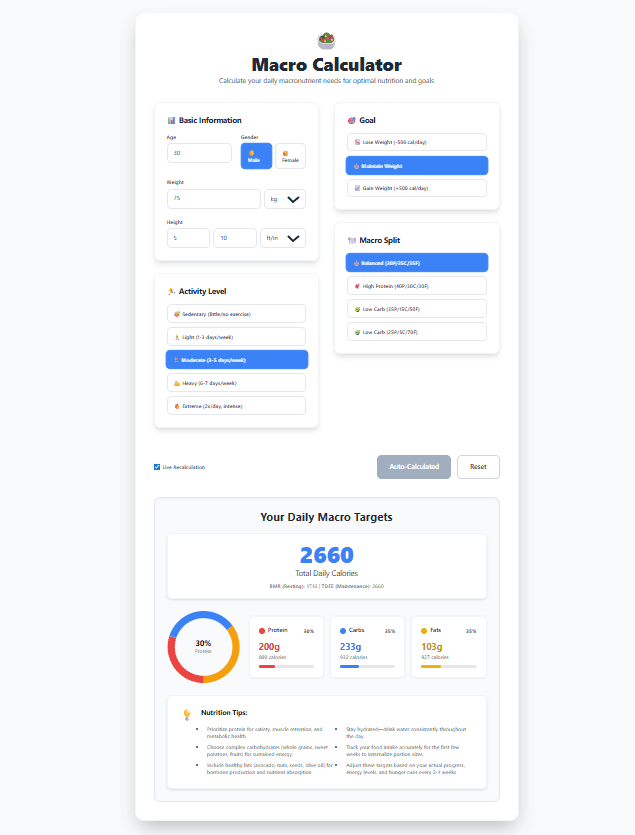
Our Macro Calculator simplifies the complex math. Here's how to use it effectively:
Step 1: Enter Your Basic Information
- Age: Metabolism changes with age
- Gender: Biological differences in muscle mass and hormones
- Weight: Current body weight (use morning weight after bathroom)
- Height: Impacts basal metabolic rate
Step 2: Select Activity Level
Be honest here: Most people overestimate activity. Choose based on:
- Sedentary: Desk job, little intentional exercise
- Light active: Light exercise 1-3 days/week
- Moderate active: Moderate exercise 3-5 days/week
- Very active: Hard exercise 6-7 days/week
- Extreme active: Athlete or physical labor job
Step 3: Choose Your Goal
- Lose weight: 500-calorie deficit from maintenance
- Maintain weight: Keep current body composition
- Gain muscle: 500-calorie surplus from maintenance
Step 4: Select Your Macro Split
- Balanced: Good starting point for most people
- High-protein: Ideal for fat loss or muscle building
- Low-carb: For those sensitive to carbohydrates
- Keto: Very low carb, high fat (consult doctor first)
Step 5: Get Your Results
The calculator provides:
- Total daily calories
- Protein, carb, and fat grams
- Visual breakdown of your macro ratios
- Practical tips for implementation
Pro tip: Use the "Live Recalculation" feature to see how changes affect your targets in real-time.
7️⃣ Setting Goals: Weight Loss, Maintenance, or Muscle Gain
Weight Loss (Calorie Deficit)
Key principles:
- Moderate deficit: 300-500 calories below maintenance
- High protein: Preserve muscle, control hunger
- Strength training: Maintain muscle mass
- Patience: 0.5-1 lb per week is ideal
Example macro approach:
- Calories: Maintenance - 500
- Protein: 1.6-2.2g per kg
- Carbs: Moderate (enough to fuel workouts)
- Fats: Fill remaining calories
Weight Maintenance
The most important phase:
- Find true maintenance: May take 2-4 weeks of tracking
- Establish habits: Without extreme restriction
- Practice consistency: Before attempting another goal
Why maintenance matters:
- Metabolic recovery post-diet
- Behavioral practice
- Psychological break
- Long-term success foundation
Muscle Gain (Calorie Surplus)
Key principles:
- Small surplus: 300-500 calories above maintenance
- Adequate protein: 1.6-2.2g per kg
- Progressive overload: In your training
- Realistic expectations: 0.5-1 lb muscle per month
Bulking mistakes to avoid:
- Dirty bulking: Excessive surplus leads to unnecessary fat
- Inadequate protein: Limits muscle growth
- No training plan: Calories without stimulus = fat
8️⃣ Macro Splits Explained: Which Is Right For You?
Balanced Split (30% Protein / 35% Carbs / 35% Fats)
Best for:
- Beginners starting their macro journey
- General health and maintenance
- Those who enjoy variety in their diet
- Active individuals without specific body composition goals
Sample day at 2000 calories:
- Protein: 150g (600 calories)
- Carbs: 175g (700 calories)
- Fats: 78g (700 calories)
High-Protein Split (40% Protein / 30% Carbs / 30% Fats)
Best for:
- Fat loss (increases satiety and TEF)
- Muscle building or retention
- Those who struggle with hunger
- Older adults (helps preserve muscle mass)
Sample day at 2000 calories:
- Protein: 200g (800 calories)
- Carbs: 150g (600 calories)
- Fats: 67g (600 calories)
Low-Carb Split (35% Protein / 15% Carbs / 50% Fats)
Best for:
- Insulin resistance or prediabetes
- Those who prefer higher-fat foods
- Breaking through weight loss plateaus
- Managing carb cravings
Sample day at 2000 calories:
- Protein: 175g (700 calories)
- Carbs: 75g (300 calories)
- Fats: 111g (1000 calories)
Keto Split (25% Protein / 5% Carbs / 70% Fats)
Important: Consult a healthcare provider before attempting keto
Best for:
- Short-term aggressive fat loss
- Medical conditions (under supervision)
- Those who respond well to very low carb
Sample day at 2000 calories:
- Protein: 125g (500 calories)
- Carbs: 25g (100 calories)
- Fats: 156g (1400 calories)
9️⃣ Calculating Your Personal Macro Targets
The Manual Calculation Method
If you want to understand the math behind our calculator:
Step 1: Calculate BMR (Basal Metabolic Rate) Using Mifflin-St Jeor equation:
For men: BMR = (10 × weight in kg) + (6.25 × height in cm) - (5 × age) + 5
For women: BMR = (10 × weight in kg) + (6.25 × height in cm) - (5 × age) - 161
Step 2: Calculate TDEE (Total Daily Energy Expenditure) TDEE = BMR × Activity Multiplier
- Sedentary: ×1.2
- Light activity: ×1.375
- Moderate activity: ×1.55
- Very active: ×1.725
- Extreme: ×1.9
Step 3: Adjust for Goal
- Weight loss: TDEE - 500
- Maintenance: TDEE
- Muscle gain: TDEE + 500
Step 4: Calculate Macros Example: 2000 calories with 40/30/30 split
- Protein: (2000 × 0.40) ÷ 4 = 200g
- Carbs: (2000 × 0.30) ÷ 4 = 150g
- Fats: (2000 × 0.30) ÷ 9 = 67g
Step 5: Adjust for Protein Minimum Ensure protein is at least 1.2g per kg body weight. If your calculation gives less, increase protein and adjust carbs/fats accordingly.
Why Use Our Calculator Instead?
Our Macro Calculator automatically:
- Handles unit conversions (kg/lbs, cm/ft-in)
- Applies activity multipliers correctly
- Enforces minimum protein requirements
- Normalizes percentages to equal 100%
- Provides visual representations
🔟 Tracking Macros: Methods and Tools
Food Tracking Apps
Food tracking apps can help monitor daily macros and calorie intake. While tools like MyFitnessPal or Cronometer are commonly used, Solvezi’s Nutrition Tracker(/health-tools/macro-calculator) is designed to simplify macro tracking and goal-based adjustments in one place.
Measurement Tools
- Food scale: Most accurate method
- Measuring cups/spoons: Good for liquids and small amounts
- Visual estimation: Palm for protein, fist for veggies, thumb for fats
How Accurate Do You Need to Be?
Level 1: Strict Tracking
- Weigh everything
- Track every day
- Best for: Initial learning, breaking plateaus
Level 2: Partial Tracking
- Track only problem meals/foods
- Estimate the rest
- Best for: Maintenance, those with history of disordered eating
Level 3: Mental Tracking
- No writing down
- Rough awareness of portions
- Best for: Experienced individuals
Level 4: Habit-Based
- Follow consistent patterns
- Use portion control methods
- Best for: Those who find tracking triggers unhealthy behaviors
Tracking Duration Recommendations
- Learning phase: 4-8 weeks of consistent tracking
- Adjustment phase: Track 5 days/week for 4 weeks
- Maintenance phase: 1 week/month or when weight changes
1️⃣1️⃣ Meal Planning with Macros
Building Macro-Friendly Meals
The Plate Method (No Tracking Needed)
- ½ plate: Non-starchy vegetables (spinach, broccoli, peppers)
- ¼ plate: Protein (chicken, fish, tofu)
- ¼ plate: Complex carbs (quinoa, sweet potato, brown rice)
- + thumb: Healthy fats (olive oil, avocado, nuts)
The Hand Method (Portion Control)
- Protein: Palm-sized
- Vegetables: Fist-sized
- Carbs: Cupped hand
- Fats: Thumb-sized
Sample Meal Plans
2000 Calories (Balanced 30/35/35)
- Breakfast: 3 eggs + 2 slices toast + avocado (500 cal)
- Lunch: Chicken salad with olive oil dressing (600 cal)
- Snack: Greek yogurt + berries (200 cal)
- Dinner: Salmon + quinoa + roasted veggies (600 cal)
- Snack: Apple + almond butter (100 cal)
1800 Calories (High-Protein 40/30/30 for Fat Loss)
- Breakfast: Protein shake + oats (400 cal)
- Lunch: Tuna salad + mixed greens (500 cal)
- Snack: Cottage cheese + pineapple (200 cal)
- Dinner: Lean beef stir-fry with vegetables (600 cal)
- Snack: Protein bar (100 cal)
Meal Timing Strategies
Does timing matter? For most people, total daily intake matters more than timing. However:
When timing helps:
- Pre-workout (1-2 hours): Carbs for energy
- Post-workout (within 2 hours): Protein + carbs for recovery
- Before bed: Casein protein for overnight repair
- During fasting windows: Protein at beginning/end
Simple approach: Spread protein across 3-4 meals, time carbs around workouts if training intensely.
1️⃣2️⃣ Common Macro Tracking Mistakes
Mistake #1: Not Tracking Everything
Common misses:
- Cooking oils and butter
- Sauces and dressings
- Beverages (except water)
- Small snacks throughout day
Solution: Track for at least 2 weeks to build awareness, then you can estimate better.
Mistake #2: Overestimating Activity
Reality check questions:
- Do you sit at a desk 8+ hours daily?
- Do you get less than 7,000 steps/day?
- Is your "exercise" mostly walking?
Solution: Choose a conservative activity level. You can always increase later.
Mistake #3: Weekly Calorie Creep
The problem: Perfect weekdays, weekend overeating negates progress.
The math:
- Weekday deficit: 500 × 5 = 2500 calories
- Weekend overage: 1000 × 2 = 2000 calories
- Net weekly deficit: Only 500 calories (0.14 lb loss instead of 1 lb)
Solution: Weekly calorie budgeting or planned flexibility meals.
Mistake #4: Not Adjusting After Weight Loss
The issue: As you lose weight, your calorie needs decrease.
Example:
- Starting: 180 lbs, TDEE 2200, eating 1700 (-500)
- After 20 lbs loss: 160 lbs, TDEE 1950, still eating 1700 (-250)
Solution: Recalculate macros every 5-10 lbs lost.
Mistake #5: Obsessive Perfectionism
Signs of unhealthy tracking:
- Anxiety when you can't track
- Guilt over "bad" days
- Isolation to avoid untrackable meals
- Numbers dictate self-worth
Solution: Practice flexibility, focus on weekly averages, take breaks.
1️⃣3️⃣ Adjusting Macros: When and How
When to Adjust
- Weight plateau (2+ weeks no change)
- Energy levels consistently low
- Hunger unmanageable
- Performance declining
- Every 4-6 weeks as part of routine check-in
How to Adjust
For stalled weight loss:
- First, verify you're tracking accurately
- Consider a diet break (1-2 weeks at maintenance)
- Small calorie reduction (100-200 calories)
- Increase activity (steps, NEAT)
- Adjust macros (often increasing protein helps)
For poor energy/recovery:
- Increase carbs, especially around workouts
- Ensure adequate calories for activity level
- Check sleep and stress management
- Consider micronutrient deficiencies
For excessive hunger:
- Increase protein (most satiating)
- Increase fiber-rich vegetables
- Increase water intake
- Consider more frequent, smaller meals
- Ensure adequate sleep (affects hunger hormones)
The Adjustment Process
- Change one variable at a time
- Give it 2 weeks before assessing
- Keep notes on how you feel
- Don't overcomplicate - small adjustments work
1️⃣4️⃣ Special Considerations
Vegetarian and Vegan Macros
Challenges:
- Lower protein density in plant foods
- Incomplete amino acid profiles
- Higher volume needed to hit targets
Solutions:
- Prioritize complete proteins: Soy, quinoa, buckwheat
- Combine proteins: Rice + beans, hummus + pita
- Use protein powders: Pea, rice, hemp blends
- Focus on protein-rich plants: Lentils, chickpeas, tofu, tempeh
Sample vegan day at 2000 calories:
- Protein: 120g (480 cal) - tofu, lentils, protein powder
- Carbs: 225g (900 cal) - oats, rice, fruits, vegetables
- Fats: 69g (620 cal) - nuts, seeds, avocado, olive oil
Gluten-Free Macros
Focus on naturally gluten-free foods:
- Proteins: All meats, fish, eggs, legumes
- Carbs: Rice, quinoa, potatoes, sweet potatoes, gluten-free oats
- Fats: All oils, nuts, seeds, avocados
Watch for: Hidden gluten in sauces, processed foods, cross-contamination.
Dairy-Free Macros
Alternatives:
- Milk: Almond, soy, oat, coconut milk
- Yogurt: Coconut, almond, soy yogurt
- Cheese: Nutritional yeast, vegan cheeses
- Protein: Focus on meats, fish, eggs, legumes
Budget-Friendly Macro Shopping
Prioritize these cost-effective foods:
- Protein: Eggs, chicken thighs, canned tuna, lentils, beans
- Carbs: Oats, rice, potatoes, bananas, seasonal vegetables
- Fats: Vegetable oils, peanut butter, sunflower seeds
Money-saving tips:
- Buy in bulk
- Choose frozen fruits/vegetables
- Cook in batches
- Use cheaper cuts of meat
1️⃣5️⃣ Macros for Different Training Styles
Strength Training (Weightlifting)
Macro priorities:
- Protein: 1.6-2.2g per kg for muscle repair
- Carbs: 3-5g per kg for glycogen and energy
- Fats: Remaining calories, minimum 0.5g per kg
Timing considerations:
- Pre-workout: Carbs for energy
- Post-workout: Protein + carbs for recovery
- Daily: Spread protein across meals
Endurance Training (Running, Cycling)
Macro priorities:
- Carbs: 5-8g per kg for sustained energy
- Protein: 1.4-1.8g per kg for recovery
- Fats: 0.5-1g per kg
Special considerations:
- Carb loading before long events
- Intra-workout nutrition for sessions >90 minutes
- Focus on easily digestible carbs during activity
HIIT and Metabolic Conditioning
Macro priorities:
- Protein: 1.6-2.0g per kg for recovery
- Carbs: 3-5g per kg for high-intensity efforts
- Fats: Fill remaining calories
Considerations:
- Higher carb needs than strength training
- Important post-workout nutrition
- May benefit from carb timing
Yoga and Low-Intensity Activity
Macro priorities:
- Protein: 1.2-1.6g per kg
- Carbs: 2-4g per kg
- Fats: Higher percentage (30-40%)
Considerations:
- Lower overall calorie needs
- May prefer higher fat for satiety
- Less emphasis on timing
1️⃣6️⃣ Sustainability: Making Macro Tracking Work Long-Term
From Tracking to Intuition
The progression:
- Stage 1 (Weeks 1-4): Strict tracking, weighing everything
- Stage 2 (Weeks 5-8): Partial tracking, estimating some meals
- Stage 3 (Months 3-6): Mental tracking, checking occasionally
- Stage 4 (6+ months): Habit-based, intuitive eating with check-ins
Signs You're Ready to Track Less
- You can accurately estimate portions
- Your weight is stable without tracking
- You have established go-to meals
- Tracking feels tedious rather than helpful
- You can enjoy social events without anxiety
Maintaining Without Tracking
Strategies that work:
- Weekly weigh-ins: Catch small gains early
- Clothing checks: How your clothes fit
- Habit routines: Consistent meal patterns
- Periodic tracking: 1 week every month or two
- Mindful eating: Pay attention to hunger/fullness
The 80/20 Rule for Sustainability
80% of meals: Planned, nutrient-dense, portion-controlled 20% of meals: Flexible, social, less structured
This balance prevents burnout while maintaining progress.
Handling Special Occasions
Before the event:
- Check menu online if possible
- Eat a protein-rich snack beforehand
- Decide in advance what you'll enjoy
During the event:
- Focus on company more than food
- Use the plate method as a guide
- Enjoy mindfully, not restrictively
After the event:
- Don't "make up" with extreme restriction
- Return to normal routine next meal
- Remember one event doesn't ruin progress
❓ Frequently Asked Questions
Q: How do I calculate my macros? A: Use our Macro Calculator for personalized recommendations based on your age, gender, weight, height, activity level, goal, and preferred macro split. The calculator does all the complex math for you and provides visual breakdowns.
Q: Should I count macros or calories? A: Count both initially. Calories determine weight change, macros determine the quality of that change (muscle vs fat). Start by hitting your calorie target, then focus on protein, then fill the rest with carbs and fats according to your chosen ratio.
Q: How long does it take to see results from macro tracking? A: Weight changes can be seen in 1-2 weeks, body composition changes in 4-8 weeks, and significant transformations in 3-6 months. Consistency is more important than perfection.
Q: Can I build muscle and lose fat at the same time? A: Yes, but mainly for beginners, overweight individuals, or those returning to training after a break. You need adequate protein (1.6-2.2g per kg), a small calorie deficit (200-300 calories), and progressive strength training.
Q: What if I go over my macros one day? A: Don't panic. Look at weekly averages rather than daily perfection. One day doesn't ruin your progress. Return to your targets at the next meal or next day. Consider adjusting other days slightly if it was a large overage.
Q: How often should I recalculate my macros? A: Every 4-6 weeks, or after every 5-10 lbs of weight change. Also recalculate if your activity level changes significantly or if you hit a plateau for 2+ weeks.
Q: Are macro calculators accurate? A: They provide estimates based on equations validated in research. Individual variation exists, so use the numbers as a starting point and adjust based on your results, energy levels, and hunger. Our calculator uses the Mifflin-St Jeor equation, considered the most accurate for the general population.
Q: What's the minimum protein I need? A: Absolute minimum for sedentary adults is 0.8g per kg, but for active individuals or those with body composition goals, 1.2-2.2g per kg is recommended. Our calculator enforces a minimum of 1.2g per kg to ensure adequate intake for health and body composition.
Q: Can I do macros on a vegetarian/vegan diet? A: Absolutely. Focus on plant-based protein sources like lentils, beans, tofu, tempeh, and protein powders. You may need to combine different plant proteins to get all essential amino acids. Our calculator works for any dietary pattern.
Q: How do I track macros when eating out? A: Many chain restaurants provide nutrition information online. For others, estimate using the hand method: palm for protein, fist for veggies, cupped hand for carbs, thumb for fats. When in doubt, prioritize protein and vegetables, and enjoy the experience.
🚀 Getting Started: Your Action Plan
Week 1: Foundation
- Calculate your macros using our Macro Calculator
- Track everything for 7 days without changing your diet
- Identify patterns in your current eating
Week 2-4: Implementation
- Start hitting your protein target each day
- Adjust carbs and fats to match your ratios
- Weigh and measure to learn portion sizes
- Create 5-10 go-to meals that fit your macros
Month 2-3: Refinement
- Adjust based on results (weight, measurements, photos)
- Experiment with timing if interested
- Practice estimating without weighing everything
- Handle special occasions without derailing
Month 4+: Mastery
- Transition to maintenance tracking (partial or periodic)
- Focus on habits rather than numbers
- Help others with what you've learned
- Enjoy the freedom of nutritional knowledge
📱 Ready to Start?
Knowledge is power, but action creates change. You now understand:
- Why macros matter
- How to calculate your personal targets
- How to implement macro tracking
- How to adjust for optimal results
Your next step is simple:
- Calculate Your Macros Now
- Start tracking for just one week
- Adjust as needed based on how you feel
- Revisit this guide when you have questions
Remember: Progress, not perfection. Consistency, not intensity. Understanding, not restriction.
Welcome to precision nutrition.
Disclaimer: This guide is for educational purposes. Consult with a healthcare provider before making significant dietary changes, especially if you have medical conditions. Individual needs may vary.