The Complete Sleep Cycle Calculator Guide: Wake Up Refreshed Every Morning
Introduction: Why Timing Matters More Than Hours
Have you ever slept for 8 hours but still woken up feeling groggy, while other times you've felt refreshed after just 6 hours? The secret isn't just how long you sleep—it's when you wake up relative to your sleep cycles.
This guide will transform how you think about sleep by explaining:
- The science behind 90-minute sleep cycles
- Why waking between cycles prevents sleep inertia
- How to calculate your optimal sleep and wake times
- Strategies to improve sleep quality naturally
- How to use our Sleep Cycle Calculator effectively
Ready to optimize your sleep? Use our Sleep Cycle Calculator to find your perfect bedtime or wake-up time.
📖 Table of Contents
- The Science of Sleep Cycles: Beyond Just Hours
- Understanding the 90-Minute Sleep Cycle
- Sleep Stages: Light, Deep, and REM Sleep
- The Problem with Sleep Inertia (Morning Grogginess)
- How the Sleep Cycle Calculator Works
- Method 1: "Sleep Now" - Finding Optimal Wake Times
- Method 2: "Wake Up At" - Finding Optimal Bedtimes
- Why 5-6 Cycles Are Optimal (7.5-9 Hours)
- Adjusting for Your Personal Sleep Latency
- Circadian Rhythm: Your Internal Body Clock
- Chronotypes: Morning Larks vs. Night Owls
- Practical Tips for Better Sleep Timing
- Common Sleep Timing Mistakes
- Special Considerations (Shift Work, Jet Lag)
- Tracking Your Sleep Patterns
- Sleep Quality vs. Sleep Quantity
- FAQs: Your Sleep Questions Answered
1️⃣ The Science of Sleep Cycles: Beyond Just Hours
Sleep Isn't Continuous
Sleep progresses through predictable stages in cycles throughout the night. Each complete cycle includes:
- NREM Stage 1: Light sleep, transition phase (5-10 minutes)
- NREM Stage 2: True sleep begins, body temperature drops (10-25 minutes)
- NREM Stage 3: Deep sleep, physical restoration (20-40 minutes)
- REM Sleep: Dreaming, memory consolidation (10-60 minutes)
The Historical Discovery
The 90-minute sleep cycle was first identified in the 1950s through electroencephalogram (EEG) studies. Researchers discovered that sleep follows predictable patterns that repeat throughout the night.
Why Cycle Timing Matters
Waking up during deep sleep (Stage 3) causes sleep inertia—that groggy, disoriented feeling. Waking during light sleep (Stage 1 or 2) or REM sleep results in feeling more refreshed.
Key insight: A 7.5-hour sleep (5 cycles) often feels better than 8 hours (5.33 cycles) because you're waking at a natural cycle endpoint.
2️⃣ Understanding the 90-Minute Sleep Cycle
The Standard Sleep Cycle
While often called a "90-minute" cycle, actual cycle lengths vary:
- First cycle: 70-100 minutes
- Later cycles: 90-120 minutes
- Average: 90 minutes
Cycle Composition Changes Through the Night
| Sleep Cycle | Deep Sleep | REM Sleep | Light Sleep |
|---|---|---|---|
| Cycle 1 | High | Low | Medium |
| Cycle 2 | High | Medium | Medium |
| Cycle 3 | Medium | High | Medium |
| Cycle 4 | Low | Very High | Medium |
| Cycle 5 | Very Low | Very High | High |
Pattern: More deep sleep early in the night, more REM sleep later.
The 14-Minute Fall-Asleep Buffer
Our calculator adds 14 minutes to account for sleep latency—the time it takes to fall asleep. This varies by individual:
- Average: 10-20 minutes
- Good sleepers: 5-10 minutes
- Insomniacs: 30+ minutes
Adjust this in your calculations if you know your personal sleep latency.
3️⃣ Sleep Stages: Light, Deep, and REM Sleep
NREM Stage 1 (Light Sleep)
Duration: 1-7 minutes per cycle Characteristics:
- Transition between wakefulness and sleep
- Easy to awaken
- Muscle activity slows
- May experience hypnic jerks (sleep starts)
NREM Stage 2 (True Sleep)
Duration: 10-25 minutes per cycle Characteristics:
- Body temperature drops
- Heart rate slows
- Sleep spindles and K-complexes (brain waves)
- Accounts for 45-55% of total sleep
NREM Stage 3 (Deep Sleep)
Duration: 20-40 minutes per cycle Characteristics:
- Difficult to awaken
- Physical restoration occurs
- Tissue repair and growth
- Immune system strengthening
- Memory consolidation
REM Sleep (Dream Sleep)
Duration: 10-60 minutes per cycle Characteristics:
- Rapid eye movements
- Brain activity similar to waking
- Temporary muscle paralysis
- Dreaming occurs
- Emotional processing and memory
4️⃣ The Problem with Sleep Inertia (Morning Grogginess)
What Is Sleep Inertia?
Sleep inertia is the temporary feeling of grogginess, disorientation, and impaired cognitive performance immediately after waking.
Causes of Sleep Inertia
- Waking during deep sleep: Most significant cause
- Sleep deprivation: Amplifies inertia
- Abrupt awakenings: Alarm clocks vs. natural awakening
- Individual factors: Genetics, age, sleep disorders
Duration and Impact
- Typical: 15-30 minutes
- Severe cases: Up to 2-4 hours
- Cognitive impairment: Equivalent to being legally drunk in some studies
How the Calculator Helps
By timing your wake-up to coincide with the end of a sleep cycle (during light sleep), you minimize sleep inertia and start your day feeling refreshed.
5️⃣ How the Sleep Cycle Calculator Works
The Calculation Formula
For "Sleep Now" mode:
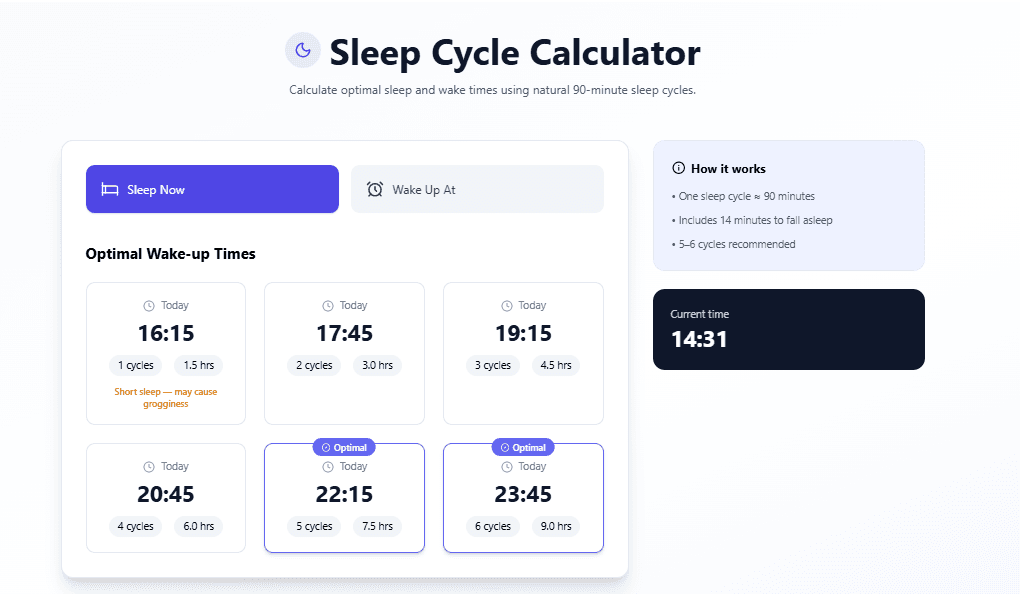
Wake Time = Current Time + 14 minutes (fall asleep) + (Cycles × 90 minutes)
For "Wake Up At" mode:
Bedtime = Wake Time - (Cycles × 90 minutes) - 14 minutes (fall asleep)
Available Sleep Cycles
The calculator provides options for 1-6 complete sleep cycles:
| Cycles | Total Sleep Time | Quality Rating |
|---|---|---|
| 1 cycle | 1.5 hours | Poor (emergency only) |
| 2 cycles | 3 hours | Very poor |
| 3 cycles | 4.5 hours | Below optimal |
| 4 cycles | 6 hours | Minimum recommended |
| 5 cycles | 7.5 hours | Optimal |
| 6 cycles | 9 hours | Optimal |
Optimal vs. Suboptimal
The calculator highlights 5-6 cycles as "Optimal" because:
- Provides sufficient deep sleep for physical restoration
- Allows adequate REM sleep for cognitive function
- Aligns with sleep research recommendations
- Minimizes sleep inertia when waking at cycle end
6️⃣ Method 1: "Sleep Now" - Finding Optimal Wake Times
When to Use This Mode
Use "Sleep Now" when:
- You're ready to go to sleep now
- You want to know the best times to set your alarm
- You have flexibility in when you wake up
- You want to avoid morning grogginess
How to Use It
- Select "Sleep Now" mode
- The calculator uses your current time
- It adds 14 minutes for falling asleep
- Calculates 6 possible wake times (1-6 cycles)
- Shows which are optimal (5-6 cycles)
Sample Calculation
Current time: 11:00 PM Fall asleep by: 11:14 PM Optimal wake times:
- 5 cycles: 6:44 AM (7.5 hours)
- 6 cycles: 8:14 AM (9 hours)
Practical Application
If you need to wake up at 7:00 AM for work, you can see that:
- 5 cycles gets you up at 6:44 AM (close enough)
- Going to bed at 11:00 PM gives you optimal sleep
7️⃣ Method 2: "Wake Up At" - Finding Optimal Bedtimes
When to Use This Mode
Use "Wake Up At" when:
- You have a fixed wake-up time (work, school)
- You want to know when to go to bed
- You're planning your evening schedule
- You want to ensure you get complete cycles
How to Use It
- Select "Wake Up At" mode
- Enter your desired wake-up time
- The calculator subtracts sleep cycles
- Shows optimal bedtimes for 1-6 cycles
- Recommends bedtimes for 5-6 cycles
Sample Calculation
Desired wake time: 7:00 AM Optimal bedtimes:
- 5 cycles: 11:16 PM (7.5 hours)
- 6 cycles: 9:46 PM (9 hours)
The 10-Minute Buffer Rule
Always aim to be in bed 10 minutes before your calculated bedtime to account for:
- Getting comfortable
- Reading or relaxing
- Actually falling asleep
8️⃣ Why 5-6 Cycles Are Optimal (7.5-9 Hours)
National Sleep Foundation Recommendations
| Age Group | Recommended Sleep |
|---|---|
| Adults (18-64) | 7-9 hours |
| Older adults (65+) | 7-8 hours |
| Teenagers (14-17) | 8-10 hours |
| School-age (6-13) | 9-11 hours |
The Science Behind 7.5 Hours
Five 90-minute cycles equals 7.5 hours, which:
- Provides sufficient deep sleep: Most deep sleep occurs in first 3-4 cycles
- Allows adequate REM sleep: REM periods lengthen in later cycles
- Minimizes sleep inertia: Waking at cycle end
- Matches natural patterns: Aligns with circadian rhythms for most adults
When 9 Hours (6 Cycles) Is Better
Consider 6 cycles if you:
- Are sleep deprived and catching up
- Have high physical activity levels
- Are recovering from illness
- Are a teenager or young adult
- Naturally require more sleep
The Risks of Too Little or Too Much
Chronic short sleep (<6 hours):
- Increased obesity risk
- Impaired immune function
- Cognitive decline
- Mood disorders
Excessive sleep (>9 hours regularly):
- May indicate underlying health issues
- Associated with depression
- Can disrupt circadian rhythm
9️⃣ Adjusting for Your Personal Sleep Latency
What Is Sleep Latency?
Sleep latency is the time it takes to fall asleep after going to bed.
Average Sleep Latency Times
| Population | Average Time |
|---|---|
| Healthy adults | 10-20 minutes |
| Good sleepers | 5-10 minutes |
| Insomniacs | 30+ minutes |
| Elderly | 15-25 minutes |
How to Measure Your Sleep Latency
- Keep a sleep diary: Note bedtime and estimated sleep time
- Use sleep tracking: Wearables can estimate sleep onset
- Time yourself: When you feel sleepy, note how long to fall asleep
Adjusting the Calculator
Our calculator uses 14 minutes as a default. Adjust mentally:
If you fall asleep faster (5 minutes):
- Subtract 9 minutes from suggested bedtimes
- Or add 9 minutes to wake times
If you fall asleep slower (30 minutes):
- Add 16 minutes to suggested bedtimes
- Or subtract 16 minutes from wake times
Improving Sleep Latency
- Consistent schedule: Go to bed at same time daily
- Bedroom environment: Cool, dark, quiet
- Wind-down routine: 30-60 minutes before bed
- Limit screens: Blue light inhibits melatonin
- Avoid stimulants: Caffeine, nicotine close to bedtime
🔟 Circadian Rhythm: Your Internal Body Clock
What Is Circadian Rhythm?
Your circadian rhythm is a 24-hour internal clock that regulates:
- Sleep-wake cycles
- Body temperature
- Hormone production
- Metabolism
- Alertness patterns
The Two-Process Model of Sleep Regulation
Process S (Sleep Pressure):
- Builds the longer you're awake
- Decreases during sleep
- Driven by adenosine accumulation
Process C (Circadian Rhythm):
- Independent of sleep/wake
- Peaks in evening (sleepiness)
- Dips in early morning (alertness)
Optimal Sleep Window
For most adults, the ideal sleep window is:
- Bedtime: 10:00 PM - 12:00 AM
- Wake time: 6:00 AM - 8:00 AM
- Matches natural light/dark cycles
How to Align with Your Circadian Rhythm
- Morning light exposure: Within 30 minutes of waking
- Consistent sleep schedule: Even on weekends
- Evening light management: Reduce blue light
- Meal timing: Finish eating 2-3 hours before bed
- Exercise timing: Morning or afternoon, not evening
1️⃣1️⃣ Chronotypes: Morning Larks vs. Night Owls
What Are Chronotypes?
Chronotypes are natural preferences for being active at certain times of day.
The Four Main Chronotypes
Lions (Morning types):
- Wake early naturally
- Most productive in morning
- 15-20% of population
Bears (Intermediate):
- Follow solar schedule
- Peak productivity 10 AM - 2 PM
- 50-55% of population
Wolves (Evening types):
- Natural night owls
- Most productive late afternoon/evening
- 15-20% of population
Dolphins (Light sleepers):
- Wake easily to sounds
- Often have insomnia
- 10% of population
Adjusting Sleep Times for Your Chronotype
| Chronotype | Optimal Bedtime | Optimal Wake Time |
|---|---|---|
| Lion | 9:00-10:00 PM | 5:00-6:00 AM |
| Bear | 10:00-11:00 PM | 6:00-7:00 AM |
| Wolf | 12:00-1:00 AM | 8:00-9:00 AM |
| Dolphin | 11:00 PM-12:00 AM | 6:30-7:30 AM |
Finding Your Chronotype
- Munich Chronotype Questionnaire: Online assessment
- Natural tendencies: When you naturally wake without alarm
- Productivity patterns: When you feel most alert
- Sleep tracker data: Consistent sleep/wake patterns
1️⃣2️⃣ Practical Tips for Better Sleep Timing
Creating a Sleep Schedule
- Calculate optimal times using our calculator
- Set consistent bed/wake times (within 30 minutes daily)
- Create bedtime routine 30-60 minutes before bed
- Use gradual adjustments (15 minutes earlier/later each night)
Optimizing Your Sleep Environment
- Temperature: 60-67°F (15-19°C)
- Darkness: Blackout curtains or sleep mask
- Quiet: White noise machine or earplugs
- Comfort: Supportive mattress and pillows
- Reserved for sleep: No work or screens in bed
Managing Sleep Disruptions
- Limit liquids: 1-2 hours before bed
- Manage stress: Journaling, meditation
- Address pain: Comfortable position, pain management
- Partner disturbances: Separate blankets, consider sleep divorce if severe
Technology and Sleep
- Blue light blockers: Apps or glasses after sunset
- Screen curfew: 1 hour before bed
- Alarm alternatives: Sunrise alarm clocks
- Sleep trackers: Use data to optimize, not obsess
1️⃣3️⃣ Common Sleep Timing Mistakes
Mistake 1: Sleeping In on Weekends
Problem: Creates "social jet lag" Solution: Limit difference to 1 hour max
Mistake 2: Napping Too Late
Problem: Reduces sleep pressure Solution: Nap before 3 PM, limit to 20-30 minutes
Mistake 3: Using Snooze Button
Problem: Fragments sleep, causes sleep inertia Solution: Place alarm across room, get up immediately
Mistake 4: Inconsistent Bedtimes
Problem: Confuses circadian rhythm Solution: Set consistent bedtime, even on weekends
Mistake 5: Watching Clock When Can't Sleep
Problem: Increases anxiety Solution: Turn clock away, get up if awake >20 minutes
Mistake 6: Exercising Too Close to Bedtime
Problem: Raises core temperature Solution: Finish exercise 2-3 hours before bed
1️⃣4️⃣ Special Considerations
Shift Work Sleep Disorder
Challenges:
- Working against natural circadian rhythm
- Social and family disruptions
- Increased health risks
Strategies:
- Consistent schedule: Even on days off
- Light management: Bright light during shift, darkness for sleep
- Strategic napping: Before or during shifts
- Sleep environment optimization: Blackout curtains, white noise
Jet Lag Management
Eastward travel (harder):
- Advance bedtime before travel
- Seek morning light at destination
- Avoid evening light
Westward travel (easier):
- Delay bedtime before travel
- Seek evening light at destination
- Avoid morning light
General strategies:
- Adjust watch to destination time immediately
- Stay hydrated, avoid alcohol
- Consider melatonin supplementation
Pregnancy and Sleep
Changes:
- Increased sleep needs (add 1 hour)
- Frequent nighttime awakenings
- Discomfort in later pregnancy
Strategies:
- More pillows for support
- Left-side sleeping for circulation
- Nap when possible
- Adjust expectations for perfect sleep
Aging and Sleep
Changes:
- Earlier bed/wake times
- More nighttime awakenings
- Reduced deep sleep
Strategies:
- Maintain consistent schedule
- Limit naps to 20 minutes
- Increase daytime light exposure
- Address medical issues affecting sleep
1️⃣5️⃣ Tracking Your Sleep Patterns
Sleep Diary Method
What to track:
- Bedtime
- Estimated sleep onset time
- Nighttime awakenings
- Wake time
- Sleep quality rating (1-10)
- Daytime energy
Benefits:
- Identifies patterns
- Helps with sleep restriction therapy
- Provides data for healthcare providers
Wearable Sleep Trackers
Popular options:
- Fitbit
- Apple Watch
- Oura Ring
- Whoop
What they measure:
- Sleep duration
- Sleep stages (estimates)
- Resting heart rate
- Heart rate variability
Limitations:
- Stage detection isn't medical grade
- May create sleep anxiety
- Accuracy varies
Professional Sleep Studies
When needed:
- Suspected sleep apnea
- Chronic insomnia
- Narcolepsy or sleep disorders
- Unexplained daytime sleepiness
Types:
- Polysomnography: Lab sleep study
- Home sleep apnea test: For apnea screening
- Multiple Sleep Latency Test: For narcolepsy
1️⃣6️⃣ Sleep Quality vs. Sleep Quantity
Components of Sleep Quality
- Sleep efficiency: Time asleep ÷ time in bed (goal: >85%)
- Sleep latency: Time to fall asleep (goal: <20 minutes)
- Wake after sleep onset: Nighttime awakenings (goal: <20 minutes total)
- Sleep stages distribution: Balanced deep, REM, light sleep
- Consistency: Regular sleep schedule
Improving Sleep Quality
Physical factors:
- Regular exercise (but not before bed)
- Healthy diet
- Limited alcohol and caffeine
- Comfortable sleep environment
Mental factors:
- Stress management
- Cognitive behavioral therapy for insomnia
- Mindfulness and meditation
- Worry journal before bed
Environmental factors:
- Optimal temperature
- Complete darkness
- Quiet environment
- Clean, allergen-free bedroom
Signs of Poor Sleep Quality
- Taking >30 minutes to fall asleep
- Waking frequently at night
- Feeling tired despite adequate hours
- Daytime sleepiness or napping
- Mood disturbances
- Cognitive impairment
❓ Frequently Asked Questions
Q: How accurate is the sleep cycle calculator? A: The calculator provides estimates based on average sleep cycle duration (90 minutes) and average sleep latency (14 minutes). Individual variations exist, so use it as a starting point and adjust based on your personal experience.
Q: What if my sleep cycles aren't exactly 90 minutes? A: Sleep cycles vary from 70-120 minutes, with 90 minutes being the average. The calculator provides a good approximation. If you know your personal cycle length (from sleep tracking), you can adjust the calculations mentally.
Q: Is it better to get 7.5 hours (5 cycles) or 8 hours of sleep? A: 7.5 hours (5 complete cycles) is often better than 8 hours because you're more likely to wake at the end of a sleep cycle rather than in the middle of deep sleep. However, individual needs vary—some people genuinely need 8+ hours.
Q: Can I use the calculator for naps? A: Yes! For naps, aim for:
- Power nap: 10-20 minutes (prevents sleep inertia)
- Cycle nap: 90 minutes (one complete cycle)
- Avoid 30-60 minute naps (may wake from deep sleep)
Q: What if I wake up during the night? A: If you wake during the night and can't fall back asleep within 20 minutes, get up and do a quiet activity until sleepy. When you return to bed, recalculate your wake time based on when you expect to fall back asleep.
Q: How do I account for different sleep latencies? A: Our calculator uses 14 minutes as default. If you typically fall asleep faster or slower:
- Faster sleeper (5 minutes): Subtract 9 minutes from bedtimes
- Slower sleeper (30 minutes): Add 16 minutes to bedtimes
- Or adjust wake times accordingly
Q: Can the calculator help with insomnia? A: While not a treatment, it can help by:
- Establishing consistent sleep times
- Reducing anxiety about sleep duration
- Preventing waking during deep sleep
- For chronic insomnia, consult a sleep specialist.
Q: What about people with non-24-hour sleep cycles? A: Individuals with Non-24 Sleep-Wake Disorder or other circadian rhythm disorders should work with a sleep specialist. The calculator assumes a 24-hour circadian rhythm.
Q: How does age affect sleep cycles? A: Sleep architecture changes with age:
- Infants: Shorter cycles (50-60 minutes)
- Children: More deep sleep
- Adults: Standard 90-minute cycles
- Elderly: Reduced deep sleep, more awakenings
The calculator is optimized for adults but can be used by all ages with adjustments.
Q: What if my work schedule changes frequently? A: For rotating shifts:
- Use the calculator for each shift
- Prioritize sleep before early shifts
- Use blackout curtains for daytime sleep
- Consider consulting a sleep specialist for shift work disorder
🚀 Your Better Sleep Journey Starts Here
Getting Started with Our Calculator
- Try the Sleep Cycle Calculator
- Experiment with both modes (Sleep Now and Wake Up At)
- Track your results for 1-2 weeks
- Adjust based on how you feel
Creating Your Personal Sleep Plan
Week 1: Baseline
- Calculate optimal times
- Track current sleep patterns
- Identify biggest sleep disruptors
Week 2: Implementation
- Set consistent bed/wake times
- Create bedtime routine
- Optimize sleep environment
Week 3: Refinement
- Adjust based on what's working
- Address specific challenges
- Incorporate additional strategies
Week 4+: Maintenance
- Stick to successful patterns
- Handle disruptions effectively
- Recalculate as needed for schedule changes
Key Principles to Remember
- Consistency matters most – Regular schedule beats perfect timing
- Quality over quantity – 7.5 hours of good sleep beats 9 hours of poor sleep
- Listen to your body – Adjust based on how you feel
- Be patient – Sleep improvements take time
- Seek help if needed – Persistent sleep issues warrant professional evaluation
Additional Resources
- Sleep tracking apps: Sleep Cycle, Pillow
- Light therapy: Sunrise alarm clocks, light therapy lamps
- Sleep education: CBT-I apps, sleep courses
- Professional help: Sleep specialists, sleep centers
🌙 Ready for Better Sleep?
You now understand:
- Why sleep cycles matter more than total hours
- How to calculate optimal sleep and wake times
- Strategies to improve sleep quality
- How to use our calculator effectively
Your next step is simple:
- Calculate your optimal sleep times now
- Choose one improvement to implement this week
- Track your progress for 7 days
- Adjust as needed based on results
Remember: Better sleep isn't about perfection—it's about consistent, small improvements that add up to more restful nights and energized days.
Sweet dreams! 😴
Disclaimer: This calculator provides estimates for educational purposes. It is not a substitute for professional medical advice, diagnosis, or treatment. If you have chronic sleep problems, insomnia, or other sleep disorders, consult a healthcare provider or sleep specialist.