The Ultimate Calorie Deficit Calculator Guide: Master Your Weight Loss Journey
Introduction: The Science Behind Sustainable Weight Loss
Weight loss isn't about starvation or extreme diets—it's about creating a sustainable calorie deficit that works with your body's natural metabolism. This comprehensive guide will help you understand how to use our Calorie Deficit Calculator effectively to achieve your weight loss goals without compromising your health or energy levels.
This guide will teach you:
- The science behind BMR and TDEE calculations
- How to determine your perfect calorie deficit
- Why different activity levels matter
- How to set realistic weight loss goals
- Strategies for maintaining your results long-term
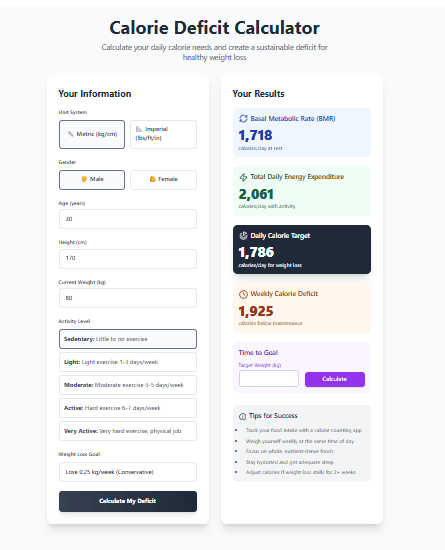
Ready to calculate your perfect calorie deficit? Use our Calorie Deficit Calculator for personalized calculations based on your unique profile.
📖 Table of Contents
- What Is a Calorie Deficit Really?
- The Science: BMR vs. TDEE Explained
- Understanding Your Metabolic Engine
- Activity Levels: Finding Your Multiplier
- Setting Realistic Weight Loss Goals
- The Calculator: Step-by-Step Guide
- Interpreting Your Results
- Your Daily Calorie Target Demystified
- Weekly Deficit: The Big Picture
- Creating Your Weight Loss Timeline
- Common Calculation Mistakes to Avoid
- Adjusting Your Deficit Over Time
- Nutrition Quality Over Quantity
- Exercise's Role in Your Deficit
- Plateaus and How to Break Them
- Maintenance: The End Goal
- Special Considerations
- Tools for Tracking Success
- FAQs: Your Questions Answered
- Your Action Plan
1️⃣ What Is a Calorie Deficit Really?
The Fundamental Principle
Calorie deficit definition:
Calories In < Calories Out = Weight Loss
But it's not that simple. Your body is a complex metabolic machine that adapts to changes.
Beyond Simple Math
A sustainable calorie deficit considers:
- Basal Metabolic Rate (BMR): What you burn at complete rest
- Total Daily Energy Expenditure (TDEE): Your total daily burn including activity
- Non-Exercise Activity Thermogenesis (NEAT): Daily movement that isn't exercise
- Thermic Effect of Food (TEF): Calories burned digesting food
- Exercise Activity Thermogenesis (EAT): Planned exercise
The Goldilocks Zone
Too small deficit: No weight loss Too large deficit: Muscle loss, metabolic slowdown, fatigue Just right deficit: Sustainable fat loss with preserved muscle
Why Extreme Deficits Fail
Rapid weight loss causes:
- Significant muscle loss
- Metabolic adaptation (slower metabolism)
- Nutrient deficiencies
- Increased hunger hormones
- Higher likelihood of regain
Our Calculator's Approach
We create a moderate, sustainable deficit that:
- Preserves lean muscle mass
- Maintains energy levels
- Supports long-term adherence
- Minimizes metabolic adaptation
2️⃣ The Science: BMR vs. TDEE Explained
Basal Metabolic Rate (BMR)
What it is: The number of calories your body needs to perform basic life-sustaining functions at complete rest.
BMR accounts for:
- Brain function
- Breathing
- Circulation
- Cell production
- Temperature regulation
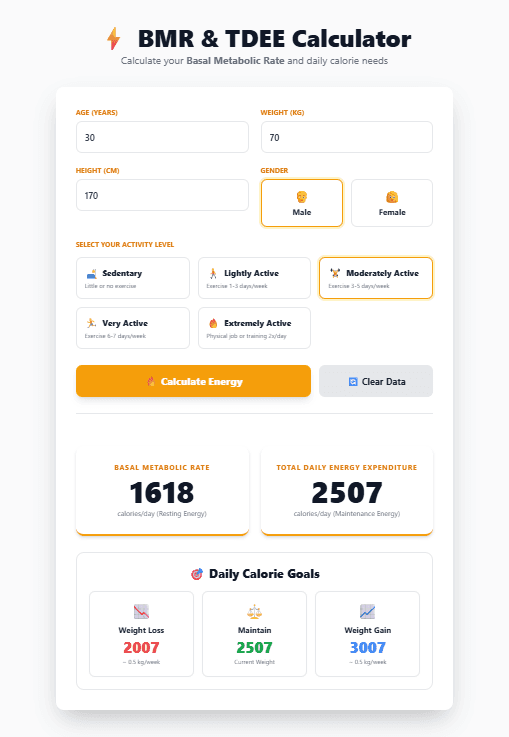
Mifflin-St Jeor Equation (used in our calculator):
For Men: BMR = (10 × weight in kg) + (6.25 × height in cm) - (5 × age) + 5
For Women: BMR = (10 × weight in kg) + (6.25 × height in cm) - (5 × age) - 161
Total Daily Energy Expenditure (TDEE)
What it is: Your total calorie burn for the day, including all activity.
TDEE Formula:
TDEE = BMR × Activity Multiplier
The Activity Multipliers
| Activity Level | Multiplier | Description |
|---|---|---|
| Sedentary | 1.2 | Little to no exercise, desk job |
| Light | 1.375 | Light exercise 1-3 days/week |
| Moderate | 1.55 | Moderate exercise 3-5 days/week |
| Active | 1.725 | Hard exercise 6-7 days/week |
| Very Active | 1.9 | Very hard exercise, physical job |
Why Accuracy Matters
Overestimating activity leads to:
- Smaller than expected deficit
- Slower weight loss
- Frustration and quitting
Underestimating activity leads to:
- Too large deficit
- Unnecessary hunger
- Potential muscle loss
Finding Your True Activity Level
Consider:
- Your job activity (sitting vs. moving)
- Structured exercise
- Daily steps
- Leisure activities
- General restlessness
Be honest with yourself for accurate results.
3️⃣ Understanding Your Metabolic Engine
What Influences Your Metabolism
Factors affecting BMR:
- Body size: Larger bodies burn more
- Body composition: Muscle burns more than fat
- Age: Metabolism slows with age
- Gender: Men typically have higher BMR
- Genetics: Some are naturally faster/slower
- Hormones: Thyroid, cortisol, etc.
- Environmental temperature
Muscle: Your Metabolic Powerhouse
Muscle tissue:
- Burns more calories at rest than fat
- Increases your BMR
- Makes weight maintenance easier
- Improves insulin sensitivity
Preserving muscle during weight loss:
- Adequate protein intake
- Strength training
- Moderate calorie deficit
- Sufficient recovery
Metabolic Adaptation
What happens: Your body becomes more efficient with fewer calories.
Signs of adaptation:
- Weight loss slows/stops
- Energy levels drop
- Hunger increases
- Temperature regulation changes
Preventing excessive adaptation:
- Moderate deficits
- Diet breaks
- Reverse dieting phases
- Adequate protein
Individual Variation
Your metabolism is unique.
- Formulas provide estimates
- Actual needs may vary ±10-15%
- Adjust based on results
- Listen to your body
4️⃣ Activity Levels: Finding Your Multiplier
Sedentary (1.2)
Typical profile:
- Desk job with little movement
- Less than 5,000 daily steps
- Minimal structured exercise
- Mostly seated leisure time
If you're sedentary:
- Focus on increasing NEAT
- Add walking breaks
- Consider standing desk
- Small changes add up
Light Activity (1.375)
Typical profile:
- Light exercise 1-3 days/week
- 5,000-7,000 daily steps
- Some movement at work
- Occasional active hobbies
This includes:
- Walking the dog
- Light gardening
- Recreational sports
- House cleaning
Moderate Activity (1.55)
Typical profile:
- Moderate exercise 3-5 days/week
- 7,000-10,000 daily steps
- Active job or lifestyle
- Regular movement breaks
This includes:
- 30-60 minutes moderate cardio
- Strength training sessions
- Active commute
- Regular sports participation
Active (1.725)
Typical profile:
- Hard exercise 6-7 days/week
- 10,000-15,000 daily steps
- Physically demanding job
- Training for events
This includes:
- Daily intense workouts
- Manual labor jobs
- Competitive sports training
- Multiple daily activity sessions
Very Active (1.9)
Typical profile:
- Very hard daily exercise
- 15,000+ daily steps
- Professional athlete
- Extreme physical job
This includes:
- Twice-daily training
- Endurance athlete training
- Construction/landscaping
- Professional dancing
Choosing Wisely
Common mistake: Overestimating activity Better to: Start conservative, adjust up Watch for: Energy levels, recovery, progress
5️⃣ Setting Realistic Weight Loss Goals
Healthy Rate of Loss
Recommended: 0.25-1% of body weight per week
For most people:
- Conservative: 0.25-0.5 kg (0.5-1 lb) per week
- Moderate: 0.5-0.75 kg (1-1.5 lb) per week
- Aggressive: 0.75-1 kg (1.5-2 lb) per week
Factors Affecting Rate
Faster loss possible if:
- Higher starting weight
- More to lose
- New to diet/exercise
- Younger age
Slower loss expected if:
- Lower starting weight
- Less to lose
- Experienced with dieting
- Older age
- Hormonal issues
The Mathematics of Loss
Calories in one pound of fat: ~3,500 calories Calories in one kilogram of fat: ~7,700 calories
Weekly deficit needed:
- 0.5 lb/week: 1,750 calorie weekly deficit
- 1 lb/week: 3,500 calorie weekly deficit
- 0.5 kg/week: 3,850 calorie weekly deficit
- 1 kg/week: 7,700 calorie weekly deficit
Daily deficit: Weekly deficit ÷ 7
Our Calculator's Goal Options
Conservative (0.25 kg / 0.5 lb per week):
- Small, sustainable deficit
- Minimal hunger
- Preserves muscle
- Good for long-term
Moderate (0.5 kg / 1 lb per week):
- Balanced approach
- Steady progress
- Manageable hunger
- Most popular choice
Aggressive (0.75 kg / 1.5 lb per week):
- Faster results
- More discipline needed
- Monitor energy levels
- Not for beginners
Very Aggressive (1 kg / 2 lb per week):
- Maximum recommended rate
- Requires strict adherence
- Higher hunger
- Risk of muscle loss
Choosing Your Rate
Consider:
- How much you have to lose
- Your timeline
- Your lifestyle
- Your experience
- Your priorities
Start moderate, adjust as needed.
6️⃣ The Calculator: Step-by-Step Guide
Step 1: Choose Your Unit System
Metric (kg/cm):
- Weight in kilograms
- Height in centimeters
- Used worldwide
- Scientific standard
Imperial (lbs/ft/in):
- Weight in pounds
- Height in feet and inches
- Used in USA
- Familiar to many
Our calculator converts automatically if you switch.
Step 2: Select Your Gender
Why gender matters:
- Different BMR equations
- Different body composition
- Different hormonal profiles
- Different calorie needs
Accurate selection ensures proper calculation.
Step 3: Enter Your Age
Age range: 15-100 years Why age matters:
- Metabolism slows with age
- BMR decreases ~1-2% per decade after 20
- Muscle loss accelerates after 30
- Activity often decreases with age
Be accurate—even 5 years makes a difference.
Step 4: Enter Your Height
Metric users: Enter centimeters (cm) Imperial users: Enter feet and inches
Height affects:
- BMR calculation
- Healthy weight ranges
- Calorie needs
Stand tall, measure accurately.
Step 5: Enter Your Current Weight
Weigh yourself:
- First thing in morning
- After using bathroom
- Before eating/drinking
- Same day each week
Be honest—starting weight doesn't determine success.
Step 6: Select Activity Level
Review the descriptions carefully. Consider:
- Your average week, not best week
- Both exercise and daily movement
- Work activity
- Leisure activity
When in doubt, choose lower level.
Step 7: Choose Weight Loss Goal
Select based on:
- How much you want to lose
- Your timeline
- Your experience
- Your lifestyle
Conservative is sustainable, aggressive is faster but harder.
Step 8: Calculate!
Click "Calculate My Deficit" to see your personalized results.
7️⃣ Interpreting Your Results
Your BMR Result
What it means: Calories needed for basic functions.
If you ate only your BMR:
- You would maintain organ function
- You would lose weight (since TDEE > BMR)
- You would feel tired and hungry
- Not sustainable long-term
Use BMR as: Baseline reference point.
Your TDEE Result
What it means: Your maintenance calories.
If you eat your TDEE:
- You maintain current weight
- Energy balance achieved
- Weight stable
TDEE is your starting point for creating a deficit.
The Magic Number: Calorie Deficit
How it's calculated:
Daily Deficit = (Weekly Loss Goal in kg × 7700) ÷ 7
Target Calories = TDEE - Daily Deficit
Example (0.5 kg/week loss):
Weekly Deficit Needed: 0.5 × 7700 = 3850 calories
Daily Deficit: 3850 ÷ 7 = 550 calories
Target Calories: TDEE - 550
Minimum Safe Calories
General guidelines:
- Women: Minimum 1200 calories/day
- Men: Minimum 1500 calories/day
Our calculator warns you if target is very low.
Never go below 1000-1200 calories without medical supervision.
8️⃣ Your Daily Calorie Target Demystified
What This Number Means
Your target is: The calories you should aim to eat each day to lose weight at your chosen rate.
How to Use Your Target
Daily tracking:
- Use a food scale for accuracy
- Track everything (yes, everything)
- Include oils, sauces, snacks
- Account for beverages
Apps that help:
- Solvezi Nutrition Tracker
- Cronometer
- Lose It!
- MyFitnessPal
Flexibility Matters
You don't need perfection:
- ±100 calories is fine
- Weekly average matters more
- One high day won't ruin progress
- Consistency over perfection
Adjusting Your Target
Reasons to adjust:
- Weight loss too fast/slow
- Energy levels poor
- Hunger unmanageable
- Lifestyle changes
How to adjust:
- Change deficit size
- Recalculate with new weight
- Adjust activity level
9️⃣ Weekly Deficit: The Big Picture
Why Weekly Matters
Daily fluctuations happen:
- Water weight changes
- Digestion timing
- Hormonal cycles
- Sodium intake
Weekly average shows true progress.
Creating Your Weekly Deficit
Options:
- Same daily deficit: Easier to track
- Higher/lower days: More flexible
- Diet breaks: Periods at maintenance
The Weekly Math
Your weekly deficit equals:
- 7 × daily deficit
- Or varying daily deficits that average to weekly goal
Example weekly planning:
- Monday-Thursday: 500 calorie deficit
- Friday-Saturday: 250 calorie deficit
- Sunday: Maintenance
- Total: 3000 calorie weekly deficit
Benefits of Weekly Planning
Allows for:
- Social events
- Higher training days
- Cheat meals
- Life flexibility
Reduces:
- Diet fatigue
- Social isolation
- Feeling restricted
Tracking Weekly Progress
Weigh yourself:
- Same day each week
- Same time of day
- Same conditions
- Track trend, not daily numbers
Measure progress by:
- Scale weight (weekly average)
- Measurements
- Photos
- How clothes fit
- Energy levels
🔟 Creating Your Weight Loss Timeline
The Timeline Calculator
How it works:
Weeks Needed = (Current Weight - Target Weight) ÷ Weekly Loss Rate
Months Needed = Weeks Needed ÷ 4.33
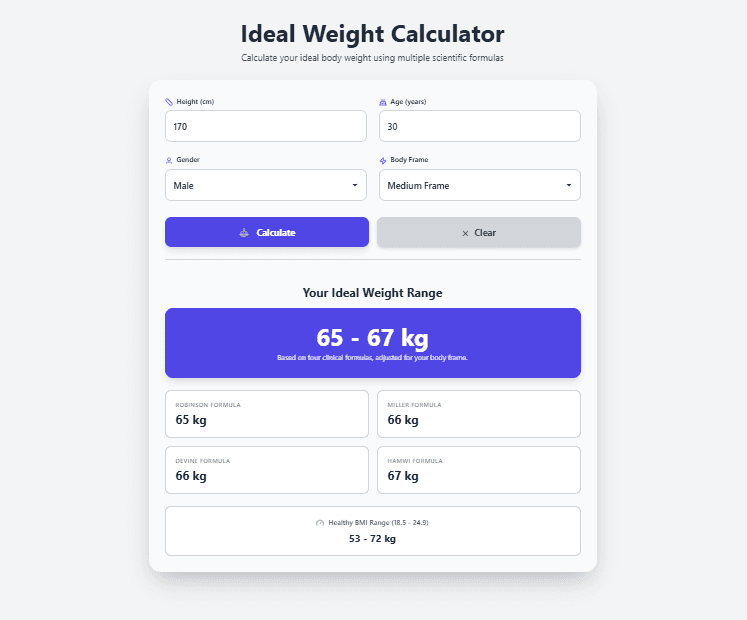
Setting Your Target Weight
Consider:
- Healthy BMI range
- Previous comfortable weight
- Body composition goals
- Sustainable maintenance
Our Ideal Weight Calculator can help determine healthy target.
Realistic Timelines
Example: 90 kg to 75 kg (15 kg loss)
- 0.25 kg/week: 60 weeks (~14 months)
- 0.5 kg/week: 30 weeks (~7 months)
- 0.75 kg/week: 20 weeks (~5 months)
- 1 kg/week: 15 weeks (~3.5 months)
Faster isn't always better—sustainability matters.
Timeline Adjustments
Expect to adjust:
- As you get lighter, loss may slow
- Life events may require maintenance breaks
- Plateaus will happen
- Goals may change
Flexible mindset prevents frustration.
Celebrating Milestones
Set mini-goals:
- Every 5 kg lost
- Every month consistent
- Clothing size changes
- Fitness improvements
Reward with non-food treats:
- New workout clothes
- Massage
- Experience
- Self-care day
1️⃣1️⃣ Common Calculation Mistakes to Avoid
Mistake 1: Overestimating Activity
Reality check: Most people are less active than they think.
Solution: Choose conservative level, adjust if losing too fast.
Mistake 2: Not Tracking Accurately
Common errors:
- Eyeballing portions
- Forgetting cooking oils
- Not tracking snacks
- Missing beverages
Solution: Weigh and measure everything for at least 2 weeks.
Mistake 3: Ignoring Non-Scale Factors
What matters besides weight:
- Measurements
- Body fat percentage
- Energy levels
- Sleep quality
- Exercise performance
Solution: Track multiple metrics.
Mistake 4: Being Too Rigid
Problem: No flexibility for life events.
Solution: Weekly calorie budgeting, planned higher days.
Mistake 5: Not Adjusting
As you lose weight:
- Your BMR decreases
- Your TDEE decreases
- Same calories = smaller deficit
Solution: Recalculate every 4-6 kg lost.
Mistake 6: Chasing Perfection
One bad day doesn't ruin progress.
Solution: Focus on weekly averages and consistency.
Mistake 7: Ignoring Hunger Signals
Extreme hunger indicates too large deficit.
Solution: Adjust deficit size, focus on satiating foods.
1️⃣2️⃣ Adjusting Your Deficit Over Time
When to Adjust
Signs you need adjustment:
- Weight loss stops for 2+ weeks
- Energy levels consistently low
- Excessive hunger
- Poor recovery from exercise
- Mood changes
How to Adjust
Option 1: Decrease calories further
- Small decrease (100-200 calories)
- Monitor for 2 weeks
- Not recommended below minimums
Option 2: Increase activity
- Add steps
- Add workout days
- Increase intensity
- Add NEAT
Option 3: Diet break
- 1-2 weeks at maintenance
- Psychological and metabolic reset
- Then return to deficit
Option 4: Reverse diet
- Slowly increase calories
- Find new maintenance
- Stay there for 4-8 weeks
- Then new deficit phase
The Metabolic Adaptation Cycle
Typical pattern:
- Initial good progress
- Slowdown after 4-8 weeks
- Plateau
- Adjustment needed
- Progress resumes
This is normal—expect and plan for it.
Recalculating with New Weight
Every 4-6 kg lost:
- Enter new weight in calculator
- Keep other inputs same
- Get new targets
- Adjust intake accordingly
Smaller body = lower calorie needs.
1️⃣3️⃣ Nutrition Quality Over Quantity
Calories Matter, But So Does Quality
1,200 calories of junk vs. whole foods:
- Same weight loss potential
- Very different health outcomes
- Different hunger levels
- Different nutrient status
The Satiety Factor
Foods that fill you up:
- High protein
- High fiber
- High water content
- Whole, unprocessed
Foods that leave you hungry:
- Processed carbs
- Sugary foods
- Low fiber
- Liquid calories
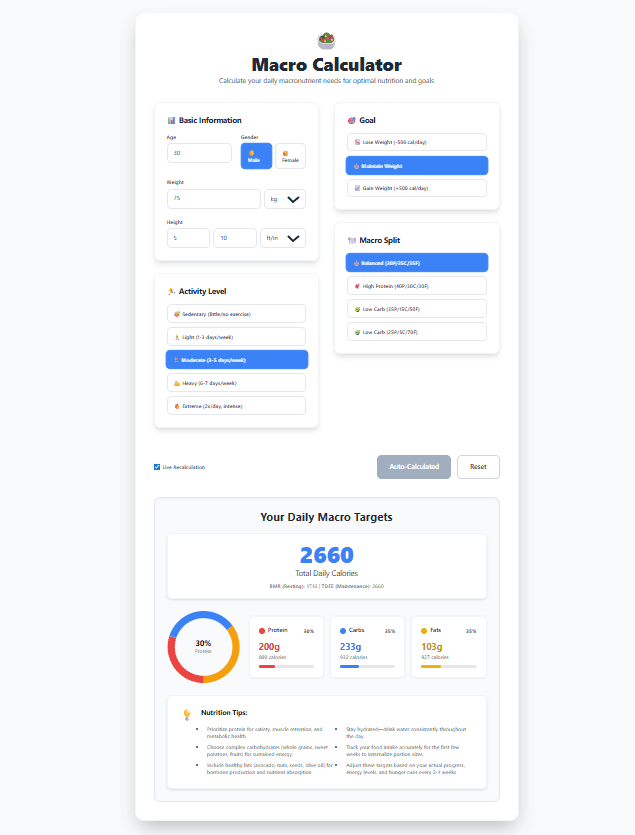
Macronutrient Balance
General recommendations for weight loss:
- Protein: 1.6-2.2 g/kg of body weight
- Fat: 20-35% of calories
- Carbs: Remainder of calories
Adjust based on:
- Activity level
- Personal preference
- Energy needs
- Hunger management
Protein Priority
Why protein matters:
- Preserves muscle during deficit
- Increases satiety
- Higher thermic effect
- Supports recovery
Good sources:
- Lean meats
- Fish
- Eggs
- Dairy
- Legumes
- Protein supplements if needed
Micronutrients Matter
Deficits can lead to deficiencies.
Focus on nutrient density:
- Vegetables (all colors)
- Fruits
- Whole grains
- Nuts and seeds
- Quality proteins
Consider supplements if:
- Very low calorie
- Restricted diet
- Medical conditions
- Blood tests show deficiencies
1️⃣4️⃣ Exercise's Role in Your Deficit
How Exercise Helps
Creates larger deficit without eating less Preserves muscle mass Improves metabolic health Enhances mood and energy Supports long-term maintenance
Exercise vs. Diet for Deficit
Diet is primary for weight loss Exercise is primary for health and maintenance Best approach: Combination
Types of Exercise for Weight Loss
Cardio:
- Burns calories during activity
- Good for heart health
- Can be high or low intensity
Strength Training:
- Builds/preserves muscle
- Increases resting metabolism
- Improves body composition
- Essential for long-term success
NEAT (Non-Exercise Activity):
- Daily movement
- Often overlooked
- Significant calorie burn
- Easy to increase
Exercise Calories: To Eat Back or Not?
General advice: Don't eat back all exercise calories.
Reasons:
- Trackers often overestimate burn
- Eating them back reduces deficit
- Can lead to slower progress
Exception: Very high activity days, athletes
Avoiding Exercise Compensation
People often:
- Move less after exercise
- Eat more "because they exercised"
- Overestimate burn
Solution:
- Track NEAT
- Don't use exercise as food justification
- Focus on consistent activity
1️⃣5️⃣ Plateaus and How to Break Them
What Is a Plateau?
Definition: No scale movement for 2+ weeks despite consistent deficit.
Remember: Weight loss isn't linear.
Common Causes
Water retention:
- Increased sodium
- Carbohydrate intake
- Hormonal cycles
- New exercise
- Stress
- Sleep changes
Muscle gain offsetting fat loss Metabolic adaptation Unconscious eating changes Inaccurate tracking
Is It Really a Plateau?
Check other metrics:
- Measurements
- Photos
- Clothing fit
- Body composition
- Energy levels
You may be losing fat even if scale isn't moving.
Breaking Through
Step 1: Verify consistency
- Food tracking accuracy
- Portion sizes
- Hidden calories
- Liquid calories
Step 2: Recalculate
- New weight = new calorie needs
- Use updated numbers
Step 3: Adjust intake
- Small decrease (100-200 calories)
- Or increase activity
Step 4: Change something
- Macronutrient ratios
- Meal timing
- Food choices
- Exercise routine
Step 5: Diet break
- 1-2 weeks at maintenance
- Psychological break
- Metabolic reset
When to Seek Help
Consider professional help if:
- Multiple plateaus despite adjustments
- Suspected medical issues
- Disordered eating patterns
- Significant metabolic damage from past dieting
1️⃣6️⃣ Maintenance: The End Goal
The Real Challenge
Most people regain weight after dieting.
Why:
- Return to old habits
- No maintenance plan
- Metabolic adaptation
- Psychological factors
Finding Your Maintenance Calories
As you approach goal weight:
- Gradually reduce deficit
- Increase calories slowly
- Find new maintenance
- Monitor weight for 4 weeks
New maintenance will be lower than original due to:
- Smaller body
- Metabolic adaptation
- Possible muscle loss
The Maintenance Range
Instead of single weight:
- Acceptable range (e.g., 3-5 lb)
- Action boundaries
- Less stress
- More flexibility
Maintenance Strategies
Successful maintainers:
- Continue tracking (less frequently)
- Regular weigh-ins
- Consistent exercise
- Mindful eating habits
- Quick correction of small gains
Reverse Dieting
Process of gradually increasing calories after deficit.
Benefits:
- Minimizes fat regain
- Helps find true maintenance
- Metabolic recovery
- Psychological transition
How to:
- Increase 50-100 calories/week
- Monitor weight response
- Stop when weight stabilizes
- That's your new maintenance
Lifelong Habits
Maintenance requires:
- Permanent lifestyle changes
- Regular monitoring
- Flexibility
- Self-compassion
It's a marathon, not a sprint.
1️⃣7️⃣ Special Considerations
Medical Conditions
Conditions affecting weight loss:
- Thyroid disorders
- PCOS
- Diabetes
- Medications
- Hormonal imbalances
Always consult healthcare provider.
Age Considerations
Older adults:
- Lower calorie needs
- Higher protein needs
- Importance of strength training
- Slower loss expected
- Focus on function
Athletes and Very Active
Different needs:
- Higher calorie requirements
- Importance of timing
- Performance considerations
- May need smaller deficit
- Professional guidance recommended
Previous Dieting History
Metabolic damage possible from:
- Extreme deficits
- Yo-yo dieting
- Chronic dieting
- Eating disorders
May need:
- Smaller deficit
- Diet breaks
- Reverse dieting
- Professional support
Psychological Factors
Weight loss is mental:
- Motivation fluctuations
- Body image issues
- Emotional eating
- All-or-nothing thinking
Consider:
- Counseling
- Support groups
- Mindfulness practices
- Self-compassion
1️⃣8️⃣ Tools for Tracking Success
Essential Tools
Food scale: Most important tool Measuring tape: For circumference Progress photos: Visual evidence Journal/app: For tracking Smart scale: Optional (body composition)
Tracking Apps
Calorie tracking:
- Solvezi Nutrition Tracker
- Cronometer
- Lose It!
- MyFitnessPal
Exercise tracking:
- Fitbit
- Apple Health
- Strava
- Google Fit
Weight tracking:
- Happy Scale (iOS)
- Libra (Android)
- Trendweight.com
What to Track
Essential:
- Daily calories
- Weekly weight average
- Monthly measurements
Optional but helpful:
- Macronutrients
- Steps/activity
- Sleep
- Energy levels
- Hunger
- Mood
How Often to Track
Food: Daily during deficit Weight: Weekly (daily can be misleading) Measurements: Monthly Photos: Every 4-8 weeks
Avoiding Obsession
Healthy tracking:
- Tool for awareness
- Not for perfection
- Allows adjustments
- Provides data
Unhealthy tracking:
- Source of anxiety
- All-consuming
- Leads to disordered patterns
- Ruins quality of life
Find balance that works for you.
❓ Frequently Asked Questions
Q: How accurate is this calorie deficit calculator? A: Our calculator uses the scientifically validated Mifflin-St Jeor equation for BMR, which is the most accurate for most people. However, individual metabolism can vary by ±10-15%. Use the calculated numbers as a starting point and adjust based on your actual results over 2-4 weeks.
Q: Can I lose weight without counting calories? A: Yes, some people succeed with portion control, intuitive eating, or specific diet approaches. However, research shows that people who track their intake lose more weight and keep it off better. Calorie counting provides concrete data and removes guesswork.
Q: What if I'm not losing weight on my calculated calories? A: First, ensure you're tracking accurately for at least 2 weeks. If still not losing: 1) You may have overestimated your activity level, 2) Your metabolism may be slower than average, 3) You may have medical issues affecting weight loss. Try reducing calories by 100-200 or increasing activity, and consider consulting a healthcare provider.
Q: Is it safe to eat below 1200 (women) or 1500 (men) calories? A: Generally not without medical supervision. Very low calorie diets can cause nutrient deficiencies, muscle loss, gallstones, and metabolic damage. Our calculator will warn you if your target is very low. If you need to go lower for medical reasons, work with a healthcare professional.
Q: How do I account for exercise calories? A: We recommend NOT eating back all your exercise calories, as trackers often overestimate burn. Instead, select your activity level based on your regular exercise routine. If you have an unusually active day, you might add 100-200 calories, but don't feel you must "earn" food through exercise.
Q: Why has my weight loss slowed down after the first few weeks? A: Initial rapid loss is often water weight. As you continue, you'll lose more fat and less water. Also, as you lose weight, your BMR decreases, so the same calorie intake creates a smaller deficit. Recalculate your needs every 4-6 kg lost.
Q: Can I build muscle while in a calorie deficit? A: Beginners or those returning to exercise after a break can build some muscle while losing fat, especially with adequate protein and strength training. However, experienced lifters will find it difficult to build significant muscle in a deficit. For maximum muscle preservation/gain with fat loss, aim for a small deficit (0.25-0.5% body weight per week) and prioritize protein and strength training.
Q: How do I maintain my weight after reaching my goal? A: Gradually increase calories by 100-200 per week until your weight stabilizes. This is your new maintenance. Continue tracking (less frequently), maintain exercise habits, weigh yourself weekly, and have a plan for when weight creeps up (small deficit until back in range).
Q: What's the difference between BMR and TDEE? A: BMR (Basal Metabolic Rate) is the calories you burn at complete rest for basic bodily functions. TDEE (Total Daily Energy Expenditure) is your BMR plus all activity calories (exercise, daily movement, digesting food). TDEE is what matters for weight management.
Q: Why does the calculator ask for gender? A: Men and women have different body compositions, hormone profiles, and metabolic rates. The BMR equations account for these differences to provide more accurate calculations.
🚀 Your Calorie Deficit Action Plan
Week 1-2: Foundation
- Calculate your deficit using our calculator
- Start tracking food intake accurately
- Weigh and measure everything for at least 2 weeks
- Establish baseline weight and measurements
Month 1: Implementation
- Follow your calorie target consistently
- Add strength training 2-3 times per week
- Increase daily movement (aim for 7,000+ steps)
- Weekly weigh-in and tracking
Month 2-3: Adjustment
- Evaluate progress after 4 weeks
- Adjust calories if needed
- Refine nutrition for satiety and health
- Establish routines that work for your lifestyle
Month 4-6: Solidification
- Recalculate needs with new weight
- Focus on consistency over perfection
- Incorporate flexibility for social events
- Celebrate non-scale victories
Maintenance Transition
- Gradually increase calories as you approach goal
- Find your maintenance range
- Develop lifelong habits
- Regular monitoring with less frequency
Tools You'll Need
- Calorie Deficit Calculator - Your personalized guide
- Food scale - For accurate tracking
- Tracking app - For consistency
- Measuring tape - For progress beyond scale
- Support system - Friends, family, or community
⚖️ Ready to Start Your Journey?
You now understand:
- How calorie deficits work
- How to calculate your personalized needs
- How to track and adjust your progress
- Strategies for long-term success
Take the first step today:
- Calculate your deficit now
- Commit to tracking for 2 weeks
- Set one small habit to start this week
- Check in weekly with your progress
Remember: Sustainable weight loss isn't about perfection—it's about consistency, flexibility, and finding what works for YOUR body and YOUR life.
Here's to your health journey! 🏆
Disclaimer: This calculator provides estimates for educational purposes. It is not a substitute for professional medical advice, diagnosis, or treatment. Individual calorie needs vary based on health conditions, medications, body composition, and other factors. Always consult with a healthcare provider before starting any weight loss program, especially if you have underlying health conditions or are taking medications.