The Complete Step Calorie Estimator Guide: From Steps to Calories Burned
Introduction: Why Counting Steps Isn't Enough
You've hit your 10,000 steps goal—but do you know what that actually means for your health and fitness? While step counting has become ubiquitous with fitness tracking, understanding the energy expenditure behind those steps is what truly matters for weight management, fitness progress, and goal setting.
This comprehensive guide will teach you:
- The science behind converting steps to calories
- How your body composition affects calorie burn
- Why walking speed and terrain matter
- How to accurately calculate your walking calories
- Strategies to maximize calorie burn from walking
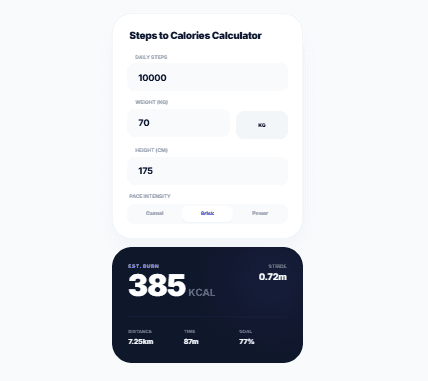
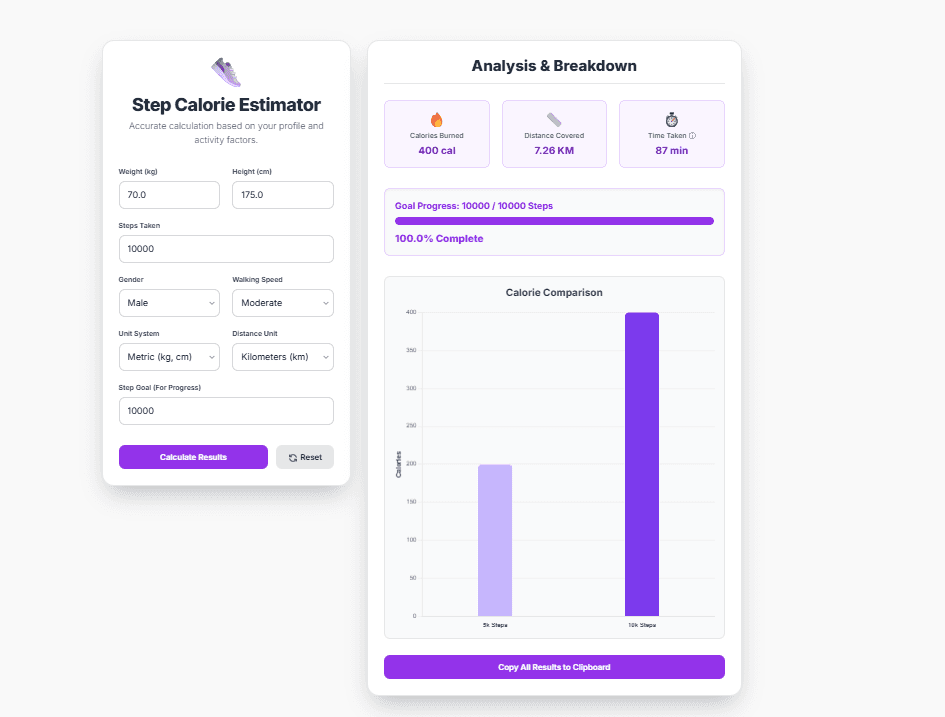
Ready to calculate your walking calories? Use our Step Calorie Estimator for personalized calculations based on your specific stats and walking patterns.
📖 Table of Contents
- The Science of Walking Calorie Burn
- Factors That Affect Calorie Burn Per Step
- How Our Step Calorie Estimator Works
- Weight: The Most Important Factor
- Height and Stride Length Calculations
- Walking Speed: Slow, Moderate, or Fast
- Gender Differences in Calorie Burn
- Terrain and Elevation Considerations
- Calculating Distance from Steps
- Estimating Time Spent Walking
- Setting and Tracking Step Goals
- Accuracy of Fitness Trackers vs. Calculations
- Walking for Weight Loss: Practical Strategies
- Comparing Walking to Other Exercises
- Special Populations and Considerations
- Optimizing Your Walking Workouts
- Common Mistakes in Step Calorie Estimation
- FAQs: Your Step Calorie Questions Answered
1️⃣ The Science of Walking Calorie Burn
Energy Expenditure Basics
Calories burned during walking come from:
- Basal Metabolic Rate (BMR): Energy for basic bodily functions
- Thermic Effect of Food (TEF): Energy to digest food
- Physical Activity Energy Expenditure (PAEE): Energy for movement
Walking primarily increases PAEE, which accounts for 15-30% of total daily energy expenditure for most people.
Metabolic Equivalents (METs)
METs measure exercise intensity relative to resting metabolism:
- 1 MET: Resting energy expenditure
- 2.5 METs: Slow walking (2.0 mph/3.2 kmh)
- 3.5 METs: Moderate walking (3.0 mph/4.8 kmh)
- 5.0 METs: Brisk walking (4.0 mph/6.4 kmh)
Calorie Formula using METs:
Calories = METs × Weight in kg × Time in hours
The Step-Based Approach
While MET-based calculations use time, our calculator uses steps because:
- Most people track steps, not walking time
- Steps account for natural pace variations
- It aligns with common fitness tracker metrics
2️⃣ Factors That Affect Calorie Burn Per Step
Primary Factors (Our Calculator Accounts For)
- Body Weight: Heavier individuals burn more calories
- Height: Affects stride length and distance covered
- Walking Speed: Faster walking burns more calories per step
- Gender: Biological differences in metabolism and body composition
- Step Count: More steps = more calories burned
Secondary Factors (Consider in Your Planning)
- Age: Metabolism slows slightly with age
- Fitness Level: Fit individuals may be more efficient
- Body Composition: Muscle burns more calories than fat at rest
- Terrain: Hills increase calorie burn
- Carrying Weight: Backpacks or weight vests increase burn
- Climate: Extreme temperatures increase energy expenditure
The Weight-Distance Relationship
Calories burned walking are primarily determined by:
- Weight moved (your body mass)
- Distance traveled (calculated from steps × stride length)
- Speed/efficiency (energy cost per unit distance)
This is why our calculator focuses on these key variables.
3️⃣ How Our Step Calorie Estimator Works
Calculation Formula
Our calculator uses a refined step-to-calorie formula:
Calories = Steps × Base Factor × (Weight in kg / 70) × Gender Factor × Speed Factor
Where:
- Base Factor: 0.04 calories per step (average)
- Weight Adjustment: Normalized to 70kg reference
- Gender Factor: 0.95 for women, 1.0 for men
- Speed Factor: 0.85 (slow), 1.0 (moderate), 1.2 (fast)
Stride Length Calculation
For accurate distance calculation:
Stride Length (m) = Height (cm) × Gender Coefficient / 100
Gender Coefficient: 0.415 (men), 0.413 (women)
Distance (km) = (Steps × Stride Length) / 1000
Time Estimation
Based on average walking speed:
Time (minutes) = (Distance in km / Speed in kmh) × 60
Speed: 4.25 kmh (slow), 5.0 kmh (moderate), 6.0 kmh (fast)
Input Requirements
Minimum values for accurate calculation:
- Steps: ≥100 steps
- Weight: ≥10kg (22 lbs)
- Height: ≥50cm (20 inches)
These ensure physiologically plausible calculations.
4️⃣ Weight: The Most Important Factor
Why Weight Matters Most
Calories burned during weight-bearing exercise like walking are directly proportional to body weight:
- Simple physics: Moving more mass requires more energy
- Approximate rule: Each pound moved burns ~0.03 calories per step
- Practical implication: Weight loss reduces calorie burn per step
Weight-Based Examples
| Weight | Calories per 10,000 Steps |
|---|---|
| 55 kg (121 lbs) | ~320 calories |
| 70 kg (154 lbs) | ~400 calories |
| 85 kg (187 lbs) | ~480 calories |
| 100 kg (220 lbs) | ~560 calories |
Based on moderate walking pace, average height
The Weight Loss Paradox
As you lose weight:
- Calorie burn per step decreases (good for sustainability)
- Walking becomes easier (can walk further/faster)
- Net effect: May need to increase steps to maintain same calorie deficit
Adjusting for Weight Changes
Recalculate your step calorie estimates every:
- 5 kg (11 lbs) of weight change
- Monthly if actively losing/gaining weight
- When plateauing in weight loss journey
5️⃣ Height and Stride Length Calculations
Stride Length Basics
Stride length is the distance from heel strike of one foot to next heel strike of the same foot.
Average stride lengths:
- Men: 0.415 × height in cm
- Women: 0.413 × height in cm
Height Examples
| Height | Stride Length | Steps per km |
|---|---|---|
| 160 cm (5'3") | ~66 cm | ~1,515 steps/km |
| 175 cm (5'9") | ~73 cm | ~1,370 steps/km |
| 190 cm (6'3") | ~79 cm | ~1,265 steps/km |
Why Stride Length Matters
- Distance accuracy: Taller people cover more distance per step
- Calorie implications: More distance = more calories burned
- Goal setting: Step goals should consider natural stride length
Measuring Your Actual Stride Length
Simple method:
- Walk 10 normal steps
- Measure total distance
- Divide by 10
- Use this in distance calculations if different from formula
Advanced method:
- Use GPS tracking on fitness apps
- Compare step count to measured distance
- Calculate average over multiple walks
6️⃣ Walking Speed: Slow, Moderate, or Fast
Speed Categories
Our calculator uses three speed categories:
Slow Walking (0.85× factor):
- Pace: 2.5-3.0 mph (4-4.8 kmh)
- Characteristics: Leisurely, conversational pace
- METs: ~2.5-3.0
- Best for: Recovery, joint issues, beginners
Moderate Walking (1.0× factor):
- Pace: 3.0-3.5 mph (4.8-5.6 kmh)
- Characteristics: Purposeful, steady pace
- METs: ~3.5-4.0
- Best for: Daily activity, weight maintenance
Fast Walking (1.2× factor):
- Pace: 3.5-4.5+ mph (5.6-7.2+ kmh)
- Characteristics: Brisk, elevated heart rate
- METs: ~4.5-5.0+
- Best for: Fitness improvement, weight loss
Calorie Burn Comparison
For 70kg person, 10,000 steps:
- Slow: ~340 calories
- Moderate: ~400 calories
- Fast: ~480 calories
That's a 40% difference between slow and fast!
Finding Your Natural Pace
Most people naturally walk at a pace that minimizes energy cost per distance—this is your "optimal" walking speed. For calorie burning, aim to exceed this comfortable pace.
7️⃣ Gender Differences in Calorie Burn
Biological Factors
Why women typically burn slightly fewer calories:
- Body composition: Higher fat percentage, lower muscle mass
- Smaller size: On average, women are smaller
- Metabolic rate: Slightly lower BMR per kg of weight
- Stride mechanics: Slightly different gait patterns
Calculator Adjustment
Our calculator applies a 0.95× factor for women (5% reduction) based on:
- Research on walking economy
- Average body composition differences
- Metabolic rate studies
Important Nuances
These averages don't apply to everyone:
- A muscular, tall woman may burn more than a sedentary, short man
- Individual variation exceeds gender averages
- Fitness level matters more than gender for calorie burn efficiency
Practical Implications
Women may need to:
- Walk slightly more steps for same calorie burn
- Focus on intensity to increase calorie expenditure
- Consider strength training to increase muscle mass and metabolism
8️⃣ Terrain and Elevation Considerations
Flat vs. Hilly Terrain
Calorie burn increases significantly with hills:
- 5% grade: ~50% more calories than flat
- 10% grade: ~100% more calories than flat
- 15% grade: ~150% more calories than flat
Adjusting Calculator Results
For hilly walks, multiply results by:
- Slight hills: 1.1-1.3×
- Moderate hills: 1.3-1.6×
- Steep hills: 1.6-2.0×
Stair Climbing
Even more calorie-intensive:
- ~2× calories of flat walking
- Excellent for fitness and calorie burn
- Counts as steps but burns more per step
Surface Type Effects
Calorie burn increases on:
- Sand: +50-100%
- Snow: +30-60%
- Uneven trails: +20-40%
- Treadmill with incline: Adjustable
Incorporating Terrain in Your Planning
- Track elevation gain using fitness apps
- Add hill sessions 2-3 times weekly
- Choose varied routes to challenge different muscles
- Listen to your body—hills increase injury risk if unprepared
9️⃣ Calculating Distance from Steps
The Step-to-Distance Formula
Basic calculation:
Distance = Steps × Your Stride Length
Using our calculator's formula:
Distance (km) = (Steps × Height in cm × Gender Coefficient) / 100,000
Accuracy Considerations
Sources of error in distance calculation:
- Variable stride length: Changes with speed, fatigue, terrain
- GPS inaccuracies: Especially in urban areas
- Pedometer errors: Miscounting steps
- Individual biomechanics: Unique walking patterns
Improving Distance Accuracy
- Calibrate your device: Walk known distance, adjust settings
- Use multiple sources: Compare pedometer, GPS, and manual count
- Know your averages: Track over time for personal baseline
- Consider purpose: Fitness tracking vs. precise measurement
Common Distance Benchmarks
| Steps | Approx. Distance (Average Height) |
|---|---|
| 2,000 steps | ~1.6 km (1 mile) |
| 5,000 steps | ~4 km (2.5 miles) |
| 10,000 steps | ~8 km (5 miles) |
| 15,000 steps | ~12 km (7.5 miles) |
| 20,000 steps | ~16 km (10 miles) |
🔟 Estimating Time Spent Walking
Time Calculation Method
Our calculator estimates time based on:
Time (minutes) = (Distance in km / Walking Speed in kmh) × 60
Default speeds:
- Slow: 4.25 kmh (2.6 mph)
- Moderate: 5.0 kmh (3.1 mph)
- Fast: 6.0 kmh (3.7 mph)
Real-World Time Examples
For 10,000 steps (~8 km at average stride):
- Slow pace: ~113 minutes (1 hour 53 minutes)
- Moderate pace: ~96 minutes (1 hour 36 minutes)
- Fast pace: ~80 minutes (1 hour 20 minutes)
Accounting for Non-Walking Time
Typical daily step accumulation includes:
- Pure walking: 20-40% of steps
- Daily activity: 60-80% of steps
- Non-step movement: Not counted but burns calories
Time Management for Step Goals
To reach 10,000 steps daily:
- Morning walk: 3,000 steps (30 minutes)
- Lunch walk: 2,000 steps (20 minutes)
- Evening walk: 3,000 steps (30 minutes)
- Daily activity: 2,000 steps (throughout day)
Total dedicated walking time: ~80 minutes
1️⃣1️⃣ Setting and Tracking Step Goals
The 10,000-Step Myth
Origins: Japanese pedometer marketing in 1960s Reality: Not evidence-based for all populations Better approach: Personalized step goals based on:
- Current activity level
- Health status
- Age and fitness
- Weight management goals
Personalized Goal Setting
Step 1: Establish baseline
- Track steps for 1 week without changing behavior
- Calculate daily average
Step 2: Set incremental goals
- Sedentary (<3,000 steps): Add 500 steps weekly
- Somewhat active (3,000-7,000): Add 1,000 steps weekly
- Active (7,000-10,000): Add 1,500 steps weekly
- Very active (>10,000): Maintain or focus on intensity
Step 3: Adjust based on progress
- Increase if goals become easy
- Maintain if sustainable
- Decrease if causing injury or burnout
Using Our Calculator's Goal Feature
- Enter your current steps
- Set a realistic goal
- Track progress percentage
- Adjust goal as you improve
Beyond Step Count: Quality Goals
Consider adding:
- Intensity minutes: Brisk walking time
- Continuous walks: Minimum 10-minute sessions
- Weekly distance goals
- Elevation gain targets
1️⃣2️⃣ Accuracy of Fitness Trackers vs. Calculations
How Fitness Trackers Estimate Calories
Common methods:
- Step count × average calorie/step (simplest)
- Heart rate + motion data (more accurate)
- Machine learning algorithms (most advanced)
Sources of error:
- Individual variability: Not accounted for in basic models
- Sensor limitations: Especially optical heart rate
- Algorithm assumptions: Based on population averages
- Device placement: Wrist vs. hip vs. ankle
Our Calculator vs. Fitness Trackers
Our calculator advantages:
- Personalized inputs: Your exact weight, height, speed
- Transparent formula: Know exactly how calculated
- Adjustable factors: Customize for your situation
- Educational: Understand what affects calorie burn
Fitness tracker advantages:
- Continuous tracking: 24/7 monitoring
- Heart rate integration: Real-time intensity measurement
- Convenience: Automatic tracking
- Trend analysis: Long-term patterns
Recommended Approach
Use both for best results:
- Calculate baseline with our tool using accurate inputs
- Compare to tracker estimates for consistency
- Adjust tracker settings if significantly different
- Use tracker for daily trends, calculator for planning
Calibration Tips
- Walk known distance with tracker, adjust stride length
- Compare calorie estimates for same activity across devices
- Use heart rate chest strap for most accurate calorie burn
- Track manually occasionally to verify automatic tracking
1️⃣3️⃣ Walking for Weight Loss: Practical Strategies
Calorie Deficit Basics
Weight loss requires:
Calories Burned > Calories Consumed
Walking contributes by:
- Increasing daily calorie expenditure
- Preserving muscle during weight loss
- Improving metabolic health
- Reducing appetite for some people
Step Targets for Weight Loss
Based on research:
- Maintenance: 7,000-10,000 steps/day
- Moderate weight loss: 10,000-12,000 steps/day
- Significant weight loss: 12,000-15,000+ steps/day
Combine with dietary changes for best results.
Creating a Step-Based Weight Loss Plan
Week 1-2: Foundation
- Establish baseline steps
- Add 500 steps daily
- Focus on consistency
Week 3-4: Building
- Reach 8,000+ steps daily
- Add one longer walk weekly
- Incorporate hills or speed intervals
Week 5-8: Optimization
- Maintain 10,000+ steps daily
- Increase intensity 2-3 days weekly
- Add resistance training 2× weekly
Plateaus and Adjustments
If weight loss stalls:
- Increase steps by 1,000-2,000 daily
- Increase intensity of some walks
- Add variety: hills, stairs, trails
- Review nutrition: Ensure calorie deficit maintained
Sustainability Focus
Avoid burnout by:
- Varying routes and scenery
- Walking with friends or podcasts
- Setting process goals (consistency) not just outcome goals (weight)
- Celebrating non-scale victories (energy, mood, fitness)
1️⃣4️⃣ Comparing Walking to Other Exercises
Calorie Burn Per Minute Comparison
| Activity | Calories per 30 min (70kg person) |
|---|---|
| Slow walking | ~105 calories |
| Moderate walking | ~140 calories |
| Fast walking | ~175 calories |
| Running (10 min/mile) | ~300 calories |
| Cycling (moderate) | ~210 calories |
| Swimming (moderate) | ~180 calories |
| Weight training | ~105 calories |
Advantages of Walking
- Accessibility: No equipment or gym needed
- Low injury risk: Gentle on joints
- Sustainability: Easier to maintain long-term
- Multi-tasking possible: Commuting, socializing
- All fitness levels: Adjustable intensity
When to Consider Other Activities
Add other exercises when:
- You need more calorie burn in less time
- You want to build significant muscle
- You're bored with walking
- You have specific fitness goals beyond weight management
Creating a Balanced Routine
Ideal weekly mix for general health:
- Walking: 150+ minutes moderate or 75+ minutes vigorous
- Strength training: 2+ sessions weekly
- Flexibility/mobility: Daily stretching
- Rest/recovery: 1-2 days lighter activity
Walking can be your primary cardio component.
1️⃣5️⃣ Special Populations and Considerations
Older Adults
Adjustments needed:
- Shorter stride length: Age-related changes
- Slower pace: Natural speed reduction
- Balance concerns: May need walking aids
- Joint issues: Softer surfaces recommended
Benefits:
- Maintains mobility and independence
- Reduces fall risk with improved balance
- Supports cognitive health
- Manages chronic conditions
Pregnancy
Safe walking guidelines:
- First trimester: Generally no restrictions
- Second trimester: May need pace/surface adjustments
- Third trimester: Shorter, more frequent walks
- Always: Consult healthcare provider
Benefits:
- Manages healthy weight gain
- Reduces pregnancy discomfort
- May ease labor and delivery
- Improves mood and energy
Rehabilitation and Injury Recovery
Walking as therapy:
- Post-surgery: Gradual return to walking
- Joint issues: Low-impact option
- Chronic pain: Pain-contingent pacing
- Cardiac rehab: Monitored walking programs
Always follow medical guidance for specific conditions.
Children and Adolescents
Age-appropriate expectations:
- Young children: Naturally active, focus on play
- School-age: 60+ minutes daily activity
- Teens: May need motivation for structured walking
Family walking can build healthy habits.
1️⃣6️⃣ Optimizing Your Walking Workouts
Intensity Strategies
1. Interval Walking
- 3 minutes moderate, 1 minute fast
- Repeat 5-8 times
- Increases calorie burn 20-30%
2. Hill Repeats
- Find moderate hill
- Walk up briskly, recover down
- Start with 3-4 repeats
3. Speed Play (Fartlek)
- Vary speed spontaneously
- Use landmarks (walk fast to next tree)
- Makes workout more engaging
Form Improvements
Proper walking form increases efficiency and calorie burn:
- Posture: Stand tall, shoulders back
- Arm swing: Bend elbows 90°, swing naturally
- Stride: Natural length, avoid overstriding
- Foot strike: Heel to toe roll
- Cadence: Aim for 100+ steps/minute for brisk pace
Equipment Enhancements
1. Weighted vest:
- Increases calorie burn 5-15%
- Start with 5-10% body weight
- Maintains natural gait better than hand/ankle weights
2. Trekking poles:
- Engages upper body
- Increases calorie burn 20-45%
- Reduces joint impact
3. Appropriate footwear:
- Proper support prevents injury
- Allows longer, more comfortable walks
- Consider activity-specific shoes
Environmental Optimization
1. Route planning:
- Include varied terrain
- Consider safety and accessibility
- Plan for water/facilities if needed
2. Weather preparation:
- Layer clothing for temperature changes
- Protect from sun/rain
- Stay hydrated
3. Social elements:
- Walking groups for motivation
- Podcasts/audiobooks for entertainment
- Dog walking for consistency
1️⃣7️⃣ Common Mistakes in Step Calorie Estimation
Mistake 1: Assuming All Steps Are Equal
Reality:
- Shopping steps ≠ brisk walking steps
- 10,000 slow steps ≠ 10,000 fast steps
- Flat steps ≠ hilly steps
Solution: Track intensity separately or use our calculator's speed factor.
Mistake 2: Overestimating Calorie Burn
Common errors:
- Using "average" calorie/step that's too high
- Not accounting for fitness improvements (increased efficiency)
- Assuming calorie burn continues post-walk (EPOC is minimal for walking)
Solution: Use conservative estimates, focus on trends not exact numbers.
Mistake 3: Ignoring Non-Step Activity
Missing calories from:
- Strength training
- Cycling, swimming
- Daily non-step movement (standing, housework)
Solution: Track all activity, not just steps.
Mistake 4: Obsessive Step Counting
Problems:
- Anxiety about missing goals
- Compulsive behavior
- Ignoring how you feel for what tracker says
Solution: Use steps as guide, not master. Listen to your body.
Mistake 5: Not Adjusting for Weight Loss
As you lose weight:
- Calorie burn per step decreases
- Same step count burns fewer calories
- Need to increase steps or intensity
Solution: Recalculate regularly with current weight.
Mistake 6: Comparing to Others
Individual differences in:
- Metabolism
- Body composition
- Walking efficiency
- Fitness level
Solution: Compare to your own baseline, not others' numbers.
❓ Frequently Asked Questions
Q: How accurate is the step calorie calculator? A: Our calculator provides estimates within 10-20% of actual calorie burn for most people when inputs are accurate. It's more precise than generic "calories per step" estimates because it personalizes for weight, height, speed, and gender. For exact measurements, metabolic testing is needed.
Q: How many calories does 10,000 steps burn? A: For an average person (70kg/154lbs, moderate pace):
- Slow walking: ~340 calories
- Moderate walking: ~400 calories
- Fast walking: ~480 calories
Use our calculator with your specific stats for personalized results.
Q: Does walking speed affect calorie burn per step? A: Yes! Faster walking burns more calories per step because:
- Increased metabolic cost
- More muscle engagement
- Different biomechanics
Our calculator accounts for this with speed factors: 0.85× (slow), 1.0× (moderate), 1.2× (fast).
Q: Why do women burn fewer calories than men for the same steps? A: On average, women burn about 5% fewer calories due to:
- Different body composition (higher fat percentage)
- Smaller size on average
- Slightly different walking mechanics
- Metabolic rate differences
Our calculator applies a 0.95× factor for women to account for this average difference.
Q: How do I calculate my stride length? A: Simple method:
- Measure 10 normal walking steps distance
- Divide by 10
Or use our calculator's formula:
- Men: Height in cm × 0.415 / 100 = stride in meters
- Women: Height in cm × 0.413 / 100 = stride in meters
Q: Should I track steps or distance? A: Track both! Steps are easier for daily motivation, distance shows actual ground covered. Our calculator provides both metrics since they tell different stories about your activity.
Q: How many steps for weight loss? A: It depends on your current activity level:
- Sedentary start: Aim for 7,000-8,000 daily
- Already active: 10,000-12,000+ daily
- Combine with diet: Most important for weight loss
- Increase gradually: Add 500-1,000 steps weekly
Q: Do hills burn more calories? A: Significantly! A 10% grade burns about twice as many calories as flat walking. Our calculator assumes flat terrain—multiply results by 1.3-2.0 for hilly walks depending on steepness.
Q: How does age affect calorie burn from walking? A: Metabolism decreases about 1-2% per decade after 30, mainly due to muscle loss. Older adults may also walk slower with shorter strides. While our calculator doesn't have an age input, these factors would slightly reduce calorie burn for older individuals.
Q: Can I use this for running steps? A: No, running has different biomechanics and calorie burn. Our calculator is optimized for walking. Running typically burns about 1.8-2× more calories per distance covered compared to walking.
🚀 Start Tracking Your Walking Calories Today
Your Action Plan
Week 1: Baseline
- Use our calculator with your current stats
- Track steps for 7 days without changes
- Note your average daily calorie burn
Week 2-4: Implementation
- Set a realistic step goal
- Use calculator to plan walking sessions
- Track progress with our goal feature
Month 2-3: Optimization
- Adjust goals based on progress
- Experiment with intensity variations
- Incorporate hills or intervals
Month 4+: Maintenance
- Establish sustainable routine
- Use calculator for periodic check-ins
- Adjust for weight changes or new goals
Tools for Success
- Step Calorie Estimator: Your personalized calculator
- Step tracker: Phone app or wearable device
- Walking journal: Note routes, how you feel
- Community: Walking groups or online challenges
- Professional guidance: If you have health concerns
Key Principles to Remember
- Consistency beats perfection – Regular walking matters more than exact calorie counts
- Progress, not perfection – Small increases add up over time
- Listen to your body – Rest when needed, push when able
- Enjoy the journey – Walking should be sustainable and enjoyable
- Use data as guide, not master – Numbers inform decisions but don't define success
👣 Ready to Step into Better Health?
You now understand:
- How steps convert to calories burned
- What factors affect your personal calorie burn
- How to set realistic walking goals
- Strategies to maximize walking benefits
Take your first step today:
- Calculate your walking calories now
- Set one small walking goal for this week
- Track your progress for 7 days
- Adjust based on what you learn
Remember: Every step counts toward better health. Whether you're walking for weight loss, fitness, stress relief, or just enjoying the outdoors, understanding the energy behind your steps empowers you to make the most of your walking routine.
Happy walking! 🚶♀️🚶♂️
Disclaimer: This calculator provides estimates for educational purposes. It is not a substitute for professional medical advice, diagnosis, or treatment. Individual results may vary. Consult with a healthcare provider before beginning any new exercise program, especially if you have health concerns or conditions.