Final Velocity Calculator – Calculate v = u + at and v² = u² + 2as
Final velocity is the velocity of an object at the end of a period of motion. It is one of the most common quantities in introductory physics, and it appears in two of the four kinematic equations: v = u + at (when you know time) and v² = u² + 2as (when you know distance).
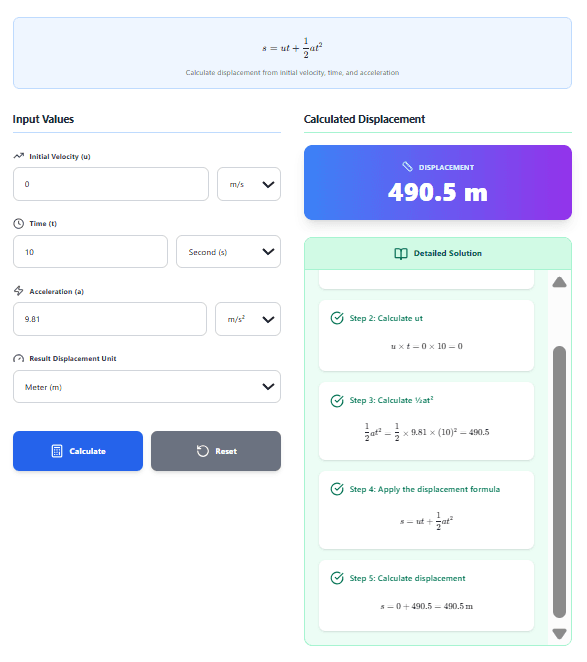
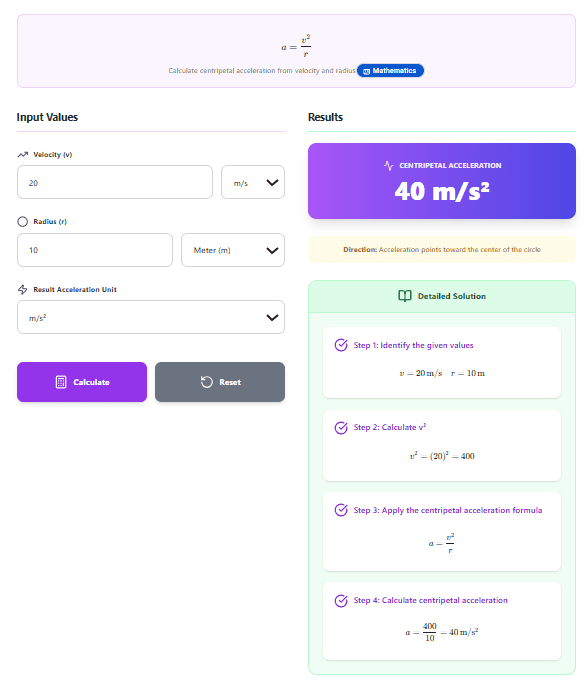
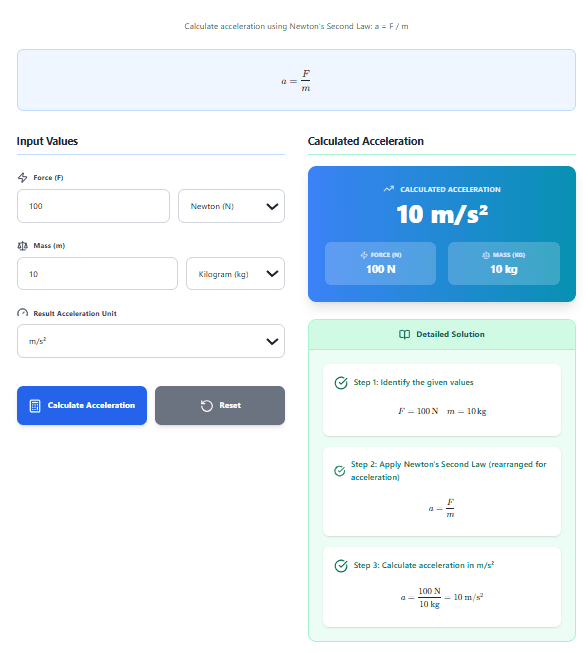
This calculator handles both forms, with automatic unit conversions and step-by-step solutions.
Quick access: Use our free final velocity calculator here
What Does This Calculator Do?
This tool calculates final velocity using one of two kinematic equations, depending on what you know.
Two calculation modes:
From Time (v = u + at) – Find final velocity from initial velocity, acceleration, and time
From Distance (v² = u² + 2as) – Find final velocity from initial velocity, acceleration, and distance
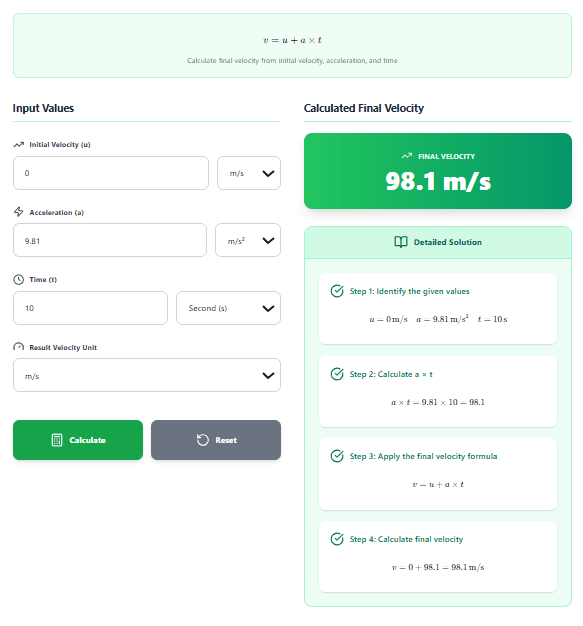
Here's a quick example:
An object dropped from rest (u = 0) falls for 10 seconds at 9.81 m/s²:
- Final velocity: 98.1 m/s
- Initial velocity: 0 m/s
- Acceleration: 9.81 m/s²
- Time: 10 s
The calculator shows you exactly how it got the answer, including any unit conversions needed.
Understanding Final Velocity
What Is Final Velocity?
Final velocity (v) is the velocity of an object at the end of a period of motion under constant acceleration. It is a vector — it has both magnitude and direction — though in one-dimensional problems, the sign tells you the direction.
The Two Kinematic Equations
v = u + at — Use when you know the time
v² = u² + 2as — Use when you know the distance, but not the time
Where:
- v = Final velocity (m/s)
- u = Initial velocity (m/s)
- a = Acceleration (m/s²)
- t = Time (s)
- s = Distance (m)
Key Relationships
- Longer time → More velocity change (v = u + at)
- Larger acceleration → More velocity change
- Larger distance → More velocity change (v² = u² + 2as)
- Sign matters — negative acceleration (deceleration) reduces velocity
The Complete Kinematic Set
The two equations here are part of a larger set of four:
| Equation | Missing Quantity |
|---|---|
| v = u + at | s (distance) |
| s = ut + ½at² | v (final velocity) |
| v² = u² + 2as | t (time) |
| s = ½(u + v)t | a (acceleration) |
All four assume constant acceleration. If acceleration changes, you need calculus or numerical methods.
Why Two Forms?
Both equations describe the same physics, but each is convenient in different situations. If a problem gives you time, use v = u + at — it is a one-step multiplication. If it gives you distance but not time, use v² = u² + 2as — it avoids needing to solve for time first.
Unit Support
This calculator handles a wide range of units automatically:
Velocity Units
| Unit | Symbol | Conversion to m/s |
|---|---|---|
| Meters per second | m/s | 1 |
| Kilometers per hour | km/h | 0.277778 |
| Miles per hour | mph | 0.44704 |
| Feet per second | ft/s | 0.3048 |
Acceleration Units
| Unit | Symbol | Conversion to m/s² |
|---|---|---|
| Meters per second squared | m/s² | 1 |
| Centimeters per second squared | cm/s² | 0.01 |
| Feet per second squared | ft/s² | 0.3048 |
Time Units
| Unit | Symbol | Conversion to s |
|---|---|---|
| Second | s | 1 |
| Millisecond | ms | 0.001 |
| Minute | min | 60 |
| Hour | h | 3600 |
Distance Units
| Unit | Symbol | Conversion to m |
|---|---|---|
| Meter | m | 1 |
| Kilometer | km | 1000 |
| Centimeter | cm | 0.01 |
| Millimeter | mm | 0.001 |
| Foot | ft | 0.3048 |
| Inch | in | 0.0254 |
How to Use the Calculator
Step 1: Choose Your Mode
Select the mode that matches the information you have:
- From Time – You know u, a, and t
- From Distance – You know u, a, and s
Step 2: Enter Your Values
Enter the known values with their units.
Step 3: Select Result Unit
Choose your preferred unit for the result.
Step 4: Calculate
Click "Calculate" and the result appears instantly.
Step 5: Review the Solution
The calculator shows detailed steps, including any unit conversions and intermediate calculations.
Step-by-Step Examples
Example 1: Free Fall (From Time)
Problem: An object is dropped from rest and falls for 3 seconds. Taking g = 9.81 m/s², what is its final velocity?
Step 1: Identify the given values
- u = 0 m/s
- a = 9.81 m/s²
- t = 3 s
Step 2: Calculate a × t
- a × t = 9.81 × 3 = 29.43
Step 3: Apply the formula
- v = u + a × t
- v = 0 + 29.43
- v = 29.43 m/s
Result: The object reaches a final velocity of about 29.4 m/s after 3 seconds of free fall.
Example 2: Car Accelerating (From Time)
Problem: A car traveling at 15 m/s accelerates at 2 m/s² for 8 seconds. What is its final velocity?
Step 1: Identify the given values
- u = 15 m/s
- a = 2 m/s²
- t = 8 s
Step 2: Calculate a × t
- a × t = 2 × 8 = 16
Step 3: Apply the formula
- v = 15 + 16 = 31 m/s
Result: The car reaches a final velocity of 31 m/s.
Example 3: Car Braking (From Time)
Problem: A car traveling at 30 m/s brakes at −5 m/s² for 4 seconds. What is its final velocity?
Step 1: Identify the given values
- u = 30 m/s
- a = −5 m/s²
- t = 4 s
Step 2: Apply the formula
- v = 30 + (−5 × 4)
- v = 30 − 20
- v = 10 m/s
Result: The car slows to 10 m/s.
Example 4: From Distance
Problem: A car starts at 5 m/s and accelerates at 3 m/s² over 50 m. What is its final velocity?
Step 1: Identify the given values
- u = 5 m/s
- a = 3 m/s²
- s = 50 m
Step 2: Calculate u²
- u² = 5² = 25
Step 3: Calculate 2as
- 2as = 2 × 3 × 50 = 300
Step 4: Apply the formula
- v² = 25 + 300 = 325
Step 5: Take the square root
- v = √325 ≈ 18.03 m/s
Result: The car's final velocity is about 18.0 m/s.
Example 5: Free Fall by Distance
Problem: A skydiver falls 500 m from rest. Ignoring air resistance, what is the final velocity?
Step 1: Identify the given values
- u = 0 m/s
- a = 9.81 m/s²
- s = 500 m
Step 2: Calculate 2as
- 2as = 2 × 9.81 × 500 = 9,810
Step 3: Apply the formula
- v² = 0 + 9,810 = 9,810
Step 4: Take the square root
- v = √9,810 ≈ 99.05 m/s
Result: The skydiver reaches about 99.0 m/s — which is roughly terminal velocity for a human in a spread-eagle position.
Example 6: Mixed Units
Problem: A car traveling at 72 km/h accelerates at 1.5 m/s² for 5 seconds. What is its final velocity in km/h?
Step 1: Convert initial velocity to m/s
- u = 72 × 0.277778 = 20 m/s
Step 2: Apply the formula
- v = 20 + (1.5 × 5) = 27.5 m/s
Step 3: Convert to km/h
- v = 27.5 / 0.277778 = 99 km/h
Result: The car's final velocity is 99 km/h.
Practical Implications
Final velocity calculations drive real decisions in physics, engineering, and everyday life:
| Situation | What final velocity tells you |
|---|---|
| Free fall | Impact speed when an object hits the ground |
| Car braking | Whether a vehicle can stop before an obstacle |
| Rocket launch | Speed at the end of a burn phase |
| Roller coaster design | Speed at the bottom of a drop |
| Sports analysis | Ball speed at the end of a throw or kick |
| Elevator safety | Velocity before an emergency brake engages |
When to Use Each Mode
| Mode | Formula | When to Use | Typical Scenario |
|---|---|---|---|
| From Time | v = u + at | You know u, a, t | Free fall for a known duration, car accelerating |
| From Distance | v² = u² + 2as | You know u, a, s | Free fall over a known distance, braking distance |
Common Questions About Final Velocity
Q: What is final velocity?
Final velocity is the velocity of an object at the end of a period of motion under constant acceleration. It is a vector quantity — it has both magnitude and direction.
Q: Which kinematic equation should I use?
It depends on what you know:
- Know u, a, and t? Use v = u + at
- Know u, a, and s? Use v² = u² + 2as
Both give the same answer when the inputs are consistent.
Q: What if acceleration is zero?
If a = 0, both formulas reduce to v = u. The object moves at constant velocity, and the final velocity equals the initial velocity.
Q: Can final velocity be negative?
Yes. Final velocity is a vector — a negative final velocity means the object is moving in the negative direction (or has reversed direction). For example, a ball thrown upward has a positive velocity on the way up and a negative velocity after it passes the peak.
Q: What is the difference between final velocity and average velocity?
Final velocity (v) is the velocity at the end of the motion. Average velocity is (u + v)/2 for constant acceleration — the value that, multiplied by time, gives the total displacement.
Q: What if the value under the square root is negative in the v² = u² + 2as form?
That happens when the combination of initial velocity, acceleration, and distance is physically inconsistent (for example, a negative acceleration that would stop and reverse the object before reaching the given distance). The calculator flags this as an error.
Q: Does final velocity depend on the mass of the object?
No. Both kinematic equations are mass-independent. A feather and a hammer, dropped in a vacuum, hit the ground at the same speed. Mass affects the forces involved, not the kinematics.
Q: What is terminal velocity?
Terminal velocity is the final velocity reached by a falling object when air resistance balances gravity. It is not the same as the kinematic final velocity, which ignores air resistance. For a human in spread-eagle position, terminal velocity is about 55–90 m/s.
Q: How do I handle non-constant acceleration?
Both kinematic equations assume constant acceleration. If acceleration changes with time or position, you need to split the motion into segments with constant acceleration, or use calculus.
Q: What real-world applications use final velocity calculations?
- Automotive safety (braking distance and impact speed)
- Sports physics (ball speed, jump velocity)
- Rocket and projectile motion
- Roller coaster and amusement ride design
- Elevator and conveyor systems
- Forensic accident reconstruction
Tips for Getting the Best Results
Choose the right mode. Use the equation that matches the inputs you have. If you know time, use v = u + at. If you know distance, use v² = u² + 2as.
Watch the signs. Negative acceleration (deceleration) reduces velocity. Negative initial velocity means the object started moving in the negative direction. Get the signs right and the formulas work.
Check the units. The calculator converts everything internally, but understanding the unit relationships helps catch mistakes. For example, km/h must be converted to m/s before plugging into a formula that uses m/s².
Remember: constant acceleration only. If acceleration changes — like a car shifting gears or a rocket staging — split the motion into segments.
Sanity-check the result. A final velocity much larger than the speed of light (299,792,458 m/s) signals an error — either a wrong input or a formula that has been misapplied.
Double-check your inputs. A single digit error changes everything. Take a moment to verify each number.
Review the steps. The step-by-step solution helps you understand the process and verify the calculation.
Final Thoughts
Final velocity is one of the first quantities students learn to calculate in kinematics, and for good reason: it is the number that tells you how fast something is moving at the end of a process — after a fall, a braking event, a rocket burn, or a sprint. The two kinematic equations that describe it, v = u + at and v² = u² + 2as, are algebraically related but each is best suited to a different set of known quantities.
The key insight is that both equations assume constant acceleration. In the real world, acceleration often changes, but for many everyday situations — a short fall, a steady braking event, a constant-thrust rocket burn — constant acceleration is an excellent approximation.
This calculator handles both forms, with full unit support (velocity in m/s, km/h, mph, ft/s; acceleration in m/s², cm/s², ft/s²; time in s, ms, min, h; distance in m, km, cm, mm, ft, in) and step-by-step solutions.
Whether you are solving a homework problem, checking a braking distance, or analyzing free fall, this tool can save time and reduce mistakes by handling the math and unit conversions automatically.