Centripetal Acceleration Calculator – Calculate a = v²/r with Step-by-Step Solutions
Any object moving in a circle is accelerating — even if its speed never changes. That is the counterintuitive core of circular motion: velocity is a vector, and a change in direction is just as much an acceleration as a change in speed.
The formula is simple: a = v²/r, where a is centripetal acceleration, v is the object's speed, and r is the radius of the circular path. This calculator handles three different calculation modes based on what you need to find, with automatic unit conversions and step-by-step solutions.
Quick access: Use our free centripetal acceleration calculator here
What Does This Calculator Do?
This tool calculates circular motion values using the centripetal acceleration formula: a = v²/r.
Three calculation modes:
Calculate Acceleration (a = v²/r) – Find centripetal acceleration from velocity and radius
Calculate Velocity (v = √(a × r)) – Find velocity from acceleration and radius
Calculate Radius (r = v²/a) – Find radius from velocity and acceleration
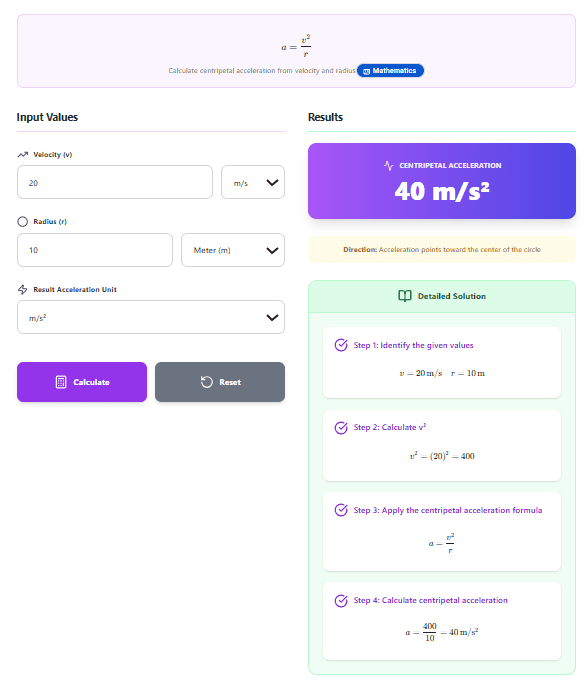
Here's a quick example:
An object moves at 20 m/s in a circle of radius 10 m:
- Centripetal acceleration: 40 m/s²
- Velocity: 20 m/s
- Radius: 10 m
The calculator shows you exactly how it got the answer, including any unit conversions needed.
Understanding Centripetal Acceleration
What Is Centripetal Acceleration?
Centripetal acceleration is the acceleration an object experiences when moving in a circular path. It always points toward the center of the circle — perpendicular to the object's velocity.
The Formula
a = v²/r
Where:
- a = Centripetal acceleration (m/s²)
- v = Velocity / speed (m/s)
- r = Radius of the circular path (m)
Key Relationships
- Faster speed → Much larger acceleration (acceleration scales with v²)
- Larger radius → Smaller acceleration (for the same speed)
- Doubling speed → Quadruples acceleration
- Doubling radius → Halves acceleration
Direction Matters
Unlike linear acceleration, centripetal acceleration does not change the object's speed — only its direction. The magnitude stays constant for uniform circular motion, but the direction continuously rotates to point at the center.
Rearranged Formulas
| What to Find | Formula |
|---|---|
| Centripetal Acceleration | a = v²/r |
| Velocity | v = √(a × r) |
| Radius | r = v²/a |
Unit Support
This calculator handles all common units automatically:
Velocity Units
| Unit | Symbol | Conversion to m/s |
|---|---|---|
| Meters per second | m/s | 1 |
| Kilometers per hour | km/h | 0.277778 |
| Miles per hour | mph | 0.44704 |
| Feet per second | ft/s | 0.3048 |
Radius Units
| Unit | Symbol | Conversion to m |
|---|---|---|
| Meter | m | 1 |
| Centimeter | cm | 0.01 |
| Millimeter | mm | 0.001 |
| Kilometer | km | 1000 |
| Foot | ft | 0.3048 |
| Inch | in | 0.0254 |
Acceleration Units
| Unit | Symbol | Conversion to m/s² |
|---|---|---|
| Meters per second squared | m/s² | 1 |
| Centimeters per second squared | cm/s² | 0.01 |
| Feet per second squared | ft/s² | 0.3048 |
| Standard gravity | g | 9.80665 |
Note: 1 g = 9.80665 m/s² — Earth's standard gravitational acceleration.
How to Use the Calculator
Step 1: Choose Your Mode
Select one of three calculation modes:
- Calculate Acceleration – Find a
- Calculate Velocity – Find v
- Calculate Radius – Find r
Step 2: Enter Your Values
Depending on the mode, enter the required values with their units.
Step 3: Select Result Unit
Choose your preferred unit for the result.
Step 4: Calculate
Click the "Calculate" button. The results appear instantly.
Step 5: Review the Solution
The calculator shows detailed steps explaining how the result was derived, including all unit conversions and intermediate calculations.
Step-by-Step Examples for Each Mode
Example 1: Calculate Centripetal Acceleration
Problem: A car rounds a curve of radius 50 m at 20 m/s. What is its centripetal acceleration?
Step 1: Identify the given values
- v = 20 m/s
- r = 50 m
Step 2: Calculate v²
- v² = (20)² = 400
Step 3: Apply the formula
- a = v²/r
- a = 400 / 50
- a = 8 m/s²
Result: The centripetal acceleration is 8 m/s².
Example 2: Calculate Velocity
Problem: An object experiences 40 m/s² of centripetal acceleration while moving in a circle of radius 10 m. What is its velocity?
Step 1: Identify the given values
- a = 40 m/s²
- r = 10 m
Step 2: Calculate a × r
- a × r = 40 × 10 = 400
Step 3: Apply the formula
- v = √(a × r)
- v = √400
- v = 20 m/s
Result: The velocity is 20 m/s.
Example 3: Calculate Radius
Problem: An object moving at 30 m/s experiences 9 m/s² of centripetal acceleration. What is the radius of its circular path?
Step 1: Identify the given values
- v = 30 m/s
- a = 9 m/s²
Step 2: Calculate v²
- v² = (30)² = 900
Step 3: Apply the formula
- r = v²/a
- r = 900 / 9
- r = 100 m
Result: The radius is 100 m.
Example 4: Convert Units Before Solving
Problem: A satellite orbits at 7.8 km/s at an altitude where its orbital radius is 6,800 km. What is its centripetal acceleration?
Step 1: Identify the given values
- v = 7.8 km/s
- r = 6,800 km
Step 2: Convert to SI units
- v = 7.8 × 1000 = 7800 m/s
- r = 6,800 × 1000 = 6,800,000 m
Step 3: Calculate v²
- v² = (7800)² = 60,840,000
Step 4: Apply the formula
- a = v²/r
- a = 60,840,000 / 6,800,000
- a ≈ 8.95 m/s²
Result: The satellite's centripetal acceleration is about 8.95 m/s².
Comparing to Earth's Gravity (g)
For many applications, expressing centripetal acceleration in multiples of Earth's gravity (g = 9.80665 m/s²) makes the number more intuitive:
| Acceleration | In g | Real-world comparison |
|---|---|---|
| 9.80665 m/s² | 1.00 g | Earth's surface gravity |
| 19.6 m/s² | 2.00 g | Roller coaster loop |
| 29.4 m/s² | 3.00 g | Fighter jet turn |
| 49.0 m/s² | 5.00 g | Astronaut training centrifuge |
| 88.3 m/s² | 9.00 g | Human tolerance limit (brief) |
This is why a car taking a tight turn at high speed feels so much more forceful than a gentle curve — the centripetal acceleration required grows with the square of speed.
When to Use Each Mode
| Mode | Formula | When to Use | Typical Scenario |
|---|---|---|---|
| Acceleration | a = v²/r | You have velocity and radius | Checking whether a turn is safe at a given speed |
| Velocity | v = √(a × r) | You have acceleration and radius | Finding the maximum safe speed for a curve |
| Radius | r = v²/a | You have velocity and acceleration | Designing a track or orbital path |
Common Questions About Centripetal Acceleration
Q: What is centripetal acceleration?
Centripetal acceleration is the acceleration an object experiences when moving along a circular path. It points toward the center of the circle and has magnitude a = v²/r.
Q: Why does an object accelerate if its speed is constant?
Because velocity is a vector — it has both speed and direction. In circular motion, the direction changes continuously, so the velocity changes even when the speed does not. Any change in velocity is an acceleration.
Q: What is the difference between centripetal and centrifugal?
Centripetal acceleration is real and points toward the center. "Centrifugal" is an apparent force that appears in a rotating reference frame — it is not a real force in an inertial frame. When you feel pushed outward in a turning car, you are actually feeling your body's inertia resisting the centripetal acceleration toward the center.
Q: Does centripetal acceleration depend on mass?
No. The formula a = v²/r does not contain mass. The force required to produce that acceleration (F = ma) does depend on mass, but the acceleration itself does not.
Q: What happens if the radius is very small?
As r approaches zero, centripetal acceleration grows without bound for any nonzero speed. In practice, a minimum radius is set by material strength, friction, or other physical constraints.
Q: How do I convert to g-force?
Divide the centripetal acceleration by 9.80665 m/s². For example, 19.6 m/s² is 2 g, which is what riders feel at the bottom of a typical roller coaster loop.
Q: What real-world situations involve centripetal acceleration?
- Cars turning corners
- Satellites in orbit
- Roller coaster loops
- Washing machine spin cycles
- A ball on a string swung in a circle
- The Moon orbiting Earth
Q: Does the calculator handle non-SI units?
Yes. Velocity accepts m/s, km/h, mph, and ft/s. Radius accepts m, cm, mm, km, ft, and in. Acceleration can be returned in m/s², cm/s², ft/s², or g.
Tips for Getting the Best Results
Choose the right mode. Make sure you're calculating what you need — acceleration, velocity, or radius.
Check your units. The calculator handles conversions automatically, but make sure you're entering values with the correct units.
Remember the v² dependence. Because acceleration scales with the square of speed, small speed increases cause large acceleration increases. Doubling speed quadruples the acceleration.
Use g for intuition. For high-acceleration cases, switch the result unit to g. It's easier to judge whether 8.95 m/s² is a lot when you see it as 0.91 g.
Double-check your inputs. A single digit error changes everything. Take a moment to verify each number.
Review the steps. The step-by-step solution helps you understand the process and verify the calculation.
Final Thoughts
Centripetal acceleration is one of those concepts that feels counterintuitive at first — an object moving at constant speed that is nonetheless accelerating. Once the vector nature of velocity clicks, it makes perfect sense: direction changes are accelerations, and circular motion is nothing but continuous direction change.
The formula a = v²/r is simple but powerful. It governs everything from cars on curved roads to satellites in orbit to the spin cycle of a washing machine. This calculator handles all three variants of the formula, with complete unit support (velocity in m/s, km/h, mph, ft/s; radius in m, cm, mm, km, ft, in; acceleration in m/s², cm/s², ft/s², g), a g-force comparison, and step-by-step solutions.
Whether you're solving a homework problem, checking a design, or simply exploring circular motion, this tool can save time and reduce mistakes by handling the math and unit conversions automatically.