Density Calculator – Calculate ρ = m/V with Step-by-Step Solutions
Density is one of the most fundamental properties of matter. It tells you how much mass is packed into a given volume — why a steel bolt feels heavy for its size, why oil floats on water, and why a helium balloon rises. The formula is simple: ρ = m/V, where ρ is density, m is mass, and V is volume.
This calculator handles three different calculation modes based on what you need to find, with automatic unit conversions, material matching, buoyancy analysis, and step-by-step solutions.
Quick access: Use our free density calculator here
What Does This Calculator Do?
This tool calculates mass, volume, or density using the density formula: ρ = m/V.
Three calculation modes:
Calculate Density (ρ = m/V) – Find density from mass and volume
Calculate Mass (m = ρ × V) – Find mass from density and volume
Calculate Volume (V = m/ρ) – Find volume from mass and density
Plus material matching – The calculator compares your result against a table of common materials and identifies the closest match.
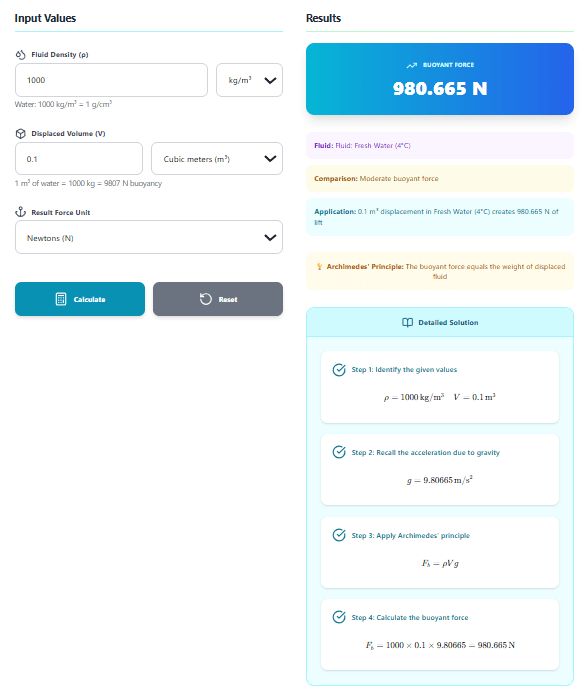
Plus buoyancy analysis – It tells you whether the material would float or sink in water.
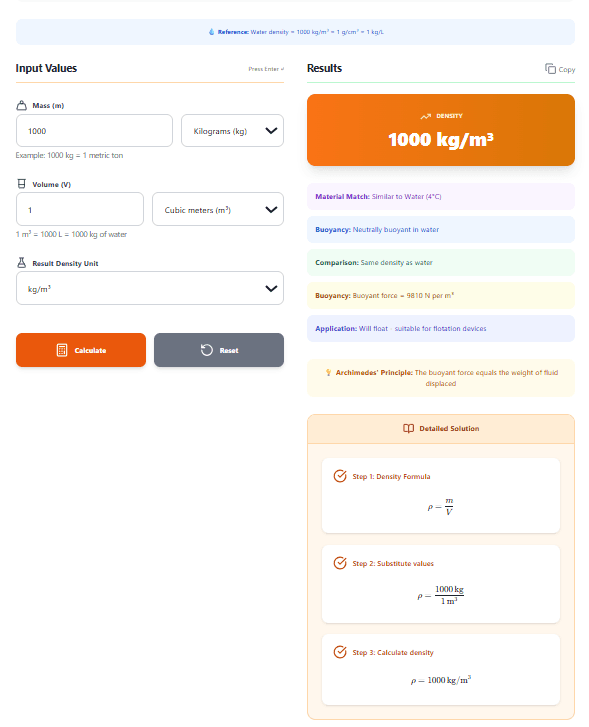
Here's a quick example:
1000 kg of water occupying 1 m³:
- Density: 1000 kg/m³
- Mass: 1000 kg
- Volume: 1 m³
- Buoyancy: Neutrally buoyant in water
The calculator shows you exactly how it got the answer, including any unit conversions needed.
Understanding Density
What Is Density?
Density (ρ) is the amount of mass per unit volume of a substance. It quantifies how tightly matter is packed together. A dense material has a lot of mass crammed into a small space; a low-density material has less mass spread over the same space.
The Formula
ρ = m/V
Where:
- ρ (rho) = Density (kg/m³ or g/cm³)
- m = Mass (kg or g)
- V = Volume (m³ or cm³)
Key Relationships
- More mass in the same volume → Higher density
- Same mass in larger volume → Lower density
- Density is an intensive property — it does not depend on how much of the material you have
- Temperature and pressure affect density — most materials expand when heated, lowering density
Density vs Weight
Density and weight are not the same:
- Density is mass per unit volume (kg/m³). It is a property of the material.
- Weight is the force of gravity on an object (N). It depends on mass and local gravity.
- On the Moon, an object weighs less but has the same density.
Density vs Specific Gravity
Specific gravity is the ratio of a substance's density to the density of water (1000 kg/m³). It is dimensionless:
Specific Gravity = ρ / ρ_water
A material with specific gravity 2.7 (like aluminum) is 2.7 times denser than water.
Rearranged Formulas
| What to Find | Formula |
|---|---|
| Density | ρ = m/V |
| Mass | m = ρ × V |
| Volume | V = m/ρ |
Unit Support
This calculator handles a wide range of units automatically:
Mass Units
| Unit | Symbol | Conversion to kg |
|---|---|---|
| Kilogram | kg | 1 |
| Gram | g | 0.001 |
| Milligram | mg | 1 × 10⁻⁶ |
| Pound | lb | 0.453592 |
| Ounce | oz | 0.0283495 |
Volume Units
| Unit | Symbol | Conversion to m³ |
|---|---|---|
| Cubic meter | m³ | 1 |
| Cubic centimeter | cm³ | 1 × 10⁻⁶ |
| Liter | L | 0.001 |
| Milliliter | mL | 1 × 10⁻⁶ |
| Cubic foot | ft³ | 0.0283168 |
| Gallon | gal | 0.00378541 |
Note: 1 cm³ = 1 mL, so both convert to the same SI value.
Density Units
| Unit | Symbol | Conversion to kg/m³ |
|---|---|---|
| Kilogram per cubic meter | kg/m³ | 1 |
| Gram per cubic centimeter | g/cm³ | 1000 |
| Gram per milliliter | g/mL | 1000 |
| Kilogram per liter | kg/L | 1000 |
| Pound per cubic foot | lb/ft³ | 16.0185 |
Note: 1 g/cm³ = 1 g/mL = 1 kg/L = 1000 kg/m³. These are numerically identical.
How to Use the Calculator
Step 1: Choose Your Mode
Select one of three calculation modes:
- Calculate Density – Find ρ
- Calculate Mass – Find m
- Calculate Volume – Find V
Step 2: Enter Your Values
Depending on the mode, enter the required values with their units.
Step 3: Select Result Unit
Choose your preferred unit for the result.
Step 4: Calculate
Click the "Calculate" button (or press Enter). The results appear instantly with material matching and buoyancy analysis.
Step 5: Review the Solution
The calculator shows detailed steps, including any unit conversions and the intermediate calculation.
Step-by-Step Examples
Example 1: Calculate Density
Problem: A block of metal has a mass of 2700 kg and a volume of 1 m³. What is its density?
Step 1: Identify the given values
- m = 2700 kg
- V = 1 m³
Step 2: Apply the formula
- ρ = m/V
- ρ = 2700 / 1
- ρ = 2700 kg/m³
Result: The density is 2700 kg/m³ — consistent with aluminum.
Example 2: Calculate Mass
Problem: A container holds 2 L of mercury (ρ = 13,546 kg/m³). What is the mass of the mercury?
Step 1: Identify the given values
- ρ = 13,546 kg/m³
- V = 2 L = 0.002 m³
Step 2: Apply the formula
- m = ρ × V
- m = 13,546 × 0.002
- m = 27.09 kg
Result: The mercury has a mass of about 27.1 kg.
Example 3: Calculate Volume
Problem: What volume does 500 g of gold (ρ = 19,300 kg/m³) occupy?
Step 1: Identify the given values
- m = 500 g = 0.5 kg
- ρ = 19,300 kg/m³
Step 2: Apply the formula
- V = m/ρ
- V = 0.5 / 19,300
- V ≈ 2.59 × 10⁻⁵ m³
Step 3: Convert to cm³
- V = 2.59 × 10⁻⁵ × 10⁶ = 25.9 cm³
Result: 500 g of gold occupies about 25.9 cm³ — a cube about 3 cm on each side.
Example 4: Material Identification
Problem: An unknown metal has a mass of 890 g and a volume of 100 cm³. What is it?
Step 1: Convert to SI
- m = 890 g = 0.89 kg
- V = 100 cm³ = 1 × 10⁻⁴ m³
Step 2: Calculate density
- ρ = 0.89 / 1 × 10⁻⁴
- ρ = 8900 kg/m³
Step 3: Compare to known materials
- Copper: 8960 kg/m³ — very close match
Result: The metal is likely copper (ρ ≈ 8960 kg/m³).
Densities of Common Materials
Here is a reference table of densities for common materials, in kg/m³ and g/cm³:
| Material | Density (kg/m³) | Density (g/cm³) | Category |
|---|---|---|---|
| Air (20 °C) | 1.204 | 0.001204 | Gas |
| Polystyrene foam | 50 | 0.050 | Solid |
| Cork | 240 | 0.240 | Solid |
| Gasoline | 740 | 0.740 | Liquid |
| Oak wood | 750 | 0.750 | Solid |
| Ethanol | 789 | 0.789 | Liquid |
| Ice | 917 | 0.917 | Solid |
| Water (4 °C) | 1000 | 1.000 | Liquid |
| Seawater | 1025 | 1.025 | Liquid |
| Brick | 2000 | 2.000 | Building |
| Concrete | 2400 | 2.400 | Building |
| Aluminum | 2700 | 2.700 | Metal |
| Granite | 2700 | 2.700 | Rock |
| Iron / Steel | 7870 | 7.870 | Metal |
| Copper | 8960 | 8.960 | Metal |
| Silver | 10,490 | 10.490 | Metal |
| Mercury | 13,546 | 13.546 | Liquid |
| Gold | 19,300 | 19.300 | Metal |
| Platinum | 21,450 | 21.450 | Metal |
| Osmium | 22,590 | 22.590 | Metal |
Notice the enormous range: air is around 1 kg/m³, water is 1000 kg/m³, and osmium — the densest naturally occurring element — is over 22,000 kg/m³. That is a factor of more than 20,000 between air and osmium.
Buoyancy: Float or Sink?
Density directly determines whether an object floats or sinks in a fluid:
- ρ_object < ρ_fluid → Object floats (buoyant force exceeds weight)
- ρ_object > ρ_fluid → Object sinks (weight exceeds buoyant force)
- ρ_object = ρ_fluid → Object is neutrally buoyant (stays suspended)
For water (ρ = 1000 kg/m³), the comparison is straightforward:
| Density Range | Behavior in Water | Examples |
|---|---|---|
| < 1000 kg/m³ | Floats | Wood, ice, oil, cork |
| = 1000 kg/m³ | Neutrally buoyant | Pure water, some plastics |
| > 1000 kg/m³ | Sinks | Metals, rocks, glass |
A fun fact: ice floats because water expands when it freezes. Solid water (ρ = 917 kg/m³) is less dense than liquid water (ρ = 1000 kg/m³). Almost every other substance is denser as a solid than as a liquid.
Practical Implications
Density drives decisions across many fields:
| Application | What density tells you |
|---|---|
| Ship design | Hull must displace enough water to support the ship's mass |
| Material selection | Aerospace uses low-density metals like aluminum and titanium |
| Oil spill behavior | Oil floats on water, which is why spills spread across the surface |
| Hot air balloons | Heated air is less dense than surrounding cool air, creating lift |
| Concrete mixing | Aggregate density affects strength and weight of the final product |
| Quality control | Density variations can indicate impurities or inconsistencies |
When to Use Each Mode
| Mode | Formula | When to Use | Typical Scenario |
|---|---|---|---|
| Density | ρ = m/V | You have mass and volume | Identifying an unknown material |
| Mass | m = ρ × V | You have density and volume | Finding how much a known volume weighs |
| Volume | V = m/ρ | You have mass and density | Determining how much space a mass occupies |
Common Questions About Density
Q: What is density?
Density is the mass per unit volume of a substance. It is calculated as ρ = m/V and is measured in kg/m³ (SI) or g/cm³ (common in chemistry).
Q: Why does ice float on water?
Because ice is less dense than liquid water. When water freezes, it expands and its density drops from 1000 kg/m³ to about 917 kg/m³. This is unusual — most substances are denser as solids — and it is why lakes freeze from the top down.
Q: What is the density of water?
Pure water has a density of exactly 1000 kg/m³ at 4 °C (the temperature at which water is densest). At room temperature (20 °C), it is about 998 kg/m³. Seawater is denser, around 1025 kg/m³, because of dissolved salts.
Q: Does density change with temperature?
Yes. Most materials expand when heated, which increases volume and decreases density. Water is a notable exception — it is densest at 4 °C, and both warming and cooling from that point decrease its density. The values in this calculator assume standard conditions.
Q: What is specific gravity?
Specific gravity (SG) is the ratio of a substance's density to the density of water. It is dimensionless. A material with SG = 2.7 (like aluminum) is 2.7 times denser than water.
Q: What is the densest element?
Osmium (Os) is the densest naturally occurring element, at about 22,590 kg/m³. Iridium is a very close second, at 22,560 kg/m³. For comparison, lead is only 11,340 kg/m³.
Q: How do I identify an unknown material by density?
Measure the mass and volume, calculate ρ = m/V, and compare it against a reference table. If the density is within about 5-10% of a known material, that material is likely the answer. The calculator does this comparison automatically.
Q: What is the difference between density and bulk density?
True density is the density of the solid material itself, with no voids. Bulk density includes the air spaces between particles — for example, a pile of sand has a lower bulk density than the sand grains themselves. Bulk density matters for powders, aggregates, and porous materials.
Q: What real-world applications depend on density?
- Ship and submarine design (buoyancy)
- Aerospace material selection (weight)
- Oil and gas separation (density differences)
- Medical imaging (bone vs tissue density)
- Food science (fat content, sugar content)
- Geology (rock identification)
Tips for Getting the Best Results
Choose the right mode. Make sure you're solving for what you need — density, mass, or volume.
Watch your units. Density is mass per volume. A common error is mixing g with m³, or kg with cm³. The calculator converts everything internally, but understanding the unit relationship helps catch mistakes.
Use the material reference table. Click any material to populate the density field in mass or volume mode. This is useful when you want to find the mass of a specific volume of a known material.
Remember the water benchmark. 1000 kg/m³ = 1 g/cm³ = 1 kg/L. This is the reference point for float/sink questions.
Check the buoyancy readout. For density-mode calculations, the calculator tells you whether the material floats or sinks in water. This is a quick sanity check on your result.
Double-check your inputs. A single digit error changes everything. Take a moment to verify each number.
Review the steps. The step-by-step solution helps you understand the process and verify the calculation.
Final Thoughts
Density is one of those properties that seems simple — just mass divided by volume — but it explains an enormous range of physical phenomena. It explains why ships float, why hot air balloons rise, why oil spills spread across the ocean surface, and why a gold bar feels so much heavier than its size suggests. It also spans an incredible range of values: from 1.2 kg/m³ for air to over 22,000 kg/m³ for osmium.
This calculator handles all three variants of the density formula, with complete unit support (mass in kg, g, mg, lb, oz; volume in m³, cm³, L, mL, ft³, gal; density in kg/m³, g/cm³, g/mL, kg/L, lb/ft³), a common-materials reference table, automatic material matching, buoyancy analysis, and step-by-step solutions.
Whether you're identifying an unknown material, calculating how much a known volume weighs, or exploring float/sink behavior, this tool can save time and reduce mistakes by handling the math and unit conversions automatically.