Energy Conversion Calculator – Convert Between J, cal, kWh, eV, BTU, and More
Energy shows up in many different forms — heat, electricity, motion, light, chemical bonds — and each field has its own preferred unit. Physicists work in joules, chemists in calories, electricians in kilowatt-hours, particle physicists in electronvolts, and HVAC engineers in BTUs. They all describe the same physical quantity, just in different scales.
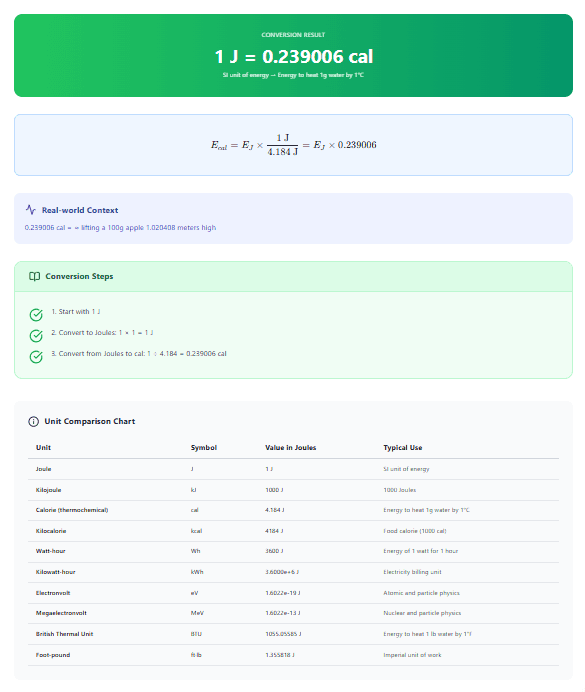
This calculator converts between ten different energy units, with step-by-step solutions, real-world context, and a unit comparison chart.
Quick access: Use our free energy conversion calculator here
What Does This Calculator Do?
This tool converts any energy value from one unit to another.
Ten supported energy units:
- Joule (J) — SI unit of energy
- Kilojoule (kJ) — 1,000 J
- Calorie (cal) — thermochemical calorie = 4.184 J
- Kilocalorie (kcal) — food calorie = 4,184 J
- Watt-hour (Wh) — electrical energy = 3,600 J
- Kilowatt-hour (kWh) — electricity billing unit = 3.6 × 10⁶ J
- Electronvolt (eV) — atomic scale = 1.602 × 10⁻¹⁹ J
- Megaelectronvolt (MeV) — nuclear physics = 1.602 × 10⁻¹³ J
- British Thermal Unit (BTU) — ≈ 1,055 J
- Foot-pound (ft·lb) — imperial work unit = 1.356 J
Plus real-world context — the result is annotated with an everyday comparison, so you can sense-check the magnitude.
Here's a quick example:
1 calorie:
- In joules: 4.184 J
- In kWh: about 1.16 × 10⁻⁶ kWh
The calculator shows you exactly how it got the answer, including all conversion steps.
Understanding Energy Units
What Is Energy?
Energy is the capacity to do work or produce heat. It comes in many forms — kinetic, potential, thermal, electrical, chemical, nuclear — and can be converted between them. The total amount is always conserved (first law of thermodynamics), but it can change form.
Why So Many Units?
Because different fields developed their own conventions before the SI system was standardized:
- Joule (J) — the SI unit, defined as the work done by 1 newton over 1 meter
- Calorie (cal) — originally defined as the heat needed to raise 1 g of water by 1 °C. Still used in chemistry and nutrition.
- Kilocalorie (kcal) — the "food calorie" on nutrition labels. 1 kcal = 1,000 cal.
- Watt-hour (Wh) and kilowatt-hour (kWh) — electrical energy. 1 Wh = 1 W × 1 h. kWh is what you see on your electricity bill.
- Electronvolt (eV) and megaelectronvolt (MeV) — energy gained by an electron crossing a 1-volt potential. Used in atomic and particle physics.
- BTU — British Thermal Unit, the energy to heat 1 lb of water by 1 °F. Common in HVAC and heating.
- Foot-pound (ft·lb) — imperial work unit, the energy to lift 1 lb by 1 foot.
The Central Role of the Joule
Every conversion goes through the joule. To convert from unit A to unit B:
- Multiply by unit A's joule factor to get joules
- Divide by unit B's joule factor to get unit B
This is why the calculator shows both steps — it makes the conversion transparent.
Conversion Factors at a Glance
| Unit | Symbol | Value in Joules |
|---|---|---|
| Joule | J | 1 |
| Kilojoule | kJ | 1,000 |
| Calorie | cal | 4.184 |
| Kilocalorie | kcal | 4,184 |
| Watt-hour | Wh | 3,600 |
| Kilowatt-hour | kWh | 3.6 × 10⁶ |
| Electronvolt | eV | 1.602 × 10⁻¹⁹ |
| Megaelectronvolt | MeV | 1.602 × 10⁻¹³ |
| BTU | BTU | 1,055.05585 |
| Foot-pound | ft·lb | 1.355817948 |
How to Use the Calculator
Step 1: Enter the Value
Enter the energy value you want to convert.
Step 2: Select the Source Unit
Choose the unit you are converting from — J, kJ, cal, kcal, Wh, kWh, eV, MeV, BTU, or ft·lb.
Step 3: Select the Target Unit
Choose the unit you are converting to.
Step 4: Convert
Click "Convert" and the result appears instantly, along with the formula and step-by-step working.
Step 5: Review the Result
The calculator shows the conversion steps, the real-world context of the result, and a unit comparison chart.
Tip: Use the swap button to reverse the direction of the conversion in one click.
Step-by-Step Examples
Example 1: Calories to Joules
Problem: Convert 1 calorie to joules.
Step 1: Convert to joules
- 1 cal × 4.184 J/cal = 4.184 J
Step 2: Confirm the target unit
- The target is joules, so we're done.
Result: 1 cal = 4.184 J.
Example 2: Joules to Calories
Problem: Convert 418.4 J to calories.
Step 1: Confirm the source is joules
- 418.4 J is already in joules
Step 2: Divide by the calorie factor
- 418.4 J / 4.184 J/cal = 100 cal
Result: 418.4 J = 100 cal.
Example 3: kWh to Joules
Problem: A household uses 1 kWh of electricity. How many joules is that?
Step 1: Convert to joules
- 1 kWh × 3.6 × 10⁶ J/kWh = 3,600,000 J
Result: 1 kWh = 3.6 × 10⁶ J = 3.6 MJ.
Example 4: eV to Joules
Problem: A photon has an energy of 1 eV. What is that in joules?
Step 1: Convert to joules
- 1 eV × 1.602 × 10⁻¹⁹ J/eV = 1.602 × 10⁻¹⁹ J
Result: 1 eV = 1.602 × 10⁻¹⁹ J.
Example 5: BTU to Joules
Problem: An air conditioner has a 12,000 BTU rating. How many joules is that?
Step 1: Convert to joules
- 12,000 BTU × 1,055.05585 J/BTU ≈ 1.266 × 10⁷ J
Result: 12,000 BTU ≈ 12.66 MJ.
Example 6: Food Calories (kcal) to Joules
Problem: A snack bar has 250 food calories (kcal). How many joules is that?
Step 1: Convert to joules
- 250 kcal × 4,184 J/kcal = 1,046,000 J
Result: 250 kcal ≈ 1.05 MJ.
Example 7: Foot-pounds to Joules
Problem: A torque wrench applies 100 ft·lb of work. How many joules is that?
Step 1: Convert to joules
- 100 ft·lb × 1.355817948 J/ft·lb ≈ 135.58 J
Result: 100 ft·lb ≈ 135.6 J.
Reference Values and Everyday Comparisons
Here are some common energy quantities to help you build intuition:
| Energy | In Joules | Everyday Comparison |
|---|---|---|
| Clicking a mouse | ~1 J | Tiny mechanical action |
| Light bulb (2 seconds) | ~100 J | Brief illumination |
| Walk up 2 flights of stairs | ~1,000 J | Small physical effort |
| 1 food calorie | 4,184 J | Nutrition label |
| Fan running 1 hour | 36,000 J | 10 Wh |
| 1 kWh electricity | 3,600,000 J | Microwave for 1 hour |
| 1 eV | 1.6 × 10⁻¹⁹ J | Atomic scale |
| 1 MeV | 1.6 × 10⁻¹³ J | Nuclear scale |
Practical Implications
Energy unit conversion matters across many fields:
| Field | Common Units | Why |
|---|---|---|
| Physics | J, eV, MeV | Fundamental calculations |
| Chemistry | cal, kcal, kJ | Reaction energies and thermochemistry |
| Nutrition | kcal | Food energy labels |
| Electrical engineering | Wh, kWh | Billing and battery capacity |
| HVAC | BTU | Heating and cooling ratings |
| Mechanical engineering | ft·lb, J | Torque and work |
| Particle physics | eV, MeV, GeV | Collider energies |
| Astronomy | ergs, J | Stellar and galactic energies |
Common Questions About Energy Conversion
Q: What is the SI unit of energy?
The joule (J). One joule is the work done by a force of one newton over a distance of one meter. It is also the energy transferred by one watt of power for one second.
Q: Why do we need so many energy units?
Because different fields developed their own conventions before SI standardization, and each unit is convenient at a particular scale. Joules for fundamental physics, calories for chemistry and nutrition, kWh for electricity, eV for atomic physics, BTU for HVAC. They are all convertible through fixed factors.
Q: How do I convert calories to joules?
Multiply by 4.184. For example, 100 cal = 418.4 J. Note that a "food calorie" (kcal) is 1,000 cal, so 1 kcal = 4,184 J.
Q: What is the difference between a calorie and a kilocalorie?
A calorie (cal) is the energy to heat 1 g of water by 1 °C. A kilocalorie (kcal) is 1,000 cal — the "food calorie" on nutrition labels. So when a label says "250 calories," it really means 250 kcal = 250,000 cal = 1,046,000 J.
Q: How do I convert kWh to joules?
Multiply by 3.6 × 10⁶. For example, 1 kWh = 3,600,000 J. That is the standard conversion used in electricity billing.
Q: What is an electronvolt?
An electronvolt (eV) is the kinetic energy gained by an electron when it is accelerated through a potential difference of one volt. It equals 1.602 × 10⁻¹⁹ J. It is the natural unit for atomic and nuclear physics.
Q: What is a BTU?
A British Thermal Unit (BTU) is the energy needed to raise the temperature of 1 pound of water by 1 °F. It equals about 1,055 J. It is common in heating, ventilation, and air conditioning (HVAC) ratings.
Q: What is a foot-pound?
A foot-pound (ft·lb) is the work done by a force of 1 pound-force acting over a distance of 1 foot. It equals about 1.356 J. It is used in imperial engineering, especially for torque and mechanical work.
Q: How do I convert between any two energy units?
The general method is: convert to joules, then convert from joules. Multiply by the source unit's factor to get joules, then divide by the target unit's factor. This calculator handles both steps automatically.
Q: Are there any energy units not included in this calculator?
The calculator covers the most common units — J, kJ, cal, kcal, Wh, kWh, eV, MeV, BTU, and ft·lb. Other units like ergs (1 erg = 10⁻⁷ J), therms (1 therm = 1.055 × 10⁸ J), and TNT equivalent (1 ton TNT = 4.184 × 10⁹ J) are also used in specialized fields.
Q: Why does the calculator show the conversion in two steps?
Because every conversion goes through the joule. Showing both steps — convert to joules, then convert from joules — makes the conversion transparent and helps catch errors.
Tips for Getting the Best Results
Know your field's preferred unit. Physics uses joules, chemistry uses calories or kJ, electrical work uses kWh, atomic physics uses eV, HVAC uses BTU. Start from the unit that matches your context.
Use the swap button. If you realize you had the direction backward, click the swap button to reverse the conversion in one click.
Watch the exponent. Energy values span over 40 orders of magnitude — from eV (10⁻¹⁹ J) to supernova energies (10⁴⁴ J). The calculator uses scientific notation for extreme values, so double-check your exponent.
Sanity-check with the real-world context. If the result seems off, the real-world comparison below the result helps you sense-check the magnitude. 1 kWh should feel like "microwave for an hour," not like "lightning bolt."
Remember: energy is conserved. The total energy in a closed system does not change — it only changes form. Unit conversions preserve the amount of energy; they just change how it is expressed.
Double-check your inputs. A single digit error changes everything. Take a moment to verify each number.
Review the steps. The step-by-step solution helps you understand the process and verify the calculation.
Final Thoughts
Energy is one of the most fundamental quantities in physics, and it shows up in an enormous range of scales — from the electronvolt energies of atomic transitions to the megaton-scale energies of nuclear weapons. Every field has its own preferred unit, and every one of those units is convertible to every other through the joule.
This calculator handles ten of the most common energy units, with step-by-step solutions, real-world context, and a unit comparison chart. The conversions themselves are simple — multiply by the source factor, divide by the target factor — but having them all in one place makes it easy to work across disciplines.
Whether you are converting a nutrition label to joules, checking an electrical bill in kWh, or exploring the electronvolt scale of atomic physics, this tool can save time and reduce mistakes by handling the math automatically.