Electrical Energy Calculator – Calculate E = P × t with Step-by-Step Solutions
Electrical energy is what you pay for on your electricity bill. It is the product of power and time — how many watts of power are drawn, multiplied by how long they are drawn. A 100 W bulb running for 24 hours uses 2.4 kWh of energy. A 2,000 W hair dryer running for 5 minutes uses about 0.167 kWh. The formula is simple: E = P × t.
This calculator handles three different calculation modes based on what you need to find, with support for power units (W, kW, MW, mW), time units (s, min, h, day), energy units (J, kJ, Wh, kWh, MWh), and step-by-step solutions.
Quick access: Use our free electrical energy calculator here
What Does This Calculator Do?
This tool calculates any one of the three quantities in the electrical energy relationship.
Three calculation modes:
Calculate Energy (E = P × t) – Find energy from power and time
Calculate Power (P = E/t) – Find power from energy and time
Calculate Time (t = E/P) – Find time from energy and power
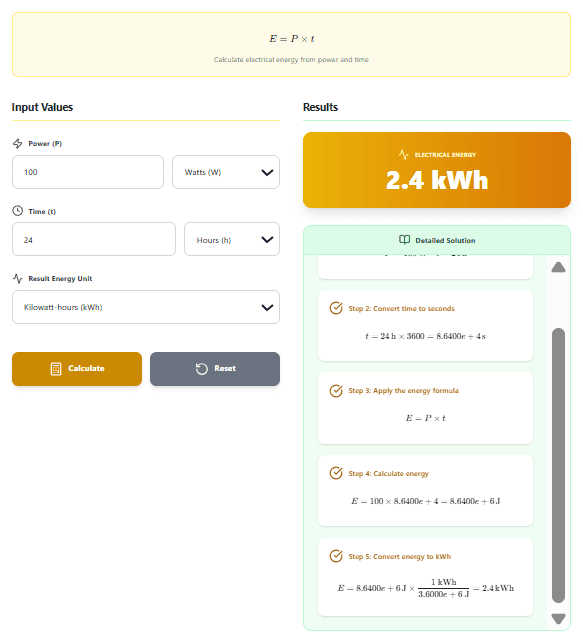
Here's a quick example:
A 100 W device running for 24 hours:
- Energy: 2.4 kWh
- Power: 100 W
- Time: 24 h
The calculator shows you exactly how it got the answer, including any unit conversions needed.
Understanding Electrical Energy
What Is Electrical Energy?
Electrical energy is the total amount of work done by an electrical system over time. It is the product of power (the rate of energy transfer) and time (how long the power flows).
The Formula
E = P × t
Where:
- E = Electrical energy (J, kWh, Wh)
- P = Power (W, kW, MW)
- t = Time (s, min, h, day)
Key Relationships
- Higher power → More energy (linear)
- Longer time → More energy (linear)
- Doubling either input → Doubles the energy
- P = E/t and t = E/P are the rearranged forms
Energy vs Power
These two are often confused:
- Power is a rate — how fast energy is being used or produced. Measured in watts (W).
- Energy is the total amount — how much is used or produced over time. Measured in joules (J) or kilowatt-hours (kWh).
An analogy: power is like the speed of a car, energy is like the distance traveled. Same relationship: distance = speed × time, energy = power × time.
The Kilowatt-Hour
The kilowatt-hour (kWh) is the unit on your electricity bill. It is the energy of 1,000 watts of power flowing for 1 hour:
1 kWh = 1,000 W × 3,600 s = 3.6 × 10⁶ J
That is why a 100 W bulb running for 10 hours uses 1 kWh — 100 W × 10 h = 1,000 Wh = 1 kWh.
Rearranged Formulas
| What to Find | Formula |
|---|---|
| Energy | E = P × t |
| Power | P = E/t |
| Time | t = E/P |
Unit Support
This calculator handles a wide range of power, time, and energy units:
Power Units
| Unit | Symbol | Conversion to W |
|---|---|---|
| Watt | W | 1 |
| Kilowatt | kW | 1,000 |
| Megawatt | MW | 1,000,000 |
| Milliwatt | mW | 0.001 |
Time Units
| Unit | Symbol | Conversion to s |
|---|---|---|
| Second | s | 1 |
| Minute | min | 60 |
| Hour | h | 3,600 |
| Day | day | 86,400 |
Energy Units
| Unit | Symbol | Conversion to J |
|---|---|---|
| Joule | J | 1 |
| Kilojoule | kJ | 1,000 |
| Watt-hour | Wh | 3,600 |
| Kilowatt-hour | kWh | 3,600,000 |
| Megawatt-hour | MWh | 3,600,000,000 |
How to Use the Calculator
Step 1: Choose Your Mode
Select one of three calculation modes:
- Calculate Energy – Find E
- Calculate Power – Find P
- Calculate Time – Find t
Step 2: Enter Your Values
Depending on the mode, enter the required values with their units.
Step 3: Select Result Unit
Choose your preferred unit for the result — kWh for energy, W or kW for power, and h or min for time.
Step 4: Calculate
Click "Calculate" and the result appears instantly.
Step 5: Review the Solution
The calculator shows detailed steps, including any unit conversions and intermediate calculations.
Step-by-Step Examples
Example 1: Household Appliance Energy
Problem: A 100 W light bulb runs for 24 hours. How much electrical energy does it use?
Step 1: Identify the given values
- P = 100 W
- t = 24 h
Step 2: Convert time to seconds
- t = 24 × 3600 = 86,400 s
Step 3: Apply the formula
- E = P × t
- E = 100 × 86,400
- E = 8,640,000 J
Step 4: Convert to kWh
- E = 8,640,000 / 3,600,000 = 2.4 kWh
Result: The bulb uses 2.4 kWh of energy — about 24 cents at typical US electricity rates.
Example 2: Electric Kettle Power
Problem: An electric kettle uses 0.15 kWh of energy to boil water in 6 minutes. What is its power?
Step 1: Identify the given values
- E = 0.15 kWh
- t = 6 min
Step 2: Convert to base units
- E = 0.15 × 3,600,000 = 540,000 J
- t = 6 × 60 = 360 s
Step 3: Apply the formula
- P = E/t
- P = 540,000 / 360
- P = 1,500 W
Result: The kettle draws 1,500 W (1.5 kW) of power.
Example 3: Battery Discharge Time
Problem: A battery stores 2.4 kWh of energy and powers a 100 W load. How long will it last?
Step 1: Identify the given values
- E = 2.4 kWh = 8,640,000 J
- P = 100 W
Step 2: Apply the formula
- t = E/P
- t = 8,640,000 / 100
- t = 86,400 s
Step 3: Convert to hours
- t = 86,400 / 3600 = 24 h
Result: The battery lasts 24 hours.
Example 4: EV Charging Energy
Problem: A 7 kW home EV charger runs for 8 hours. How much energy does it deliver?
Step 1: Identify the given values
- P = 7 kW
- t = 8 h
Step 2: Apply the formula directly in kWh
- E = 7 kW × 8 h = 56 kWh
Result: The charger delivers 56 kWh of energy — enough to add about 200 miles of range to a typical EV.
Example 5: Industrial Motor
Problem: A 500 kW industrial motor runs for 30 minutes. How much energy does it consume?
Step 1: Identify the given values
- P = 500 kW
- t = 30 min = 0.5 h
Step 2: Apply the formula
- E = 500 × 0.5 = 250 kWh
Result: The motor consumes 250 kWh of energy.
Practical Implications
Electrical energy calculations drive real decisions across many fields:
| Application | What the calculation tells you |
|---|---|
| Electricity bills | How much you pay, based on kWh consumed |
| Appliance ratings | Energy use per cycle, per hour, per day |
| Battery sizing | How long a battery will last at a given load |
| EV range | How far you can drive on a charge |
| Solar panel design | How much energy a system will produce |
| Industrial motor sizing | Energy cost of running machinery |
When to Use Each Mode
| Mode | Formula | When to Use | Typical Scenario |
|---|---|---|---|
| Energy | E = P × t | You know power and time | Calculating electricity usage or battery drain |
| Power | P = E/t | You know energy and time | Rating an appliance or motor |
| Time | t = E/P | You know energy and power | Estimating battery life or charge time |
Common Questions About Electrical Energy
Q: What is electrical energy?
Electrical energy is the total amount of work done by an electrical system over time. It equals power multiplied by time: E = P × t. It is measured in joules (J) or kilowatt-hours (kWh).
Q: What is the difference between energy and power?
Power is a rate — how fast energy is used, measured in watts. Energy is the total — how much is used over time, measured in joules or kilowatt-hours. Power is like the speed of a car; energy is like the distance traveled.
Q: What is a kilowatt-hour?
A kilowatt-hour (kWh) is the energy of 1,000 watts flowing for 1 hour. It equals 3.6 × 10⁶ J. It is the standard unit on electricity bills because it is a convenient size for household and industrial consumption.
Q: How do I convert joules to kWh?
Divide by 3,600,000. For example, 3,600,000 J = 1 kWh. Conversely, 1 kWh = 3.6 × 10⁶ J.
Q: How do I calculate the cost of running an appliance?
Multiply the energy consumed (in kWh) by your electricity rate (in $/kWh). For example, a 1,500 W hair dryer running for 20 minutes uses 0.5 kWh — about 5 cents at $0.10/kWh.
Q: Why do some batteries list energy in Wh and others in mAh?
mAh (milliamp-hours) measures charge, and it only tells you the energy if you also know the voltage. Wh (watt-hours) measures energy directly and is more useful for comparing batteries of different voltages. To convert: Wh = (mAh × V) / 1000.
Q: What is the difference between kWh and kW?
kW is a unit of power — the rate of energy use. kWh is a unit of energy — the total amount consumed. A 1 kW device running for 1 hour uses 1 kWh of energy.
Q: How much energy does a typical home use per day?
In the US, an average home uses about 30 kWh per day. In Europe, it is closer to 10–15 kWh per day. The difference is mostly heating, cooling, and appliance size.
Q: What are typical appliance power ratings?
- LED bulb: 5–15 W
- Incandescent bulb: 40–100 W
- Laptop: 50–100 W
- Refrigerator: 100–200 W (average, running)
- Washing machine: 500–2,000 W
- Electric kettle: 1,500–3,000 W
- Air conditioner: 1,000–3,500 W
- EV charger: 7,000–22,000 W
Q: Why does my electricity bill vary so much?
Because energy use depends on both power and time. Heating and cooling run for long periods at high power, which dominates most household bills. Small appliances used briefly use very little energy, even if their power rating is high.
Tips for Getting the Best Results
Choose the right mode. Make sure you are solving for what you need — energy, power, or time.
Watch the units. Power in W, kW, or MW; time in s, min, h, or day; energy in J, kJ, Wh, kWh, or MWh. The calculator converts everything internally, but understanding the unit relationships helps catch mistakes.
Use kWh for household calculations. Joules are the SI unit, but kWh is what appears on your bill. The calculator handles both — pick the one that matches your context.
Remember the kWh conversion. 1 kWh = 3,600,000 J = 3.6 × 10⁶ J. This one conversion covers most everyday calculations.
Use scientific notation for extreme values. Industrial and utility-scale calculations often involve very large or very small numbers. The calculator handles exponential notation.
Double-check your inputs. A single digit error changes everything. Take a moment to verify each number.
Review the steps. The step-by-step solution helps you understand the process and verify the calculation.
Final Thoughts
Electrical energy is one of the most practical quantities in everyday life. It is what appears on your electricity bill, what determines how long a battery lasts, and what drives the design of everything from phone chargers to power grids. The formula E = P × t is simple, but it connects the rate of energy use (power) to the total amount used (energy) in a way that applies across all scales.
The key insight is that energy depends on both power and time. A 2,000 W appliance running for 5 minutes uses less energy than a 100 W appliance running for 3 hours. That is why your bill depends as much on how long you run things as on how powerful they are.
This calculator handles all three variants of the formula, with complete unit support (power in W, kW, MW, mW; time in s, min, h, day; energy in J, kJ, Wh, kWh, MWh), and step-by-step solutions.
Whether you are estimating a bill, sizing a battery, or planning an EV charge, this tool can save time and reduce mistakes by handling the math and unit conversions automatically.