Electrical Power Calculator – Calculate P = VI = I²R = V²/R with Step-by-Step Solutions
Electrical power is the rate at which electrical energy is transferred. It is what makes a light bulb glow, a motor turn, and a phone charge. The fundamental relationship is simple: P = V × I, where P is power, V is voltage, and I is current. But with Ohm's law (V = IR), the same power can be written in three equivalent ways — and knowing which one to use depends on what you already know.
This calculator handles four different calculation modes, with support for voltage, current, resistance, and power units, plus step-by-step solutions.
Quick access: Use our free electrical power calculator here
What Does This Calculator Do?
This tool calculates any one of the four quantities in the electrical power relationship.
Four calculation modes:
Calculate Power (P = VI, P = I²R, P = V²/R) – Find power from voltage, current, or resistance
Calculate Voltage (V = P/I, V = √(P×R)) – Find voltage from power and current, or power and resistance
Calculate Current (I = P/V, I = √(P/R)) – Find current from power and voltage, or power and resistance
Calculate Resistance (R = V²/P, R = P/I²) – Find resistance from voltage and power, or power and current
Plus a formula selector – In each mode, choose which of the equivalent forms to use based on the values you already know.
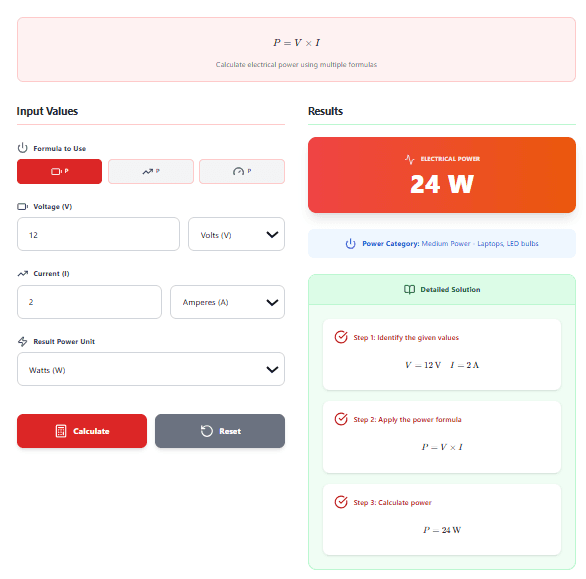
Here's a quick example:
A device running at 12 V and drawing 2 A:
- Power: 24 W
- Voltage: 12 V
- Current: 2 A
- Resistance: 6 Ω
The calculator shows you exactly how it got the answer, including any unit conversions needed.
Understanding Electrical Power
What Is Electrical Power?
Electrical power is the rate at which electrical energy is transferred by a circuit. It is measured in watts (W), where 1 W = 1 joule per second. A device that uses 1 watt converts 1 joule of electrical energy into another form (light, heat, motion) every second.
The Three Power Formulas
Because V, I, and R are linked by Ohm's law (V = IR), power can be written three equivalent ways:
P = V × I — Use when you know voltage and current
P = I² × R — Use when you know current and resistance
P = V² / R — Use when you know voltage and resistance
All three give the same power. Which one you use depends on which quantities you already have.
Key Relationships
- More voltage → More power (linear, at constant current)
- More current → More power (linear in V×I, quadratic in I²R)
- More resistance → Less power (at constant voltage) or more power (at constant current)
- Power is always positive — it is a rate of energy transfer, not a signed quantity
Rearranged Formulas
| What to Find | Formula |
|---|---|
| Power | P = VI = I²R = V²/R |
| Voltage | V = P/I or V = √(P×R) |
| Current | I = P/V or I = √(P/R) |
| Resistance | R = V²/P or R = P/I² |
Power Categories
Electrical power spans an enormous range, from microwatts to megawatts:
| Category | Range | Examples |
|---|---|---|
| Micropower | < 1 mW | Medical implants, sensors |
| Very Low Power | 1 mW – 0.1 W | LED indicators, calculators |
| Low Power | 0.1 W – 1 W | Smartphones, tablets |
| Medium Power | 1 W – 100 W | Laptops, LED bulbs |
| High Power | 100 W – 1 kW | Appliances, power tools |
| Very High Power | 1 kW – 10 kW | Electric vehicles, AC units |
| Extreme Power | > 10 kW | Industrial machinery, data centers |
Unit Support
This calculator handles a wide range of units:
Voltage Units
| Unit | Symbol | Conversion to V |
|---|---|---|
| Volt | V | 1 |
| Millivolt | mV | 0.001 |
| Kilovolt | kV | 1,000 |
Current Units
| Unit | Symbol | Conversion to A |
|---|---|---|
| Ampere | A | 1 |
| Milliampere | mA | 0.001 |
| Microampere | µA | 1 × 10⁻⁶ |
Resistance Units
| Unit | Symbol | Conversion to Ω |
|---|---|---|
| Ohm | Ω | 1 |
| Kiloohm | kΩ | 1,000 |
| Megaohm | MΩ | 1,000,000 |
Power Units
| Unit | Symbol | Conversion to W |
|---|---|---|
| Watt | W | 1 |
| Milliwatt | mW | 0.001 |
| Kilowatt | kW | 1,000 |
| Megawatt | MW | 1,000,000 |
How to Use the Calculator
Step 1: Choose Your Mode
Select one of four calculation modes:
- Calculate Power – Find P
- Calculate Voltage – Find V
- Calculate Current – Find I
- Calculate Resistance – Find R
Step 2: Choose the Formula
In each mode, choose which of the equivalent forms to use based on what you know:
- In Power mode: P = VI, P = I²R, or P = V²/R
- In Voltage mode: V = P/I or V = √(P×R)
- In Current mode: I = P/V or I = √(P/R)
- In Resistance mode: R = V²/P or R = P/I²
Step 3: Enter Your Values
Enter the known values with their units.
Step 4: Select Result Unit
Choose your preferred unit for the result.
Step 5: Calculate
Click "Calculate" and the result appears instantly.
Step 6: Review the Solution
The calculator shows detailed steps, including any unit conversions and intermediate calculations.
Step-by-Step Examples
Example 1: Power from Voltage and Current
Problem: A device runs at 12 V and draws 2 A. What is its power?
Step 1: Identify the given values
- V = 12 V
- I = 2 A
Step 2: Apply the formula
- P = V × I
- P = 12 × 2
- P = 24 W
Result: The device uses 24 W of power. It is a Low Power device.
Example 2: Power from Current and Resistance
Problem: A 3 A current flows through a 4 Ω resistor. How much power is dissipated?
Step 1: Identify the given values
- I = 3 A
- R = 4 Ω
Step 2: Apply the formula
- P = I² × R
- P = 3² × 4
- P = 9 × 4
- P = 36 W
Result: The resistor dissipates 36 W of power — enough to get noticeably hot.
Example 3: Power from Voltage and Resistance
Problem: A 120 V circuit drives a 60 Ω load. What is the power?
Step 1: Identify the given values
- V = 120 V
- R = 60 Ω
Step 2: Apply the formula
- P = V² / R
- P = (120)² / 60
- P = 14,400 / 60
- P = 240 W
Result: The circuit delivers 240 W — typical for a small appliance or heating element.
Example 4: Voltage from Power and Current
Problem: A device uses 24 W and draws 2 A. What voltage does it need?
Step 1: Identify the given values
- P = 24 W
- I = 2 A
Step 2: Apply the formula
- V = P/I
- V = 24/2
- V = 12 V
Result: The device needs 12 V.
Example 5: Current from Power and Resistance
Problem: A 100 W device has a resistance of 25 Ω. What current does it draw?
Step 1: Identify the given values
- P = 100 W
- R = 25 Ω
Step 2: Apply the formula
- I = √(P/R)
- I = √(100/25)
- I = √4
- I = 2 A
Result: The device draws 2 A.
Example 6: Resistance from Voltage and Power
Problem: A 24 W device runs on 12 V. What is its resistance?
Step 1: Identify the given values
- V = 12 V
- P = 24 W
Step 2: Apply the formula
- R = V²/P
- R = (12)² / 24
- R = 144/24
- R = 6 Ω
Result: The device's resistance is 6 Ω.
Practical Implications
Electrical power calculations drive real decisions across electronics and electrical engineering:
| Application | What power tells you |
|---|---|
| Component rating | Whether a resistor, transistor, or wire can handle the power without overheating |
| Power supply sizing | How much power a supply must provide |
| Battery drain | How long a battery will last at a given power draw |
| Appliance cost | Power × time × rate = energy cost |
| Circuit protection | Fuse and breaker ratings are based on power |
| Heat dissipation | How much heat a component must shed |
When to Use Each Mode
| Mode | Formula | When to Use | Typical Scenario |
|---|---|---|---|
| Power | P = VI, P = I²R, P = V²/R | You know two of V, I, R | Rating a component or appliance |
| Voltage | V = P/I or V = √(P×R) | You know power and current, or power and resistance | Finding the voltage a device needs |
| Current | I = P/V or I = √(P/R) | You know power and voltage, or power and resistance | Finding the current a device draws |
| Resistance | R = V²/P or R = P/I² | You know voltage and power, or power and current | Designing a load for a target power |
Common Questions About Electrical Power
Q: What is electrical power?
Electrical power is the rate at which electrical energy is transferred in a circuit. It is measured in watts (W), where 1 W = 1 J/s. A 60 W bulb converts 60 joules of electrical energy into light and heat every second.
Q: Why are there three power formulas?
Because Ohm's law (V = IR) links the three circuit quantities. Substituting V = IR into P = VI gives P = I²R. Substituting I = V/R gives P = V²/R. All three are equivalent — you use whichever one matches the values you already know.
Q: What is the difference between power and energy?
Power is a rate — how fast energy is used. Energy is the total amount used. A 60 W bulb running for 1 hour uses 60 Wh of energy. Power is measured in watts; energy is measured in joules or watt-hours.
Q: How much power does a typical appliance use?
- LED bulb: 5–15 W
- Incandescent bulb: 40–100 W
- Laptop: 50–100 W
- Refrigerator: 100–200 W (average, running)
- Washing machine: 500–2,000 W
- Electric kettle: 1,500–3,000 W
- Air conditioner: 1,000–3,500 W
- EV charger: 7,000–22,000 W
Q: Why do resistors have power ratings?
Because when current flows through a resistor, electrical energy is converted into heat. If the power exceeds the resistor's rating, it will overheat and fail. Common ratings are 1/8 W, 1/4 W, 1/2 W, 1 W, and higher for power resistors.
Q: What is the difference between peak and RMS power?
For AC circuits, RMS (root-mean-square) values give the equivalent DC power. Peak power is the instantaneous maximum, which for a sine wave is twice the average power. Most power ratings use RMS values.
Q: How do I calculate the cost of running an appliance?
Multiply the power (in kW) by the time (in hours) by your electricity rate ($/kWh). For example, a 1,500 W hair dryer running for 20 minutes uses 0.5 kWh. At $0.10/kWh, that is 5 cents.
Q: What is power factor?
In AC circuits with reactive loads (motors, transformers), the voltage and current are out of phase, so the real power (W) is less than the apparent power (VA). The ratio is the power factor (PF). For purely resistive loads, PF = 1.
Q: What is the relationship between power and heat?
In a resistive circuit, all electrical power is converted to heat: P = I²R. This is why resistors get hot and why power transmission lines lose energy. For non-resistive loads (motors, LEDs), some power is converted to other forms (motion, light) and only a fraction becomes heat.
Q: What real-world applications use electrical power calculations?
- Circuit design (sizing resistors, wires, and power supplies)
- Appliance ratings and energy cost estimates
- Battery life estimation
- Motor and generator design
- Power transmission and distribution
- Heat sink design for electronics
Tips for Getting the Best Results
Choose the right formula. Use the formula that matches the values you already have. If you know V and I, use P = VI. If you know I and R, use P = I²R. If you know V and R, use P = V²/R. All three give the same answer.
Watch your units. Voltage in V, mV, or kV; current in A, mA, or µA; resistance in Ω, kΩ, or MΩ; power in W, mW, kW, or MW. The calculator converts everything internally, but understanding the unit relationships helps catch mistakes.
Check the power category. For power-mode calculations, the calculator tells you whether the result is micropower, low power, high power, and so on. This is a quick sanity check on your result.
Remember the square relationships. P = I²R is quadratic in current — doubling the current quadruples the power. P = V²/R is quadratic in voltage. These square relationships matter when you are working near component limits.
Don't exceed component ratings. Resistors, transistors, and wires have maximum power ratings. Exceeding them leads to overheating and failure. Always check the rating before designing a circuit.
Double-check your inputs. A single digit error changes everything. Take a moment to verify each number.
Review the steps. The step-by-step solution helps you understand the process and verify the calculation.
Final Thoughts
Electrical power is one of the most fundamental quantities in electronics. It tells you how much energy a circuit transfers per second, whether a component can handle the load, and how much an appliance costs to run. The three equivalent formulas — P = VI, P = I²R, and P = V²/R — all say the same thing in different ways, and knowing which one to use is the key skill.
The relationships are simple but powerful. Because power depends on the square of current (in I²R) and the square of voltage (in V²/R), small changes in V or I can have large effects on power. That is why a slightly higher voltage can dramatically increase the heat dissipated in a resistor, and why power supplies and fuses are sized with careful margins.
This calculator handles all four quantities (power, voltage, current, resistance) with multiple formulas in each mode, complete unit support (voltage in V, mV, kV; current in A, mA, µA; resistance in Ω, kΩ, MΩ; power in W, mW, kW, MW), power categories, and step-by-step solutions.
Whether you are designing a circuit, rating a component, or estimating an appliance's energy use, this tool can save time and reduce mistakes by handling the math and unit conversions automatically.