Capacitor Calculator – Calculate Capacitance, Charge, or Voltage Using C = Q/V
Capacitors are everywhere in electronics. They store energy, filter signals, smooth power supplies, and enable countless circuit functions. Understanding how capacitance, charge, and voltage relate to each other is essential for anyone working with electronics.
The fundamental relationship is simple: C = Q/V. But applying it correctly with different units and understanding the energy stored in a capacitor can be challenging. This calculator handles three different calculation modes with automatic unit conversions and step-by-step solutions.
Quick access: Use our free capacitor calculator here
What Does This Calculator Do?
This tool calculates capacitor values using the fundamental relationship: C = Q/V.
Three calculation modes:
Calculate Capacitance (C = Q/V) – Find capacitance from charge and voltage
Calculate Charge (Q = C × V) – Find charge stored from capacitance and voltage
Calculate Voltage (V = Q/C) – Find voltage from charge and capacitance
Plus energy calculations – Each mode also calculates the energy stored in the capacitor.
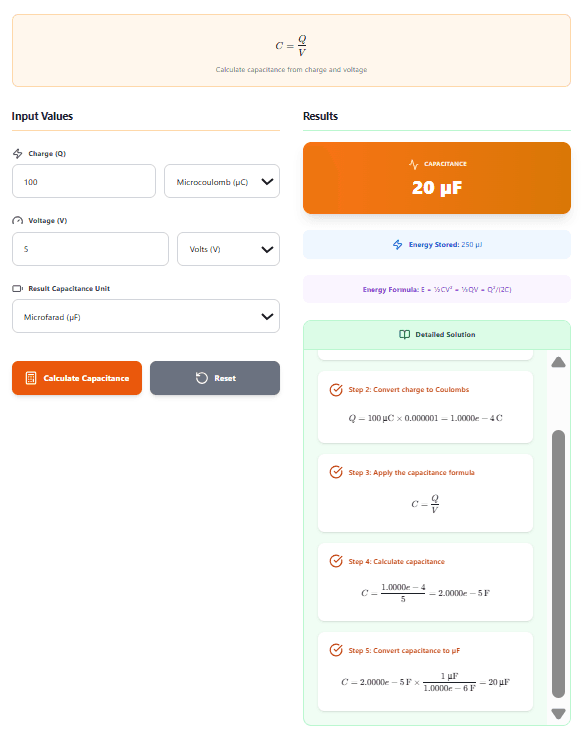
Here's a quick example:
A capacitor stores 100 µC of charge at 5 V:
- Capacitance: 20 µF
- Charge: 100 µC
- Voltage: 5 V
- Energy stored: 250 µJ
The calculator shows you exactly how it got the answer, including all unit conversions.
Understanding Capacitor Fundamentals
What Is a Capacitor?
A capacitor is a device that stores electrical energy in an electric field. It consists of two conductive plates separated by an insulating material (dielectric).
The Basic Relationship
C = Q/V
Where:
- C = Capacitance (farads)
- Q = Charge stored (coulombs)
- V = Voltage applied (volts)
Key Relationships
- Larger capacitance → More charge storage at same voltage
- Higher voltage → More charge storage at same capacitance
- More charge → Higher voltage at same capacitance
Energy Stored in a Capacitor
E = ½CV² = ½QV = Q²/(2C)
Energy is measured in joules (J). This energy is stored in the electric field between the plates.
Unit Support
This calculator handles all common units automatically:
Capacitance Units
| Unit | Symbol | Conversion to F |
|---|---|---|
| Farad | F | 1 |
| Millifarad | mF | 0.001 |
| Microfarad | µF | 0.000001 |
| Nanofarad | nF | 0.000000001 |
| Picofarad | pF | 0.000000000001 |
Charge Units
| Unit | Symbol | Conversion to C |
|---|---|---|
| Coulomb | C | 1 |
| Millicoulomb | mC | 0.001 |
| Microcoulomb | µC | 0.000001 |
| Nanocoulomb | nC | 0.000000001 |
| Picocoulomb | pC | 0.000000000001 |
Voltage Units
| Unit | Symbol | Conversion to V |
|---|---|---|
| Volt | V | 1 |
| Millivolt | mV | 0.001 |
| Kilovolt | kV | 1000 |
| Megavolt | MV | 1000000 |
How to Use the Calculator
Step 1: Choose Your Mode
Select one of three calculation modes:
- Capacitance – Find C
- Charge – Find Q
- Voltage – Find V
Step 2: Enter Your Values
Depending on the mode, enter the required values with their units.
Step 3: Select Result Unit
Choose your preferred unit for the result.
Step 4: Calculate
Click the "Calculate" button. The results appear instantly with step-by-step solutions and energy calculation.
Step-by-Step Examples for Each Mode
Example 1: Calculate Capacitance
Problem: A capacitor stores 100 µC of charge at 5 V. What is its capacitance?
Step 1: Identify the given values
- Q = 100 µC = 100 × 10⁻⁶ C
- V = 5 V
Step 2: Apply the formula
- C = Q/V
- C = (100 × 10⁻⁶) / 5
- C = 20 × 10⁻⁶ F = 20 µF
Step 3: Calculate energy
- E = ½ × Q × V = ½ × 100 × 10⁻⁶ × 5
- E = 250 × 10⁻⁶ J = 250 µJ
Result: 20 µF, storing 250 µJ
Example 2: Calculate Charge
Problem: A 10 µF capacitor is charged to 5 V. How much charge does it store?
Step 1: Identify the given values
- C = 10 µF = 10 × 10⁻⁶ F
- V = 5 V
Step 2: Apply the formula
- Q = C × V
- Q = (10 × 10⁻⁶) × 5
- Q = 50 × 10⁻⁶ C = 50 µC
Step 3: Calculate energy
- E = ½ × C × V² = ½ × 10 × 10⁻⁶ × 25
- E = 125 × 10⁻⁶ J = 125 µJ
Result: 50 µC, storing 125 µJ
Example 3: Calculate Voltage
Problem: A 10 µF capacitor stores 100 µC of charge. What is the voltage?
Step 1: Identify the given values
- Q = 100 µC = 100 × 10⁻⁶ C
- C = 10 µF = 10 × 10⁻⁶ F
Step 2: Apply the formula
- V = Q/C
- V = (100 × 10⁻⁶) / (10 × 10⁻⁶)
- V = 10 V
Step 3: Calculate energy
- E = ½ × Q × V = ½ × 100 × 10⁻⁶ × 10
- E = 500 × 10⁻⁶ J = 500 µJ
Result: 10 V, storing 500 µJ
Common Capacitor Values
| Type | Typical Values | Voltage Ratings | Applications |
|---|---|---|---|
| Ceramic | 1 pF to 100 µF | 50-1000 V | Decoupling, filtering |
| Electrolytic | 1 µF to 100,000 µF | 6.3-450 V | Power supply smoothing |
| Tantalum | 0.1 µF to 1000 µF | 2.5-125 V | Compact, stable |
| Film | 100 pF to 10 µF | 50-1000 V | Audio, precision |
| Supercapacitor | 1 F to 5000+ F | 2.3-5.5 V | Energy storage, backup |
Energy Storage Reference
| Capacitance | Voltage | Energy Stored |
|---|---|---|
| 1 pF | 5 V | 12.5 pJ |
| 1 nF | 5 V | 12.5 nJ |
| 100 nF | 5 V | 1.25 µJ |
| 1 µF | 5 V | 12.5 µJ |
| 10 µF | 5 V | 125 µJ |
| 100 µF | 5 V | 1.25 mJ |
| 1000 µF | 5 V | 12.5 mJ |
| 1000 µF | 10 V | 50 mJ |
| 1 F | 1 V | 0.5 J |
| 1 F | 5 V | 12.5 J |
| 10 F | 5 V | 125 J |
| 100 F | 5 V | 1250 J |
When to Use Each Mode
| Mode | Formula | When to Use | Typical Scenario |
|---|---|---|---|
| Capacitance | C = Q/V | You have Q and V | Determining capacitor value from measurement |
| Charge | Q = C × V | You have C and V | Calculating charge stored in a timing circuit |
| Voltage | V = Q/C | You have Q and C | Checking voltage across a charged capacitor |
Common Questions About Capacitors
Q: What is capacitance?
Capacitance is the ability of a component to store electrical charge. It's measured in farads (F) and represents the ratio of charge to voltage: C = Q/V.
Q: What is a farad?
A farad (F) is the unit of capacitance. One farad stores one coulomb of charge at one volt. In practice, most capacitors are microfarads (µF), nanofarads (nF), or picofarads (pF).
Q: What is a coulomb?
A coulomb (C) is the unit of electric charge. It represents the amount of charge transported by a current of one ampere in one second.
Q: What is a volt?
A volt (V) is the unit of electric potential difference. It represents the potential difference needed to cause one ampere of current to flow through one ohm of resistance.
Q: How does a capacitor store energy?
A capacitor stores energy in the electric field between its plates. The energy formula is E = ½CV², showing that energy increases with the square of voltage.
Q: What is the difference between a capacitor and a battery?
Both store energy, but they work differently. A capacitor stores energy electrostatically (in an electric field) and can charge/discharge very quickly. A battery stores energy chemically and has higher energy density but slower charge/discharge.
Q: What is a farad in real terms?
One farad is a very large value. Most capacitors in a smartphone are in the µF, nF, or pF range — a 10 µF capacitor, for example, is 0.00001 F. Supercapacitors can reach 10 F or more.
Q: Can I mix different units?
No — C, Q, and V must be in consistent SI units (farads, coulombs, volts) for the formula to work directly. The calculator converts your entered units to SI internally, so you can enter values in µF, µC, or mV and it will handle the rest.
Tips for Getting the Best Results
Choose the right mode. Make sure you're calculating what you need — capacitance, charge, or voltage.
Check your units. The calculator handles conversions automatically, but make sure you're entering values with the correct units.
Double-check your inputs. A single digit error changes everything. Take a moment to verify each number.
Review the steps. The step-by-step solution helps you understand the process and verify the calculation.
Check the energy. The energy calculation helps you understand the capacitor's storage capability.
Consider voltage limits. Capacitors have maximum voltage ratings. Don't exceed them.
Final Thoughts
Understanding the relationship between capacitance, charge, and voltage is essential for anyone working with electronics. The formula C = Q/V is simple but powerful — it connects the fundamental properties of capacitors in a way that applies to every circuit.
This calculator handles all three variants of the formula, making it a comprehensive tool for capacitor calculations. Whether you're designing a circuit, checking homework, or exploring electronics, this tool can save time and reduce mistakes by handling the math and unit conversions automatically.