Distance Calculator – Calculate d = v × t with Step-by-Step Solutions
Distance is one of the most basic quantities in physics and everyday life. If you know how fast something is moving and how long it has been moving, you know how far it has gone. The formula is simple: d = v × t, where d is distance, v is velocity (or speed), and t is time.
The subtlety is in the units. Velocity can be in m/s, km/h, mph, ft/s, cm/s, or knots; time can be in seconds, minutes, hours, or milliseconds; and the answer can be in meters, kilometers, miles, feet, yards, or centimeters. This calculator handles all of those combinations automatically, with step-by-step solutions.
Quick access: Use our free distance calculator here
What Does This Calculator Do?
This tool calculates distance using the fundamental kinematic relationship: d = v × t.
What you enter:
- Velocity (v) with unit
- Time (t) with unit
What you get:
- Distance (d) in your preferred unit
- The converted velocity in m/s
- The converted time in seconds
- Step-by-step working
Here's a quick example:
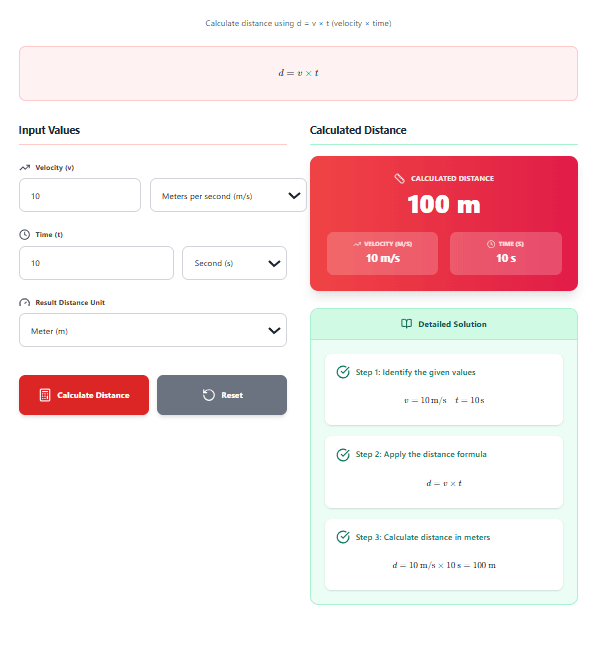
An object moving at 10 m/s for 10 seconds:
- Distance: 100 m
- Velocity: 10 m/s
- Time: 10 s
The calculator shows you exactly how it got the answer, including any unit conversions needed.
Understanding the Distance Formula
The Formula
d = v × t
Where:
- d = Distance traveled (m, km, mi, etc.)
- v = Velocity or speed (m/s, km/h, mph, etc.)
- t = Time (s, min, h, etc.)
Distance vs Displacement
The formula d = v × t gives distance for motion in a single direction at constant speed. It is technically the same as displacement in that case, but the two are not always interchangeable:
- Distance is a scalar — the total length of the path traveled, regardless of direction.
- Displacement is a vector — the straight-line change in position, with direction.
If an object moves in a straight line without changing direction, distance and displacement are equal. If it turns around, they diverge — a round trip has positive distance but zero displacement.
Distance vs Speed vs Velocity
- Speed is a scalar — how fast something moves.
- Velocity is a vector — how fast and in which direction.
- For the formula d = v × t, either works as long as you are only interested in the magnitude of the distance traveled. If the direction matters, use velocity.
Key Relationships
- Higher velocity → More distance (linear)
- Longer time → More distance (linear)
- Doubling either input → Doubles the distance
- The relationship is linear — no squares, no reciprocals
Rearranged Formulas
| What to Find | Formula |
|---|---|
| Distance | d = v × t |
| Velocity | v = d/t |
| Time | t = d/v |
Unit Support
This calculator handles a wide range of velocity, time, and distance units:
Velocity Units
| Unit | Symbol | Conversion to m/s |
|---|---|---|
| Meters per second | m/s | 1 |
| Kilometers per hour | km/h | 0.277778 |
| Miles per hour | mph | 0.44704 |
| Feet per second | ft/s | 0.3048 |
| Centimeters per second | cm/s | 0.01 |
| Knot | knot | 0.514444 |
The knot is a nautical mile per hour, common in aviation and marine navigation.
Time Units
| Unit | Symbol | Conversion to s |
|---|---|---|
| Second | s | 1 |
| Minute | min | 60 |
| Hour | h | 3600 |
| Millisecond | ms | 0.001 |
Distance Units
| Unit | Symbol | Conversion to m |
|---|---|---|
| Meter | m | 1 |
| Kilometer | km | 1000 |
| Centimeter | cm | 0.01 |
| Millimeter | mm | 0.001 |
| Mile | mi | 1609.344 |
| Foot | ft | 0.3048 |
| Yard | yd | 0.9144 |
How to Use the Calculator
Step 1: Enter Velocity
Enter the velocity (or speed) value and select its unit. The calculator supports m/s, km/h, mph, ft/s, cm/s, and knots.
Step 2: Enter Time
Enter the time value and select its unit. The calculator supports seconds, minutes, hours, and milliseconds.
Step 3: Select Result Unit
Choose your preferred unit for the distance — meters, kilometers, miles, feet, yards, centimeters, or millimeters.
Step 4: Calculate
Click "Calculate Distance" and the result appears instantly with full working.
Step 5: Review the Solution
The calculator shows detailed steps, including any unit conversions and the intermediate multiplication.
Step-by-Step Examples
Example 1: Walking Distance (Basic)
Problem: You walk at 1.4 m/s for 600 seconds. How far do you walk?
Step 1: Identify the given values
- v = 1.4 m/s
- t = 600 s
Step 2: Apply the formula
- d = v × t
- d = 1.4 × 600
- d = 840 m
Result: You walk 840 m.
Example 2: Car Trip (km/h and Hours)
Problem: A car travels at 90 km/h for 2.5 hours. How far does it travel?
Step 1: Identify the given values
- v = 90 km/h
- t = 2.5 h
Step 2: Convert velocity to m/s
- v = 90 × 0.277778 = 25 m/s
Step 3: Convert time to seconds
- t = 2.5 × 3600 = 9000 s
Step 4: Apply the formula
- d = 25 × 9000 = 225,000 m
Step 5: Convert to km
- d = 225,000 / 1000 = 225 km
Result: The car travels 225 km.
Example 3: Running a Mile
Problem: A runner moves at 4 m/s. How long does it take to cover 1 mile (1609.344 m)?
Step 1: Identify the given values
- v = 4 m/s
- d = 1 mile
Step 2: Convert distance to meters
- d = 1609.344 m
Step 3: Rearrange the formula
- t = d/v
- t = 1609.344 / 4
- t ≈ 402.3 s
Step 4: Convert to minutes
- t ≈ 6.71 min
Result: The runner takes about 402 seconds — roughly 6 minutes 42 seconds — to run a mile.
Example 4: Nautical Navigation (Knots)
Problem: A ship travels at 20 knots for 6 hours. How far does it go?
Step 1: Convert velocity to m/s
- v = 20 × 0.514444 = 10.289 m/s
Step 2: Convert time to seconds
- t = 6 × 3600 = 21,600 s
Step 3: Apply the formula
- d = 10.289 × 21,600 = 222,240 m
Step 4: Convert to nautical miles
- 1 nautical mile = 1852 m
- d = 222,240 / 1852 ≈ 120 nautical miles
Result: The ship travels 120 nautical miles. (For knots, 20 knots × 6 h = 120 nautical miles — the units cancel directly.)
Example 5: Mixed Units
Problem: A drone flies at 45 mph for 90 seconds. How far does it travel in meters?
Step 1: Convert velocity to m/s
- v = 45 × 0.44704 ≈ 20.117 m/s
Step 2: Convert time to seconds
- t = 90 s
Step 3: Apply the formula
- d = 20.117 × 90
- d ≈ 1810.5 m
Result: The drone travels about 1810 m (or 1.81 km).
Common Applications
Distance calculations appear everywhere:
| Context | What the calculation tells you |
|---|---|
| Driving / travel planning | How far you can go in a given time |
| Running and cycling | Pace and distance for training |
| Aviation | Flight range between airports |
| Marine navigation | Voyage distance in nautical miles |
| Astronomy | Light-travel distance from stars |
| Physics problems | Motion under constant velocity |
When to Use Each Rearrangement
| What you know | What you can find | Formula |
|---|---|---|
| Velocity and time | Distance | d = v × t |
| Distance and time | Velocity | v = d/t |
| Distance and velocity | Time | t = d/v |
The calculator on this page handles the first case. The other two are simple rearrangements — useful when your known quantities are different.
Common Questions About Distance
Q: What is the formula for distance?
The formula is d = v × t, where d is distance, v is velocity (or speed), and t is time. It assumes constant velocity — no acceleration.
Q: What is the difference between distance and displacement?
Distance is a scalar — the total length of the path traveled. Displacement is a vector — the straight-line change in position, with direction. If you walk around a block and return to your starting point, your distance is the perimeter but your displacement is zero.
Q: What is the difference between speed and velocity?
Speed is a scalar — how fast something moves. Velocity is a vector — how fast and in which direction. For the d = v × t formula, either works as long as you only care about the magnitude of the distance.
Q: Can the distance formula handle acceleration?
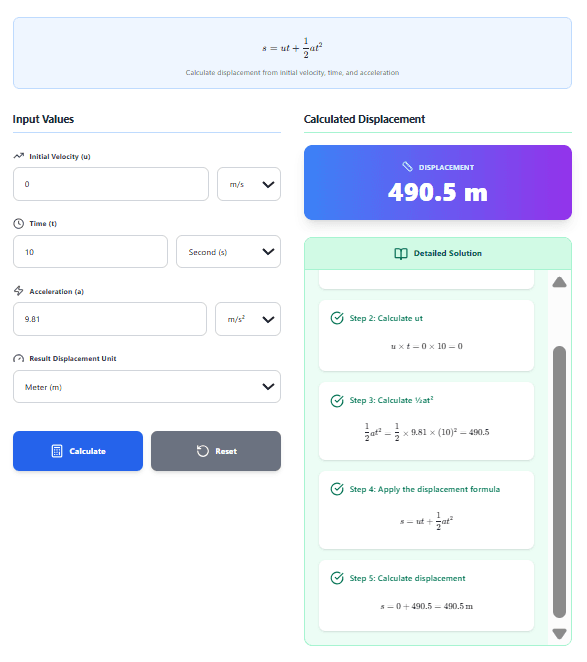
No. The formula d = v × t assumes constant velocity. If the object is accelerating, you need the kinematic equations — s = ut + ½at², s = ½(u + v)t, or s = vt − ½at².
Q: Why is the knot used in navigation?
A knot is one nautical mile per hour. A nautical mile is defined as one minute of latitude — so 1 knot × 1 hour = 1 nautical mile, and the units work out cleanly for navigation on a sphere. That is why ships and aircraft use knots rather than km/h or mph.
Q: How do I convert km/h to m/s?
Divide by 3.6, or multiply by 0.277778. For example, 72 km/h = 20 m/s. This conversion is essential when mixing highway speeds with distances in meters.
Q: How do I convert mph to m/s?
Multiply by 0.44704. For example, 60 mph ≈ 26.82 m/s. The exact value is 0.44704 m/s per mph, based on 1 mile = 1609.344 m.
Q: What is the speed of light in km/h?
About 1.08 billion km/h (1,079,252,849 km/h). The speed of light is exactly 299,792,458 m/s, which converts to about 1.08 × 10⁹ km/h. Light travels roughly 300,000 km every second — that is the ultimate speed limit for distance calculations at constant velocity.
Q: Does the calculator work for light-years?
Not directly, but you can get there with unit conversions. A light-year is about 9.461 × 10¹⁵ m. Multiply the speed of light by the number of seconds in a year to find that distance. The calculator does not include astronomical units, but the same d = v × t formula applies.
Q: What real-world applications rely on distance calculations?
- Trip planning (how far can I drive on a full tank?)
- Running and cycling pace
- Flight range estimation
- Marine navigation
- Astronomy (light-travel distances)
- Sports analytics (how far a ball travels)
Tips for Getting the Best Results
Match your units carefully. The most common error is mixing m/s with hours, or km/h with seconds. The calculator converts everything internally, but understanding the relationships helps catch mistakes.
Use knots for navigation. If you are working with aviation or marine distances, knots and nautical miles simplify the math.
Watch the units of the result. A distance in meters is fine for physics problems; a distance in miles or kilometers is more intuitive for travel. The calculator lets you pick the output unit.
Remember: constant velocity only. If the object accelerates, decelerates, or changes direction, this formula does not apply. Split the motion into segments with constant velocity.
Double-check your inputs. A single digit error changes everything. Take a moment to verify each number.
Review the steps. The step-by-step solution helps you understand the process and verify the calculation.
Final Thoughts
Distance is one of the simplest physical quantities, and the formula d = v × t is one of the first equations students learn. But it is also one of the most useful: the same relationship governs everyday travel, navigation, sports, and astronomy. The only complications are the units — and this calculator handles all of them.
The formula assumes constant velocity, so it does not cover accelerating objects. But for the vast majority of everyday distance calculations — walking, driving, flying, sailing — velocity is close enough to constant over the interval you care about, and d = v × t gives the right answer.
This calculator handles the distance formula with support for velocity in m/s, km/h, mph, ft/s, cm/s, and knots; time in seconds, minutes, hours, and milliseconds; and distance in meters, kilometers, centimeters, millimeters, miles, feet, and yards. The output includes step-by-step working and a summary of the converted inputs.
Whether you are planning a trip, solving a physics problem, or navigating at sea, this tool can save time and reduce mistakes by handling the math and unit conversions automatically.