Displacement Calculator – Calculate s = ut + ½at² with Step-by-Step Solutions
Displacement is the change in an object's position — not the total distance traveled, but how far it ended up from where it started, and in which direction. It is one of the fundamental quantities in kinematics, and it is governed by a small set of equations that describe motion under constant acceleration.
Which equation you use depends on what information you have. This calculator handles three different forms of the displacement formula, with automatic unit conversions and step-by-step solutions.
Quick access: Use our free displacement calculator here
What Does This Calculator Do?
This tool calculates displacement using three kinematic equations, depending on which quantities you know.
Three calculation modes:
From Time (s = ut + ½at²) – Find displacement from initial velocity, time, and acceleration
From Velocity (s = ½(u + v)t) – Find displacement from initial velocity, final velocity, and time
From Acceleration (s = vt − ½at²) – Find displacement from final velocity, time, and acceleration
Here's a quick example:
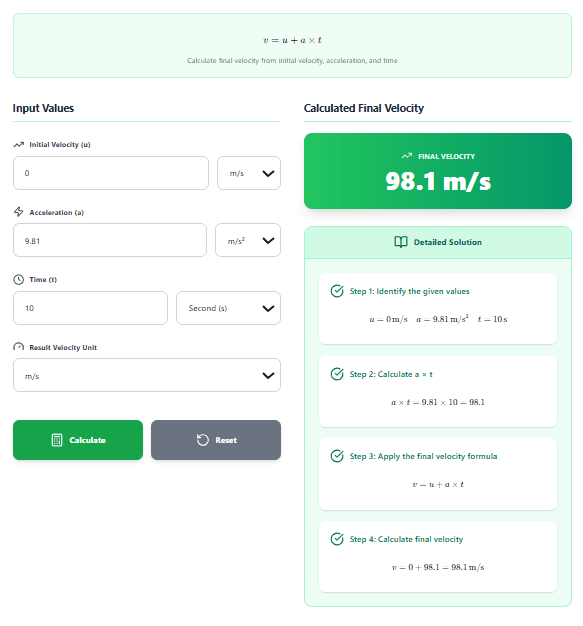
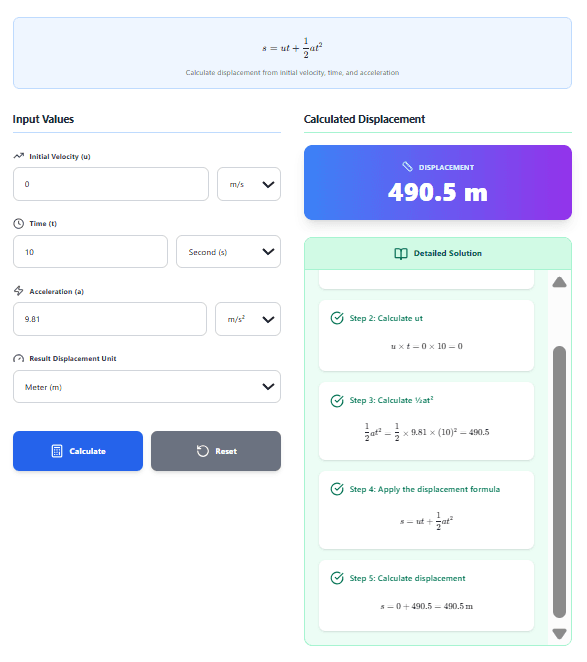
An object starts from rest (u = 0), accelerates at 9.81 m/s² for 10 seconds:
- Displacement: 490.5 m
- Initial velocity: 0 m/s
- Time: 10 s
- Acceleration: 9.81 m/s²
The calculator shows you exactly how it got the answer, including any unit conversions needed.
Understanding Displacement
What Is Displacement?
Displacement (s) is the change in position of an object. It is a vector quantity — it has both a magnitude and a direction. Displacement is not the same as distance traveled: if you walk around a block and return to your starting point, your distance traveled is the perimeter of the block, but your displacement is zero.
The Three Kinematic Equations
These three forms of the displacement formula all describe motion under constant acceleration. They are algebraically equivalent, but each is convenient when you know a different set of quantities.
1. s = ut + ½at² Use when you know: initial velocity, time, and acceleration.
2. s = ½(u + v)t Use when you know: initial velocity, final velocity, and time.
3. s = vt − ½at² Use when you know: final velocity, time, and acceleration.
Where:
- s = Displacement (m)
- u = Initial velocity (m/s)
- v = Final velocity (m/s)
- a = Acceleration (m/s²)
- t = Time (s)
Key Relationships
- Higher initial velocity → More displacement (linear)
- Longer time → More displacement (quadratic if accelerating from rest)
- Higher acceleration → More displacement (quadratic)
- Sign matters — negative acceleration (deceleration) reduces displacement
The Complete Kinematic Set
Displacement is just one of the five kinematic quantities. The others are:
- v = u + at (velocity-time)
- v² = u² + 2as (velocity-displacement)
- s = ut + ½at² (displacement-time)
- s = ½(u + v)t (displacement with average velocity)
All of these assume constant acceleration. If acceleration changes, you need calculus or numerical methods.
Unit Support
This calculator handles a wide range of units automatically:
Velocity Units
| Unit | Symbol | Conversion to m/s |
|---|---|---|
| Meters per second | m/s | 1 |
| Kilometers per hour | km/h | 0.277778 |
| Miles per hour | mph | 0.44704 |
| Feet per second | ft/s | 0.3048 |
Acceleration Units
| Unit | Symbol | Conversion to m/s² |
|---|---|---|
| Meters per second squared | m/s² | 1 |
| Centimeters per second squared | cm/s² | 0.01 |
| Feet per second squared | ft/s² | 0.3048 |
Time Units
| Unit | Symbol | Conversion to s |
|---|---|---|
| Second | s | 1 |
| Millisecond | ms | 0.001 |
| Minute | min | 60 |
| Hour | h | 3600 |
Displacement Units
| Unit | Symbol | Conversion to m |
|---|---|---|
| Meter | m | 1 |
| Kilometer | km | 1000 |
| Centimeter | cm | 0.01 |
| Millimeter | mm | 0.001 |
| Foot | ft | 0.3048 |
| Inch | in | 0.0254 |
How to Use the Calculator
Step 1: Choose Your Mode
Select the mode that matches the information you have:
- From Time – You know u, t, and a
- From Velocity – You know u, v, and t
- From Acceleration – You know v, t, and a
Step 2: Enter Your Values
Depending on the mode, enter the required values with their units.
Step 3: Select Result Unit
Choose your preferred unit for the result.
Step 4: Calculate
Click the "Calculate" button. The results appear instantly.
Step 5: Review the Solution
The calculator shows detailed steps, including any unit conversions and intermediate calculations.
Step-by-Step Examples
Example 1: Free Fall (From Time)
Problem: An object is dropped from rest and falls for 3 seconds. Taking g = 9.81 m/s², how far does it fall?
Step 1: Identify the given values
- u = 0 m/s
- t = 3 s
- a = 9.81 m/s²
Step 2: Apply the formula
- s = ut + ½at²
- s = (0 × 3) + ½ × 9.81 × 3²
- s = 0 + ½ × 9.81 × 9
- s = 44.145 m
Result: The object falls about 44.1 m.
Example 2: Car Braking (From Time)
Problem: A car traveling at 30 m/s brakes at −5 m/s² for 4 seconds. What is its displacement during braking?
Step 1: Identify the given values
- u = 30 m/s
- t = 4 s
- a = −5 m/s²
Step 2: Apply the formula
- s = ut + ½at²
- s = (30 × 4) + ½ × (−5) × 4²
- s = 120 + (−40)
- s = 80 m
Result: The car travels 80 m while braking.
Example 3: Average Velocity Method (From Velocity)
Problem: A cyclist accelerates from 5 m/s to 15 m/s over 10 seconds. How far does the cyclist travel?
Step 1: Identify the given values
- u = 5 m/s
- v = 15 m/s
- t = 10 s
Step 2: Apply the formula
- s = ½(u + v)t
- s = ½ × (5 + 15) × 10
- s = ½ × 20 × 10
- s = 100 m
Result: The cyclist travels 100 m.
Example 4: Rocket Launch (From Acceleration)
Problem: A rocket reaches a final velocity of 200 m/s after 20 seconds of launch, accelerating at 5 m/s². What is its displacement?
Step 1: Identify the given values
- v = 200 m/s
- t = 20 s
- a = 5 m/s²
Step 2: Apply the formula
- s = vt − ½at²
- s = (200 × 20) − ½ × 5 × 20²
- s = 4000 − 1000
- s = 3000 m
Result: The rocket's displacement is 3000 m (3 km).
Example 5: Mixed Units
Problem: A car traveling at 72 km/h brakes at −2 m/s² for 5 seconds. What is its displacement in meters?
Step 1: Convert velocity to m/s
- u = 72 km/h × 0.277778 = 20 m/s
Step 2: Apply the formula
- s = ut + ½at²
- s = (20 × 5) + ½ × (−2) × 5²
- s = 100 + (−25)
- s = 75 m
Result: The car travels 75 m while braking.
Practical Implications
Displacement calculations drive decisions in physics, engineering, and everyday life:
| Situation | What displacement tells you |
|---|---|
| Car braking distance | How much road you need to stop safely |
| Free fall | How far an object falls in a given time |
| Rocket launch | The altitude gained during the burn phase |
| Sports analysis | How far a ball travels during a play |
| Elevator motion | Distance covered during acceleration and deceleration |
| Projectile motion | Horizontal displacement of a launched object |
When to Use Each Mode
| Mode | Formula | When to Use | Typical Scenario |
|---|---|---|---|
| From Time | s = ut + ½at² | You know u, t, a | Free fall, braking distance |
| From Velocity | s = ½(u + v)t | You know u, v, t | Average-velocity problems |
| From Acceleration | s = vt − ½at² | You know v, t, a | Rocket launches, deceleration |
Common Questions About Displacement
Q: What is displacement?
Displacement is the change in position of an object — how far it ended up from where it started, along with the direction. It is a vector quantity, measured in meters (or other length units).
Q: What is the difference between displacement and distance?
Distance is the total length of the path traveled, regardless of direction. Displacement is the straight-line change in position. If you walk in a circle and return to your starting point, your distance is the circumference but your displacement is zero.
Q: Which kinematic equation should I use?
It depends on what you know:
- Know u, t, and a? Use s = ut + ½at²
- Know u, v, and t? Use s = ½(u + v)t
- Know v, t, and a? Use s = vt − ½at²
All three give the same answer when the inputs are consistent.
Q: What if acceleration is zero?
If a = 0, all three formulas reduce to s = ut (or equivalently s = vt, since u = v when there is no acceleration). The object moves at constant velocity, and displacement is just velocity times time.
Q: Can displacement be negative?
Yes. Displacement is a vector — a negative displacement means the object ended up in the opposite direction from the chosen positive axis. For example, a ball thrown upward has a positive displacement on the way up and a negative displacement (relative to its starting point) after it passes the throw height on the way down.
Q: What is the difference between displacement and position?
Position is where an object is, measured from a chosen origin. Displacement is the change in position — final position minus initial position. Displacement does not depend on where you put the origin; position does.
Q: How do I handle non-constant acceleration?
The three kinematic equations assume constant acceleration. If acceleration changes with time, you need to integrate: s = ∫v dt. The calculator does not handle variable acceleration.
Q: Why does the formula have a ½ in it?
The ½at² term comes from integrating velocity over time. When acceleration is constant, velocity grows linearly (v = u + at), and the area under the velocity-time graph is a trapezoid — half the base times the sum of parallel sides. That area is exactly the displacement.
Q: What real-world applications use displacement calculations?
- Automotive braking distance and safety systems
- Projectile motion (sports, ballistics)
- Rocket and spacecraft trajectories
- Elevator and conveyor belt design
- Sports analytics (golf, baseball, soccer)
- Free-fall physics demonstrations
Tips for Getting the Best Results
Choose the right mode. Use the equation that matches the inputs you have. If you have u, v, and t, use the average-velocity form — it avoids needing acceleration.
Watch the signs. Negative acceleration (deceleration) reduces displacement. Negative initial velocity means the object started moving in the negative direction. Get the signs right and the formulas work.
Check your units. The calculator converts everything internally, but understanding the unit relationship helps catch mistakes. For example, km/h must be converted to m/s before plugging into a formula that uses m/s².
Remember: constant acceleration only. If acceleration changes during the motion — like a car shifting gears or a rocket staging — you need to split the motion into segments with constant acceleration in each.
Double-check your inputs. A single digit error changes everything. Take a moment to verify each number.
Review the steps. The step-by-step solution helps you understand the process and verify the calculation.
Final Thoughts
Displacement is one of the first quantities students encounter in kinematics, and for good reason: it captures the essence of motion in a single number. The three kinematic equations that describe it — s = ut + ½at², s = ½(u + v)t, and s = vt − ½at² — are algebraically equivalent, but each is best suited to a different set of known quantities.
This calculator handles all three forms, with full unit support (velocity in m/s, km/h, mph, ft/s; acceleration in m/s², cm/s², ft/s²; time in s, ms, min, h; displacement in m, km, cm, mm, ft, in) and step-by-step solutions.
Whether you're solving a homework problem, checking a braking distance, or analyzing a rocket launch, this tool can save time and reduce mistakes by handling the math and unit conversions automatically.