Acceleration Calculator – Calculate Acceleration Using Newton's Second Law (a = F/m)
Understanding Newton's Second Law is much easier when you can experiment with different force and mass values. This calculator helps you do that instantly while showing each calculation step.
Whether you're a student checking homework, an engineer verifying designs, or someone curious about physics, this tool handles the math and unit conversions so you can focus on understanding the concepts.
Quick access: Use our free acceleration calculator here
What Does This Calculator Do?
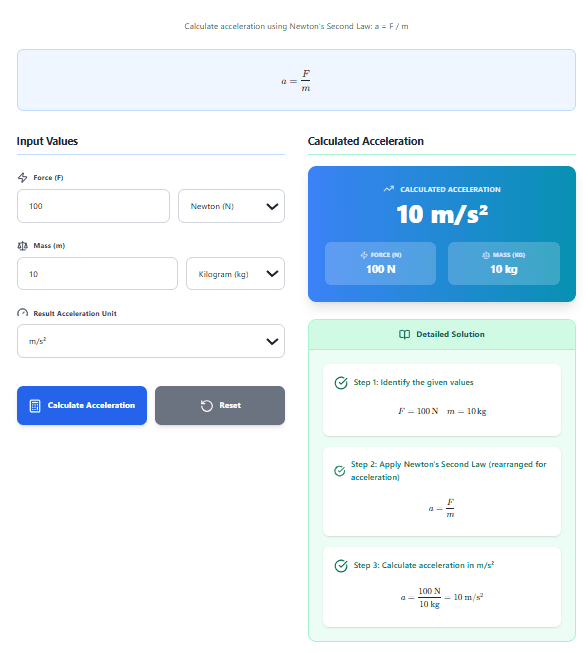
This tool calculates acceleration using Newton's Second Law: a = F / m. Enter force and mass values, choose your units, and get instant results with complete step-by-step solutions.
Here's a quick example:
Apply 100 Newtons of force to a 10 kg object:
- Acceleration: 10 m/s²
- Force: 100 N
- Mass: 10 kg
The calculator shows you exactly how it got the answer, including any unit conversions needed.
Why Unit Conversions Matter
Many physics problems become confusing because of mixed units. Force might be in pound-force (lbf) while mass is in grams. Without converting to consistent units, the result is meaningless.
This calculator handles all the conversions automatically:
Force units supported: Newton (N), Kilonewton (kN), Pound-force (lbf), Dyne (dyn)
Mass units supported: Kilogram (kg), Gram (g), Milligram (mg), Pound (lb)
Acceleration units supported: m/s², cm/s², ft/s², km/h²
Simply select your input units, choose your preferred output unit, and the tool does the rest.
The Formula: a = F/m
Understanding Newton's Second Law
Newton's Second Law of Motion states that the acceleration of an object depends on two factors:
- The net force applied to the object (direct relationship)
- The mass of the object (inverse relationship)
In equation form: F = ma
To solve for acceleration, rearrange the formula: a = F / m
What Each Variable Means
| Variable | Meaning | Common Units |
|---|---|---|
| F | Force (push or pull) | N, kN, lbf, dyn |
| m | Mass (amount of matter) | kg, g, mg, lb |
| a | Acceleration (rate of velocity change) | m/s², cm/s², ft/s², km/h² |
Key Relationships
- Double the force (same mass) → Double the acceleration
- Double the mass (same force) → Half the acceleration
- Triple both force and mass → Same acceleration
Step-by-Step Example
Let's work through a complete example step by step.
Problem: A force of 100 N is applied to a 10 kg object. What is the acceleration?
Step 1: Identify the given values
- F = 100 N
- m = 10 kg
Step 2: Apply the formula
- a = F / m
Step 3: Calculate
- a = 100 / 10
- a = 10 m/s²
Result: The object accelerates at 10 m/s².
Real-World Examples
Example 1: A Car
A car engine applies 4,000 N of force to a 1,200 kg vehicle.
Calculation:
- a = 4,000 / 1,200
- a = 3.33 m/s²
Result: The car accelerates at approximately 3.33 m/s² (about 0-60 mph in 8 seconds).
Example 2: A Shopping Cart
You push a 15 kg shopping cart with 30 N of force.
Calculation:
- a = 30 / 15
- a = 2 m/s²
Result: The cart accelerates at 2 m/s².
Example 3: A Rocket
A rocket engine produces 7,000,000 N of thrust with a mass of 500,000 kg.
Calculation:
- a = 7,000,000 / 500,000
- a = 14 m/s²
Result: The rocket accelerates at 14 m/s² (about 1.4 times Earth's gravity).
Comparing Force, Mass, and Acceleration
The table below shows how changing force and mass affects acceleration:
| Force | Mass | Acceleration | Relationship |
|---|---|---|---|
| 10 N | 2 kg | 5 m/s² | Baseline |
| 50 N | 10 kg | 5 m/s² | Same acceleration (both increased proportionally) |
| 100 N | 20 kg | 5 m/s² | Same acceleration |
| 200 N | 20 kg | 10 m/s² | Double the force → Double the acceleration |
| 100 N | 50 kg | 2 m/s² | More mass → Less acceleration |
This table illustrates the direct relationship between force and acceleration, and the inverse relationship between mass and acceleration.
How to Use This Calculator
Step 1: Enter Force
Type the force value and select the unit from the dropdown menu.
Example: Enter 100 and select Newton (N)
Step 2: Enter Mass
Type the mass value and select the unit from the dropdown menu.
Example: Enter 10 and select Kilogram (kg)
Step 3: Choose Output Unit
Select the acceleration unit you want for your result.
Example: Select m/s²
Step 4: Calculate
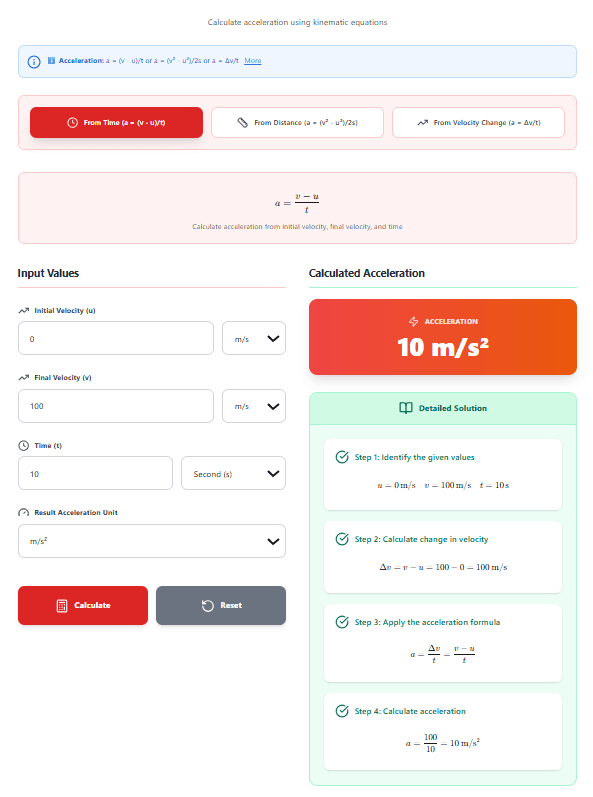
Click the "Calculate Acceleration" button. The results appear instantly.
Step 5: Review the Solution
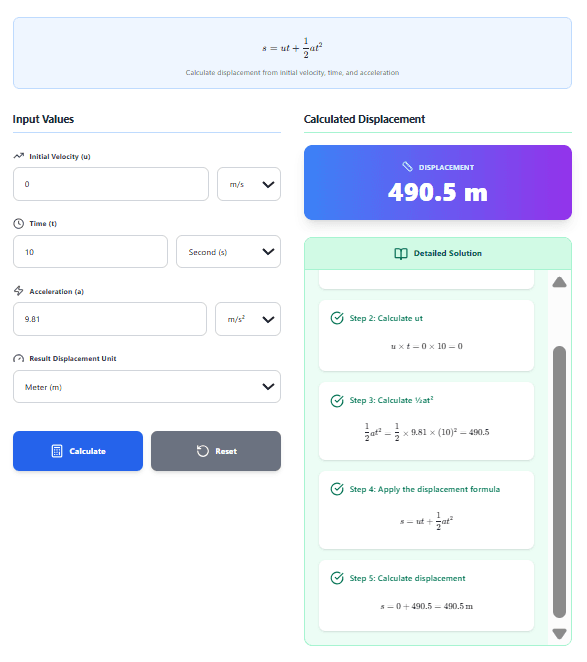
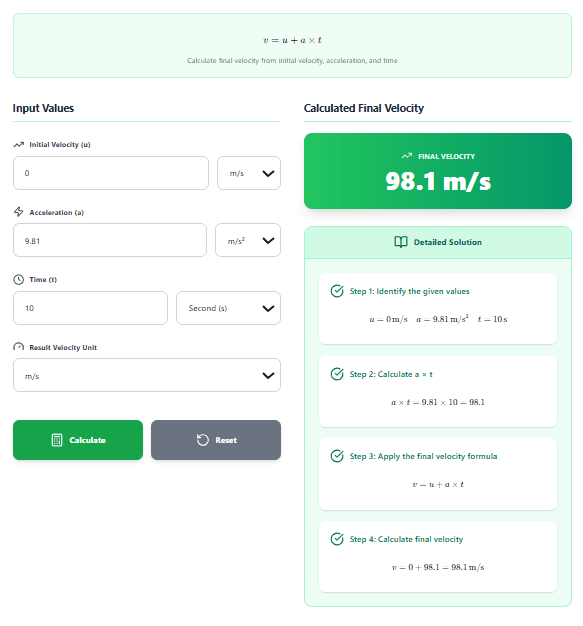
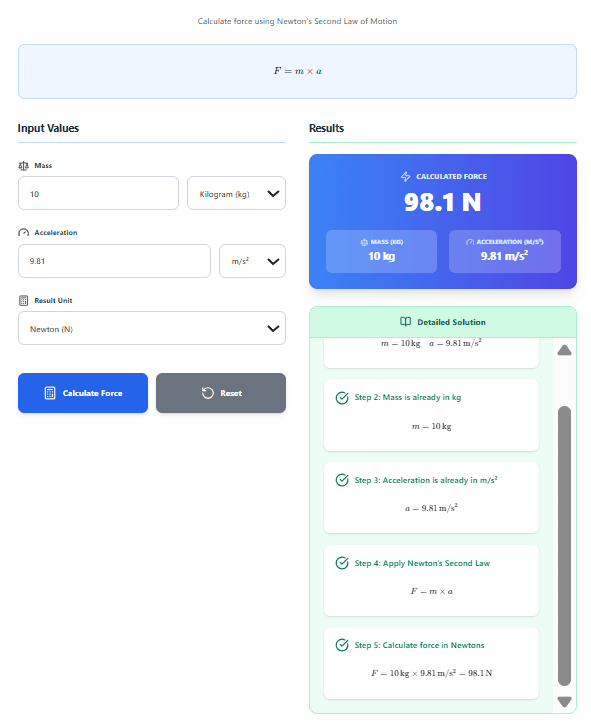
The tool shows detailed steps explaining how the result was calculated, including:
- Given values with units
- Any unit conversions performed
- The formula being applied
- The final calculation
Unit Conversion Reference
Force Conversions
| From | To N | Conversion Factor |
|---|---|---|
| 1 N | 1 N | 1 |
| 1 kN | 1000 N | 1000 |
| 1 lbf | 4.44822 N | 4.44822 |
| 1 dyn | 0.00001 N | 0.00001 |
Mass Conversions
| From | To kg | Conversion Factor |
|---|---|---|
| 1 kg | 1 kg | 1 |
| 1 g | 0.001 kg | 0.001 |
| 1 mg | 0.000001 kg | 0.000001 |
| 1 lb | 0.453592 kg | 0.453592 |
Acceleration Conversions
| From | To m/s² | Conversion Factor |
|---|---|---|
| 1 m/s² | 1 m/s² | 1 |
| 1 cm/s² | 0.01 m/s² | 0.01 |
| 1 ft/s² | 0.3048 m/s² | 0.3048 |
| 1 km/h² | 0.0000771605 m/s² | 0.0000771605 |
Real-World Applications
🚗 Automotive
- Calculating 0-60 mph times
- Determining stopping distances
- Evaluating engine performance
🚀 Aerospace
- Rocket launch acceleration
- Aircraft takeoff requirements
- Spacecraft orbital maneuvers
🏗️ Engineering
- Elevator acceleration and comfort
- Crane load calculations
- Structural dynamic loads
🏃 Sports Science
- Athlete sprint acceleration
- Equipment impact testing
- Performance analysis
📚 Education
- Physics homework verification
- Lab experiment analysis
- Concept demonstration
Common Questions About Acceleration
Q: What is Newton's Second Law?
Newton's Second Law explains how force, mass, and acceleration are related. It states that the acceleration of an object depends on the net force applied to it and its mass. In equation form, F = ma, which can also be rearranged as a = F/m when you're calculating acceleration.
Q: How do I calculate acceleration from force and mass?
Use the formula a = F / m. Divide the force by the mass. Make sure your units are consistent—force in Newtons and mass in kilograms gives acceleration in m/s². This calculator handles the math and unit conversions for you.
Q: What happens to acceleration if I double the force?
The acceleration doubles, assuming the mass stays the same. This is the direct relationship between force and acceleration.
Q: What happens to acceleration if I double the mass?
The acceleration becomes half, assuming the force stays the same. This is the inverse relationship between mass and acceleration.
Q: Why do I need consistent units?
The formula requires all measurements in compatible units. If force is in Newtons, mass must be in kilograms to get acceleration in m/s². Mixing units gives incorrect results. The calculator handles these conversions automatically.
Q: Can this calculator help with homework?
Yes. It shows complete step-by-step solutions, making it a useful learning tool. You can check your work, understand the process, and verify your answers.
Q: What if my force or mass is zero?
Neither force nor mass can be zero in this calculation. Force of zero means no acceleration. Mass of zero is physically impossible for real objects. The calculator will show an error message if you enter zero.
Types of Acceleration Problems
Finding Acceleration (a = F/m)
Problem: F = 50 N, m = 5 kg Solution: a = 50 / 5 = 10 m/s²
Finding Force (F = m × a)
Problem: m = 5 kg, a = 10 m/s² Solution: F = 5 × 10 = 50 N
Finding Mass (m = F / a)
Problem: F = 50 N, a = 10 m/s² Solution: m = 50 / 10 = 5 kg
Multi-Unit Example
Problem: F = 100 lbf, m = 20 lb
Step 1: Convert to SI units
- lbf to N: 100 × 4.44822 = 444.822 N
- lb to kg: 20 × 0.453592 = 9.07184 kg
Step 2: Calculate
- a = 444.822 / 9.07184 = 49.03 m/s²
Tips for Getting the Best Results
Double-check your inputs. A single digit error changes everything. Take a moment to verify each number before calculating.
Understand your units. Know what units you're entering and what units you want for the result. The tool handles conversions, but you should know what you're working with.
Review the steps. The step-by-step solution helps you learn the process. Don't just copy the answer—understand how it was derived.
Practice with different values. Try various force and mass combinations to see how acceleration responds. This builds intuition about the relationships.
Use the table for comparison. The comparison table helps you see patterns in how changing force and mass affects acceleration.
Verify with a second method. If possible, calculate using a different approach and compare results to confirm accuracy.
How This Calculator Helps Different Users
Students
- Check homework answers
- Learn from step-by-step solutions
- Understand unit conversions
- Build problem-solving skills
Teachers
- Create examples for lessons
- Verify student work
- Demonstrate concepts
- Save time on repetitive calculations
Engineers & Professionals
- Quick design verification
- Unit conversion automation
- Reliable calculation results
- Time savings on routine checks
Everyone
- No manual unit conversions
- Instant, accurate results
- Clear explanations
- Free and accessible
What Makes This Calculator Different
Complete unit support. Force, mass, and acceleration units are all covered. No need to look up conversion factors.
Step-by-step solutions. Shows every calculation, not just the final answer. Learn as you calculate.
Multiple output units. Choose the acceleration unit that works for your application.
Instant results. No waiting—just enter values and get answers immediately.
Free and accessible. Available to anyone with an internet connection.
Final Thoughts
Understanding acceleration doesn't have to be complicated. With the right tools and clear explanations, anyone can grasp the relationship between force, mass, and acceleration.
This calculator handles the math while you focus on understanding the physics. Use it to check homework, verify designs, or simply explore how changing force and mass affects acceleration.
Whether you're solving a homework problem, checking engineering calculations, or simply learning physics, this tool can save time and reduce mistakes by handling the math and unit conversions automatically.
Calculate Acceleration Now – Free Tool
Tags: acceleration calculator, newton's second law calculator, force calculator, physics calculator, a = f/m calculator, acceleration formula calculator, force mass acceleration calculator, newton's law calculator, physics formula calculator, acceleration unit converter, force unit converter, mass unit converter, step by step calculator, physics tool, science calculator, kinematics calculator, mechanics calculator, f=ma calculator, acceleration problems, physics homework helper, how to calculate acceleration, acceleration from force and mass, newton's second law formula, acceleration equation, calculate acceleration, physics formulas, force mass acceleration, acceleration units, force units, mass units, free physics calculator, online acceleration calculator