Angular Velocity Calculator – Calculate ω = v/r with Step-by-Step Solutions
Rotational motion is everywhere — from the wheels of a moving car to the blades of a ceiling fan, from the spin of a CD to the rotation of planets. Understanding how fast something spins is essential in physics, engineering, and everyday life.
Angular velocity (ω, pronounced "omega") is the rotational equivalent of linear velocity. While linear velocity tells you how fast something moves in a straight line, angular velocity tells you how fast something spins. The core formula is simple: ω = v / r, where v is linear velocity and r is the radius.
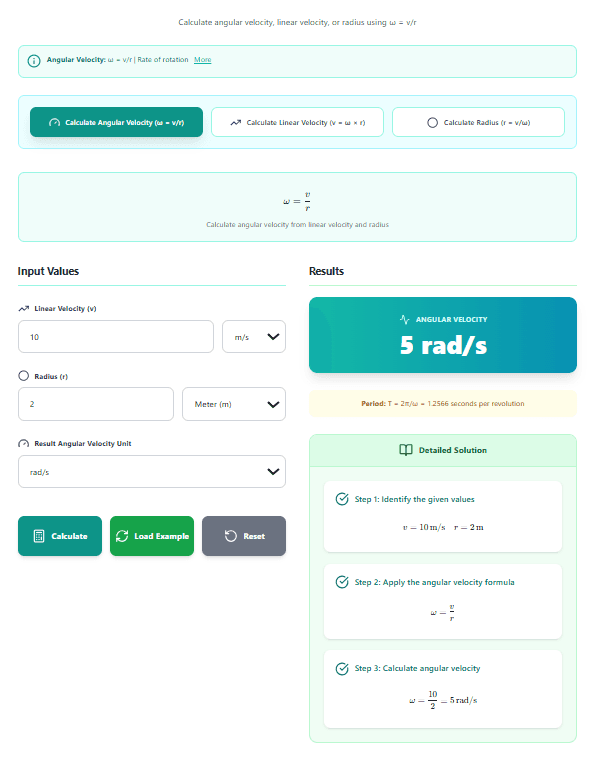
This calculator handles angular velocity calculations using this fundamental formula, supporting multiple units with step-by-step solutions. Whether you need to find angular velocity from linear speed and radius, or convert between RPM and rad/s, this tool handles the math automatically.
Quick access: Use our free angular velocity calculator here
What Does This Calculator Do?
This tool calculates angular velocity using the fundamental relationship between linear and rotational motion: ω = v / r.
You can calculate:
- Angular Velocity (ω) – From linear velocity and radius
- Linear Velocity (v) – From angular velocity and radius
- Radius (r) – From linear velocity and angular velocity
- Unit Conversions – Between rad/s, RPM, deg/s, and rps
Here's a quick example:
A car is traveling at 30 m/s with wheels of radius 0.35 m:
- Angular velocity: 85.71 rad/s (≈ 819 RPM)
- Linear velocity: 30 m/s
- Radius: 0.35 m
The calculator shows you exactly how it got the answer, including any unit conversions needed.
Understanding Angular Velocity
What Is Angular Velocity?
Angular velocity (ω) is the rate of change of angular displacement — it measures how fast an object rotates or spins. Think of it as "rotational speed" measured in radians per second (rad/s).
The Fundamental Formula
ω = v / r
Where:
- ω = Angular velocity (rad/s)
- v = Linear velocity (m/s) — the speed of a point on the rotating object
- r = Radius (m) — the distance from the center of rotation
Key Insights
- Same ω for all points on a rigid rotating object — every point on a spinning wheel has the same angular velocity
- Different v for different r — points farther from the center move faster linearly
- The relationship: v = ω × r — farther from center = faster linear speed
Related Formulas
These are just rearrangements of the same formula:
- ω = v / r – Find angular velocity from linear speed and radius
- v = ω × r – Find linear velocity from angular velocity and radius
- r = v / ω – Find radius from linear velocity and angular velocity
Unit Support
This calculator handles all common angular velocity units automatically:
Angular Velocity Units
| Unit | Symbol | Conversion to rad/s |
|---|---|---|
| Radians per second | rad/s | 1 |
| Revolutions per minute | RPM | 2π/60 ≈ 0.10472 |
| Degrees per second | deg/s | π/180 ≈ 0.01745 |
| Revolutions per second | rps | 2π ≈ 6.28319 |
Quick Conversion Reference
- RPM → rad/s: Multiply by 0.10472 (or 2π/60)
- rad/s → RPM: Multiply by 9.5493 (or 60/2π)
- deg/s → rad/s: Multiply by 0.01745 (or π/180)
- rad/s → deg/s: Multiply by 57.2958 (or 180/π)
How to Use the Calculator
Step 1: Choose Your Calculation
Select what you want to calculate:
- Angular Velocity (ω) – Enter linear velocity and radius
- Linear Velocity (v) – Enter angular velocity and radius
- Radius (r) – Enter linear velocity and angular velocity
Step 2: Enter Your Values
Enter the required values with their units:
For Angular Velocity:
- Linear velocity (v) with unit
- Radius (r) with unit
For Linear Velocity:
- Angular velocity (ω) with unit
- Radius (r) with unit
For Radius:
- Linear velocity (v) with unit
- Angular velocity (ω) with unit
Step 3: Select Result Unit
Choose your preferred unit for the result.
Step 4: Calculate
Click the "Calculate" button. The results appear instantly.
Step 5: Review the Solution
The calculator shows detailed steps explaining how the result was derived, including all unit conversions and intermediate calculations.
Step-by-Step Examples
Example 1: Calculate Angular Velocity
Problem: A car is traveling at 30 m/s. The wheels have a radius of 0.35 m. What is the angular velocity of the wheels in rad/s and RPM?
Step 1: Identify the given values
- v = 30 m/s
- r = 0.35 m
Step 2: Apply the formula
- ω = v / r
- ω = 30 / 0.35
- ω = 85.71 rad/s
Step 3: Convert to RPM
- 85.71 × 9.5493 = 819 RPM
Result: The wheels spin at 85.71 rad/s (≈ 819 RPM).
Example 2: Calculate Linear Velocity
Problem: A ceiling fan blade rotates at 20 rad/s. The blade tip is 0.75 m from the center. How fast does the tip move?
Step 1: Identify the given values
- ω = 20 rad/s
- r = 0.75 m
Step 2: Apply the formula
- v = ω × r
- v = 20 × 0.75
- v = 15 m/s
Result: The blade tip moves at 15 m/s (≈ 54 km/h).
Example 3: Calculate Radius
Problem: A point on a spinning disk moves at 10 m/s and the disk rotates at 25 rad/s. How far is the point from the center?
Step 1: Identify the given values
- v = 10 m/s
- ω = 25 rad/s
Step 2: Apply the formula
- r = v / ω
- r = 10 / 25
- r = 0.4 m
Result: The point is 0.4 m from the center.
Real-World Examples
Car Wheel Example
| Parameter | Value |
|---|---|
| Vehicle Speed | 30 m/s (108 km/h) |
| Wheel Radius | 0.35 m |
| Angular Velocity | 85.71 rad/s |
| RPM | 819 RPM |
Step-by-step:
- Given: v = 30 m/s, r = 0.35 m
- ω = v / r = 30 / 0.35 = 85.71 rad/s
- Convert to RPM: 85.71 × 9.5493 = 819 RPM
Ceiling Fan Example
| Parameter | Value |
|---|---|
| Fan Speed | 20 RPM |
| Blade Radius | 0.75 m |
| Angular Velocity | 2.094 rad/s |
| Tip Speed | 1.57 m/s (5.65 km/h) |
Step-by-step:
- 20 RPM to rad/s: 20 × 0.10472 = 2.094 rad/s
- Tip speed: v = ω × r = 2.094 × 0.75 = 1.57 m/s
Earth's Rotation Example
| Parameter | Value |
|---|---|
| Rotation Period | 24 hours |
| Earth's Radius | 6,371 km |
| Angular Velocity | 7.27 × 10⁻⁵ rad/s |
| Equator Speed | 465 m/s (1,674 km/h) |
Step-by-step:
- One rotation = 2π rad in 24 hours
- 24 hours = 86,400 seconds
- ω = 2π / 86400 = 7.27×10⁻⁵ rad/s
- Equator speed: v = ω × r = 7.27×10⁻⁵ × 6,371,000 = 463 m/s
Angular Velocity vs Linear Velocity
Key Differences
| Aspect | Angular Velocity (ω) | Linear Velocity (v) |
|---|---|---|
| What it measures | Rotation speed | Straight-line speed |
| Units | rad/s, RPM, deg/s, rps | m/s, km/h, mph, ft/s |
| Depends on | How fast something spins | How fast something moves |
| Same for all points? | Yes (on rigid object) | No (depends on radius) |
| Relationship | Independent of radius | Depends on radius (v = ω × r) |
| Example | Wheel spins at 85.71 rad/s | Car moves at 30 m/s |
The Connection: v = ω × r
This is the bridge between rotational and linear motion:
- Points farther from center have higher linear velocity
- Points closer to center have lower linear velocity
- All points have the same angular velocity
Common Angular Velocities
| Object | RPM | rad/s | Description |
|---|---|---|---|
| Clock's second hand | 1 | 0.1047 | One rotation per minute |
| Ceiling fan (low) | 80 | 8.38 | Gentle air circulation |
| Ceiling fan (high) | 200 | 20.94 | Strong air movement |
| Car engine (idle) | 800 | 83.78 | Idling at stop light |
| Car engine (redline) | 7,000 | 733.0 | Maximum power output |
| Desktop hard drive | 7,200 | 754.0 | Standard computer drive |
| F1 car wheel | 10,000+ | 1,047+ | Racing speeds |
| Turbocharger | 150,000 | 15,708 | High-performance engine |
| Earth's rotation | 0.000694 | 0.0000727 | Once per day |
Where Angular Velocity Is Used
🚗 Automotive
- Wheel speed from vehicle speed
- Engine crankshaft RPM
- Transmission gear ratios
- Tire rotation monitoring
🏭 Engineering
- Machine spindle speeds
- Conveyor belt drive systems
- Motor speed control
- Gear train calculations
🔧 Manufacturing
- CNC machine tool speeds
- Drill bit rotation speeds
- Grinding wheel speeds
- Cutting speed optimization
🌀 Everyday Life
- Ceiling fan speed settings
- Bicycle wheel rotation
- CD/DVD drive speeds
- Washing machine spin cycles
🌍 Earth & Space
- Planetary rotation speeds
- Orbital motion calculations
- Satellite stabilization
- Astronomical observations
Common Questions About Angular Velocity
Q: What is angular velocity?
Angular velocity (ω) is the rate of change of angular displacement — it measures how fast an object rotates or spins. The standard unit is radians per second (rad/s).
Q: What's the formula for angular velocity?
The basic formula is ω = v / r, where v is linear velocity and r is the radius. This can also be written as v = ω × r or r = v / ω.
Q: How do I convert RPM to rad/s?
Multiply RPM by 0.10472 (which is 2π/60). For example, 100 RPM = 100 × 0.10472 = 10.47 rad/s.
Q: What's the difference between angular velocity and linear velocity?
Angular velocity (ω) measures rotational speed in rad/s. Linear velocity (v) measures straight-line speed in m/s. They're related by v = ω × r — a point farther from the center moves faster.
Q: Can angular velocity be negative?
Yes. The sign indicates direction of rotation. Counterclockwise is typically positive, clockwise is negative. The magnitude tells you the actual speed.
Q: What is the unit of angular velocity?
The standard SI unit is rad/s (radians per second). Other common units include RPM (revolutions per minute), deg/s (degrees per second), and rps (revolutions per second).
Q: What is Earth's angular velocity?
Earth rotates once per 24 hours. That's 2π rad / 86,400 s = 7.27 × 10⁻⁵ rad/s. At the equator, this translates to a linear speed of about 465 m/s (1,674 km/h).
Q: How is angular velocity used in real life?
Angular velocity is used in car wheels, ceiling fans, engines, robotics, CD/DVD drives, centrifuges, Earth's rotation, and any rotating machinery.
Tips for Getting the Best Results
Choose the right calculation mode. Make sure you're calculating what you need — angular velocity, linear velocity, or radius.
Check your units. The calculator handles conversions automatically, but make sure you're entering the right values with the right units.
Double-check your inputs. A single digit error changes everything. Take a moment to verify each number.
Review the steps. The step-by-step solution helps you understand the process and verify the calculation.
Use real-world examples. The examples section shows how angular velocity applies to everyday objects like car wheels, ceiling fans, and more.
Practice with different values. Try various combinations to see how changing radius affects linear velocity at constant angular velocity.
Quick Reference
Key Formulas
| What to Find | Formula | Units |
|---|---|---|
| Angular Velocity | ω = v / r | rad/s |
| Linear Velocity | v = ω × r | m/s |
| Radius | r = v / ω | m |
Quick Conversions
| Conversion | Factor |
|---|---|
| RPM → rad/s | × 0.10472 |
| rad/s → RPM | × 9.5493 |
| deg/s → rad/s | × 0.01745 |
| rad/s → deg/s | × 57.2958 |
Key Insight
Every point on a rigid rotating object has the SAME angular velocity. But linear velocity increases with distance from the center.
How This Calculator Helps Different Users
Students
- Check homework answers
- Learn from step-by-step solutions
- Understand rotational physics concepts
- Build problem-solving skills
Teachers
- Create examples for lessons
- Verify student work
- Demonstrate rotational physics
- Save time on repetitive calculations
Engineers
- Quick design verification
- Unit conversion automation
- Reliable calculation results
- Time savings on routine checks
Everyone
- No manual unit conversions
- Instant, accurate results
- Clear explanations
- Free and accessible
What Makes This Calculator Different
Three calculation modes. Covers angular velocity, linear velocity, and radius — all from the same fundamental relationship.
Complete unit support. Angular velocity (rad/s, RPM, deg/s, rps), linear velocity (m/s, km/h, mph, ft/s), and radius (m, km, cm, mm, ft, in) are all covered.
Step-by-step solutions. Shows every calculation, not just the final answer. Learn as you calculate.
Real-world examples. Includes practical examples like car wheels, ceiling fans, Earth's rotation, and drill bits.
Unit conversion tables. Quick reference for converting between rad/s, RPM, deg/s, and rps.
Free and accessible. Available to anyone with an internet connection.
Final Thoughts
Understanding angular velocity is essential for anyone studying rotational physics or working with rotating machinery. The formula ω = v / r is simple but powerful — it connects linear and rotational motion in a way that shows up everywhere from car wheels to planetary motion.
Whether you're calculating wheel RPM from vehicle speed, determining blade tip speed for a fan, or just learning physics, this tool handles the math while you focus on understanding the concepts.
Calculate Angular Velocity Now – Free Tool
Tags: angular velocity calculator, angular velocity, omega calculator, physics calculator, ω = v/r calculator, angular velocity formula, rotational motion, physics tool, rpm calculator, rad/s calculator, linear velocity calculator, rotational physics, mechanics calculator, step by step calculator, physics homework helper, science calculator, engineering calculator, velocity converter, circular motion calculator, how to calculate angular velocity, angular velocity from linear velocity and radius, omega formula, rad/s to RPM, RPM to rad/s, angular velocity units, rotational speed calculator, free physics calculator, online angular velocity calculator