Acceleration Kinematics Calculator – Calculate Acceleration Using Kinematic Equations
Kinematics is the branch of physics that describes motion without considering what causes it. Acceleration is a key concept—it tells us how quickly velocity changes over time or distance.
Understanding how to calculate acceleration using different kinematic equations is essential for physics students, engineers, and anyone working with motion problems. The challenge often isn't the math itself—it's knowing which formula to use and keeping units straight.
This calculator handles three different kinematic methods for finding acceleration, each suited to different types of problems. Whether you know initial and final velocities with time, velocities with distance, or just the change in velocity over time, this tool handles the math and unit conversions automatically.
Quick access: Use our free acceleration kinematics calculator here
What Does This Calculator Do?
This tool calculates acceleration using three different kinematic equations, giving you flexibility based on what information you have available.
Three calculation methods:
From Time: a = (v - u)/t – Use when you know initial velocity, final velocity, and time
From Distance: a = (v² - u²)/2s – Use when you know initial velocity, final velocity, and distance
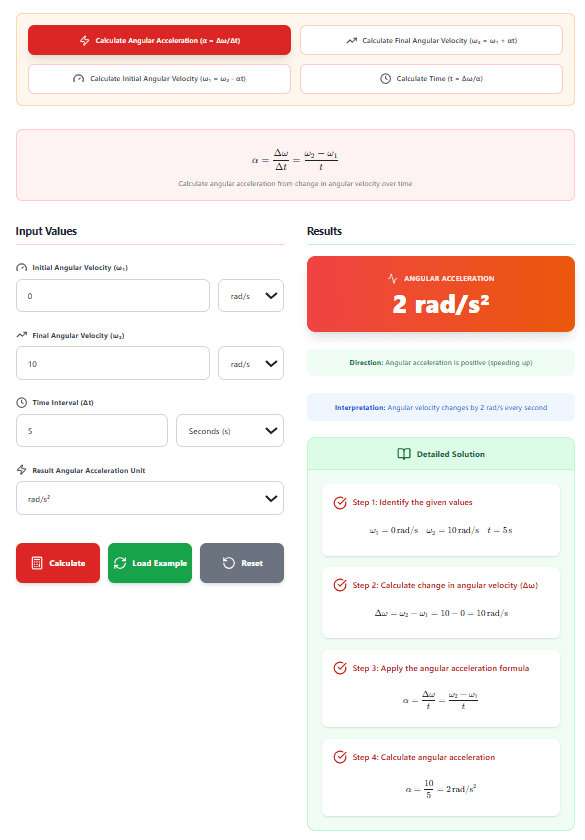
From Velocity Change: a = Δv/t – Use when you know the change in velocity and time
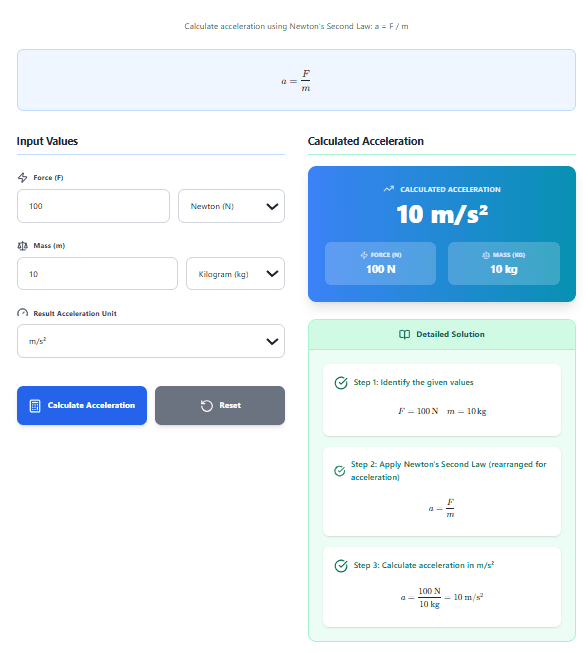
Here's a quick example using the first method:
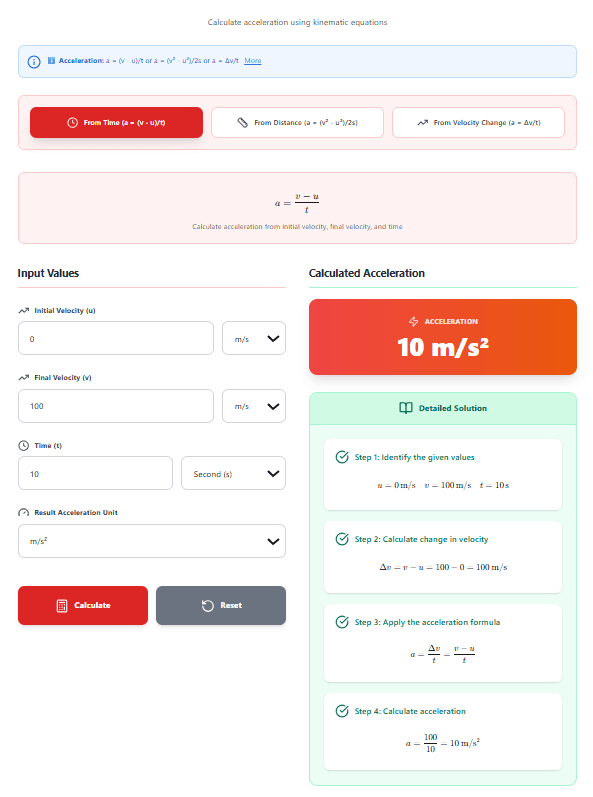
A car accelerates from 0 m/s to 100 m/s in 10 seconds:
- Acceleration: 10 m/s²
- Initial velocity: 0 m/s
- Final velocity: 100 m/s
- Time: 10 s
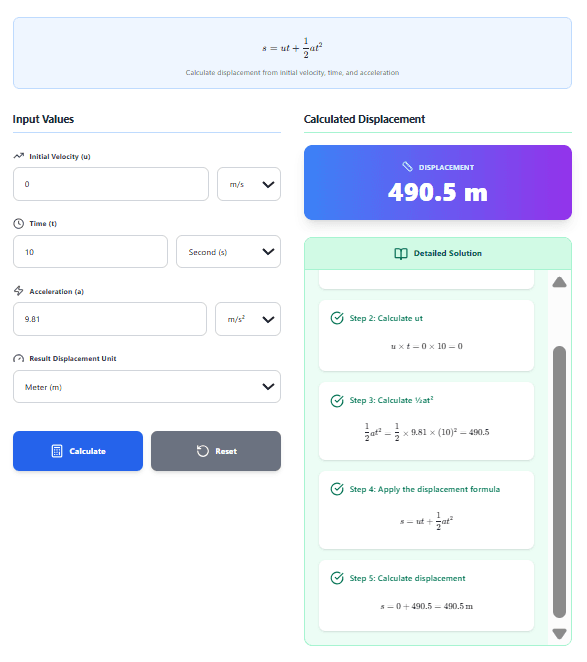
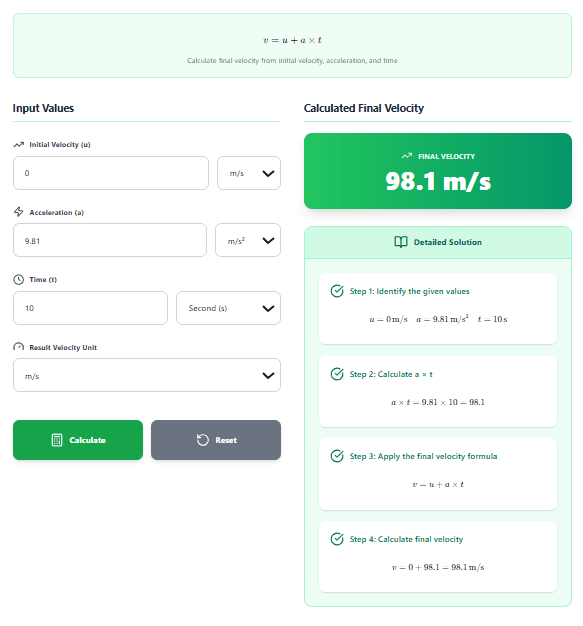
The calculator shows you exactly how it got the answer, including any unit conversions needed.
Understanding Kinematic Equations for Acceleration
Method 1: Acceleration from Velocity and Time (a = (v-u)/t)
This is the most common method. Use it when you know:
- Initial velocity (u)
- Final velocity (v)
- Time taken (t)
Equation: a = (v - u) / t
Example: A cyclist accelerates from 5 m/s to 15 m/s in 4 seconds.
- a = (15 - 5) / 4
- a = 10 / 4
- a = 2.5 m/s²
Method 2: Acceleration from Velocity and Distance (a = (v²-u²)/2s)
Use this when you know:
- Initial velocity (u)
- Final velocity (v)
- Distance covered (s)
Equation: a = (v² - u²) / 2s
Example: A train increases speed from 10 m/s to 20 m/s over 100 meters.
- a = (20² - 10²) / (2 × 100)
- a = (400 - 100) / 200
- a = 300 / 200
- a = 1.5 m/s²
Method 3: Acceleration from Velocity Change and Time (a = Δv/t)
Use this when you know:
- Change in velocity (Δv)
- Time taken (t)
Equation: a = Δv / t
Example: A rocket's velocity increases by 300 m/s in 15 seconds.
- a = 300 / 15
- a = 20 m/s²
Unit Support
One of the biggest challenges in physics calculations is keeping units consistent. This calculator handles conversions automatically for all supported units.
Velocity Units
| Unit | Symbol | Conversion to m/s |
|---|---|---|
| Meters per second | m/s | 1 |
| Kilometers per hour | km/h | 0.277778 |
| Miles per hour | mph | 0.44704 |
| Feet per second | ft/s | 0.3048 |
Acceleration Units
| Unit | Symbol | Conversion from m/s² |
|---|---|---|
| Meters per second squared | m/s² | 1 |
| Centimeters per second squared | cm/s² | 0.01 |
| Feet per second squared | ft/s² | 0.3048 |
Time Units
| Unit | Symbol | Conversion to seconds |
|---|---|---|
| Second | s | 1 |
| Millisecond | ms | 0.001 |
| Minute | min | 60 |
| Hour | h | 3600 |
Distance Units
| Unit | Symbol | Conversion to meters |
|---|---|---|
| Meter | m | 1 |
| Kilometer | km | 1000 |
| Centimeter | cm | 0.01 |
| Millimeter | mm | 0.001 |
| Foot | ft | 0.3048 |
| Inch | in | 0.0254 |
How to Use the Calculator
Step 1: Choose Your Method
Select one of three calculation modes:
- From Time – Use a = (v-u)/t
- From Distance – Use a = (v²-u²)/2s
- From Velocity Change – Use a = Δv/t
Step 2: Enter Your Values
Depending on the mode you selected, enter:
For "From Time" mode:
- Initial velocity (u) with unit
- Final velocity (v) with unit
- Time (t) with unit
For "From Distance" mode:
- Initial velocity (u) with unit
- Final velocity (v) with unit
- Distance (s) with unit
For "From Velocity Change" mode:
- Change in velocity (Δv) with unit
- Time (t) with unit
Step 3: Select Result Unit
Choose your preferred acceleration unit for the result.
Step 4: Calculate
Click the "Calculate" button. The results appear instantly.
Step 5: Review the Solution
The calculator shows detailed steps explaining how the result was derived, including all unit conversions and intermediate calculations.
Step-by-Step Examples for Each Method
Example 1: From Time Method
Problem: A car accelerates from 10 km/h to 60 km/h in 8 seconds. What is the acceleration in m/s²?
Step 1: Identify the given values
- u = 10 km/h
- v = 60 km/h
- t = 8 s
Step 2: Convert velocities to m/s
- u = 10 × 0.277778 = 2.77778 m/s
- v = 60 × 0.277778 = 16.6667 m/s
Step 3: Calculate change in velocity
- Δv = 16.6667 - 2.77778 = 13.8889 m/s
Step 4: Apply the formula
- a = Δv / t
- a = 13.8889 / 8
- a = 1.73611 m/s²
Result: The car accelerates at approximately 1.74 m/s².
Example 2: From Distance Method
Problem: A train increases speed from 15 m/s to 35 m/s over a distance of 500 meters. What is the acceleration?
Step 1: Identify the given values
- u = 15 m/s
- v = 35 m/s
- s = 500 m
Step 2: Calculate u²
- u² = 225
Step 3: Calculate v²
- v² = 1225
Step 4: Calculate v² - u²
- 1225 - 225 = 1000
Step 5: Calculate 2s
- 2 × 500 = 1000
Step 6: Apply the formula
- a = 1000 / 1000
- a = 1 m/s²
Result: The train accelerates at 1 m/s².
Example 3: From Velocity Change Method
Problem: A rocket's velocity increases by 500 mph in 20 seconds. What is the acceleration in ft/s²?
Step 1: Identify the given values
- Δv = 500 mph
- t = 20 s
Step 2: Convert velocity change to m/s
- 500 × 0.44704 = 223.52 m/s
Step 3: Apply the formula
- a = 223.52 / 20
- a = 11.176 m/s²
Step 4: Convert to ft/s²
- 11.176 / 0.3048 = 36.6667 ft/s²
Result: The rocket accelerates at approximately 36.67 ft/s².
When to Use Each Method
Use a = (v-u)/t when you have:
- Initial and final velocities
- Time taken
Typical scenarios:
- Cars accelerating from stop
- Sprinters in a race
- Aircraft takeoff roll
Use a = (v²-u²)/2s when you have:
- Initial and final velocities
- Distance covered
- No time information
Typical scenarios:
- Vehicles braking to a stop
- Roller coaster motion between points
- Projectile motion problems
Use a = Δv/t when you have:
- Change in velocity
- Time taken
- Don't need initial and final separately
Typical scenarios:
- Objects being pushed or pulled
- Rocket launches
- Collision analysis
Comparison Table
| Method | Formula | When to Use | Example |
|---|---|---|---|
| From Time | a = (v-u)/t | Have velocities and time | Car acceleration from 0-60 mph in 6 s |
| From Distance | a = (v²-u²)/2s | Have velocities and distance | Train braking over known distance |
| From Velocity Change | a = Δv/t | Have velocity change and time | Rocket thrust over time |
Real-World Applications
🚗 Automotive Engineering
- 0-60 mph acceleration calculations
- Braking distance and deceleration
- Performance testing and validation
🚀 Aerospace
- Rocket launch acceleration profiles
- Aircraft takeoff and landing
- Spacecraft orbital maneuvers
🏗️ Civil Engineering
- Elevator acceleration design
- Roller coaster safety calculations
- Traffic engineering and road design
🏃 Sports Science
- Athlete sprint performance
- Acceleration phases in running
- Equipment testing and design
📚 Education
- Physics homework verification
- Lab experiment analysis
- Concept demonstration
Common Questions About Kinematic Acceleration
Q: What is acceleration in kinematics?
Acceleration is the rate at which velocity changes with time. In kinematics, it describes how an object's motion changes, regardless of what causes the change (that's dynamics).
Q: When should I use each kinematic equation for acceleration?
Use a = (v-u)/t when you have initial velocity, final velocity, and time. Use a = (v²-u²)/2s when you have velocities and distance but no time. Use a = Δv/t when you know the change in velocity and time.
Q: What's the difference between velocity and acceleration?
Velocity is how fast an object moves and in what direction. Acceleration is how quickly that velocity changes—it's the rate of change of velocity.
Q: Can acceleration be negative?
Yes. Negative acceleration (also called deceleration or retardation) means velocity is decreasing. For example, when a car brakes, it has negative acceleration.
Q: What if my initial velocity is zero?
That's perfectly fine. The formulas work with u = 0. This represents starting from rest, which is common in many problems.
Q: Do the formulas work with any units?
Yes, but you must be consistent. The calculator handles unit conversions automatically. If you work manually, convert all values to compatible units before calculating.
Q: What does "kinematics" mean?
Kinematics is the branch of physics that describes motion without considering the forces that cause it. It deals with displacement, velocity, acceleration, and time.
Q: Why are there three different formulas?
Different problems give you different information. Sometimes you know time, sometimes you know distance, sometimes you only know the change in velocity. Each formula is adapted to the information you have available.
Tips for Getting the Best Results
Choose the right method. Make sure you're using the formula that matches the information you have. Using the wrong formula will give incorrect results.
Double-check your inputs. A single digit error changes everything. Take a moment to verify each number before calculating.
Understand your units. Know what units you're entering and what units you want for the result. The tool handles conversions, but you should know what you're working with.
Review the steps. The step-by-step solution helps you learn the process. Don't just copy the answer—understand how it was derived.
Practice with different values. Try various combinations to see how acceleration responds to changes in velocity, time, and distance. This builds intuition.
Use consistent sign conventions. Positive velocity usually means moving in a positive direction. Negative means the opposite direction. Keep signs consistent throughout.
How This Calculator Helps Different Users
Students
- Check homework answers
- Learn from step-by-step solutions
- Understand which formula to use
- Build problem-solving skills
Teachers
- Create examples for lessons
- Verify student work
- Demonstrate concepts
- Save time on repetitive calculations
Engineers & Professionals
- Quick design verification
- Unit conversion automation
- Reliable calculation results
- Time savings on routine checks
Everyone
- No manual unit conversions
- Instant, accurate results
- Clear explanations
- Free and accessible
What Makes This Calculator Different
Three calculation methods. Covers all common kinematic acceleration scenarios. No need to search for the right formula.
Complete unit support. Velocity, acceleration, time, and distance units are all covered. No need to look up conversion factors.
Step-by-step solutions. Shows every calculation, not just the final answer. Learn as you calculate.
Multiple output units. Choose the acceleration unit that works for your application.
Instant results. No waiting—just enter values and get answers immediately.
Free and accessible. Available to anyone with an internet connection.
Final Thoughts
Understanding acceleration through kinematics is essential for anyone studying physics or working with motion. The three equations covered here—a = (v-u)/t, a = (v²-u²)/2s, and a = Δv/t—form the foundation of motion analysis.
Each method serves a different purpose, and knowing which one to use is as important as knowing how to calculate. This calculator helps you apply the right formula with the right units, making physics problems more manageable.
Whether you're solving a homework problem, checking engineering calculations, or simply exploring how motion works, this tool can save time and reduce mistakes by handling the math and unit conversions automatically.
Calculate Acceleration Kinematics Now – Free Tool
Tags: acceleration calculator, kinematics calculator, acceleration kinematics, physics calculator, kinematic equations, a = (v-u)/t calculator, acceleration formula calculator, physics formula calculator, velocity acceleration calculator, motion calculator, physics tool, science calculator, mechanics calculator, kinematic formulas, acceleration unit converter, velocity unit converter, time unit converter, distance unit converter, step by step calculator, physics homework helper, how to calculate acceleration, kinematic equations explained, acceleration from velocity and time, acceleration from velocity and distance, acceleration from velocity change, physics formulas, motion equations, free physics calculator, online acceleration calculator