Capacitance Calculator – Calculate Parallel Plate Capacitance Using C = ε₀εᵣA/d
Capacitors are fundamental components in electronics, used in everything from power supplies to touchscreens to energy storage systems. Understanding how to calculate capacitance is essential for anyone working with circuits, whether you're a student, hobbyist, or professional engineer.
The formula for a parallel plate capacitor is simple: C = ε₀εᵣA/d. But applying it correctly with different units and materials can be challenging. This calculator handles three different calculation modes with automatic unit conversions and step-by-step solutions.
Quick access: Use our free capacitance calculator here
What Does This Calculator Do?
This tool calculates parallel plate capacitance using the formula: C = ε₀εᵣA/d.
Three calculation modes:
Calculate Capacitance (C = ε₀εᵣA/d) – Find capacitance from plate area and distance
Calculate Plate Area (A = Cd/ε₀εᵣ) – Find area needed for desired capacitance
Calculate Plate Distance (d = ε₀εᵣA/C) – Find distance needed for desired capacitance
Here's a quick example:
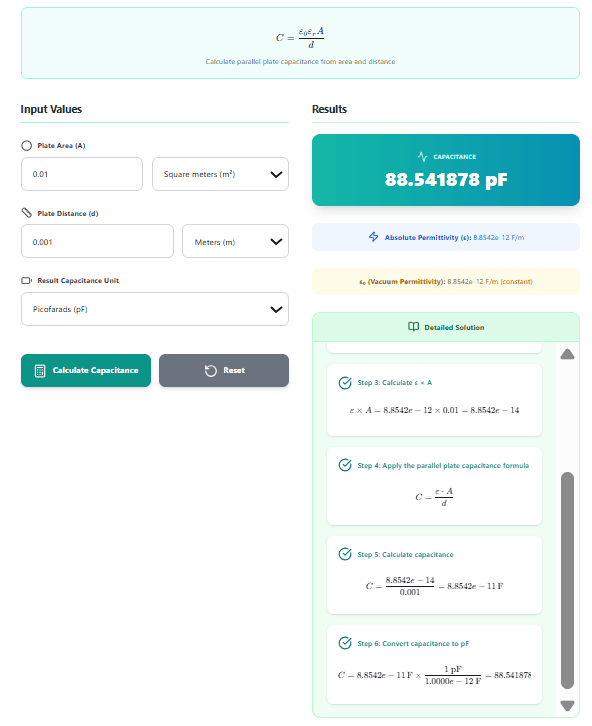
Two parallel plates with area 0.01 m² separated by 0.001 m with air (εᵣ = 1):
- Capacitance: 88.54 pF
- Area: 0.01 m² (100 cm²)
- Distance: 0.001 m (1 mm)
The calculator shows you exactly how it got the answer, including all unit conversions.
Understanding Capacitance
What Is Capacitance?
Capacitance is the ability of a system to store electrical charge. It's measured in farads (F) and represents the amount of charge stored per volt of potential difference.
Parallel Plate Capacitor Formula
C = ε₀εᵣA/d
Where:
- C = Capacitance (farads)
- ε₀ = Vacuum permittivity (8.8541878128 × 10⁻¹² F/m) – a fundamental constant
- εᵣ = Relative permittivity (dielectric constant) – material property
- A = Area of each plate (m²)
- d = Separation distance between plates (m)
Key Relationships
- Larger area → Larger capacitance
- Smaller distance → Larger capacitance
- Higher dielectric constant → Larger capacitance
- ε = ε₀εᵣ = Absolute permittivity of the material
Unit Support
This calculator handles all common units automatically:
Area Units
| Unit | Symbol | Conversion to m² |
|---|---|---|
| Square meter | m² | 1 |
| Square centimeter | cm² | 0.0001 |
| Square millimeter | mm² | 0.000001 |
| Square inch | in² | 0.00064516 |
Distance Units
| Unit | Symbol | Conversion to m |
|---|---|---|
| Meter | m | 1 |
| Centimeter | cm | 0.01 |
| Millimeter | mm | 0.001 |
| Inch | in | 0.0254 |
Capacitance Units
| Unit | Symbol | Conversion to F |
|---|---|---|
| Farad | F | 1 |
| Microfarad | µF | 0.000001 |
| Nanofarad | nF | 0.000000001 |
| Picofarad | pF | 0.000000000001 |
How to Use the Calculator
Step 1: Enter the Dielectric Constant
Enter the relative permittivity (εᵣ) of the dielectric material between plates.
Common dielectric constants (approximate):
- Air/Vacuum: 1.0
- Paper: 2.0–3.0
- Glass: 4.0–8.0
- Mica: 5.0–7.0
- Ceramic: 10–100+
- Water: 80
- Polyester: 3.0–3.5
- Teflon: 2.1
Step 2: Choose Your Mode
Select one of three calculation modes:
- Capacitance – Find C
- Plate Area – Find A
- Plate Distance – Find d
Step 3: Enter Your Values
Depending on the mode, enter the required values with their units.
Step 4: Select Result Unit
Choose your preferred unit for the result.
Step 5: Calculate
Click the "Calculate" button. The results appear instantly with step-by-step solutions.
Step-by-Step Examples for Each Mode
Example 1: Calculate Capacitance
Problem: Two plates with area 0.01 m² are separated by 1 mm (0.001 m) with air dielectric (εᵣ = 1). What is the capacitance?
Step 1: Identify the given values
- A = 0.01 m²
- d = 0.001 m
- εᵣ = 1
- ε₀ = 8.8541878128 × 10⁻¹² F/m
Step 2: Calculate ε₀εᵣ
- ε = ε₀ × εᵣ = 8.854 × 10⁻¹² × 1 = 8.854 × 10⁻¹²
Step 3: Calculate C = εA/d
- C = (8.854 × 10⁻¹² × 0.01) / 0.001
- C = 8.854 × 10⁻¹⁴ / 0.001
- C = 8.854 × 10⁻¹¹ F = 88.54 pF
Result: 88.54 pF
Example 2: Calculate Plate Area
Problem: You need a 100 pF capacitor with plates separated by 0.001 m and air dielectric (εᵣ = 1). What area do you need?
Step 1: Identify the given values
- C = 100 pF = 1 × 10⁻¹⁰ F
- d = 0.001 m
- εᵣ = 1
Step 2: Calculate ε₀εᵣ
- ε = 8.854 × 10⁻¹² × 1 = 8.854 × 10⁻¹²
Step 3: Calculate A = Cd/ε
- A = (1 × 10⁻¹⁰ × 0.001) / 8.854 × 10⁻¹²
- A = 1 × 10⁻¹³ / 8.854 × 10⁻¹²
- A = 0.01129 m² = 112.9 cm²
Result: 112.9 cm² (about 10.6 cm × 10.6 cm)
Example 3: Calculate Plate Distance
Problem: A 1 nF capacitor uses plates of area 0.01 m² with air dielectric (εᵣ = 1). What distance is needed?
Step 1: Identify the given values
- C = 1 nF = 1 × 10⁻⁹ F
- A = 0.01 m²
- εᵣ = 1
Step 2: Calculate ε₀εᵣ
- ε = 8.854 × 10⁻¹² × 1 = 8.854 × 10⁻¹²
Step 3: Calculate d = εA/C
- d = (8.854 × 10⁻¹² × 0.01) / 1 × 10⁻⁹
- d = 8.854 × 10⁻¹⁴ / 1 × 10⁻⁹
- d = 8.854 × 10⁻⁵ m = 0.08854 mm
Result: 0.0885 mm (88.5 µm)
Common Dielectric Constants
| Material | εᵣ (Relative Permittivity) | Breakdown Strength (V/m) |
|---|---|---|
| Vacuum | 1.0000 | – |
| Air (1 atm) | 1.0006 | 3 × 10⁶ |
| Teflon | 2.1 | 60 × 10⁶ |
| Polyethylene | 2.25 | 47 × 10⁶ |
| Polystyrene | 2.5 | 24 × 10⁶ |
| Paper | 2.0–3.0 | 16 × 10⁶ |
| Glass | 4.0–8.0 | 10 × 10⁶ |
| Mica | 5.0–7.0 | 200 × 10⁶ |
| Ceramic | 10–100+ | 10 × 10⁶ |
| Water | 80 | – |
| Barium titanate | 1000–10,000 | ~10 × 10⁶ |
Note: For air, εᵣ is often approximated as 1.0 in calculations; the precise value at 1 atm is 1.0006.
Real-World Applications
🔌 Electronics
- Capacitor design and selection
- Circuit board layout
- Filter and timing circuits
- Power supply filtering
- Energy storage systems
📱 Consumer Electronics
- Touchscreen sensors
- Smartphone components
- Camera flash capacitors
- Power supplies
🔋 Energy Storage
- Supercapacitors (EDLCs)
- Battery replacement
- Energy harvesting
- Regenerative braking
🏭 Industrial
- Motor start capacitors
- Power factor correction
- High-voltage systems
- Medical devices
When to Use Each Mode
| Mode | Formula | When to Use | Typical Scenario |
|---|---|---|---|
| Capacitance | C = ε₀εᵣA/d | You have A and d | Designing a capacitor from physical dimensions |
| Plate Area | A = Cd/ε₀εᵣ | You have C and d | Determining required plate size for a target value |
| Plate Distance | d = ε₀εᵣA/C | You have C and A | Spacing optimization and voltage breakdown checks |
Common Questions About Capacitance
Q: What is capacitance?
Capacitance is the ability of a system to store electrical charge. It's the ratio of charge stored to potential difference applied, measured in farads.
Q: What is the formula for a parallel plate capacitor?
The formula is C = ε₀εᵣA/d, where A is plate area, d is plate separation, and εᵣ is the dielectric constant.
Q: What is ε₀ (epsilon naught)?
ε₀ is the vacuum permittivity, a fundamental physical constant equal to 8.8541878128 × 10⁻¹² F/m. It's part of the capacitance formula and never changes.
Q: What is εᵣ (epsilon r)?
εᵣ is the relative permittivity (dielectric constant) of the material between the plates. It depends on the material and affects capacitance directly.
Q: How does plate area affect capacitance?
Capacitance is directly proportional to plate area. Doubling the area doubles the capacitance.
Q: How does plate distance affect capacitance?
Capacitance is inversely proportional to plate distance. Halving the distance doubles the capacitance.
Q: What is a farad?
A farad (F) is the unit of capacitance. One farad stores one coulomb of charge at one volt. Common values are microfarads (µF), nanofarads (nF), and picofarads (pF).
Q: Why use different dielectric materials?
Different dielectrics change capacitance, breakdown voltage, and temperature stability. For example, a high-εᵣ ceramic (εᵣ ≈ 1000) can deliver the same capacitance in a much smaller package than air — but ceramics are also more temperature-sensitive. Teflon (εᵣ = 2.1) is very stable but gives lower capacitance per unit area.
Tips for Getting the Best Results
Enter the dielectric constant. Always set εᵣ correctly for your material. The calculator defaults to air/vacuum (εᵣ ≈ 1).
Choose the right mode. Make sure you're calculating what you need — capacitance, area, or distance.
Check your units. The calculator handles conversions automatically, but make sure you're entering values with the correct units.
Double-check your inputs. A single digit error changes everything. Take a moment to verify each number.
Review the steps. The step-by-step solution helps you understand the process and verify the calculation.
Consider the dielectric. Different materials have different εᵣ values. Check your material's dielectric constant for accurate results.
Final Thoughts
Understanding capacitance is essential for anyone working with electronics, from students to professional engineers. The formula C = ε₀εᵣA/d is simple but powerful — it connects physical geometry and material properties to electrical behavior.
This calculator handles all three variants of the formula, with complete unit support, dielectric constant input, and built-in ε₀. Whether you're designing a capacitor, checking homework, or exploring electronics, it saves time and reduces mistakes by handling the math and unit conversions automatically.