Conductivity Calculator – Convert Between σ and ρ Using σ = 1/ρ
Electrical conductivity and resistivity are two ways of describing the same physical property: how easily a material lets electric current flow through it. Conductivity (σ) measures how well a material conducts; resistivity (ρ) measures how strongly it resists. They are exact reciprocals — know one and you know the other.
The formula is simple: σ = 1/ρ, or equivalently, ρ = 1/σ. This calculator handles both directions, with automatic unit conversions across S/m, kS/m, MS/m, µS/cm, Ω·m, Ω·cm, and more, plus step-by-step solutions.
Quick access: Use our free conductivity calculator here
What Does This Calculator Do?
This tool converts between electrical conductivity and resistivity using the reciprocal relationship.
Two calculation modes:
Calculate Conductivity (σ = 1/ρ) – Find conductivity from resistivity
Calculate Resistivity (ρ = 1/σ) – Find resistivity from conductivity
Here's a quick example:
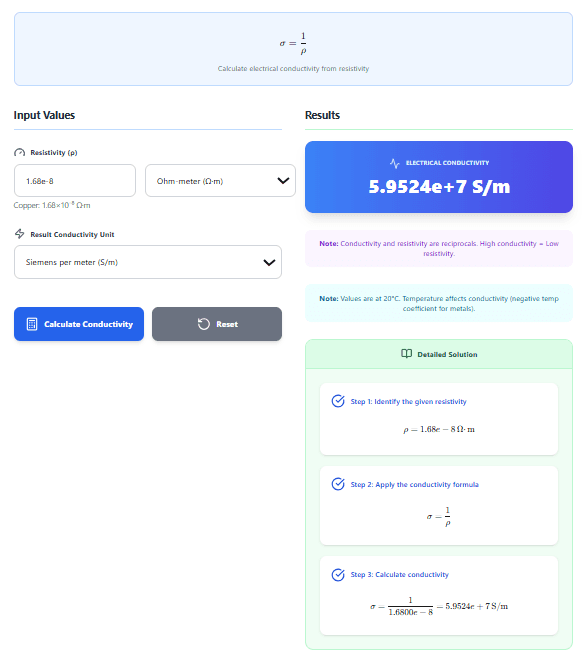
Copper has a resistivity of 1.68 × 10⁻⁸ Ω·m:
- Resistivity: 1.68 × 10⁻⁸ Ω·m
- Conductivity: 5.95 × 10⁷ S/m
The calculator shows you exactly how it got the answer, including any unit conversions needed.
Understanding Conductivity and Resistivity
What Is Electrical Conductivity?
Electrical conductivity (σ) is a measure of how well a material conducts electric current. Higher conductivity means current flows more easily. It is measured in siemens per meter (S/m).
What Is Electrical Resistivity?
Electrical resistivity (ρ) is a measure of how strongly a material resists the flow of electric current. Higher resistivity means current flows less easily. It is measured in ohm-meters (Ω·m).
The Reciprocal Relationship
σ = 1/ρ and ρ = 1/σ
This is the entire physics of the calculator. A material with high conductivity has low resistivity, and vice versa. The two properties are just two ways of saying the same thing.
Key Relationships
- High σ → Low ρ (good conductor)
- Low σ → High ρ (good insulator)
- Doubling σ → Halving ρ
- Units are inversely related — S/m and Ω·m are reciprocal units
Why Both Quantities Exist
Conductivity is more natural when describing how well something conducts (e.g., metals, electrolytes). Resistivity is more natural when describing how much a material resists (e.g., insulators, wire gauges). Different fields prefer different quantities, but the underlying physics is identical.
Rearranged Formulas
| What to Find | Formula |
|---|---|
| Conductivity | σ = 1/ρ |
| Resistivity | ρ = 1/σ |
Unit Support
This calculator handles a wide range of conductivity and resistivity units automatically:
Resistivity Units
| Unit | Symbol | Conversion to Ω·m |
|---|---|---|
| Ohm-meter | Ω·m | 1 |
| Ohm-centimeter | Ω·cm | 0.01 |
| Ohm-square-millimeter per meter | Ω·mm²/m | 1 × 10⁻⁶ |
| Microhm-centimeter | µΩ·cm | 1 × 10⁻⁸ |
Conductivity Units
| Unit | Symbol | Conversion to S/m |
|---|---|---|
| Siemens per meter | S/m | 1 |
| Kilosiemens per meter | kS/m | 1,000 |
| Megasiemens per meter | MS/m | 1,000,000 |
| Microsiemens per centimeter | µS/cm | 0.0001 |
| Millisiemens per centimeter | mS/cm | 0.1 |
Note: 1 S/m = 10,000 µS/cm. The µS/cm and mS/cm units are common in water quality and electrochemistry.
How to Use the Calculator
Step 1: Choose Your Mode
Select one of two calculation modes:
- Calculate Conductivity – Find σ
- Calculate Resistivity – Find ρ
Step 2: Enter Your Value
Enter the known value (resistivity or conductivity) with its unit.
Step 3: Select Result Unit
Choose your preferred unit for the result.
Step 4: Calculate
Click the "Calculate" button. The results appear instantly.
Step 5: Review the Solution
The calculator shows detailed steps, including any unit conversions and the reciprocal calculation.
Step-by-Step Examples
Example 1: Copper (Find Conductivity from Resistivity)
Problem: Copper has a resistivity of 1.68 × 10⁻⁸ Ω·m at 20 °C. What is its conductivity?
Step 1: Identify the given value
- ρ = 1.68 × 10⁻⁸ Ω·m
Step 2: Apply the formula
- σ = 1/ρ
- σ = 1 / (1.68 × 10⁻⁸)
- σ ≈ 5.95 × 10⁷ S/m
Result: Copper's conductivity is about 5.95 × 10⁷ S/m (59.5 MS/m).
Example 2: Silver (Find Conductivity)
Problem: Silver has a resistivity of 1.59 × 10⁻⁸ Ω·m. What is its conductivity?
Step 1: Identify the given value
- ρ = 1.59 × 10⁻⁸ Ω·m
Step 2: Apply the formula
- σ = 1 / (1.59 × 10⁻⁸)
- σ ≈ 6.29 × 10⁷ S/m
Result: Silver's conductivity is about 6.29 × 10⁷ S/m — the highest of any metal.
Example 3: Pure Water (Find Resistivity)
Problem: Ultrapure water has a conductivity of 5.5 × 10⁻⁶ S/m (5.5 µS/m). What is its resistivity?
Step 1: Identify the given value
- σ = 5.5 × 10⁻⁶ S/m
Step 2: Apply the formula
- ρ = 1/σ
- ρ = 1 / (5.5 × 10⁻⁶)
- ρ ≈ 1.82 × 10⁵ Ω·m
Result: Ultrapure water's resistivity is about 1.82 × 10⁵ Ω·m (18.2 MΩ·cm) — the standard benchmark for pure water.
Example 4: Unit Conversion (Find Conductivity in µS/cm)
Problem: A saltwater sample has a resistivity of 0.2 Ω·m. What is its conductivity in µS/cm?
Step 1: Convert resistivity to σ in S/m
- σ = 1/0.2 = 5 S/m
Step 2: Convert S/m to µS/cm
- 1 S/m = 10,000 µS/cm
- σ = 5 × 10,000 = 50,000 µS/cm
Result: The conductivity is 50,000 µS/cm — typical for brackish water.
Typical Material Values
Here are representative values at 20 °C. Notice how many orders of magnitude separate conductors from insulators.
| Material | Resistivity (Ω·m) | Conductivity (S/m) | Category |
|---|---|---|---|
| Silver | 1.59 × 10⁻⁸ | 6.30 × 10⁷ | Best conductor |
| Copper | 1.68 × 10⁻⁸ | 5.96 × 10⁷ | Excellent conductor |
| Gold | 2.44 × 10⁻⁸ | 4.10 × 10⁷ | Excellent conductor |
| Aluminum | 2.65 × 10⁻⁸ | 3.77 × 10⁷ | Good conductor |
| Tungsten | 5.60 × 10⁻⁸ | 1.79 × 10⁷ | Good conductor |
| Iron | 9.71 × 10⁻⁸ | 1.03 × 10⁷ | Conductor |
| Seawater | ~0.2 | ~5 | Conductive liquid |
| Tap water | ~1–100 | ~0.01–1 | Weak conductor |
| Ultrapure water | ~1.82 × 10⁵ | ~5.5 × 10⁻⁶ | Near-insulator |
| Glass | ~10¹⁰–10¹⁴ | ~10⁻¹⁰–10⁻¹⁴ | Insulator |
| Rubber | ~10¹³ | ~10⁻¹³ | Insulator |
| Teflon | ~10²²–10²⁴ | ~10⁻²²–10⁻²⁴ | Excellent insulator |
Silver, copper, and gold sit at the top. Insulators like glass and rubber sit about 15 to 20 orders of magnitude lower. That enormous range is why the calculator uses exponential notation for extreme values.
Practical Implications
Conductivity and resistivity drive practical decisions across many fields:
| Application | What matters | Why |
|---|---|---|
| Wire gauge selection | Low resistivity | Copper and aluminum minimize power loss in transmission |
| Insulation design | High resistivity | Rubber, glass, and plastics keep current where it belongs |
| Water quality testing | Conductivity in µS/cm | Dissolved ions increase conductivity — a proxy for purity |
| Semiconductor doping | Tuned conductivity | Doping silicon moves it between conductor and insulator |
| Electroplating | Solution conductivity | Controls current distribution and coating uniformity |
| Heating elements | Moderate resistivity | Nichrome converts current to heat efficiently |
When to Use Each Mode
| Mode | Formula | When to Use | Typical Scenario |
|---|---|---|---|
| Conductivity | σ = 1/ρ | You know the resistivity | Checking how well a metal conducts |
| Resistivity | ρ = 1/σ | You know the conductivity | Finding the resistivity of a water sample or electrolyte |
Common Questions About Conductivity
Q: What is electrical conductivity?
Electrical conductivity (σ) measures how well a material conducts electric current. It is the reciprocal of resistivity and is measured in siemens per meter (S/m).
Q: What is the relationship between conductivity and resistivity?
They are exact reciprocals: σ = 1/ρ and ρ = 1/σ. A material with high conductivity has low resistivity, and vice versa.
Q: Why is conductivity measured in siemens per meter?
The siemens (S) is the unit of conductance — the reciprocal of resistance (Ω). Since conductivity is conductance per unit length, it is expressed in S/m. Resistivity, its reciprocal, is in Ω·m.
Q: What is the best conducting metal?
Silver has the highest electrical conductivity of any metal (σ ≈ 6.30 × 10⁷ S/m), but copper is used far more often because it is much cheaper and nearly as conductive. Gold is used in connectors and contacts because it resists corrosion.
Q: Why does temperature affect conductivity?
For metals, higher temperature increases atomic vibrations, which scatter electrons more and reduce conductivity — so metals have a negative temperature coefficient. For semiconductors and electrolytes, higher temperature usually increases conductivity. The values in this calculator are typically quoted at 20 °C.
Q: What is the conductivity of pure water?
Ultrapure water has a conductivity of about 5.5 × 10⁻⁶ S/m (5.5 µS/m), corresponding to a resistivity of about 18.2 MΩ·cm. Any dissolved ions increase conductivity dramatically, which is why conductivity is used as a water purity test.
Q: How do I convert S/m to µS/cm?
Multiply by 10,000: 1 S/m = 10,000 µS/cm. This conversion is common in water quality measurements. The calculator handles it automatically.
Q: What is the difference between conductivity and conductance?
Conductance (G) is the reciprocal of resistance (R) and depends on the shape and size of a specific object. Conductivity (σ) is a material property independent of shape. The relationship is σ = G × (L/A), where L is length and A is cross-sectional area.
Tips for Getting the Best Results
Choose the right mode. Make sure you're converting in the direction you need — conductivity from resistivity, or the reverse.
Watch the units. Conductivity and resistivity come in many scales. If your result seems off by orders of magnitude, the input unit is the usual culprit.
Use µS/cm for water. Water quality measurements almost always use µS/cm or mS/cm. The calculator supports both.
Remember the reciprocal. A material with very high resistivity (like Teflon) has almost zero conductivity. Exponential notation is normal for extreme cases.
Check the temperature. Conductivity values are temperature-dependent. The values here assume 20 °C unless otherwise stated.
Double-check your inputs. A single digit error changes the result by orders of magnitude when dealing with exponential values.
Review the steps. The step-by-step solution helps you understand the process and verify the calculation.
Final Thoughts
Electrical conductivity and resistivity are simple reciprocals, but the range they cover — from silver at 6.3 × 10⁷ S/m to Teflon at 10⁻²⁴ S/m — spans over 30 orders of magnitude. That enormous range is what makes materials science interesting: a single parameter, tuned by composition and structure, decides whether a material becomes a wire, a resistor, a semiconductor, or an insulator.
This calculator handles both directions of the conversion, with complete unit support (S/m, kS/m, MS/m, µS/cm, mS/cm, Ω·m, Ω·cm, Ω·mm²/m, µΩ·cm) and step-by-step solutions.
Whether you're checking a material's datasheet, analyzing a water sample, or studying semiconductor physics, this tool can save time and reduce mistakes by handling the math and unit conversions automatically.