Charles's Law Calculator – Calculate V₁/T₁ = V₂/T₂ with Step-by-Step Solutions
Charles's Law describes how gases behave when they are heated or cooled at constant pressure. The relationship is direct and intuitive: heat a gas and it expands; cool it and it contracts. This is why a hot air balloon rises, why a balloon shrinks in a freezer, and why a car tire's pressure can creep up on a long drive.
The formula is elegant and simple: V₁/T₁ = V₂/T₂. But applying it correctly requires absolute temperature — and getting that wrong is the most common mistake. This calculator handles four different calculation modes based on what you need to find, with automatic unit conversions and step-by-step solutions.
Quick access: Use our free Charles's Law calculator here
What Does This Calculator Do?
This tool calculates volume or temperature changes using Charles's Law: V₁/T₁ = V₂/T₂.
Four calculation modes:
Calculate Final Volume (V₂ = V₁T₂/T₁) – Find volume after a temperature change
Calculate Final Temperature (T₂ = V₂T₁/V₁) – Find temperature after a volume change
Calculate Initial Volume (V₁ = V₂T₁/T₂) – Find starting volume from final conditions
Calculate Initial Temperature (T₁ = V₁T₂/V₂) – Find starting temperature from final conditions
Plus a V/T constant readout – Shows V₁/T₁ = V₂/T₂ and a ratio analysis of whether the gas expanded or contracted.
Here's a quick example:
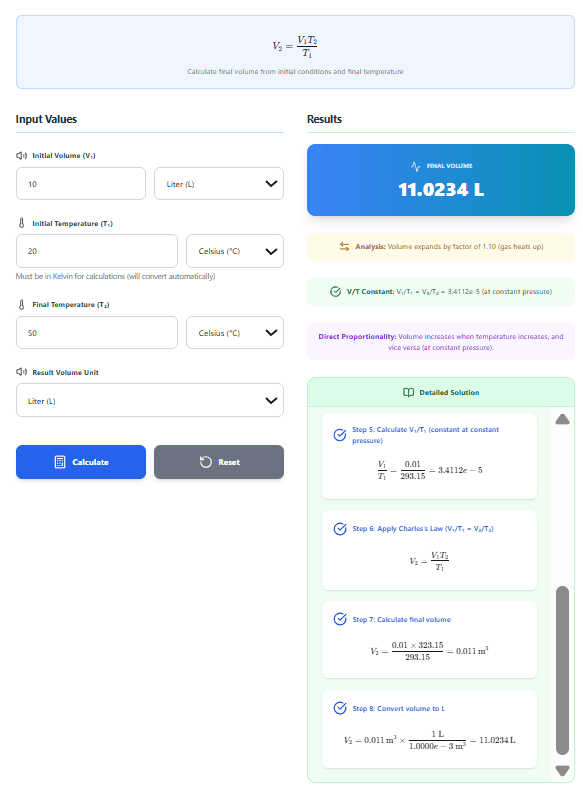
A gas occupies 10 L at 20 °C. It is heated to 50 °C at constant pressure:
- Final volume: 11.02 L
- Initial volume: 10 L
- Initial temperature: 20 °C
- Final temperature: 50 °C
The calculator shows you exactly how it got the answer, including all temperature conversions.
Understanding Charles's Law
What Is Charles's Law?
Charles's Law states that at constant pressure, the volume of a fixed amount of gas is directly proportional to its absolute temperature. As temperature increases, volume increases proportionally.
The Formula
V₁/T₁ = V₂/T₂
Where:
- V₁ = Initial volume
- T₁ = Initial absolute temperature (Kelvin)
- V₂ = Final volume
- T₂ = Final absolute temperature (Kelvin)
Key Relationships
- Direct relationship: Volume ÷ Temperature = Constant (at constant pressure)
- Double the temperature → Double the volume
- Halve the temperature → Halve the volume
- V₁/T₁ = V₂/T₂ is always true at constant pressure
Why Kelvin Matters
Temperatures must be absolute — Kelvin, not Celsius or Fahrenheit. Charles's Law is a ratio of temperatures, and Celsius has an arbitrary zero point (water freezes at 0 °C, but that is a convention, not a physical floor). Plugging Celsius values directly into the ratio gives nonsense.
The calculator converts automatically. If you enter 20 °C, it uses 293.15 K internally. You don't need to do the conversion yourself, but you do need to understand why it's happening — otherwise the numbers will not make sense.
Rearranged Formulas
| What to Find | Formula |
|---|---|
| Final Volume | V₂ = V₁T₂/T₁ |
| Final Temperature | T₂ = V₂T₁/V₁ |
| Initial Volume | V₁ = V₂T₁/T₂ |
| Initial Temperature | T₁ = V₁T₂/V₂ |
Unit Support
This calculator handles all common volume and temperature units automatically:
Volume Units
| Unit | Symbol | Conversion to m³ |
|---|---|---|
| Cubic Meter | m³ | 1 |
| Liter | L | 0.001 |
| Milliliter | mL | 0.000001 |
| Cubic Centimeter | cm³ | 0.000001 |
| Cubic Foot | ft³ | 0.0283168 |
| Gallon | gal | 0.00378541 |
Note: 1 mL = 1 cm³, so both convert to the same SI value.
Temperature Units
| Unit | Symbol | Conversion to K |
|---|---|---|
| Kelvin | K | 1 |
| Celsius | °C | T(K) = T(°C) + 273.15 |
| Fahrenheit | °F | T(K) = (T(°F) − 32) × 5/9 + 273.15 |
Charles's Law uses absolute temperature. The calculator converts °C and °F to Kelvin internally before applying the formula.
How to Use the Calculator
Step 1: Choose Your Mode
Select one of four calculation modes:
- Calculate Final Volume – Find V₂
- Calculate Final Temperature – Find T₂
- Calculate Initial Volume – Find V₁
- Calculate Initial Temperature – Find T₁
Step 2: Enter Your Values
Depending on the mode, enter the required values with their units.
Step 3: Select Result Unit
Choose your preferred unit for the result.
Step 4: Calculate
Click the "Calculate" button. The results appear instantly.
Step 5: Review the Solution
The calculator shows detailed steps explaining how the result was derived, including all temperature conversions and intermediate calculations.
Step-by-Step Examples for Each Mode
Example 1: Calculate Final Volume (V₂)
Problem: A gas occupies 10 L at 20 °C. It is heated to 50 °C at constant pressure. What is the new volume?
Step 1: Identify the given values
- V₁ = 10 L
- T₁ = 20 °C
- T₂ = 50 °C
Step 2: Convert temperatures to Kelvin
- T₁ = 20 + 273.15 = 293.15 K
- T₂ = 50 + 273.15 = 323.15 K
Step 3: Apply Charles's Law
- V₂ = V₁T₂/T₁
- V₂ = (10 × 323.15) / 293.15
- V₂ ≈ 11.02 L
Result: The gas expands to about 11.02 L.
Example 2: Calculate Final Temperature (T₂)
Problem: A gas at 20 °C occupies 10 L. It is compressed to 8 L at constant pressure. What is the new temperature?
Step 1: Identify the given values
- V₁ = 10 L
- T₁ = 20 °C = 293.15 K
- V₂ = 8 L
Step 2: Apply Charles's Law
- T₂ = V₂T₁/V₁
- T₂ = (8 × 293.15) / 10
- T₂ = 234.52 K
Step 3: Convert to Celsius
- T₂ = 234.52 − 273.15 = −38.63 °C
Result: The gas cools to about −38.6 °C.
Example 3: Calculate Initial Volume (V₁)
Problem: A gas occupies 12 L at 50 °C. What was its volume at 20 °C, at constant pressure?
Step 1: Identify the given values
- V₂ = 12 L
- T₁ = 20 °C = 293.15 K
- T₂ = 50 °C = 323.15 K
Step 2: Apply Charles's Law
- V₁ = V₂T₁/T₂
- V₁ = (12 × 293.15) / 323.15
- V₁ ≈ 10.89 L
Result: The initial volume was about 10.89 L.
Example 4: Calculate Initial Temperature (T₁)
Problem: A gas occupies 10 L at an unknown temperature. When heated to 50 °C, it expands to 12 L at constant pressure. What was the initial temperature?
Step 1: Identify the given values
- V₁ = 10 L
- V₂ = 12 L
- T₂ = 50 °C = 323.15 K
Step 2: Apply Charles's Law
- T₁ = V₁T₂/V₂
- T₁ = (10 × 323.15) / 12
- T₁ ≈ 269.29 K
Step 3: Convert to Celsius
- T₁ = 269.29 − 273.15 = −3.86 °C
Result: The initial temperature was about −3.9 °C.
Example 5: Negative Celsius Temperature
Problem: A balloon contains 2 L of air at 25 °C. It is placed in a freezer at −10 °C. What is its new volume?
Step 1: Identify the given values
- V₁ = 2 L
- T₁ = 25 °C = 298.15 K
- T₂ = −10 °C = 263.15 K
Step 2: Apply Charles's Law
- V₂ = V₁T₂/T₁
- V₂ = (2 × 263.15) / 298.15
- V₂ ≈ 1.77 L
Result: The balloon shrinks to about 1.77 L.
This is why a balloon shrivels in a freezer — the air inside cools, its molecules slow down, and the volume contracts to match.
Practical Implications
Charles's Law explains several everyday phenomena that are easy to overlook:
| Situation | What Happens | Why |
|---|---|---|
| Hot air balloon | Rises when heated | Heated air expands, becomes less dense than surrounding cool air |
| Balloon in freezer | Shrinks | Cooled air contracts, reducing volume |
| Car tire on a hot day | Pressure may rise | At constant volume, heating increases pressure (Gay-Lussac's Law) |
| Bread rising in oven | Expands | Gas bubbles in dough expand as temperature increases |
| Aerosol can in sun | Risk of bursting | Trapped gas expands as temperature rises, raising pressure |
Note the third entry: Charles's Law holds pressure constant, while Gay-Lussac's Law holds volume constant. A car tire is closer to constant volume, so it follows Gay-Lussac's Law, not Charles's Law. This is a common confusion — the two laws are related but apply to different constraints.
When to Use Each Mode
| Mode | Formula | When to Use | Typical Scenario |
|---|---|---|---|
| Final Volume | V₂ = V₁T₂/T₁ | You have V₁, T₁, T₂ | Predicting expansion when heating a gas |
| Final Temperature | T₂ = V₂T₁/V₁ | You have V₁, T₁, V₂ | Finding the temperature after compression |
| Initial Volume | V₁ = V₂T₁/T₂ | You have V₂, T₁, T₂ | Working backward from final conditions |
| Initial Temperature | T₁ = V₁T₂/V₂ | You have V₁, V₂, T₂ | Determining the starting temperature |
Common Questions About Charles's Law
Q: What is Charles's Law?
Charles's Law describes the direct relationship between volume and absolute temperature at constant pressure. It states that V₁/T₁ = V₂/T₂.
Q: What are the conditions for Charles's Law?
Charles's Law applies when:
- Pressure is constant
- Gas amount (number of moles) is constant
- Gas behaves ideally
Q: What happens to volume when temperature doubles?
Volume doubles. Since V₁/T₁ = V₂/T₂, if T₂ = 2T₁, then V₂ = 2V₁ — provided the temperature is measured in Kelvin.
Q: Why must temperature be in Kelvin?
Because the formula is a ratio of absolute temperatures. Celsius has an arbitrary zero, so the ratio breaks. Kelvin starts at absolute zero, which is the physically meaningful baseline. Using Celsius in Charles's Law gives wrong answers.
Q: Can I mix different volume units?
No — for the formula to work directly, V₁ and V₂ must be in the same volume unit. The calculator converts your entered units to m³ internally, so you can enter V₁ in liters and V₂ in gallons if you want — but if you're doing it by hand, keep them consistent.
Q: What happens if temperature changes but pressure doesn't stay constant?
Charles's Law no longer applies. If pressure changes too, you need the Combined Gas Law: P₁V₁/T₁ = P₂V₂/T₂. Boyle's Law covers constant temperature, Charles's Law covers constant pressure, and Gay-Lussac's Law covers constant volume.
Q: Does Charles's Law work for all gases?
Charles's Law is exact only for an ideal gas. Real gases deviate near their condensation point and at very high pressures, where intermolecular forces and molecular volume become significant. For most everyday calculations — air at room temperature and moderate pressure — the deviation is small enough to ignore.
Q: What is the difference between Charles's Law and Gay-Lussac's Law?
Both are special cases of the Combined Gas Law. Charles's Law holds pressure constant and relates volume to temperature. Gay-Lussac's Law holds volume constant and relates pressure to temperature. They look similar but apply to different experimental setups.
Q: What real-world applications use Charles's Law?
- Hot air balloons
- Weather balloons
- Internal combustion engines (during intake)
- Bread and pastry baking
- Aerosol can design
- Cryogenic storage
Tips for Getting the Best Results
Choose the right mode. Make sure you're calculating what you need — final volume, final temperature, initial volume, or initial temperature.
Convert to Kelvin first. If you're doing the math by hand, convert both temperatures to Kelvin before applying the formula. This is the single most common source of error.
Check your units. The calculator handles conversions automatically, but make sure you're entering values with the correct units.
Double-check your inputs. A single digit error changes everything. Take a moment to verify each number.
Watch for negative Celsius values. A gas at −38 °C is still physically valid (234.5 K), but a gas at −300 °C is below absolute zero and impossible. The calculator flags this as an error.
Review the steps. The step-by-step solution helps you understand the process and verify the calculation.
Final Thoughts
Charles's Law is one of the most intuitive gas laws — heat a gas and it expands, cool it and it contracts. The formula V₁/T₁ = V₂/T₂ is simple, but it only works with absolute temperature, which trips up more students than any other part of the calculation.
This calculator handles all four variants of the formula, with complete unit support (volume in m³, L, mL, cm³, ft³, gal; temperature in K, °C, °F), a V/T constant readout, and step-by-step solutions that show every conversion.
Whether you're solving a homework problem, checking a design, or exploring how gases behave, this tool can save time and reduce mistakes by handling the math and unit conversions automatically.