Boyle's Law Calculator – Calculate P₁V₁ = P₂V₂ with Step-by-Step Solutions
Boyle's Law is one of the fundamental gas laws in physics and chemistry. It describes the inverse relationship between pressure and volume when temperature is held constant. Simply put: when you squeeze a gas (decrease volume), its pressure increases. When you let it expand (increase volume), its pressure decreases.
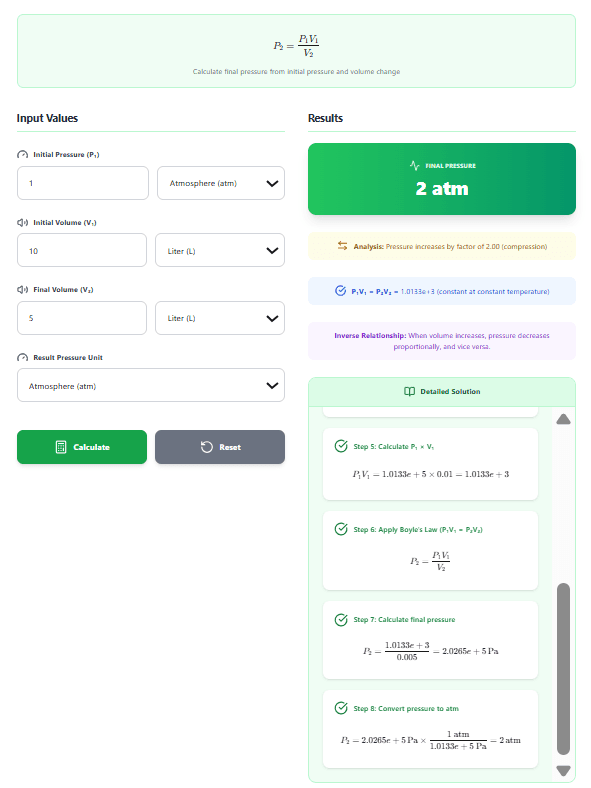
The formula is elegant and simple: P₁V₁ = P₂V₂. But applying it correctly with different units can be tricky. This calculator handles four different calculation modes based on what information you have available, with automatic unit conversions and step-by-step solutions.
Quick access: Use our free Boyle's Law calculator here
What Does This Calculator Do?
This tool calculates pressure or volume changes using Boyle's Law: P₁V₁ = P₂V₂.
Four calculation modes:
Calculate Final Pressure (P₂ = P₁V₁/V₂) – Find pressure after volume change
Calculate Final Volume (V₂ = P₁V₁/P₂) – Find volume after pressure change
Calculate Initial Pressure (P₁ = P₂V₂/V₁) – Find starting pressure from final conditions
Calculate Initial Volume (V₁ = P₂V₂/P₁) – Find starting volume from final conditions
Here's a quick example:
A syringe contains 10 mL of air at 1 atm. You compress it to 5 mL:
- Final pressure: 2 atm
- Initial pressure: 1 atm
- Initial volume: 10 mL
- Final volume: 5 mL
The calculator shows you exactly how it got the answer, including any unit conversions needed.
Understanding Boyle's Law
What Is Boyle's Law?
Boyle's Law states that at constant temperature, the pressure of a fixed amount of gas is inversely proportional to its volume. As volume decreases, pressure increases proportionally.
The Formula
P₁V₁ = P₂V₂
Where:
- P₁ = Initial pressure
- V₁ = Initial volume
- P₂ = Final pressure
- V₂ = Final volume
Key Relationships
- Inverse relationship: Pressure × Volume = Constant (at constant temperature)
- Double the pressure → Half the volume
- Double the volume → Half the pressure
- P₁V₁ = P₂V₂ is always true at constant temperature
Rearranged Formulas
| What to Find | Formula |
|---|---|
| Final Pressure | P₂ = P₁V₁/V₂ |
| Final Volume | V₂ = P₁V₁/P₂ |
| Initial Pressure | P₁ = P₂V₂/V₁ |
| Initial Volume | V₁ = P₂V₂/P₁ |
Unit Support
This calculator handles all common pressure and volume units automatically:
Pressure Units
| Unit | Symbol | Conversion to Pa |
|---|---|---|
| Pascal | Pa | 1 |
| Kilopascal | kPa | 1000 |
| Atmosphere | atm | 101325 |
| Bar | bar | 100000 |
| Millimeter of Mercury | mmHg | 133.322 |
| Pounds per square inch | psi | 6894.76 |
Volume Units
| Unit | Symbol | Conversion to m³ |
|---|---|---|
| Cubic Meter | m³ | 1 |
| Liter | L | 0.001 |
| Milliliter | mL | 0.000001 |
| Cubic Centimeter | cm³ | 0.000001 |
| Cubic Foot | ft³ | 0.0283168 |
| Gallon | gal | 0.00378541 |
Note: 1 mL = 1 cm³, so both convert to the same SI value.
How to Use the Calculator
Step 1: Choose Your Mode
Select one of four calculation modes:
- Calculate Final Pressure – Find P₂
- Calculate Final Volume – Find V₂
- Calculate Initial Pressure – Find P₁
- Calculate Initial Volume – Find V₁
Step 2: Enter Your Values
Depending on the mode, enter the required values with their units.
Step 3: Select Result Unit
Choose your preferred unit for the result.
Step 4: Calculate
Click the "Calculate" button. The results appear instantly.
Step 5: Review the Solution
The calculator shows detailed steps explaining how the result was derived, including all unit conversions and intermediate calculations.
Step-by-Step Examples for Each Mode
Example 1: Calculate Final Pressure (P₂)
Problem: A bicycle pump contains 0.5 L of air at 1 atm. You compress it to 0.25 L. What is the final pressure?
Step 1: Identify the given values
- P₁ = 1 atm
- V₁ = 0.5 L
- V₂ = 0.25 L
Step 2: Apply Boyle's Law
- P₂ = P₁V₁/V₂
- P₂ = (1 × 0.5) / 0.25
- P₂ = 0.5 / 0.25
- P₂ = 2 atm
Result: The pressure doubles to 2 atm.
Example 2: Calculate Final Volume (V₂)
Problem: A scuba tank contains 10 L of air at 200 atm. The air is released to 1 atm. What volume will it occupy?
Step 1: Identify the given values
- P₁ = 200 atm
- V₁ = 10 L
- P₂ = 1 atm
Step 2: Apply Boyle's Law
- V₂ = P₁V₁/P₂
- V₂ = (200 × 10) / 1
- V₂ = 2000 L
Result: The air expands to 2000 L.
Example 3: Calculate Initial Pressure (P₁)
Problem: A gas is compressed from 10 L to 5 L. Its final pressure is 2 atm. What was its initial pressure?
Step 1: Identify the given values
- V₁ = 10 L
- V₂ = 5 L
- P₂ = 2 atm
Step 2: Apply Boyle's Law
- P₁ = P₂V₂/V₁
- P₁ = (2 × 5) / 10
- P₁ = 10 / 10
- P₁ = 1 atm
Result: The initial pressure was 1 atm.
Example 4: Calculate Initial Volume (V₁)
Problem: A gas at 1 atm is compressed until its pressure reaches 2 atm at a volume of 5 L. What was its initial volume?
Step 1: Identify the given values
- P₁ = 1 atm
- P₂ = 2 atm
- V₂ = 5 L
Step 2: Apply Boyle's Law
- V₁ = P₂V₂/P₁
- V₁ = (2 × 5) / 1
- V₁ = 10 L
Result: The initial volume was 10 L.
When to Use Each Mode
| Mode | Formula | When to Use | Typical Scenario |
|---|---|---|---|
| Final Pressure | P₂ = P₁V₁/V₂ | You have P₁, V₁, V₂ | Compressing gas in a syringe or pump |
| Final Volume | V₂ = P₁V₁/P₂ | You have P₁, V₁, P₂ | Gas expanding into a larger space, or a balloon rising |
| Initial Pressure | P₁ = P₂V₂/V₁ | You have P₂, V₂, V₁ | Working backward from final conditions |
| Initial Volume | V₁ = P₂V₂/P₁ | You have P₁, P₂, V₂ | Finding the original gas volume before compression |
Common Questions About Boyle's Law
Q: What is Boyle's Law?
Boyle's Law describes the inverse relationship between pressure and volume at constant temperature. It states that P₁V₁ = P₂V₂.
Q: What are the conditions for Boyle's Law?
Boyle's Law applies when:
- Temperature is constant
- Gas amount (number of moles) is constant
- Gas behaves ideally
Q: What happens to pressure when volume doubles?
Pressure halves. Since P₁V₁ = P₂V₂, if V₂ = 2V₁, then P₂ = P₁/2.
Q: What happens to volume when pressure triples?
Volume becomes one-third. Since P₁V₁ = P₂V₂, if P₂ = 3P₁, then V₂ = V₁/3.
Q: Can I mix different pressure units?
No — for the formula to work directly, P₁ and P₂ must be in the same pressure unit, and V₁ and V₂ must be in the same volume unit. The calculator converts your entered units internally, so you can enter P₁ in atm and P₂ in kPa if you want — but if you're doing it by hand, keep each pair consistent.
Q: What are real-world applications of Boyle's Law?
- Syringes and pumps
- Scuba diving (air expands as you rise)
- Breathing (lungs expand and contract)
- Engine cylinders
- Spray cans
Q: What does "inverse relationship" mean?
An inverse relationship means that as one variable increases, the other decreases proportionally. In Boyle's Law, pressure and volume are inversely related.
Q: What happens if temperature changes?
Boyle's Law only applies at constant temperature. If temperature changes, you need Charles's Law or the Combined Gas Law.
Q: Does Boyle's Law work for all gases?
Boyle's Law is exact only for an ideal gas. Real gases deviate at very high pressures or near their condensation point, where intermolecular forces and molecular volume become significant. For most everyday calculations — air at room temperature and moderate pressure — the deviation is small enough to ignore.
Tips for Getting the Best Results
Choose the right mode. Make sure you're calculating what you need — final pressure, final volume, initial pressure, or initial volume.
Check your units. The calculator handles conversions automatically, but make sure you're entering values with the correct units.
Double-check your inputs. A single digit error changes everything. Take a moment to verify each number.
Review the steps. The step-by-step solution helps you understand the process and verify the calculation.
Use real-world examples. The examples section shows how Boyle's Law applies to everyday situations like syringes, pumps, and scuba tanks.
Remember constant temperature. Boyle's Law only works when temperature doesn't change. If temperature changes, use the Combined Gas Law.
Final Thoughts
Boyle's Law is one of the most fundamental and useful gas laws in physics and chemistry. Understanding the inverse relationship between pressure and volume is essential for anyone working with gases, from students to engineers to healthcare professionals.
The formula P₁V₁ = P₂V₂ is simple but powerful — it applies to everything from syringes and pumps to breathing and scuba diving. This calculator handles all four variants of the formula, with complete unit support, step-by-step solutions, and practical real-world examples.
Whether you're solving a homework problem, checking engineering calculations, or simply exploring how gases behave, this tool can save time and reduce mistakes by handling the math and unit conversions automatically.