Efficiency Calculator – Calculate η = Output/Input with Step-by-Step Solutions
Efficiency is one of the most practical concepts in physics and engineering. It tells you how much of what you put in actually comes out as useful work — and how much is lost along the way. An incandescent bulb converts only about 5% of its electrical input into visible light; the rest becomes heat. A modern combined-cycle power plant reaches about 60%. A lithium-ion battery discharges around 90–95% of what it stores.
The formula is simple: η = Output/Input. This calculator handles three different calculation modes — find efficiency, output, or input — with support for both power and energy units, percentage or decimal efficiency, and step-by-step solutions.
Quick access: Use our free efficiency calculator here
What Does This Calculator Do?
This tool calculates any one of the three quantities in the efficiency relationship.
Three calculation modes:
Calculate Efficiency (η = Output/Input) – Find how efficient a system is
Calculate Output (Output = η × Input) – Find the useful output from a given input and efficiency
Calculate Input (Input = Output/η) – Find how much input is required to produce a given output
Plus power or energy mode – In efficiency mode, choose whether you are working with power (W, kW, MW, HP, ft·lb/s) or energy (J, kJ, cal, kcal, Wh, eV).
Plus percentage or decimal output – Efficiency can be displayed as a percentage (0–100%) or as a decimal (0–1).
Here's a quick example:
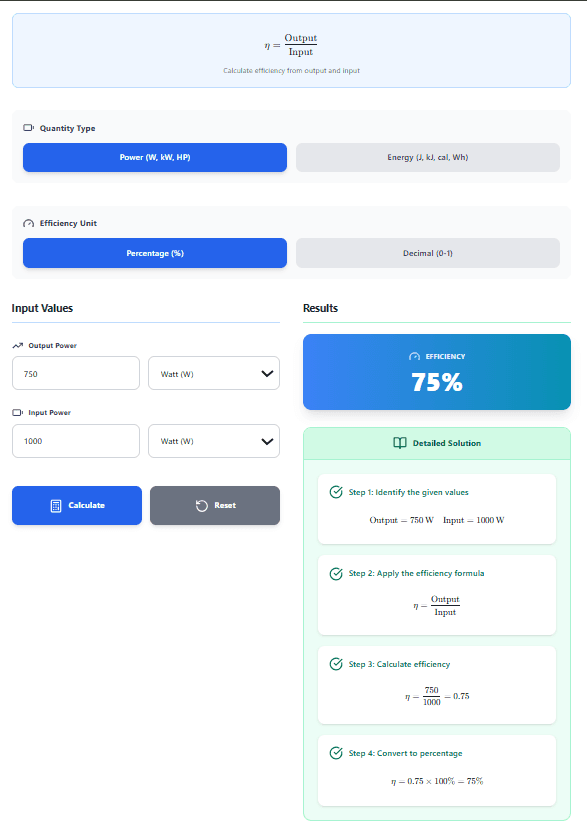
A system produces 750 W of useful output from 1000 W of input:
- Efficiency: 75%
- Output: 750 W
- Input: 1000 W
The calculator shows you exactly how it got the answer, including any unit conversions needed.
Understanding Efficiency
What Is Efficiency?
Efficiency (η) is the ratio of useful output to total input. It measures how much of what you put into a system actually comes out as something useful, versus how much is wasted — typically as heat, friction, or other losses.
The Formula
η = Output / Input
Where:
- η (eta) = Efficiency (dimensionless, or expressed as %)
- Output = Useful output (in W or J)
- Input = Total input (same units as output)
Key Relationships
- η = 1 (100%) → Perfect efficiency — all input becomes useful output
- η = 0 (0%) → No useful output — all input is lost
- 0 < η < 1 → Real systems — some input is always wasted
- Output and input must be in the same units → W with W, J with J
Why Real Systems Are Never 100% Efficient
No real system converts energy with perfect efficiency. Losses come from:
- Friction — mechanical losses in moving parts
- Heat — resistive heating, exhaust, cooling
- Sound — vibration and acoustic energy loss
- Radiation — light, infrared, or other emissions
- Incomplete conversion — fuel that does not fully burn, electrons that do not reach the load
The second law of thermodynamics requires that some energy be degraded — that is why η = 1 is impossible for a real heat engine.
Common Efficiency Values
| System | Typical Efficiency |
|---|---|
| Incandescent bulb | ~5% (light only) |
| LED bulb | ~30–50% (light only) |
| Gasoline car engine | ~25% |
| Diesel engine | ~35% |
| Electric motor (large) | ~90–95% |
| Lithium-ion battery (round-trip) | ~90–95% |
| Transformer (large power) | ~98–99% |
| Combined-cycle power plant | ~60% |
| Solar panel (commercial) | ~20% |
Rearranged Formulas
| What to Find | Formula |
|---|---|
| Efficiency | η = Output/Input |
| Output | Output = η × Input |
| Input | Input = Output/η |
Unit Support
This calculator handles both power and energy units, so it works for rate-based efficiency (power in, power out) and total-energy efficiency (energy in, energy out).
Power Units
| Unit | Symbol | Conversion to W |
|---|---|---|
| Watt | W | 1 |
| Kilowatt | kW | 1,000 |
| Megawatt | MW | 1,000,000 |
| Horsepower | HP | 745.7 |
| Foot-pound per second | ft·lb/s | 1.35582 |
Energy Units
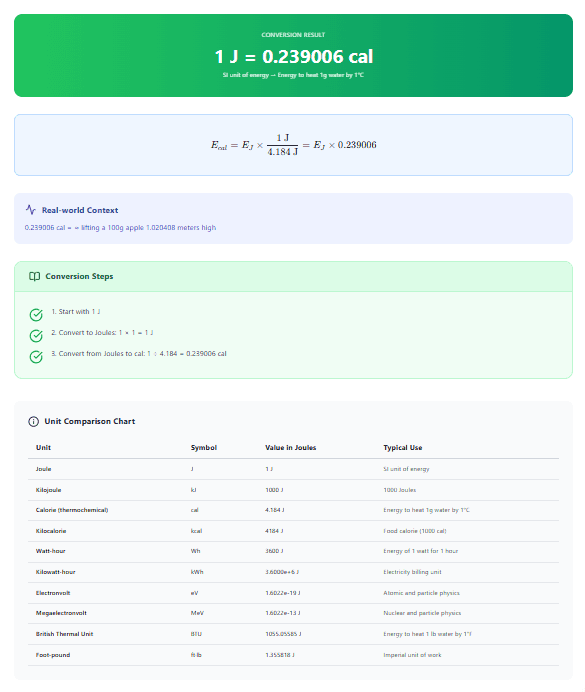
| Unit | Symbol | Conversion to J |
|---|---|---|
| Joule | J | 1 |
| Kilojoule | kJ | 1,000 |
| Calorie | cal | 4.184 |
| Kilocalorie | kcal | 4,184 |
| Watt-hour | Wh | 3,600 |
| Electronvolt | eV | 1.602 × 10⁻¹⁹ |
Note: When calculating efficiency, output and input must be in the same type of quantity. Both should be power or both should be energy.
How to Use the Calculator
Step 1: Choose Your Mode
- Efficiency – Find η from output and input
- Output – Find output from efficiency and input
- Input – Find input from output and efficiency
Step 2: (Efficiency mode only) Choose Power or Energy
Select Power if your output and input are rates (W, kW, HP). Select Energy if they are totals (J, kJ, cal, Wh).
Step 3: Choose Efficiency Unit
- Percentage (0–100%) for everyday use
- Decimal (0–1) for formulas and calculations
Step 4: Enter Your Values
Enter the known values with their units.
Step 5: Calculate
Click "Calculate" and the result appears instantly.
Step 6: Review the Solution
The calculator shows detailed steps, including all unit conversions and intermediate calculations.
Step-by-Step Examples
Example 1: Electric Motor Efficiency
Problem: An electric motor draws 5 kW of electrical power and delivers 4.5 kW of mechanical power. What is its efficiency?
Step 1: Identify the given values
- Output = 4.5 kW
- Input = 5 kW
Step 2: Convert both to Watts
- Output = 4.5 × 1000 = 4500 W
- Input = 5 × 1000 = 5000 W
Step 3: Apply the formula
- η = Output/Input
- η = 4500/5000
- η = 0.9
Step 4: Convert to percentage
- η = 0.9 × 100 = 90%
Result: The motor is 90% efficient.
Example 2: Power Plant Output
Problem: A power plant is 40% efficient. If it consumes 500 MW of thermal input, what is its electrical output?
Step 1: Identify the given values
- η = 40% = 0.4
- Input = 500 MW
Step 2: Apply the formula
- Output = η × Input
- Output = 0.4 × 500
- Output = 200 MW
Result: The plant produces 200 MW of electrical output.
Example 3: Required Input for a Target Output
Problem: A 90%-efficient motor needs to deliver 4.5 kW of mechanical output. How much electrical input does it need?
Step 1: Identify the given values
- Output = 4.5 kW
- η = 90% = 0.9
Step 2: Apply the formula
- Input = Output/η
- Input = 4.5/0.9
- Input = 5 kW
Result: The motor needs 5 kW of electrical input.
Example 4: Energy Efficiency
Problem: A battery stores 3600 J of energy and delivers 3200 J to a load. What is its efficiency?
Step 1: Identify the given values
- Output = 3200 J
- Input = 3600 J
Step 2: Apply the formula
- η = 3200/3600
- η ≈ 0.8889
Step 3: Convert to percentage
- η ≈ 88.89%
Result: The battery's round-trip efficiency is about 88.9%.
Example 5: Car Engine Efficiency
Problem: A car engine produces 75 kW of mechanical power from 300 kW of fuel input. What is its efficiency?
Step 1: Identify the given values
- Output = 75 kW
- Input = 300 kW
Step 2: Apply the formula
- η = 75/300
- η = 0.25
Result: The engine is 25% efficient — typical for a gasoline engine, where three-quarters of the fuel energy is lost as heat.
Practical Implications
Efficiency calculations drive real decisions across physics and engineering:
| Application | What efficiency tells you |
|---|---|
| Appliance ratings | How much of the electricity you pay for actually does useful work |
| Engine design | Trade-offs between power output and fuel consumption |
| Power grid | Transmission losses in transformers and lines |
| Renewable energy | How much of the incident sunlight or wind becomes electricity |
| Battery selection | Round-trip losses during charge/discharge |
| HVAC systems | Heating and cooling efficiency (SEER, COP) |
When to Use Each Mode
| Mode | Formula | When to Use | Typical Scenario |
|---|---|---|---|
| Efficiency | η = Output/Input | You know output and input | Rating an existing system |
| Output | Output = η × Input | You know efficiency and input | Predicting useful output |
| Input | Input = Output/η | You know output and efficiency | Sizing a system for a target output |
Common Questions About Efficiency
Q: What is efficiency?
Efficiency (η) is the ratio of useful output to total input. It measures how much of the energy or power you put into a system is actually converted into something useful.
Q: Can efficiency be greater than 100%?
No. A system that produced more output than input would violate the conservation of energy. For real systems, η is always less than 1 (100%). Heat pumps and refrigerators appear to exceed 100%, but that is because their useful output is measured differently — they use the Coefficient of Performance (COP), not efficiency.
Q: Why is efficiency usually expressed as a percentage?
Because percentages are intuitive. Saying "90% efficient" immediately conveys that 90 cents of every dollar of input becomes useful output. In formulas, use the decimal form (0.9).
Q: What is the difference between efficiency and COP?
Efficiency is the ratio of output work (or energy) to input. COP (Coefficient of Performance) is used for heat pumps and refrigerators, where the useful output is heat moved, not work produced. COP can exceed 1; efficiency cannot.
Q: Does efficiency depend on the size of the system?
Not directly. Efficiency is a ratio, so it does not scale with size. A small motor and a large motor can have the same efficiency if they use the same technology. But in practice, larger systems often have higher efficiency because fixed losses (like friction) become a smaller fraction of the total.
Q: What is the difference between first-law and second-law efficiency?
First-law efficiency is the simple ratio η = Output/Input, based only on energy conservation. Second-law (exergy) efficiency compares the system to the theoretical maximum — the Carnot limit for heat engines. Second-law efficiency is always less than or equal to first-law efficiency.
Q: Why are electric motors more efficient than combustion engines?
Electric motors convert electrical energy directly into mechanical motion with very few losses (mainly resistive heating and friction). Combustion engines are heat engines, and the second law of thermodynamics caps their efficiency at the Carnot limit — typically 30–40% for practical designs.
Q: How do I improve efficiency?
- Reduce friction with better lubrication and materials
- Reduce resistive losses with better conductors
- Recover waste heat (combined cycle, regenerative braking)
- Operate closer to the design point (rated load)
- Use higher-quality components and tighter tolerances
Q: What is round-trip efficiency?
Round-trip efficiency is the efficiency of a storage system over a full charge-discharge cycle. For a battery, it is the energy out divided by the energy in over a full cycle. Lithium-ion batteries typically reach 90–95%; pumped hydro storage is around 70–80%.
Tips for Getting the Best Results
Choose the right mode. Make sure you are solving for what you need — efficiency, output, or input.
Match your units. In efficiency mode, output and input must be the same type of quantity — both power or both energy. The calculator handles unit conversions, but mixing a power input with an energy output is a conceptual error.
Choose percentage or decimal consistently. If your input is a percentage (75), use percentage mode. If your input is a decimal (0.75), use decimal mode. Mixing them is the most common source of error.
Check the sanity of the result. Efficiency should be between 0 and 1 (or 0 and 100%). If you get a value greater than 1, something is wrong — usually an input or output swapped.
Use percentage for communication, decimal for calculation. In reports and specifications, percentages are standard. In formulas and spreadsheets, decimals are easier to work with.
Double-check your inputs. A single digit error changes everything. Take a moment to verify each number.
Review the steps. The step-by-step solution helps you understand the process and verify the calculation.
Final Thoughts
Efficiency is one of those concepts that seems simple — just output divided by input — but it carries a lot of physics and engineering weight. It sets the boundary between what is possible and what is not, drives the economics of energy systems, and shapes the design of everything from light bulbs to power plants.
The formula η = Output/Input works equally well for power (rate of energy) and energy (total amount), and it scales cleanly with different unit systems. The only real trap is keeping the units and the percentage/decimal distinction straight — and the calculator handles that for you.
This calculator handles all three variants of the formula, with power and energy modes, percentage and decimal output, full unit support (power in W, kW, MW, HP, ft·lb/s; energy in J, kJ, cal, kcal, Wh, eV), and step-by-step solutions.
Whether you are checking an appliance rating, sizing a motor, or analyzing a power plant, this tool can save time and reduce mistakes by handling the math and unit conversions automatically.