Buoyancy Calculator – Calculate Buoyant Force Using F_b = ρVg with Step-by-Step Solutions
Have you ever wondered why a massive steel ship floats while a small stone sinks? The answer lies in buoyancy and Archimedes' Principle. This fundamental law of physics explains how objects behave in fluids — whether they float, sink, or remain suspended.
The formula is simple: F_b = ρVg, where the buoyant force equals the weight of displaced fluid. But applying it correctly with different units and understanding float/sink analysis can be challenging. This calculator handles three different calculation modes with automatic unit conversions and step-by-step solutions.
Quick access: Use our free buoyancy calculator here
What Does This Calculator Do?
This tool calculates buoyancy-related values using Archimedes' Principle: F_b = ρVg.
Three calculation modes:
Calculate Buoyant Force (F_b = ρVg) – Find upward force from fluid density and displaced volume
Calculate Displaced Volume (V = F_b/ρg) – Find volume of fluid displaced from buoyant force and density
Calculate Fluid Density (ρ = F_b/Vg) – Find fluid density from buoyant force and displaced volume
Plus float/sink analysis – Compare object weight with buoyant force to determine if it floats or sinks.
Here's a quick example:
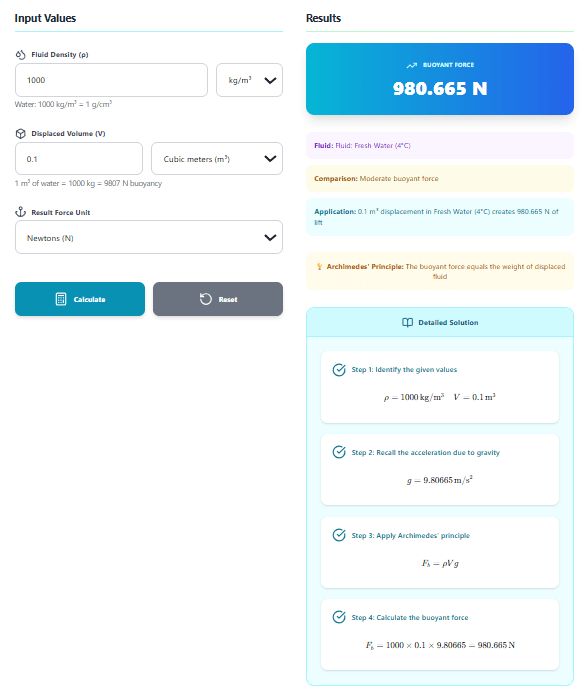
A 0.1 m³ object displaces water (ρ = 1000 kg/m³):
- Buoyant force: 981 N (≈ 100 kg of lift)
- Fluid density: 1000 kg/m³
- Displaced volume: 0.1 m³
The calculator shows you exactly how it got the answer, including any unit conversions needed.
Understanding Buoyancy
What Is Buoyancy?
Buoyancy is the upward force exerted by a fluid on an object immersed in it. This force is equal to the weight of the fluid displaced by the object.
Archimedes' Principle
F_b = ρVg
Where:
- F_b = Buoyant force (Newtons)
- ρ (rho) = Density of the fluid (kg/m³)
- V = Volume of fluid displaced (m³)
- g = Acceleration due to gravity (9.80665 m/s²)
Key Relationships
- Floats: Object density < Fluid density → Buoyant force > Object weight
- Sinks: Object density > Fluid density → Object weight > Buoyant force
- Neutrally buoyant: Object density = Fluid density → Forces balance
Apparent Weight
Apparent Weight = Real Weight - Buoyant Force
This is what a scale would read if you weighed the object while submerged.
Unit Support
This calculator handles all common units automatically:
Fluid Density Units
| Unit | Symbol | Conversion to kg/m³ |
|---|---|---|
| Kilograms per cubic meter | kg/m³ | 1 |
| Grams per cubic centimeter | g/cm³ | 1000 |
| Grams per milliliter | g/mL | 1000 |
| Kilograms per liter | kg/L | 1000 |
Note: 1 g/cm³ = 1 g/mL = 1 kg/L — they are numerically identical because 1 cm³ = 1 mL and 1 kg/L = 1000 kg/m³.
Volume Units
| Unit | Symbol | Conversion to m³ |
|---|---|---|
| Cubic meter | m³ | 1 |
| Cubic centimeter | cm³ | 0.000001 |
| Liter | L | 0.001 |
| Milliliter | mL | 0.000001 |
Note: 1 cm³ = 1 mL, so both convert to the same SI value.
Force Units
| Unit | Symbol | Conversion to N |
|---|---|---|
| Newton | N | 1 |
| Kilonewton | kN | 1000 |
| Pound-force | lbf | 4.44822 |
How to Use the Calculator
Step 1: Choose Your Mode
Select one of three calculation modes:
- Buoyant Force – Find F_b
- Displaced Volume – Find V
- Fluid Density – Find ρ
Step 2: Enter Your Values
Depending on the mode, enter the required values with their units.
Step 3: Optional — Include Object Weight
Toggle on to analyze whether the object floats or sinks. Enter the object's density for comparison.
Step 4: Select Result Unit
Choose your preferred unit for the result.
Step 5: Calculate
Click the "Calculate" button. The results appear instantly.
Step 6: Review the Solution
The calculator shows detailed steps explaining how the result was derived, including all unit conversions and intermediate calculations.
Step-by-Step Examples for Each Mode
Example 1: Calculate Buoyant Force
Problem: A 0.1 m³ object is submerged in water (ρ = 1000 kg/m³). What is the buoyant force?
Step 1: Identify the given values
- ρ = 1000 kg/m³
- V = 0.1 m³
- g = 9.80665 m/s²
Step 2: Apply the formula
- F_b = ρVg
- F_b = 1000 × 0.1 × 9.80665
- F_b = 980.665 N
Result: The buoyant force is 980.67 N (about 100 kg of lift).
Example 2: Calculate Displaced Volume
Problem: An object experiences a buoyant force of 981 N in water (ρ = 1000 kg/m³). What volume of water is displaced?
Step 1: Identify the given values
- F_b = 981 N
- ρ = 1000 kg/m³
- g = 9.80665 m/s²
Step 2: Apply the formula
- V = F_b / (ρg)
- V = 981 / (1000 × 9.80665)
- V = 981 / 9806.65
- V = 0.1 m³
Result: The object displaces 0.1 m³ of water.
Example 3: Calculate Fluid Density
Problem: A 0.1 m³ object experiences a buoyant force of 981 N. What is the fluid density?
Step 1: Identify the given values
- F_b = 981 N
- V = 0.1 m³
- g = 9.80665 m/s²
Step 2: Apply the formula
- ρ = F_b / (Vg)
- ρ = 981 / (0.1 × 9.80665)
- ρ = 981 / 0.980665
- ρ = 1000 kg/m³
Result: The fluid density is 1000 kg/m³ (water).
Float/Sink Analysis Example
Problem: A wooden block (ρ = 750 kg/m³) with volume 0.1 m³ is placed in water (ρ = 1000 kg/m³). Will it float or sink?
Step 1: Calculate buoyant force (if fully submerged)
- F_b = ρ_water × V × g
- F_b = 1000 × 0.1 × 9.80665 = 980.67 N
Step 2: Calculate object weight
- W = ρ_wood × V × g
- W = 750 × 0.1 × 9.80665 = 735.5 N
Step 3: Compare
- F_b (980.67 N) > W (735.5 N)
Result: The block FLOATS. Because the buoyant force at full submersion exceeds its weight, the block rises until equilibrium is reached — it floats with only part of its volume submerged.
The submerged fraction equals the density ratio:
- Submerged fraction = ρ_wood / ρ_water = 750 / 1000 = 0.75
So 75% of the block sits below the waterline, and 25% is above it. This is why a wooden block bobs mostly underwater, while a foam block (ρ ≈ 50 kg/m³) floats almost entirely above the surface.
Common Fluid Densities
| Fluid | Density (kg/m³) | Density (g/cm³) |
|---|---|---|
| Fresh Water (4°C) | 1000 | 1.000 |
| Sea Water | 1025 | 1.025 |
| Mercury | 13546 | 13.546 |
| Air (20°C) | 1.204 | 0.001204 |
| Gasoline | 740 | 0.740 |
| Diesel | 850 | 0.850 |
| Crude Oil | 870 | 0.870 |
| Olive Oil | 920 | 0.920 |
| Ethanol | 789 | 0.789 |
| Glycerin | 1260 | 1.260 |
| Milk | 1030 | 1.030 |
| Blood | 1060 | 1.060 |
| Honey | 1420 | 1.420 |
Common Material Densities
| Material | Density (kg/m³) | Density (g/cm³) | Floats in Water? |
|---|---|---|---|
| Cork | 240 | 0.240 | Yes |
| Polystyrene foam | 50 | 0.050 | Yes |
| Wood (oak) | 750 | 0.750 | Yes |
| Water (reference) | 1000 | 1.000 | Neutral |
| Concrete | 2400 | 2.400 | No |
| Aluminum | 2700 | 2.700 | No |
| Steel | 7850 | 7.850 | No |
| Gold | 19300 | 19.300 | No |
Real-World Applications
🚢 Marine Engineering
- Ship design and stability
- Submarine buoyancy control
- Floating structures
- Harbour and dock design
🌊 Fluid Dynamics
- Balloon and airship design
- Hydraulic systems
- Fluid flow analysis
- Underwater vehicles
🏊♂️ Everyday Life
- Swimming and floating
- Fishing (floats and bobbers)
- Boating and sailing
- Scuba diving (buoyancy control)
🔬 Science & Engineering
- Density measurement
- Material testing
- Hydrometer design
- Process engineering
When to Use Each Mode
| Mode | Formula | When to Use | Typical Scenario |
|---|---|---|---|
| Buoyant Force | F_b = ρVg | You have density and volume | Designing a floating object or calculating lift |
| Displaced Volume | V = F_b/ρg | You have force and density | Sizing an object for a target buoyancy |
| Fluid Density | ρ = F_b/Vg | You have force and volume | Identifying an unknown liquid |
Common Questions About Buoyancy
Q: What is Archimedes' Principle?
Archimedes' Principle states that the buoyant force on an object equals the weight of the fluid displaced by that object. It explains why objects float or sink.
Q: What is the buoyant force formula?
The formula is F_b = ρVg, where ρ is fluid density, V is displaced volume, and g is gravitational acceleration.
Q: What makes an object float or sink?
An object floats if its density is less than the fluid density (buoyant force > weight). It sinks if its density is greater (weight > buoyant force). If the densities are equal, the object is neutrally buoyant — it neither rises nor sinks, staying suspended at any depth. Submarines aim for this state when cruising.
Q: What is apparent weight?
Apparent weight is the weight of an object when submerged in a fluid. It equals the real weight minus the buoyant force. This is what a scale would read underwater.
Q: Why do ships float if they're made of steel?
Ships float because they displace a large volume of water. Their overall density (including the air inside) is less than water, even though steel is denser than water.
Q: How do submarines control buoyancy?
Submarines use ballast tanks. Filling them with water increases weight and causes sinking. Pumping water out decreases weight and causes rising.
Q: Does buoyancy depend on depth?
In an incompressible fluid like water, buoyancy does not depend on depth — the displaced volume and fluid density are the same at 1 m or 100 m. In a compressible fluid like air, density changes with depth (or altitude), so buoyancy can vary. The formula F_b = ρVg uses the local fluid density.
Q: What is the difference between density and specific gravity?
Density is mass per unit volume (kg/m³). Specific gravity is the ratio of a substance's density to the density of water (unitless).
Tips for Getting the Best Results
Choose the right mode. Make sure you're calculating what you need — buoyant force, displaced volume, or fluid density.
Check your units. The calculator handles conversions automatically, but make sure you're entering values with the correct units.
Use the float/sink analysis. Toggle on object weight to see if your object will float or sink. This is especially useful for design problems.
Use common fluid references. The calculator includes a list of common fluid densities for quick reference.
Double-check your inputs. A single digit error changes everything. Take a moment to verify each number.
Review the steps. The step-by-step solution helps you understand the process and verify the calculation.
Final Thoughts
Archimedes' Principle is one of the most elegant and useful laws in physics. Understanding buoyancy is essential for anyone working with fluids — from marine engineers to swimmers to students learning about density and forces.
The formula F_b = ρVg is simple but powerful — it applies to everything from ships and submarines to balloons and hydrometers. This calculator handles all three variants of the formula, with complete unit support, float/sink analysis, common fluid references, and apparent weight calculation.
Whether you're solving a homework problem, designing a floating structure, checking engineering calculations, or simply exploring how objects behave in fluids, this tool can save time and reduce mistakes by handling the math and unit conversions automatically.