Flow Rate Calculator – Calculate Q = A × v with Step-by-Step Solutions
Flow rate is one of the most practical quantities in fluid mechanics. It tells you how much fluid passes a given point per unit time — how much water flows through a pipe, how much air moves through a duct, how much blood pumps through an artery. The fundamental relationship is simple: Q = A × v, where Q is volumetric flow rate, A is cross-sectional area, and v is flow velocity.
This calculator handles three different calculation modes based on what you need to find, with pipe size presets, Reynolds number analysis, and step-by-step solutions.
Quick access: Use our free flow rate calculator here
What Does This Calculator Do?
This tool calculates any one of the three quantities in the flow rate relationship.
Three calculation modes:
Calculate Flow Rate (Q = A × v) – Find volumetric flow rate from area and velocity
Calculate Area (A = Q/v) – Find the required cross-sectional area for a target flow rate
Calculate Velocity (v = Q/A) – Find the flow velocity from flow rate and area
Plus a Reynolds number toggle – Turn it on to see whether the flow is laminar, transitional, or turbulent, based on pipe diameter and fluid properties.
Plus pipe size presets – Quick-select common pipe sizes (½" to 12") with their cross-sectional areas.
Here's a quick example:
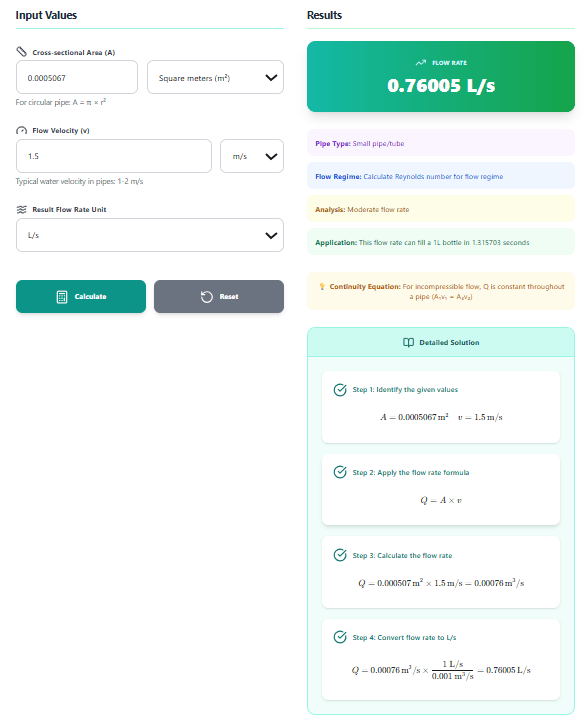
Water flows through a 1-inch pipe (area ≈ 0.0005067 m²) at 1.5 m/s:
- Flow rate: about 0.76 L/s (0.00076 m³/s)
- Area: 0.0005067 m²
- Velocity: 1.5 m/s
The calculator shows you exactly how it got the answer, including all unit conversions.
Understanding Flow Rate
What Is Flow Rate?
Volumetric flow rate (Q) is the volume of fluid that passes through a given cross-section per unit time. It is measured in cubic meters per second (m³/s) in SI, though liters per second (L/s), liters per minute (L/min), and gallons per minute (GPM) are common in practice.
The Formula
Q = A × v
Where:
- Q = Volumetric flow rate (m³/s)
- A = Cross-sectional area (m²)
- v = Flow velocity (m/s)
Key Relationships
- Larger area → More flow (at constant velocity)
- Higher velocity → More flow (at constant area)
- For a fixed flow rate, decreasing the area increases the velocity and vice versa
The Continuity Equation
For an incompressible fluid (like water), the flow rate is constant through a pipe of varying cross-section:
A₁v₁ = A₂v₂
This is the continuity equation. It means that if a pipe narrows, the velocity must increase to keep the flow rate the same. This is why a garden hose sprays faster when you partially cover the opening with your thumb.
Reynolds Number and Flow Regime
When flow rate and area are known, the calculator can also estimate the Reynolds number:
Re = (v × D) / ν
Where:
- v = Flow velocity (m/s)
- D = Pipe diameter (m)
- ν (nu) = Kinematic viscosity of the fluid (m²/s)
The Reynolds number determines the flow regime:
| Reynolds Number | Flow Regime |
|---|---|
| Re < 2,000 | Laminar (smooth, orderly) |
| 2,000 < Re < 4,000 | Transitional |
| Re > 4,000 | Turbulent (chaotic, mixing) |
For water at 20 °C, the kinematic viscosity is about 1 × 10⁻⁶ m²/s. This is the default value used by the calculator.
Rearranged Formulas
| What to Find | Formula |
|---|---|
| Flow Rate | Q = A × v |
| Area | A = Q/v |
| Velocity | v = Q/A |
Unit Support
This calculator handles a wide range of units:
Area Units
| Unit | Symbol | Conversion to m² |
|---|---|---|
| Square meter | m² | 1 |
| Square centimeter | cm² | 0.0001 |
| Square millimeter | mm² | 1 × 10⁻⁶ |
| Square foot | ft² | 0.092903 |
| Square inch | in² | 0.00064516 |
Velocity Units
| Unit | Symbol | Conversion to m/s |
|---|---|---|
| Meters per second | m/s | 1 |
| Centimeters per second | cm/s | 0.01 |
| Feet per second | ft/s | 0.3048 |
| Kilometers per hour | km/h | 0.277778 |
| Miles per hour | mph | 0.44704 |
Flow Rate Units
| Unit | Symbol | Conversion to m³/s |
|---|---|---|
| Cubic meter per second | m³/s | 1 |
| Liter per second | L/s | 0.001 |
| Liter per minute | L/min | 1.667 × 10⁻⁵ |
| Cubic meter per hour | m³/h | 2.778 × 10⁻⁴ |
| Gallon per second | gal/s | 0.00378541 |
| Gallon per minute | gal/min | 6.309 × 10⁻⁵ |
| Cubic foot per second | ft³/s | 0.0283168 |
How to Use the Calculator
Step 1: Choose Your Mode
Select one of three calculation modes:
- Calculate Flow Rate – Find Q
- Calculate Area – Find A
- Calculate Velocity – Find v
Step 2: (Optional) Load a Pipe Size or Typical Velocity
Click any preset button to load a common pipe size or a typical flow velocity (water in pipe, air in duct, river flow, etc.).
Step 3: (Optional) Enable Reynolds Number Analysis
Turn on the flow regime toggle and enter the pipe diameter to see whether the flow is laminar, transitional, or turbulent.
Step 4: Enter Your Values
Enter the known values with their units.
Step 5: Select Result Unit
Choose your preferred unit for the result.
Step 6: Calculate
Click "Calculate" and the result appears instantly with pipe type, flow regime, and step-by-step working.
Step-by-Step Examples
Example 1: Flow Rate in a Pipe
Problem: Water flows through a 1-inch pipe (A = 0.0005067 m²) at 1.5 m/s. What is the flow rate?
Step 1: Identify the given values
- A = 0.0005067 m²
- v = 1.5 m/s
Step 2: Apply the formula
- Q = A × v
- Q = 0.0005067 × 1.5
- Q = 0.000760 m³/s
Step 3: Convert to L/s
- Q = 0.000760 / 0.001 = 0.76 L/s
Result: The flow rate is 0.76 L/s — a typical household plumbing flow.
Example 2: Required Pipe Area
Problem: You need a flow rate of 0.001 m³/s (1 L/s) at a velocity of 1.5 m/s. What cross-sectional area is required?
Step 1: Identify the given values
- Q = 0.001 m³/s
- v = 1.5 m/s
Step 2: Apply the formula
- A = Q/v
- A = 0.001 / 1.5
- A ≈ 0.000667 m²
Step 3: Calculate the diameter (assuming a circular pipe)
- d = 2√(A/π) = 2√(0.000667/π) ≈ 0.0291 m = 29.1 mm
Result: The required area is about 6.67 cm², corresponding to a pipe of about 29 mm diameter — close to a 1-inch pipe.
Example 3: Flow Velocity in a Duct
Problem: Air flows through a 4-inch pipe (A = 0.008107 m²) at a rate of 0.05 m³/s. What is the velocity?
Step 1: Identify the given values
- Q = 0.05 m³/s
- A = 0.008107 m²
Step 2: Apply the formula
- v = Q/A
- v = 0.05 / 0.008107
- v ≈ 6.17 m/s
Result: The flow velocity is about 6.17 m/s — a typical duct velocity for HVAC systems.
Example 4: Continuity Equation in a Narrowing Pipe
Problem: Water flows through a 2-inch pipe (A₁ = 0.002027 m²) at 1 m/s. The pipe narrows to a 1-inch section (A₂ = 0.0005067 m²). What is the velocity in the narrow section?
Step 1: Apply the continuity equation
- A₁v₁ = A₂v₂
- v₂ = A₁v₁ / A₂
Step 2: Substitute values
- v₂ = 0.002027 × 1 / 0.0005067
- v₂ = 4 m/s
Result: The velocity in the narrow section is 4 m/s. Reducing the area by a factor of 4 increases the velocity by a factor of 4.
Example 5: Reynolds Number Analysis
Problem: Water flows through a 1-inch pipe (diameter = 0.0254 m) at 1.5 m/s. Is the flow laminar or turbulent?
Step 1: Identify the given values
- v = 1.5 m/s
- D = 0.0254 m
- ν = 1 × 10⁻⁶ m²/s (water at 20 °C)
Step 2: Apply the Reynolds number formula
- Re = (v × D) / ν
- Re = (1.5 × 0.0254) / 1 × 10⁻⁶
- Re ≈ 38,100
Result: Re ≈ 38,100 — well above 4,000, so the flow is turbulent.
Common Pipe Sizes and Areas
| Pipe Size | Diameter (m) | Area (m²) |
|---|---|---|
| ½" | 0.0127 | 0.0001267 |
| ¾" | 0.01905 | 0.000285 |
| 1" | 0.0254 | 0.0005067 |
| 2" | 0.0508 | 0.002027 |
| 4" | 0.1016 | 0.008107 |
| 6" | 0.1524 | 0.01824 |
| 12" | 0.3048 | 0.07297 |
Typical Flow Velocities
| Application | Typical Velocity (m/s) |
|---|---|
| Water in pipe | 1–2 |
| Air in duct | 5–10 |
| River flow | 0.5–2 |
| Blood in artery | 0.1–0.5 |
| Oil in pipeline | 1–3 |
| Walking speed (comparison) | 1.4 |
Practical Implications
Flow rate calculations drive real decisions across engineering and everyday life:
| Application | What flow rate tells you |
|---|---|
| Plumbing design | Required pipe size for a given fixture demand |
| HVAC systems | Air duct sizing for heating and cooling |
| Water treatment | Flow through filters, clarifiers, and channels |
| Medical devices | Blood flow rates in IV lines and dialysis |
| Oil and gas pipelines | Throughput and pressure drop calculations |
| Environmental engineering | River discharge, stormwater runoff |
| Fire suppression | Required flow for sprinkler systems |
When to Use Each Mode
| Mode | Formula | When to Use | Typical Scenario |
|---|---|---|---|
| Flow Rate | Q = A × v | You know area and velocity | Sizing a pipe or duct |
| Area | A = Q/v | You know flow rate and velocity | Finding the required pipe diameter |
| Velocity | v = Q/A | You know flow rate and area | Checking if velocity is within limits |
Common Questions About Flow Rate
Q: What is flow rate?
Flow rate (Q) is the volume of fluid that passes through a given cross-section per unit time. It is measured in m³/s (SI) or L/s, L/min, GPM, etc. for practical applications.
Q: What is the continuity equation?
For an incompressible fluid, the flow rate is the same at every cross-section of a pipe: A₁v₁ = A₂v₂. This is the continuity equation. It means that when a pipe narrows, the fluid speeds up to keep the flow rate constant.
Q: What is the difference between volumetric and mass flow rate?
Volumetric flow rate (Q) measures volume per time (m³/s). Mass flow rate (ṁ) measures mass per time (kg/s). They are related by density: ṁ = ρQ. Volumetric flow rate is what this calculator computes.
Q: What is the Reynolds number?
The Reynolds number (Re) is a dimensionless quantity that predicts whether flow will be laminar or turbulent. It is Re = vD/ν, where v is velocity, D is pipe diameter, and ν is kinematic viscosity. Low Re means laminar, high Re means turbulent.
Q: What is laminar vs turbulent flow?
- Laminar flow (Re < 2,000): fluid moves in smooth, parallel layers. Predictable, low mixing.
- Turbulent flow (Re > 4,000): fluid moves chaotically with eddies and mixing. Higher friction but better heat transfer.
- Transitional flow (2,000 < Re < 4,000): between the two regimes.
Q: What is the typical velocity for water in pipes?
For building plumbing, 1–2 m/s is typical — fast enough to avoid sedimentation but slow enough to avoid noise and erosion. Fire sprinkler systems often use 3–5 m/s. High velocities above 3 m/s can cause erosion and water hammer.
Q: How do I calculate the pipe diameter from flow rate?
First find the area: A = Q/v. Then, for a circular pipe, A = πr² = π(d/2)², so the diameter is d = 2√(A/π). The calculator does this automatically in area mode.
Q: Why does flow velocity increase when a pipe narrows?
Because of the continuity equation. For incompressible flow, A₁v₁ = A₂v₂. If the area decreases (A₂ < A₁), the velocity must increase (v₂ > v₁) to keep the product constant. This is why a garden hose sprays faster when the opening is partially covered.
Q: What is the typical kinematic viscosity of water?
At 20 °C, water has a kinematic viscosity of about 1 × 10⁻⁶ m²/s. This value is used by the calculator for Reynolds number analysis. It changes with temperature — water is more viscous when cold.
Q: What are typical flow rates in everyday life?
- Kitchen faucet: about 0.0001 m³/s (6 L/min)
- Shower head: about 0.00015 m³/s (9 L/min)
- Garden hose: about 0.00025 m³/s (15 L/min)
- Fire hose: about 0.05 m³/s (3,000 L/min)
- Small river: about 10 m³/s
- Mississippi River: about 17,000 m³/s
Tips for Getting the Best Results
Choose the right mode. Make sure you are solving for what you need — flow rate, area, or velocity.
Use the pipe size presets. Click any preset to load a common pipe area directly. This is useful when you already know the pipe size and want to find flow rate or velocity.
Enable Reynolds number analysis for design work. If you are designing a system, knowing whether the flow is laminar or turbulent matters for pressure drop, heat transfer, and mixing. The calculator computes this automatically when you provide a pipe diameter.
Watch the units. Area in m², cm², mm², ft², or in²; velocity in m/s, cm/s, ft/s, km/h, or mph; flow rate in m³/s, L/s, L/min, m³/h, gal/s, gal/min, or ft³/s. The calculator converts everything internally, but understanding the unit relationships helps catch mistakes.
Check the velocity range. For water in pipes, 1–2 m/s is usually the sweet spot. Higher velocities increase pressure drop and noise; lower velocities can cause sedimentation.
Double-check your inputs. A single digit error changes everything. Take a moment to verify each number.
Review the steps. The step-by-step solution helps you understand the process and verify the calculation.
Final Thoughts
Flow rate is one of the most useful quantities in fluid mechanics, and the formula Q = A × v is one of the simplest. It connects three quantities that describe how fluid moves through a pipe, duct, or channel — and because of the continuity equation, changing one of them changes the others in predictable ways.
The key insight is that flow rate is conserved in an incompressible fluid. Whatever enters a pipe must exit it, unless the fluid is stored somewhere. So when a pipe narrows, the velocity must increase. When a pipe widens, the velocity decreases. This is why plumbing works, why HVAC ducts are sized the way they are, and why rivers speed up in narrow canyons.
The Reynolds number adds another layer: not just how fast the fluid flows, but whether it flows smoothly or chaotically. Laminar flow is easier to model and has lower friction losses; turbulent flow mixes better and transfers heat more effectively. Which one you want depends on the application.
This calculator handles all three variants of the formula, with pipe size presets, typical velocity references, Reynolds number analysis, and step-by-step solutions. Unit support includes area (m², cm², mm², ft², in²), velocity (m/s, cm/s, ft/s, km/h, mph), and flow rate (m³/s, L/s, L/min, m³/h, gal/s, gal/min, ft³/s).
Whether you are designing a plumbing system, sizing an HVAC duct, or analyzing river discharge, this tool can save time and reduce mistakes by handling the math and unit conversions automatically.