Circular Velocity Calculator – Calculate v = 2πr/T with Step-by-Step Solutions
Any object moving in a circle at a constant speed has a circular velocity — the linear speed along the circular path. It is the number you get when you divide the circumference of the circle by the time it takes to complete one full revolution.
The formula is simple: v = 2πr/T, where v is circular velocity, r is the radius of the circular path, and T is the orbital period. This calculator handles three different calculation modes based on what you need to find, with automatic unit conversions and step-by-step solutions.
Quick access: Use our free circular velocity calculator here
What Does This Calculator Do?
This tool calculates orbital motion values using the circular velocity formula: v = 2πr/T.
Three calculation modes:
Calculate Velocity (v = 2πr/T) – Find circular velocity from radius and period
Calculate Radius (r = vT/2π) – Find radius from velocity and period
Calculate Period (T = 2πr/v) – Find orbital period from radius and velocity
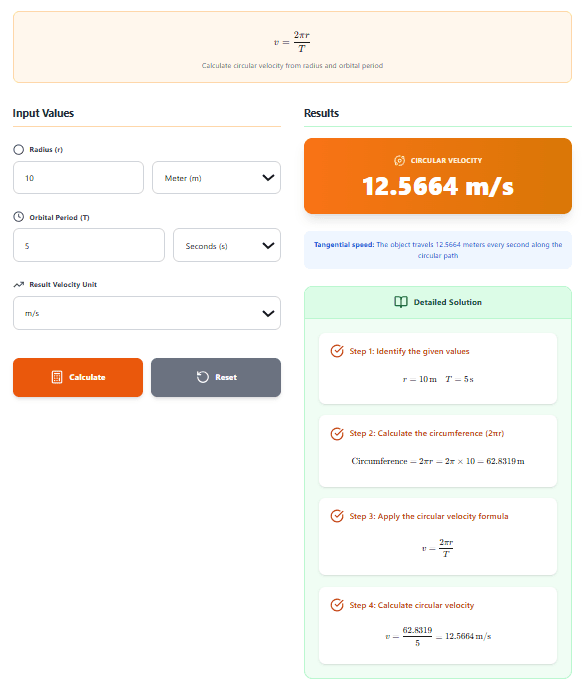
Here's a quick example:
An object moves in a circle of radius 10 m with an orbital period of 5 s:
- Circular velocity: 12.566 m/s
- Radius: 10 m
- Period: 5 s
The calculator shows you exactly how it got the answer, including any unit conversions needed.
Understanding Circular Velocity
What Is Circular Velocity?
Circular velocity is the constant linear speed of an object moving along a circular path. It points tangent to the circle at every instant, and its magnitude is the circumference divided by the orbital period.
The Formula
v = 2πr/T
Where:
- v = Circular velocity (m/s)
- r = Radius of the circular path (m)
- T = Orbital period — time for one full revolution (s)
- 2πr = Circumference of the circle (m)
Key Relationships
- Larger radius → Higher velocity (for the same period)
- Longer period → Lower velocity (for the same radius)
- Doubling radius → Doubles the velocity (same period)
- Doubling period → Halves the velocity (same radius)
Circular Velocity vs Angular Velocity
These two are often confused:
- Circular (linear) velocity — how fast the object moves along the path, in m/s. Depends on radius.
- Angular velocity — how fast the angle changes, in rad/s. Same for every point on a rigid rotating object.
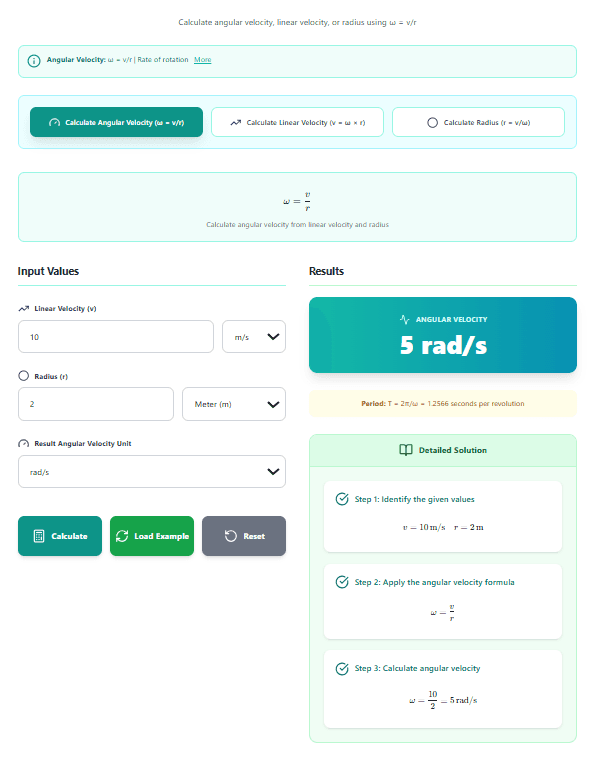
The relationship is v = ωr, where ω is angular velocity. Two points on a spinning disk have the same ω but different v — the outer point moves faster in linear terms.
Rearranged Formulas
| What to Find | Formula |
|---|---|
| Circular Velocity | v = 2πr/T |
| Radius | r = vT/2π |
| Orbital Period | T = 2πr/v |
Unit Support
This calculator handles all common units automatically, including astronomical scales:
Radius Units
| Unit | Symbol | Conversion to m |
|---|---|---|
| Meter | m | 1 |
| Centimeter | cm | 0.01 |
| Millimeter | mm | 0.001 |
| Kilometer | km | 1000 |
| Foot | ft | 0.3048 |
| Inch | in | 0.0254 |
| Astronomical Unit | AU | 149,597,870,700 |
1 AU is the average Earth–Sun distance — about 149.6 million km.
Period Units
| Unit | Symbol | Conversion to s |
|---|---|---|
| Seconds | s | 1 |
| Milliseconds | ms | 0.001 |
| Minutes | min | 60 |
| Hours | h | 3600 |
| Days | day | 86,400 |
| Years | year | 31,556,952 |
1 year here is a Julian year (365.25 days), the standard used in astronomy.
Velocity Units
| Unit | Symbol | Conversion to m/s |
|---|---|---|
| Meters per second | m/s | 1 |
| Kilometers per hour | km/h | 0.277778 |
| Miles per hour | mph | 0.44704 |
| Feet per second | ft/s | 0.3048 |
| Kilometers per second | km/s | 1000 |
How to Use the Calculator
Step 1: Choose Your Mode
Select one of three calculation modes:
- Calculate Velocity – Find v
- Calculate Radius – Find r
- Calculate Period – Find T
Step 2: Enter Your Values
Depending on the mode, enter the required values with their units.
Step 3: Select Result Unit
Choose your preferred unit for the result.
Step 4: Calculate
Click the "Calculate" button. The results appear instantly.
Step 5: Review the Solution
The calculator shows detailed steps explaining how the result was derived, including all unit conversions and intermediate calculations.
Step-by-Step Examples for Each Mode
Example 1: Calculate Circular Velocity
Problem: A satellite orbits Earth at a radius of 7,000 km with an orbital period of 97 minutes. What is its circular velocity?
Step 1: Identify the given values
- r = 7,000 km
- T = 97 minutes
Step 2: Convert to SI units
- r = 7,000 × 1000 = 7,000,000 m
- T = 97 × 60 = 5,820 s
Step 3: Calculate the circumference
- 2πr = 2π × 7,000,000 ≈ 43,982,297 m
Step 4: Apply the formula
- v = 2πr/T
- v = 43,982,297 / 5,820
- v ≈ 7,557 m/s
Result: The satellite's circular velocity is about 7,557 m/s (7.56 km/s).
Example 2: Calculate Radius
Problem: An object moves at 12.566 m/s with an orbital period of 5 s. What is the radius of its circular path?
Step 1: Identify the given values
- v = 12.566 m/s
- T = 5 s
Step 2: Calculate v × T
- vT = 12.566 × 5 = 62.83
Step 3: Apply the formula
- r = vT/2π
- r = 62.83 / (2π)
- r ≈ 10 m
Result: The radius is 10 m.
Example 3: Calculate Orbital Period
Problem: A planet orbits the Sun at a radius of 1 AU with a circular velocity of 29.78 km/s. What is its orbital period?
Step 1: Identify the given values
- r = 1 AU = 149,597,870,700 m
- v = 29.78 km/s = 29,780 m/s
Step 2: Calculate the circumference
- 2πr = 2π × 149,597,870,700 ≈ 940,000,000,000 m (9.4 × 10¹¹ m)
Step 3: Apply the formula
- T = 2πr/v
- T = 9.4 × 10¹¹ / 29,780
- T ≈ 31,558,000 s
Step 4: Convert to days (optional)
- T ≈ 31,558,000 / 86,400 ≈ 365.25 days
Result: The orbital period is about 365.25 days — one year.
Practical Implications
Circular velocity shows up everywhere from playgrounds to planetary orbits. Here are some representative values:
| Object | Radius | Period | Circular Velocity |
|---|---|---|---|
| Carousel (outer horse) | 5 m | 20 s | 1.57 m/s |
| Low Earth orbit satellite | 7,000 km | ~97 min | ~7.6 km/s |
| Geostationary satellite | 42,164 km | 24 h | ~3.07 km/s |
| International Space Station | 6,778 km | ~92 min | ~7.66 km/s |
| Moon around Earth | 384,400 km | 27.3 days | ~1.02 km/s |
| Earth around Sun | 1 AU | 365.25 days | ~29.78 km/s |
| Mars around Sun | 1.52 AU | 687 days | ~24.07 km/s |
Two things stand out from this table:
- Orbital velocity decreases with radius — the farther out you go, the slower the orbital speed (for objects orbiting the same central body).
- Geostationary satellites have a period of exactly 24 hours, so they stay above the same point on Earth's equator.
When to Use Each Mode
| Mode | Formula | When to Use | Typical Scenario |
|---|---|---|---|
| Velocity | v = 2πr/T | You have radius and period | Finding orbital speed of a satellite or planet |
| Radius | r = vT/2π | You have velocity and period | Working backward from observed motion |
| Period | T = 2πr/v | You have radius and velocity | Predicting how long one orbit takes |
Common Questions About Circular Velocity
Q: What is circular velocity?
Circular velocity is the constant linear speed of an object moving along a circular path. It equals the circumference (2πr) divided by the orbital period (T).
Q: How is circular velocity different from angular velocity?
Circular velocity (v) is the linear speed along the path, measured in m/s. Angular velocity (ω) is the rate of angle change, measured in rad/s. They are related by v = ωr — so two points on the same rotating disk have the same ω but different v.
Q: Does circular velocity depend on mass?
No. The formula v = 2πr/T does not contain mass. Whether the orbiting object is a small satellite or a large moon, its circular velocity depends only on the radius and period. Mass does come into play when you derive the velocity from gravity (v = √(GM/r)), but the kinematic formula here is mass-independent.
Q: What is the difference between circular velocity and escape velocity?
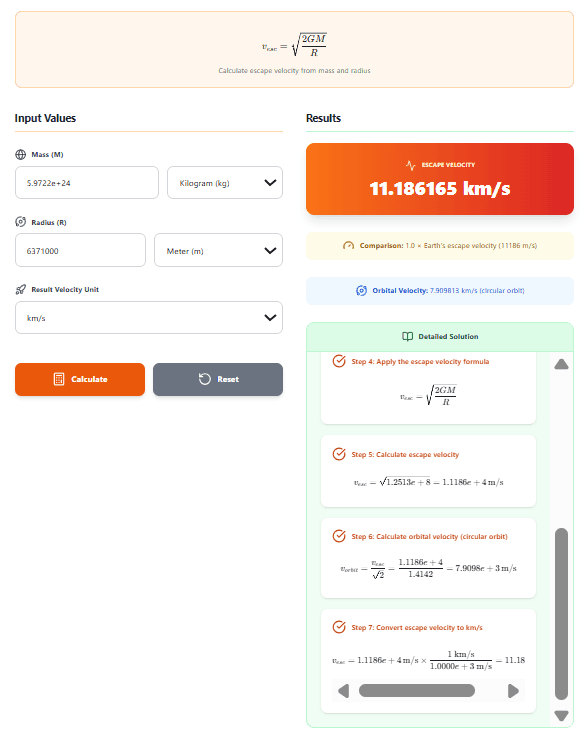
Circular velocity keeps an object in orbit around a body. Escape velocity is the minimum speed needed to break free of that body's gravity entirely. For any given radius, escape velocity is √2 times the circular velocity — about 41% higher.
Q: What is the period of a geostationary satellite?
Exactly 24 hours — one sidereal day. That is why geostationary satellites appear to hover over the same point on Earth's equator. At that period, the required radius is about 42,164 km from Earth's center.
Q: Can I use this for elliptical orbits?
Not directly. The formula v = 2πr/T assumes a circular orbit with constant speed. Elliptical orbits have varying speed — faster at periapsis (closest point) and slower at apoapsis (farthest point). For elliptical orbits, you need Kepler's laws and the vis-viva equation.
Q: Does the calculator handle astronomical distances?
Yes. The radius unit list includes the Astronomical Unit (AU = 149,597,870,700 m), and the period unit list includes years (Julian year = 365.25 days). You can also mix and match — enter the radius in AU, the period in years, and get a velocity in km/s.
Q: What real-world applications use circular velocity?
- Satellite orbit design
- Planetary motion calculations
- Amusement park ride engineering
- Centrifuge operation
- Astronomy and astrophysics
- Rotating machinery analysis
Tips for Getting the Best Results
Choose the right mode. Make sure you're calculating what you need — velocity, radius, or period.
Check your units. The calculator handles conversions automatically, but make sure you're entering values with the correct units. For orbital problems, mixing AU with m or years with seconds is easy to do by accident.
Use km/s for orbital speeds. Orbital velocities are often in the km/s range, so switching the result unit to km/s gives a more readable number than m/s.
Watch for large numbers. For astronomical problems, the result can be huge — the calculator handles this with exponential notation and a "million/billion/trillion" readout for large values.
Remember: this is uniform circular motion. The formula assumes constant speed. Real orbits are usually elliptical, and real satellites experience drag and perturbations.
Double-check your inputs. A single digit error changes everything. Take a moment to verify each number.
Review the steps. The step-by-step solution helps you understand the process and verify the calculation.
Final Thoughts
Circular velocity is one of those clean physics ideas that scales from a child's carousel to the orbit of Mars. The formula v = 2πr/T is simple — divide the circumference by the time for one trip around — but it carries real weight. It tells you how fast a satellite must move to stay in orbit, why geostationary satellites sit at a specific altitude, and why distant planets orbit the Sun so much more slowly than Earth does.
This calculator handles all three variants of the formula, with complete unit support (radius in m, cm, mm, km, ft, in, and AU; period in s, ms, min, h, day, and year; velocity in m/s, km/h, mph, ft/s, and km/s), large-number formatting, and step-by-step solutions.
Whether you're solving a homework problem, designing a satellite orbit, or exploring how planets move, this tool can save time and reduce mistakes by handling the math and unit conversions automatically.