Escape Velocity Calculator – Calculate v = √(2GM/R) with Step-by-Step Solutions
Escape velocity is the minimum speed an object needs to break free from a gravitational field without any further propulsion. It is why rockets are enormous, why the Moon has no atmosphere, and why black holes are black. The formula is simple: v_esc = √(2GM/R), where G is the gravitational constant, M is the mass of the body, and R is its radius.
This calculator handles three different calculation modes based on what you need to find, with celestial body presets, automatic unit conversions, and step-by-step solutions.
Quick access: Use our free escape velocity calculator here
What Does This Calculator Do?
This tool calculates any one of the three quantities in the escape velocity relationship.
Three calculation modes:
Calculate Escape Velocity (v = √(2GM/R)) – Find the speed needed to escape
Calculate Mass (M = v²R/(2G)) – Find the mass of a body from its escape velocity
Calculate Radius (R = 2GM/v²) – Find the radius of a body from its escape velocity
Plus celestial body presets – Quick-select Earth, Moon, Mars, Jupiter, Sun, Saturn, Venus, Mercury, Pluto, or a neutron star.
Plus orbital velocity – For velocity-mode calculations, the calculator also reports the circular orbit velocity (v_orb = v_esc/√2).
Here's a quick example:
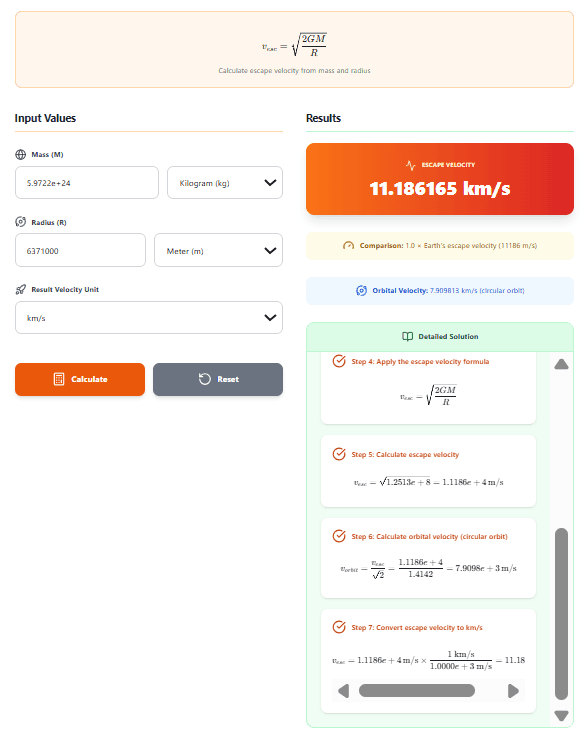
Earth (M = 5.9722 × 10²⁴ kg, R = 6,371,000 m):
- Escape velocity: 11,186 m/s (about 11.2 km/s)
- Orbital velocity: 7,910 m/s (about 7.9 km/s)
The calculator shows you exactly how it got the answer, including all unit conversions.
Understanding Escape Velocity
What Is Escape Velocity?
Escape velocity is the minimum speed needed for an object to escape from the gravitational influence of a celestial body without any additional propulsion. If you launch an object at this speed (ignoring air resistance), it will never fall back — its kinetic energy is exactly enough to overcome the gravitational potential energy binding it to the body.
The Formula
v_esc = √(2GM/R)
Where:
- v_esc = Escape velocity (m/s)
- G = Gravitational constant = 6.67430 × 10⁻¹¹ m³ kg⁻¹ s⁻²
- M = Mass of the celestial body (kg)
- R = Radius of the body (m)
Key Relationships
- More mass → Higher escape velocity (scales with √M)
- Larger radius → Lower escape velocity (scales with 1/√R)
- Independent of the escaping object's mass — a small rocket and a large boulder need the same escape velocity
- v_esc = √2 × v_orb — escape velocity is √2 times the circular orbital velocity
Why Is Escape Velocity Independent of the Object's Mass?
The escape velocity formula does not contain the mass of the escaping object. This is because the kinetic energy (½mv²) and the gravitational potential energy (GMm/R) both scale with the object's mass m, so m cancels out. The same escape velocity applies to a molecule of hydrogen or a Saturn V rocket.
Escape Velocity vs Orbital Velocity
For a circular orbit at radius R, the orbital velocity is:
v_orb = √(GM/R)
That means:
v_esc = √2 × v_orb
So escaping requires about 41% more speed than staying in a circular orbit. This is why it takes so much more fuel to leave Earth's gravity completely than to reach low Earth orbit.
Escape Velocity and Black Holes
If the escape velocity of a body exceeds the speed of light, then not even light can escape — the body is a black hole. The Schwarzschild radius (the radius of the event horizon) is defined by setting v_esc = c:
R_s = 2GM/c²
For Earth's mass, the Schwarzschild radius is about 9 mm. For the Sun, it is about 3 km.
Rearranged Formulas
| What to Find | Formula |
|---|---|
| Escape Velocity | v_esc = √(2GM/R) |
| Mass | M = v²R/(2G) |
| Radius | R = 2GM/v² |
Unit Support
This calculator handles a wide range of units, including astronomical scales:
Mass Units
| Unit | Symbol | Conversion to kg |
|---|---|---|
| Kilogram | kg | 1 |
| Gram | g | 0.001 |
| Pound | lb | 0.453592 |
| Ounce | oz | 0.0283495 |
| Earth mass | M⊕ | 5.9722 × 10²⁴ |
| Jupiter mass | M_J | 1.8982 × 10²⁷ |
| Solar mass | M☉ | 1.9885 × 10³⁰ |
Radius Units
| Unit | Symbol | Conversion to m |
|---|---|---|
| Meter | m | 1 |
| Kilometer | km | 1,000 |
| Centimeter | cm | 0.01 |
| Millimeter | mm | 0.001 |
| Astronomical Unit | AU | 1.496 × 10¹¹ |
| Earth radius | R⊕ | 6,371,000 |
| Jupiter radius | R_J | 69,911,000 |
| Solar radius | R☉ | 696,340,000 |
Velocity Units
| Unit | Symbol | Conversion to m/s |
|---|---|---|
| Meters per second | m/s | 1 |
| Kilometers per second | km/s | 1,000 |
| Miles per hour | mph | 0.44704 |
| Kilometers per hour | km/h | 0.277778 |
| Feet per second | ft/s | 0.3048 |
How to Use the Calculator
Step 1: Choose Your Mode
Select one of three calculation modes:
- Calculate Escape Velocity – Find v_esc
- Calculate Mass – Find M
- Calculate Radius – Find R
Step 2: (Optional) Load a Celestial Body
Click any of the preset buttons to load Earth, Moon, Mars, Jupiter, Sun, Saturn, Venus, Mercury, Pluto, or a neutron star.
Step 3: Enter Your Values
Enter the known values with their units.
Step 4: Select Result Unit
Choose your preferred unit for the result.
Step 5: Calculate
Click "Calculate" and the result appears instantly with a comparison, orbital velocity, and step-by-step working.
Step 6: Review the Solution
The calculator shows detailed steps, including all unit conversions and intermediate calculations.
Step-by-Step Examples
Example 1: Earth's Escape Velocity
Problem: What is the escape velocity from Earth's surface? (M = 5.9722 × 10²⁴ kg, R = 6,371,000 m)
Step 1: Identify the given values
- M = 5.9722 × 10²⁴ kg
- R = 6,371,000 m
- G = 6.67430 × 10⁻¹¹
Step 2: Calculate 2GM
- 2GM = 2 × 6.67430 × 10⁻¹¹ × 5.9722 × 10²⁴ ≈ 7.972 × 10¹⁴
Step 3: Divide by R
- 2GM/R = 7.972 × 10¹⁴ / 6,371,000 ≈ 1.2513 × 10⁸
Step 4: Take the square root
- v_esc = √(1.2513 × 10⁸) ≈ 11,186 m/s
Result: Earth's escape velocity is about 11,186 m/s, or 11.2 km/s.
Example 2: Escape Velocity from the Moon
Problem: What is the escape velocity from the Moon? (M = 7.342 × 10²² kg, R = 1,737,400 m)
Step 1: Identify the given values
- M = 7.342 × 10²² kg
- R = 1,737,400 m
Step 2: Calculate 2GM
- 2GM = 2 × 6.67430 × 10⁻¹¹ × 7.342 × 10²² ≈ 9.803 × 10¹²
Step 3: Divide by R
- 2GM/R = 9.803 × 10¹² / 1,737,400 ≈ 5.642 × 10⁶
Step 4: Take the square root
- v_esc = √(5.642 × 10⁶) ≈ 2,375 m/s
Result: The Moon's escape velocity is about 2,375 m/s, or 2.4 km/s — roughly one-fifth of Earth's. That is why the Moon has no atmosphere: gas molecules at lunar temperatures easily exceed 2.4 km/s.
Example 3: Escape Velocity from the Sun
Problem: What is the escape velocity from the Sun's surface? (M = 1.9885 × 10³⁰ kg, R = 696,340,000 m)
Step 1: Identify the given values
- M = 1.9885 × 10³⁰ kg
- R = 696,340,000 m
Step 2: Apply the formula
- v_esc ≈ 617,700 m/s
Result: The Sun's escape velocity is about 617.7 km/s — about 0.2% of the speed of light. This is the speed a spacecraft would need to escape the Sun's gravity if it were launched from the Sun's surface.
Example 4: Escape Velocity from a Neutron Star
Problem: A neutron star has a mass of 2.8 × 10³⁰ kg and a radius of 10,000 m. What is its escape velocity?
Step 1: Identify the given values
- M = 2.8 × 10³⁰ kg
- R = 10,000 m
Step 2: Apply the formula
- v_esc ≈ 1.93 × 10⁸ m/s
Result: The escape velocity is about 193,000 km/s — roughly 64% of the speed of light. Neutron stars are extreme objects, and this is why their surface gravity is so intense.
Example 5: Finding Mass from Escape Velocity
Problem: A planet has an escape velocity of 5,030 m/s and a radius of 3,389,500 m. What is its mass?
Step 1: Identify the given values
- v_esc = 5,030 m/s
- R = 3,389,500 m
Step 2: Apply the rearranged formula
- M = v²R/(2G)
- M = (5,030)² × 3,389,500 / (2 × 6.67430 × 10⁻¹¹)
- M ≈ 6.39 × 10²³ kg
Result: The mass is about 6.39 × 10²³ kg — the mass of Mars.
Example 6: Finding the Schwarzschild Radius
Problem: What is the Schwarzschild radius of a body with the Sun's mass (1.9885 × 10³⁰ kg)?
Step 1: Set v_esc = c and rearrange
- R_s = 2GM/c²
Step 2: Plug in
- R_s = 2 × 6.67430 × 10⁻¹¹ × 1.9885 × 10³⁰ / (299,792,458)²
- R_s ≈ 2,953 m
Result: The Schwarzschild radius of a solar-mass black hole is about 2.95 km.
Escape Velocities of Common Celestial Bodies
| Body | Mass (kg) | Radius (m) | Escape Velocity (m/s) |
|---|---|---|---|
| Moon | 7.34 × 10²² | 1,737,400 | 2,380 |
| Mercury | 3.29 × 10²³ | 2,439,700 | 4,300 |
| Mars | 6.39 × 10²³ | 3,389,500 | 5,030 |
| Venus | 4.87 × 10²⁴ | 6,051,800 | 10,400 |
| Earth | 5.97 × 10²⁴ | 6,371,000 | 11,186 |
| Saturn | 5.68 × 10²⁶ | 58,232,000 | 35,500 |
| Jupiter | 1.90 × 10²⁷ | 69,911,000 | 59,500 |
| Sun | 1.99 × 10³⁰ | 696,340,000 | 617,700 |
| Neutron star | 2.8 × 10³⁰ | 10,000 | 1.93 × 10⁸ |
Practical Implications
Escape velocity drives decisions and understanding across astronomy, spaceflight, and physics:
| Application | What escape velocity tells you |
|---|---|
| Rocket design | Minimum speed a rocket must reach to leave a planet |
| Atmospheric retention | Whether a planet can hold onto light gases (H₂, He) |
| Black hole physics | Event horizon radius (Schwarzschild radius) |
| Planetary science | Why the Moon has no atmosphere, why Mars lost most of its air |
| Space missions | Fuel budget for leaving Earth, the Moon, or the solar system |
| Stellar evolution | Escape velocity of supernova remnants |
When to Use Each Mode
| Mode | Formula | When to Use | Typical Scenario |
|---|---|---|---|
| Escape Velocity | v_esc = √(2GM/R) | You know mass and radius | Finding how fast a rocket must go |
| Mass | M = v²R/(2G) | You know v_esc and radius | Determining the mass of an exoplanet |
| Radius | R = 2GM/v² | You know mass and v_esc | Finding the Schwarzschild radius |
Common Questions About Escape Velocity
Q: What is escape velocity?
Escape velocity is the minimum speed needed for an object to escape from a gravitational field without any additional propulsion. It is the speed at which an object's kinetic energy equals the gravitational potential energy binding it to the body.
Q: Does escape velocity depend on the mass of the escaping object?
No. The escape velocity formula v_esc = √(2GM/R) does not contain the mass of the escaping object. A molecule and a rocket need the same speed to escape, because both kinetic and potential energy scale with the object's mass.
Q: What is the escape velocity of Earth?
About 11.2 km/s (11,186 m/s). That is roughly 33 times the speed of sound at sea level, or about 0.004% of the speed of light.
Q: Why does the Moon have no atmosphere?
Because its escape velocity (2.38 km/s) is low enough that gas molecules — especially light ones like hydrogen and helium — can exceed it at lunar temperatures. Over billions of years, the atmosphere escaped into space.
Q: What is orbital velocity?
Orbital velocity is the speed needed to maintain a circular orbit at a given radius. It is v_orb = √(GM/R), which is escape velocity divided by √2 (about 71%). For Earth's surface, orbital velocity is about 7.9 km/s.
Q: What happens if you exceed escape velocity?
You leave the gravitational field entirely. The object travels away forever, slowing down but never stopping, because the gravitational force decreases with distance. Its total energy is positive (unbound).
Q: What is the escape velocity of a black hole?
By definition, the escape velocity at the event horizon of a black hole is the speed of light. That is why nothing — not even light — can escape. The radius at which this occurs is the Schwarzschild radius: R_s = 2GM/c².
Q: What is a neutron star's escape velocity?
For a typical neutron star (mass ~1.4–3 solar masses, radius ~10 km), the escape velocity is about 0.5–0.7 times the speed of light. That is extremely relativistic — a significant fraction of c.
Q: Does escape velocity include air resistance?
The formula v_esc = √(2GM/R) assumes no air resistance. In a real atmosphere, a rocket must overcome both gravity and drag, so the required speed at the surface is higher. Escape velocity is a theoretical lower bound.
Q: What is the difference between escape velocity and the speed needed to reach orbit?
Orbital velocity (about 7.9 km/s for low Earth orbit) is the speed needed to stay in a circular orbit. Escape velocity (about 11.2 km/s) is the speed needed to leave Earth's gravity entirely. Escaping requires about 41% more speed than orbiting — and much more fuel.
Q: What real-world applications use escape velocity?
- Rocket launches (planning Δv budgets)
- Planetary science (atmospheric retention models)
- Black hole physics (Schwarzschild radius)
- Space mission design (interplanetary trajectories)
- Astronomy (stellar evolution, supernova remnants)
- Astrobiology (habitability of exoplanets)
Tips for Getting the Best Results
Choose the right mode. Make sure you are solving for what you need — escape velocity, mass, or radius.
Use the celestial body presets. Click any preset to load its mass and radius directly. This is useful when you want to compare different bodies or check the calculator against known values.
Watch the units. Masses in kg, Earth masses, or solar masses; radii in m, km, AU, or Earth/Sun radii. The calculator converts everything internally, but understanding the unit relationships helps catch mistakes.
Remember: v_esc = √2 × v_orb. Escape velocity is about 41% higher than the circular orbital velocity at the same radius. This relationship is useful for sanity checks.
Check the speed-of-light limit. If the calculated escape velocity exceeds 299,792,458 m/s, the body would be a black hole. The calculator flags this case.
Double-check your inputs. A single digit error changes everything — especially when working with scientific notation. Take a moment to verify each number.
Review the steps. The step-by-step solution helps you understand the process and verify the calculation.
Final Thoughts
Escape velocity is one of the most fundamental quantities in gravitational physics. It explains why the Moon has no atmosphere, why rockets are so large, why black holes are black, and why the Sun holds onto its outer layers while smaller bodies cannot. The formula v_esc = √(2GM/R) is simple, but its implications span from planetary science to relativistic astrophysics.
The key insight is that escape velocity depends only on the mass and radius of the celestial body — not on the mass of the escaping object. A hydrogen molecule and a Saturn V rocket both need 11.2 km/s to leave Earth's gravity. This is why atmospheric retention is about temperature and molecular mass, not about the size of the planet's inhabitants.
This calculator handles all three variants of the formula, with celestial body presets (Earth, Moon, Mars, Jupiter, Sun, Saturn, Venus, Mercury, Pluto, neutron star), full unit support (mass in kg, g, lb, oz, M⊕, M_J, M☉; radius in m, km, cm, mm, AU, R⊕, R_J, R☉; velocity in m/s, km/s, mph, km/h, ft/s), and step-by-step solutions.
Whether you are designing a space mission, studying planetary atmospheres, or exploring black hole physics, this tool can save time and reduce mistakes by handling the math and unit conversions automatically.