Einstein Energy Calculator – Calculate E = mc² with Step-by-Step Solutions
In 1905, Albert Einstein published a short paper with a deceptively simple equation: E = mc². It said that mass and energy are two forms of the same thing — that a small amount of mass contains an enormous amount of energy. That single relationship explains why the Sun shines, why nuclear reactors generate power, and why atomic bombs are so devastating.
The formula is simple, but the numbers are not. A single kilogram of mass corresponds to about 9 × 10¹⁶ joules — the energy released by roughly 21 megatons of TNT. This calculator handles three different calculation modes based on what you need to find, with unit support spanning from electronvolts to gigajoules and from atomic mass units to the mass of the Sun, plus step-by-step solutions.
Quick access: Use our free Einstein energy calculator here
What Does This Calculator Do?
This tool calculates any one of the three quantities in Einstein's mass-energy equivalence.
Three calculation modes:
Calculate Energy (E = mc²) – Find the energy equivalent of a given mass
Calculate Mass (m = E/c²) – Find the mass equivalent of a given energy
Calculate Speed of Light (c = √(E/m)) – Work backward from energy and mass
Here's a quick example:
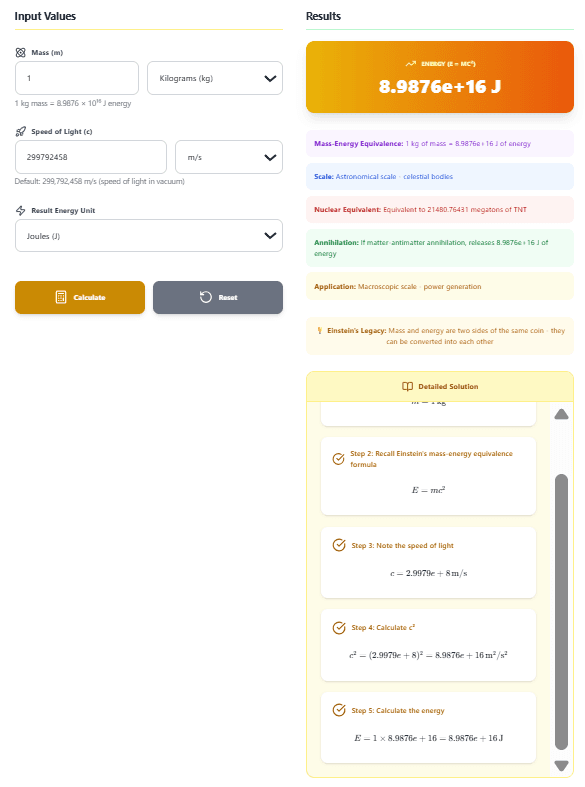
1 kg of mass converted entirely to energy:
- Energy: 8.9876 × 10¹⁶ J
- Mass: 1 kg
- Equivalent TNT: about 21.5 megatons
The calculator shows you exactly how it got the answer, including all unit conversions.
Understanding Mass-Energy Equivalence
What Does E = mc² Mean?
E = mc² says that mass and energy are interchangeable. A body at rest has an energy content equal to its mass times the speed of light squared. When mass is converted into energy — as in nuclear reactions — the amount released is enormous because c² is enormous.
The Formula
E = mc²
Where:
- E = Energy (J)
- m = Mass (kg)
- c = Speed of light in vacuum = 299,792,458 m/s
Key Relationships
- More mass → More energy (linear)
- c² is enormous → ~9 × 10¹⁶ m²/s²
- 1 gram of mass → ~9 × 10¹³ J (about 21 kilotons of TNT)
- 1 atomic mass unit (amu) → 931.5 MeV
- Electron rest mass → 0.511 MeV/c²
- Proton rest mass → 938.27 MeV/c²
Why the Speed of Light Appears
The speed of light, c, is the maximum speed at which information or matter can travel. It is a fundamental constant of nature. The fact that c² appears in E = mc² is not a coincidence — it reflects the geometry of spacetime and the way energy and momentum transform between reference frames.
Mass-Energy in Nuclear Reactions
When a nucleus undergoes fission or fusion, a small amount of mass is converted into energy. For example:
- Fission of U-235: About 0.1% of the mass is converted to energy
- Fusion of hydrogen into helium (in the Sun): About 0.7% of the mass is converted
- Matter-antimatter annihilation: 100% of the mass is converted
The efficiency of conversion determines how much energy is released per unit mass.
Rearranged Formulas
| What to Find | Formula |
|---|---|
| Energy | E = mc² |
| Mass | m = E/c² |
| Speed of Light | c = √(E/m) |
Unit Support
This calculator handles a huge range of mass, energy, and speed units — from subatomic to astronomical scales.
Mass Units
| Unit | Symbol | Conversion to kg |
|---|---|---|
| Kilogram | kg | 1 |
| Gram | g | 0.001 |
| Milligram | mg | 1 × 10⁻⁶ |
| Microgram | µg | 1 × 10⁻⁹ |
| Pound | lb | 0.45359237 |
| Atomic mass unit | amu | 1.66053906660 × 10⁻²⁷ |
Energy Units
| Unit | Symbol | Conversion to J |
|---|---|---|
| Joule | J | 1 |
| Kilojoule | kJ | 1,000 |
| Megajoule | MJ | 1,000,000 |
| Gigajoule | GJ | 1 × 10⁹ |
| Electronvolt | eV | 1.602176634 × 10⁻¹⁹ |
| Kiloelectronvolt | keV | 1.602176634 × 10⁻¹⁶ |
| Megaelectronvolt | MeV | 1.602176634 × 10⁻¹³ |
| Gigaelectronvolt | GeV | 1.602176634 × 10⁻¹⁰ |
| Teraelectronvolt | TeV | 1.602176634 × 10⁻⁷ |
| Kilowatt-hour | kWh | 3.6 × 10⁶ |
Speed Units
| Unit | Symbol | Conversion to m/s |
|---|---|---|
| Meters per second | m/s | 1 |
| Kilometers per second | km/s | 1,000 |
| Speed of light | c | 299,792,458 |
How to Use the Calculator
Step 1: Choose Your Mode
Select one of three calculation modes:
- Calculate Energy – Find E
- Calculate Mass – Find m
- Calculate Speed of Light – Find c
Step 2: Enter Your Values
Depending on the mode, enter the required values with their units. The calculator accepts very large and very small numbers — use scientific notation (e.g., 1e-31) if needed.
Step 3: Select Result Unit
Choose your preferred unit for the result.
Step 4: Calculate
Click "Calculate" and the result appears instantly with additional analysis.
Step 5: Review the Solution
The calculator shows detailed steps, including all unit conversions and intermediate calculations.
Step-by-Step Examples
Example 1: 1 kg of Mass to Energy
Problem: How much energy is contained in 1 kg of mass?
Step 1: Identify the given value
- m = 1 kg
Step 2: Apply the formula
- E = mc²
- E = 1 × (299,792,458)²
- E ≈ 8.9876 × 10¹⁶ J
Result: 1 kg of mass is equivalent to about 8.99 × 10¹⁶ J. That is roughly the energy released by 21.5 megatons of TNT.
Example 2: Electron Rest Energy
Problem: What is the rest energy of an electron (m = 9.109 × 10⁻³¹ kg)?
Step 1: Identify the given value
- m = 9.109 × 10⁻³¹ kg
Step 2: Apply the formula
- E = mc²
- E = 9.109 × 10⁻³¹ × (299,792,458)²
- E ≈ 8.187 × 10⁻¹⁴ J
Step 3: Convert to MeV
- 1 MeV = 1.602 × 10⁻¹³ J
- E ≈ 0.511 MeV
Result: The electron's rest energy is 0.511 MeV — a fundamental constant in particle physics.
Example 3: Mass from Energy
Problem: The Hiroshima atomic bomb released about 6.3 × 10¹³ J. How much mass was converted to energy?
Step 1: Identify the given value
- E = 6.3 × 10¹³ J
Step 2: Apply the rearranged formula
- m = E/c²
- m = 6.3 × 10¹³ / (299,792,458)²
- m ≈ 7.0 × 10⁻⁴ kg
Result: About 0.7 grams of mass was converted into energy — that is all it took to destroy a city.
Example 4: 1 amu to MeV
Problem: What is the energy equivalent of 1 atomic mass unit (1 amu = 1.660539 × 10⁻²⁷ kg)?
Step 1: Apply the formula
- E = mc²
- E = 1.660539 × 10⁻²⁷ × (299,792,458)²
- E ≈ 1.492 × 10⁻¹⁰ J
Step 2: Convert to MeV
- E ≈ 1.492 × 10⁻¹⁰ / 1.602 × 10⁻¹³
- E ≈ 931.5 MeV
Result: 1 amu = 931.5 MeV. This is the conversion factor used throughout nuclear physics.
Example 5: Verifying the Speed of Light
Problem: If 1 kg of mass corresponds to 8.9876 × 10¹⁶ J, verify that the speed of light comes out to 299,792,458 m/s.
Step 1: Apply the rearranged formula
- c = √(E/m)
- c = √(8.9876 × 10¹⁶ / 1)
- c = √(8.9876 × 10¹⁶)
- c ≈ 299,792,458 m/s
Result: Confirms c = 299,792,458 m/s — the speed of light in vacuum.
Reference Masses and Energies
Reference Masses
| Object | Mass (kg) |
|---|---|
| Electron | 9.11 × 10⁻³¹ |
| Proton | 1.673 × 10⁻²⁷ |
| Neutron | 1.675 × 10⁻²⁷ |
| Uranium-235 atom | 3.90 × 10⁻²⁵ |
| DNA molecule | 1 × 10⁻¹⁸ |
| Human cell | 1 × 10⁻¹² |
| Grain of sand | 1 × 10⁻⁵ |
| Paperclip | 0.001 |
| Human (70 kg) | 70 |
| Car | 1,500 |
| Boeing 747 | 180,000 |
| Empire State Building | 3.3 × 10⁸ |
| Great Pyramid | 5.9 × 10⁹ |
| Earth | 5.972 × 10²⁴ |
| Sun | 1.989 × 10³⁰ |
Reference Energies
| Event | Energy (J) |
|---|---|
| Electron rest energy | 8.19 × 10⁻¹⁴ |
| Proton rest energy | 1.50 × 10⁻¹⁰ |
| 1 kg TNT explosion | 4.18 × 10⁶ |
| Daily human energy use | 1 × 10⁷ |
| Lightning bolt | 1 × 10⁹ |
| Hiroshima atomic bomb | 6.3 × 10¹³ |
| Hurricane energy (per day) | 5 × 10¹⁹ |
| Sun output (per second) | 3.8 × 10²⁶ |
| Supernova | 1 × 10⁴⁴ |
Practical Implications
Mass-energy equivalence drives real physics across many scales:
| Application | What E = mc² tells you |
|---|---|
| Nuclear power plants | Fission converts ~0.1% of fuel mass to energy |
| Nuclear weapons | Small mass conversions release enormous energy |
| Particle accelerators | Particle collisions create new massive particles from kinetic energy |
| Stellar fusion | The Sun converts ~4 million tons of mass per second |
| Medical PET scans | Electron-positron annihilation produces detectable gamma rays |
| Cosmology | The early universe was a hot soup of energy converting to matter |
When to Use Each Mode
| Mode | Formula | When to Use | Typical Scenario |
|---|---|---|---|
| Energy | E = mc² | You know mass | Finding the energy equivalent of a mass |
| Mass | m = E/c² | You know energy | Finding how much mass is converted in a reaction |
| Speed of Light | c = √(E/m) | You know energy and mass | Verifying the relationship or finding c |
Common Questions About Mass-Energy Equivalence
Q: What does E = mc² actually mean?
It means that mass and energy are equivalent. A body at rest has an intrinsic energy content equal to its mass times the speed of light squared. Mass can be converted into energy (nuclear reactions) and energy into mass (particle creation in accelerators).
Q: Why is the speed of light squared in the formula?
The c² factor comes from the geometry of spacetime and the way energy and momentum transform between reference frames. It ensures that the equation is consistent with special relativity — that the laws of physics look the same in all inertial frames.
Q: How much energy is in 1 kg of mass?
About 8.99 × 10¹⁶ J. That is roughly the energy released by 21.5 megatons of TNT — about 1,500 times the energy of the Hiroshima bomb.
Q: How much mass is converted in a nuclear reaction?
It depends on the reaction. Fission of uranium-235 converts about 0.1% of the fuel mass to energy. Fusion of hydrogen to helium in the Sun converts about 0.7%. Matter-antimatter annihilation converts 100%.
Q: Can I use E = mc² for a moving object?
E = mc² gives the rest energy of an object. For a moving object, the total energy is E = γmc², where γ = 1/√(1 − v²/c²) is the Lorentz factor. As v → c, γ → ∞, which is why no massive object can reach the speed of light.
Q: What is the rest energy of a proton?
The proton rest mass is 1.6726219 × 10⁻²⁷ kg, which corresponds to a rest energy of about 938.27 MeV (or 1.503 × 10⁻¹⁰ J).
Q: What is the relationship between amu and MeV?
1 atomic mass unit (amu) = 931.5 MeV/c². This is the standard conversion factor in nuclear physics. When you see "mass defect" or "binding energy" tables, they often use MeV or amu interchangeably via this factor.
Q: Does E = mc² apply to chemical reactions?
Yes, but the mass changes are far too small to measure. A typical chemical reaction changes mass by less than 1 part in 10¹⁰. Nuclear reactions change mass by 0.1–1%, which is why they release millions of times more energy.
Q: What is annihilation?
Annihilation is the process where a particle and its antiparticle meet and convert their entire mass into energy — usually in the form of photons. For example, an electron and a positron annihilate to produce two gamma-ray photons, each with 0.511 MeV of energy.
Q: What real-world applications use E = mc²?
- Nuclear power generation
- Nuclear weapons
- Particle physics experiments
- PET (positron emission tomography) scans
- Stellar and cosmological models
- Radiation therapy (some forms)
Tips for Getting the Best Results
Use scientific notation for extreme values. Masses of particles and energies of reactions can span many orders of magnitude. The calculator handles them, but scientific notation (e.g., 9.11e-31) is easier to enter and read.
Pick the right unit. For nuclear physics, MeV and amu are standard. For everyday calculations, J and kg are simpler. The calculator supports both ends of the scale.
Watch the exponent. A single mistake in the exponent (10⁻³¹ vs 10⁻³⁰) changes the answer by a factor of 10. Take an extra moment to verify each number.
Remember that c is fixed. In the energy and mass modes, the speed of light is pre-filled to 299,792,458 m/s. You can change it if you are working in a hypothetical medium, but for vacuum calculations, leave it as is.
Use the reference masses and energies. The calculator includes a list of common particles, atoms, and macroscopic objects. Click any of them to load the value directly into the input.
Double-check your inputs. A single digit error changes everything. Take a moment to verify each number.
Review the steps. The step-by-step solution helps you understand the process and verify the calculation.
Final Thoughts
E = mc² is one of the most famous equations in all of science, and for good reason. It says that mass and energy are not separate things — they are two forms of the same underlying quantity. A gram of matter contains enough energy to power a city for a day. A kilogram contains enough to level a city.
The formula itself is simple, but its implications are enormous. It explains the Sun's power source, the destructive force of nuclear weapons, the creation of particles in accelerators, and the evolution of the early universe. Every nuclear reaction, every PET scan, every supernova, and every particle collider is a direct test of E = mc².
This calculator handles all three variants of the formula, with support for masses from the electron to the Sun, energies from the electronvolt to the gigajoule, and speeds in m/s, km/s, or multiples of c. It also includes reference tables of common masses and energies, plus step-by-step solutions.
Whether you are solving a physics problem, checking a nuclear reaction calculation, or exploring the equivalence of mass and energy, this tool can save time and reduce mistakes by handling the math and unit conversions automatically.