de Broglie Wavelength Calculator – Calculate λ = h/p with Step-by-Step Solutions
In 1924, Louis de Broglie proposed something radical: if light can behave as both a wave and a particle, then matter should too. Every object with momentum has a wavelength — a de Broglie wavelength. For everyday objects it is so tiny that it is undetectable, but for electrons, protons, and neutrons it is the foundation of quantum mechanics.
The formula is simple: λ = h/p, where λ is the de Broglie wavelength, h is Planck's constant, and p is momentum. This calculator handles four different calculation modes based on what you need to find, with automatic unit conversions, an optional relativistic mode, and step-by-step solutions.
Quick access: Use our free de Broglie wavelength calculator here
What Does This Calculator Do?
This tool calculates matter-wave values using the de Broglie relation: λ = h/p.
Four calculation modes:
Calculate Wavelength (λ = h/p) – Find de Broglie wavelength from momentum
Calculate Momentum (p = h/λ) – Find momentum from wavelength
Calculate Velocity (v = h/mλ) – Find velocity from wavelength and mass
Calculate Mass (m = h/λv) – Find mass from wavelength and velocity
Plus a relativistic mode – Toggle it on for particles moving faster than 10% of the speed of light, and the calculator applies Lorentz factor corrections.
Here's a quick example:
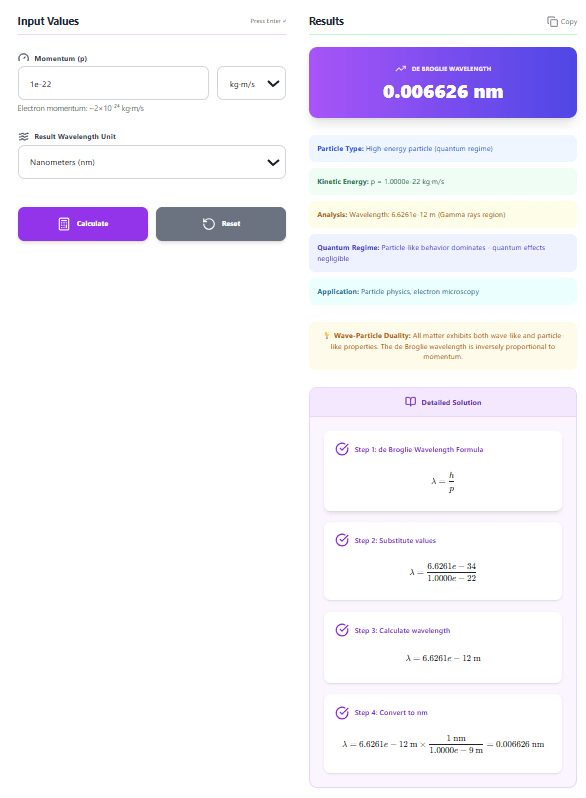
An electron with momentum 1 × 10⁻²² kg·m/s:
- de Broglie wavelength: 6.626 × 10⁻¹² m (6.626 pm)
- Momentum: 1 × 10⁻²² kg·m/s
The calculator shows you exactly how it got the answer, including any unit conversions needed.
Understanding the de Broglie Wavelength
What Is the de Broglie Wavelength?
The de Broglie wavelength is the wavelength associated with any object that has momentum. It quantifies the wave-like nature of matter — the more momentum an object has, the shorter its wavelength, and the less its wave-like behavior is noticeable.
The Formula
λ = h/p
Where:
- λ (lambda) = de Broglie wavelength (m)
- h = Planck's constant = 6.62607015 × 10⁻³⁴ J·s
- p = Momentum = mv (kg·m/s)
Key Relationships
- More momentum → Shorter wavelength (inverse relationship)
- Heavier particle → Shorter wavelength at the same speed
- Faster particle → Shorter wavelength at the same mass
- Macroscopic objects → Wavelengths so tiny they are undetectable
- Subatomic particles → Wavelengths comparable to atomic spacing
Wave-Particle Duality
The de Broglie relation is the mathematical expression of wave-particle duality. It says that every object — an electron, a proton, a baseball, a planet — has both particle-like and wave-like properties. Which one dominates depends on the wavelength relative to the size of the environment:
- λ ≫ system size → Wave-like behavior dominates (diffraction, interference)
- λ ≪ system size → Particle-like behavior dominates (classical mechanics)
This is why electrons diffract through crystals (λ ≈ atomic spacing) while a thrown baseball does not (λ ≈ 10⁻³⁴ m).
Rearranged Formulas
| What to Find | Formula |
|---|---|
| Wavelength | λ = h/p |
| Momentum | p = h/λ |
| Velocity | v = h/(mλ) |
| Mass | m = h/(λv) |
Relativistic Corrections
For particles moving faster than about 10% of the speed of light (0.1c), the classical momentum p = mv is no longer accurate. The relativistic momentum is p = γmv, where γ is the Lorentz factor:
γ = 1/√(1 − v²/c²)
At v = 0.1c, γ ≈ 1.005 — a 0.5% correction. At v = 0.9c, γ ≈ 2.29 — a massive correction. The calculator's relativistic toggle applies this correction automatically.
Unit Support
This calculator handles a wide range of units relevant to quantum and particle physics:
Momentum Units
| Unit | Symbol | Conversion to kg·m/s |
|---|---|---|
| Kilogram-meter per second | kg·m/s | 1 |
| Gram-centimeter per second | g·cm/s | 1 × 10⁻⁵ |
| Electron-volt over c | eV/c | 5.344 × 10⁻²⁸ |
Wavelength Units
| Unit | Symbol | Conversion to m |
|---|---|---|
| Meter | m | 1 |
| Nanometer | nm | 1 × 10⁻⁹ |
| Picometer | pm | 1 × 10⁻¹² |
| Angstrom | Å | 1 × 10⁻¹⁰ |
| Femtometer | fm | 1 × 10⁻¹⁵ |
Mass Units
| Unit | Symbol | Conversion to kg |
|---|---|---|
| Kilogram | kg | 1 |
| Gram | g | 0.001 |
| Atomic mass unit | amu | 1.66053906660 × 10⁻²⁷ |
| Electron-volt over c² | eV/c² | 1.783 × 10⁻³⁶ |
Velocity Units
| Unit | Symbol | Conversion to m/s |
|---|---|---|
| Meters per second | m/s | 1 |
| Kilometers per second | km/s | 1000 |
| Centimeters per second | cm/s | 0.01 |
| Miles per hour | mph | 0.44704 |
How to Use the Calculator
Step 1: Choose Your Mode
Select one of four calculation modes:
- Calculate Wavelength – Find λ
- Calculate Momentum – Find p
- Calculate Velocity – Find v
- Calculate Mass – Find m
Step 2: Enter Your Values
Depending on the mode, enter the required values with their units.
Step 3: Optional — Enable Relativistic Mode
Toggle on if the particle moves faster than about 10% of the speed of light. This applies Lorentz factor corrections.
Step 4: Select Result Unit
Choose your preferred unit for the result.
Step 5: Calculate
Click "Calculate" or press Enter. The results appear instantly with additional analysis (particle type, kinetic energy, quantum regime).
Step 6: Review the Solution
The calculator shows detailed steps explaining how the result was derived, including all unit conversions and intermediate calculations.
Step-by-Step Examples
Example 1: Electron in a Microscope
Problem: An electron in a transmission electron microscope has a momentum of 1 × 10⁻²² kg·m/s. What is its de Broglie wavelength?
Step 1: Identify the given value
- p = 1 × 10⁻²² kg·m/s
Step 2: Apply the formula
- λ = h/p
- λ = (6.626 × 10⁻³⁴) / (1 × 10⁻²²)
- λ = 6.626 × 10⁻¹² m
Result: The wavelength is 6.626 × 10⁻¹² m (6.626 pm) — about the size of an atomic nucleus.
Example 2: Thermal Neutron
Problem: A thermal neutron has a de Broglie wavelength of 0.1 nm. What is its momentum?
Step 1: Identify the given value
- λ = 0.1 nm = 1 × 10⁻¹⁰ m
Step 2: Apply the rearranged formula
- p = h/λ
- p = (6.626 × 10⁻³⁴) / (1 × 10⁻¹⁰)
- p = 6.626 × 10⁻²⁴ kg·m/s
Result: The momentum is 6.626 × 10⁻²⁴ kg·m/s — typical for thermal neutrons used in diffraction experiments.
Example 3: Electron Velocity
Problem: An electron (mass 9.109 × 10⁻³¹ kg) has a de Broglie wavelength of 0.1 nm. What is its velocity?
Step 1: Identify the given values
- λ = 0.1 nm = 1 × 10⁻¹⁰ m
- m = 9.109 × 10⁻³¹ kg
Step 2: Apply the formula
- v = h/(mλ)
- v = (6.626 × 10⁻³⁴) / (9.109 × 10⁻³¹ × 1 × 10⁻¹⁰)
- v ≈ 7.27 × 10⁶ m/s
Result: The velocity is about 7.27 × 10⁶ m/s — roughly 2.4% of the speed of light, so non-relativistic.
Example 4: Identifying a Particle
Problem: A particle has a de Broglie wavelength of 0.1 nm and a velocity of 2.2 × 10⁶ m/s. What is its mass?
Step 1: Identify the given values
- λ = 0.1 nm = 1 × 10⁻¹⁰ m
- v = 2.2 × 10⁶ m/s
Step 2: Apply the formula
- m = h/(λv)
- m = (6.626 × 10⁻³⁴) / (1 × 10⁻¹⁰ × 2.2 × 10⁶)
- m ≈ 3.01 × 10⁻³⁰ kg
Result: The mass is about 3.01 × 10⁻³⁰ kg. Compare to the electron rest mass (9.11 × 10⁻³¹ kg) — this particle is about 3.3× heavier, so it is not an electron.
Example 5: Relativistic Electron
Problem: An electron moves at 0.9c (2.7 × 10⁸ m/s). What is its de Broglie wavelength, taking relativity into account?
Step 1: Calculate the Lorentz factor
- γ = 1/√(1 − 0.9²) = 1/√(0.19) ≈ 2.294
Step 2: Calculate relativistic momentum
- p = γmv = 2.294 × 9.109 × 10⁻³¹ × 2.7 × 10⁸
- p ≈ 5.64 × 10⁻²² kg·m/s
Step 3: Apply the formula
- λ = h/p = (6.626 × 10⁻³⁴) / (5.64 × 10⁻²²)
- λ ≈ 1.17 × 10⁻¹² m
Result: The wavelength is about 1.17 pm — an X-ray-scale wavelength. Without the relativistic correction, you would get 2.7 pm, off by more than a factor of 2.
Common Particles Reference
These are the rest masses and rest energies of particles commonly used in de Broglie calculations:
| Particle | Mass (kg) | Rest Energy (MeV) |
|---|---|---|
| Electron | 9.109 × 10⁻³¹ | 0.511 |
| Muon | 1.884 × 10⁻²⁸ | 105.66 |
| Proton | 1.673 × 10⁻²⁷ | 938.27 |
| Neutron | 1.675 × 10⁻²⁷ | 939.57 |
| Alpha particle | 6.645 × 10⁻²⁷ | 3727.38 |
Wavelength Ranges Reference
For context, here is where different de Broglie wavelengths fall on the electromagnetic spectrum:
| Region | Wavelength Range (m) | Typical Object |
|---|---|---|
| Gamma rays | < 10⁻¹¹ | High-energy nuclear particles |
| X-rays | 10⁻¹¹ – 10⁻⁸ | Fast electrons in TEM |
| Ultraviolet | 10⁻⁸ – 4 × 10⁻⁷ | Slow electrons |
| Visible | 4 × 10⁻⁷ – 7 × 10⁻⁷ | Thermal atoms |
| Infrared | 7 × 10⁻⁷ – 10⁻³ | Cold atoms, molecules |
| Microwave | 10⁻³ – 10⁻¹ | Ultracold atoms |
| Radio | > 10⁻¹ | Bose-Einstein condensates |
The comparison is not physical — de Broglie waves are matter waves, not electromagnetic waves — but the wavelength scale determines which experimental techniques are useful.
When to Use Each Mode
| Mode | Formula | When to Use | Typical Scenario |
|---|---|---|---|
| Wavelength | λ = h/p | You have momentum | Finding the wavelength of a particle beam |
| Momentum | p = h/λ | You have wavelength | Working backward from a diffraction measurement |
| Velocity | v = h/(mλ) | You have wavelength and mass | Finding how fast a particle must move |
| Mass | m = h/(λv) | You have wavelength and velocity | Identifying an unknown particle |
Common Questions About de Broglie Wavelength
Q: What is the de Broglie wavelength?
The de Broglie wavelength is the wavelength associated with any object that has momentum. It is defined by λ = h/p, where h is Planck's constant and p is momentum.
Q: Why don't we see the wave nature of everyday objects?
Because their momentum is enormous compared to h. A 1 kg ball moving at 1 m/s has a de Broglie wavelength of about 6.6 × 10⁻³⁴ m — many orders of magnitude smaller than an atomic nucleus. No experiment can detect such a tiny wavelength.
Q: What is wave-particle duality?
Wave-particle duality is the principle that every object exhibits both wave-like and particle-like properties. The de Broglie relation quantifies this: an object's wavelength determines whether its wave nature is observable.
Q: When do I need relativistic corrections?
When the particle's velocity exceeds about 10% of the speed of light (0.1c). At that point, classical momentum (p = mv) underestimates the true momentum by more than 0.5%, and the error grows rapidly. The calculator's relativistic toggle applies the Lorentz factor γ automatically.
Q: What is the de Broglie wavelength of an electron at rest?
An electron at rest has zero momentum, so λ = h/p becomes infinite. In practice, an electron is never perfectly at rest — it always has some thermal or quantum motion. The de Broglie wavelength only makes sense for objects with nonzero momentum.
Q: Why are electron microscopes so powerful?
Because their electrons have very short de Broglie wavelengths — on the order of picometers — which lets them resolve features far smaller than the wavelength of visible light (~500 nm). The resolution of any microscope is fundamentally limited by its wavelength.
Q: Does the de Broglie wavelength depend on charge?
No. The formula λ = h/p contains only mass and velocity (which together give momentum). Charge does not enter the calculation. A neutron and a proton at the same speed have nearly identical de Broglie wavelengths (their masses differ by about 0.1%).
Q: What is the difference between de Broglie wavelength and Compton wavelength?
The Compton wavelength is h/(mc) — it is the wavelength associated with the particle's rest mass and appears in Compton scattering. The de Broglie wavelength is h/p — it depends on the particle's actual momentum, which can be any value. For a particle at rest, the Compton wavelength is finite but the de Broglie wavelength diverges.
Q: What real-world applications rely on the de Broglie wavelength?
- Electron microscopy — resolution limited by λ
- Neutron diffraction — crystal structure studies
- Electron diffraction — molecular structure determination
- Atom interferometry — precision measurement of gravity and rotation
- Matter-wave experiments — Bose-Einstein condensates, ultracold atoms
Tips for Getting the Best Results
Choose the right mode. Make sure you're solving for what you need — wavelength, momentum, velocity, or mass.
Use scientific notation. De Broglie quantities involve very small or very large numbers. Exponential notation (1.0e-31, etc.) is often easier to enter than long decimal strings.
Enable relativistic mode for fast particles. If the velocity exceeds 0.1c, toggle it on. The calculator will apply the Lorentz factor and warn you if the correction is significant.
Watch the units. Momentum in eV/c, mass in amu, and wavelength in Å are all common in atomic and particle physics. The calculator handles them all — just make sure you are using the unit you actually have data for.
Cross-check against the common particles table. If your mass result is close to an electron or proton mass, you have likely identified the particle.
Remember: λ is inversely proportional to p. Small changes in momentum produce large changes in wavelength when momentum is small. This is why slow particles have long, detectable wavelengths.
Review the steps. The step-by-step solution helps you understand the process and verify the calculation.
Final Thoughts
The de Broglie wavelength is one of the most important ideas in modern physics. It is the bridge between classical mechanics, where matter is solid and predictable, and quantum mechanics, where matter is fuzzy and probabilistic. The formula λ = h/p is short, but it carries the entire framework of wave-particle duality.
For everyday objects, the wavelength is so small that wave-like behavior is completely unobservable — which is why classical mechanics works so well. For electrons, neutrons, and atoms, the wavelength is comparable to atomic and molecular dimensions, which is why quantum effects dominate at that scale.
This calculator handles all four variants of the formula, with support for relativistic corrections, a wide range of units (kg·m/s, g·cm/s, eV/c, m, nm, pm, Å, fm, kg, g, amu, eV/c², m/s, km/s, cm/s, mph), common particle references, wavelength range comparison, and step-by-step solutions.
Whether you're solving a quantum mechanics problem, designing an electron microscope, or exploring wave-particle duality, this tool can save time and reduce mistakes by handling the math and unit conversions automatically.