Carnot Efficiency Calculator – Find the Maximum Efficiency of Any Heat Engine
No heat engine can beat the Carnot limit. Not a car engine, not a power plant turbine, not the most advanced combined-cycle system ever built. The number this calculator gives you is the theoretical ceiling — the absolute best any engine could do between two temperatures, if friction, heat loss, and every other real-world inefficiency vanished.
Feed in your hot and cold reservoir temperatures and you get that ceiling instantly, plus work output, heat rejected, and how your numbers stack up against real engines.
What Carnot Efficiency Actually Is
Sadi Carnot worked this out in 1824, before the concept of energy was even formalized. His result was simple and brutal: any heat engine operating between a hot reservoir at T₁ and a cold reservoir at T₂ has a maximum possible efficiency of:
η = 1 − T₂/T₁
That is it. Everything else — fuel type, engine design, materials, how clever the engineering is — does not move this number. It is a hard limit imposed by thermodynamics.
Why Kelvin Matters
T₁ and T₂ must be absolute temperatures. Not Celsius, not Fahrenheit. Kelvin.
The formula comes from a ratio. Celsius has an arbitrary zero point (water freezes at 0°C, but that is a convention, not a physical floor), so plugging Celsius values into the ratio gives nonsense. Kelvin starts at absolute zero — the actual bottom — which is what the physics requires.
The calculator converts automatically. If you enter 400°C, it uses 673.15 K internally. You do not need to do the conversion yourself, but you do need to understand why it is happening — otherwise the numbers will not make sense.
What the Efficiency Number Means
An efficiency of 0.55 (or 55%) means: for every 100 joules of heat you put in, at most 55 joules come out as work. The other 45 joules get dumped to the cold reservoir. That is not waste you can eliminate — it is thermodynamics. The second law requires it.
Five Things You Can Calculate
| You want | Formula |
|---|---|
| Maximum efficiency | η = 1 − T₂/T₁ |
| Hot reservoir needed | T₁ = T₂/(1 − η) |
| Cold reservoir needed | T₂ = T₁(1 − η) |
| Work output | W = η × Q₁ |
| Heat input needed | Q₁ = W/η |
Each of these is just the base formula rearranged. The calculator handles all five.
How to Use the Calculator
Pick the mode that matches what you are solving for, enter your values with units, and hit calculate. The result comes with the full working — every conversion, every step — so you can verify it yourself.
Here is what each mode looks like in practice.
Finding Maximum Efficiency
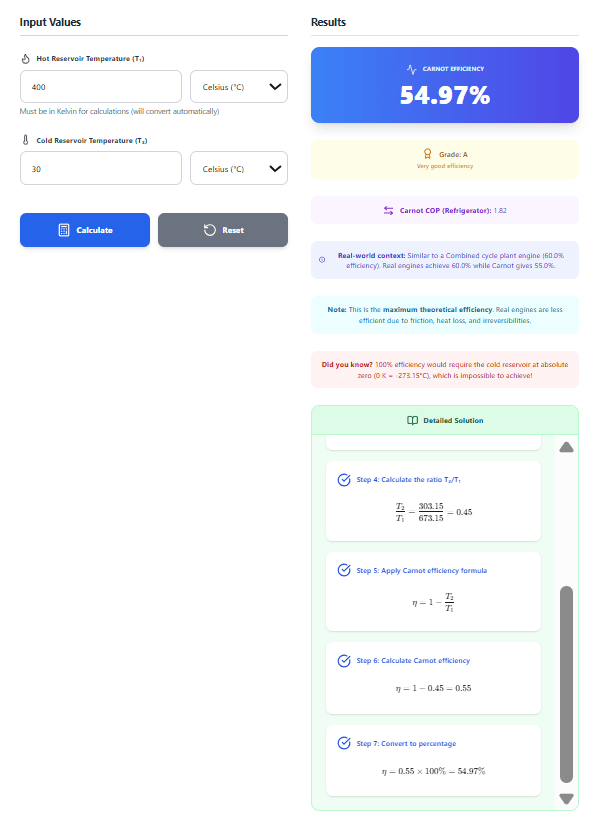
Problem: A steam plant runs between 400°C and 30°C. What is the best it can theoretically do?
- T₁ = 400°C = 673.15 K
- T₂ = 30°C = 303.15 K
- η = 1 − 303.15/673.15 = 0.550
Answer: 55.0%.
That is the ceiling. Real steam plants in this temperature range typically hit 35–42%. The gap is friction, heat loss, and irreversibilities.
Finding the Hot Reservoir You Need
Problem: You want 55% efficiency with a 30°C cold reservoir. How hot does the hot side have to be?
- T₂ = 303.15 K, η = 0.55
- T₁ = 303.15 / (1 − 0.55) = 673.67 K
- 673.67 − 273.15 = 400.5°C
Notice this is slightly above 400°C — because 55% is not exactly achievable at exactly 400°C. Small rounding differences matter when you are working backwards.
Finding the Cold Reservoir
Problem: A 400°C hot reservoir, 55% target efficiency. What cold temperature do you need?
- T₁ = 673.15 K, η = 0.55
- T₂ = 673.15 × 0.45 = 302.92 K
- 29.8°C
Slightly below 30°C — same rounding effect in reverse.
Work Output
Problem: 55% efficiency, 1000 kJ of heat supplied. How much work comes out?
- W = 0.55 × 1000 = 550 kJ
- Heat rejected: 1000 − 550 = 450 kJ
That 450 kJ goes to the cold reservoir. It is not recoverable as work. It is the price of converting heat into motion.
Heat Input
Problem: 55% efficiency, 550 kJ of work needed. How much heat must you supply?
- Q₁ = 550 / 0.55 = 1000 kJ
Same numbers as above, just rearranged. This is what makes these five modes genuinely useful — you rarely know all the inputs going in.
Beyond the Formula
Carnot efficiency is a clean theoretical result. Real engines are messier. Here is what actually happens when you build one.
Why Real Engines Fall Short
| Engine type | Typical efficiency |
|---|---|
| Gasoline car | 25% |
| Diesel | 35% |
| Gas turbine | 35% |
| Steam turbine plant | 42% |
| Combined cycle | 60% |
Every one of these is below the Carnot limit for its operating temperatures. The reasons are consistent:
- Friction. Pistons against cylinder walls, bearings, gears — mechanical losses that turn work back into heat.
- Heat loss. Hot surfaces radiate to the surroundings. That heat never reaches the working fluid.
- Irreversibility. Real processes do not run infinitely slowly. Combustion is fast, expansion is fast, and fast means entropy increases more than the minimum.
- Incomplete combustion. Not all fuel burns. Unburnt fuel exits as pollution, not work.
- Non-ideal fluids. Steam is not an ideal gas. Real fluids have specific heats that vary with temperature, phase changes that are not perfectly sharp, and other quirks that the ideal Carnot analysis ignores.
None of these can be eliminated. They can only be reduced. That is why a combined cycle plant with every modern efficiency trick still tops out around 60%.
Common Mistakes
Using Celsius in the formula. The single most common error. η = 1 − 30/400 gives 92.5%, which is physically impossible. The formula requires Kelvin. The calculator converts for you, but if you are doing it by hand, convert first.
Assuming efficiency above 1 is possible. It is not. If your calculation gives more than 100%, you have made an error — usually a temperature conversion mistake.
Thinking Carnot is achievable. Carnot is a limit, not a target. No engine has ever reached it. Reversible processes do not exist in the real world.
Confusing efficiency with COP. For a refrigerator or heat pump, the useful output is heat moved, not work produced. That is COP, and it follows a different formula — for a heat pump, COP = T_H/(T_H − T_C), and for a refrigerator, COP = T_C/(T_H − T_C). Same temperatures, but different useful outputs.
How to Actually Improve Efficiency
If you are designing a heat engine and want to push closer to the Carnot limit:
- Raise T₁. Higher combustion temperature, better materials, ceramic coatings in turbines.
- Lower T₂. Better cooling, larger condensers, cooler ambient environment. This is often easier than raising T₁.
- Reduce irreversibilities. Slower expansion, better lubrication, fewer sharp transitions between states.
- Recover waste heat. Combined cycle plants use the exhaust from a gas turbine to run a steam turbine — squeezing a second cycle out of the same heat.
The first two are pure thermodynamics. The last two are engineering.
Carnot vs Otto vs Rankine
Carnot is the theoretical ceiling, but real engines use different cycles. Here is how they compare.
| Cycle | Used in | Typical η | Key idea |
|---|---|---|---|
| Carnot | Theoretical only | Highest possible | Isothermal + adiabatic, infinitely slow |
| Otto | Gasoline engines | 25–35% | Constant-volume heat addition |
| Diesel | Diesel engines | 30–40% | Constant-pressure heat addition |
| Rankine | Steam power plants | 35–45% | Phase change of water/steam |
| Brayton | Gas turbines | 30–40% | Continuous flow, open cycle |
| Combined | Modern power plants | 55–60% | Brayton + Rankine stacked |
All of these are below Carnot for the same temperatures, for the reasons above. The Otto cycle, for example, cannot reach Carnot efficiency because its heat addition is not isothermal — the temperature rises as the piston compresses, which limits how much of the heat can be converted to work.
Why Bother With Carnot, Then?
Because it tells you the target. If your gasoline engine runs at 25% and Carnot says the limit is 60% for your operating temperatures, you know there is room to improve — and you know roughly how much. If your steam plant hits 42% and Carnot says 55%, that 13% gap is where every engineering decision lives.
Carnot efficiency is the ruler. Real engines are what you measure against it.
Worked Case Study: A Real Power Plant
Let us put all of this together on a realistic scenario.
A natural gas power plant operates with a combustion temperature of 1,100°C and a cooling tower that rejects heat at 35°C.
Step 1: Convert to Kelvin.
- T₁ = 1373.15 K
- T₂ = 308.15 K
Step 2: Carnot efficiency.
- η = 1 − 308.15/1373.15 = 0.7756 → 77.6%
That is the theoretical ceiling. No commercial natural gas plant operates near this limit.
Step 3: Real efficiency. A modern combined-cycle plant at these temperatures typically achieves 58–62%. Let us say 60%.
Step 4: The gap. 77.6% − 60% = 17.6 percentage points lost to friction, heat loss, incomplete combustion, and irreversibilities. That is the engineering challenge.
Step 5: What it means for output. If the plant consumes 1,000 MW of thermal energy from natural gas:
- Carnot limit: 776 MW of work possible
- Real: 600 MW of work produced
- Heat rejected: 400 MW
The 400 MW rejected to the cooling tower is not waste in the sense of being recoverable. It is the second-law requirement. The 176 MW gap between Carnot and real is what engineers work to shrink.
That is what Carnot efficiency is for — not as a target, but as a reference point that tells you how much room is left.
Quick Answers
Why must temperatures be in Kelvin? Because the formula is a ratio of absolute temperatures. Celsius has an arbitrary zero, so the ratio breaks. Kelvin starts at absolute zero, which is the physically meaningful baseline.
Can any engine reach 100% efficiency? Only if the cold reservoir is at 0 K (−273.15°C). No real system can maintain that. Even in theory, 100% requires infinite temperature difference or absolute zero cooling, neither of which is achievable.
Is Carnot efficiency the same for refrigerators? No — refrigerators and heat pumps use COP (Coefficient of Performance). For a heat pump, COP = T_H/(T_H − T_C) = 1/η. For a refrigerator, COP = T_C/(T_H − T_C) = 1/η − 1. Same temperatures, but different useful outputs and different formulas.
What is the highest efficiency achieved by a real engine? Combined-cycle gas turbine power plants have reached around 62% in the best commercial installations as of recent records. Single-cycle gas turbines and other engine types are lower.
Does fuel type affect Carnot efficiency? No. Carnot efficiency depends only on the two reservoir temperatures. Fuel type affects how hot you can run T₁, but the formula itself does not care.