How to Convert Time Between Time Zones – Complete Guide to Timezone Converter
Have you ever tried to schedule a meeting with someone in another country and ended up confused about who is ahead and who is behind? Or maybe you have booked an international flight and wondered why the arrival time is listed as the next day?
I remember my first remote job. My team was spread across New York, London, and Sydney. Scheduling a simple 30-minute meeting took forever. Someone would suggest 10 AM. But 10 AM where? New York 10 AM was 3 PM in London and 1 AM the next day in Sydney. Nobody could agree. We spent more time finding a meeting time than actually meeting.
After weeks of confusion, I finally sat down and learned how time zones actually work. Now I can convert time zones in my head for common cities. This guide will teach you everything I learned. No complicated theories. Just practical knowledge you can use right away.
Quick access: Use free timezone converter here
What is a Time Zone? Simple Answer
A time zone is a region of the world that uses the same standard time. Instead of every city having its own time (based on when the sun is overhead), nearby cities share the same time.
Example: New York, Boston, and Washington DC are all in the same time zone. Even though the sun is at its highest at slightly different moments in each city, they all use Eastern Time.
Why do we need time zones?
Before time zones, every town had its own local time based on the sun. When it was noon in one town, it was 12:05 PM in the next town. This worked fine for local life, but when trains and telephones connected cities, chaos followed. Train schedules were impossible. A train departing at "noon" meant different things in different towns.
In 1883, the world adopted time zones. Now we have a system where time is consistent across regions.
A Brief History of Time Zones
Understanding the history helps explain why time zones are the way they are today.
Before 1883: Local Sun Time
Every town set its clocks based on the sun. When the sun was at its highest point (zenith), it was noon. This worked for thousands of years. But as travel and communication sped up, this system broke down.
1876: The Idea is Born
Sir Sandford Fleming, a Canadian engineer, missed a train because a schedule showed PM instead of AM. He realized the world needed a standardized time system. He proposed dividing the world into 24 time zones, each 15 degrees of longitude wide.
1883: North America Adopts Time Zones
Railways in the United States and Canada adopted standard time zones. Before this, there were over 100 local times in North America.
1884: International Meridian Conference
25 countries met in Washington DC. They agreed to use Greenwich, England as the Prime Meridian (0 degrees longitude). This became the reference point for all time zones.
Today: 40+ Time Zones
Due to political boundaries and half-hour offsets, there are now more than 40 time zones worldwide.
Key timeline:
- 1876: Sir Sandford Fleming proposes time zones
- 1883: North American railways adopt standard time
- 1884: International Meridian Conference establishes GMT as reference
- 1972: UTC becomes the official international standard
How Time Zones Work – The Science (Simplified)
You do not need to be a scientist to understand time zones. Here is the simple explanation.
Earth's Rotation
The Earth rotates 360 degrees in 24 hours. This means it rotates 15 degrees per hour (360 ÷ 24 = 15).
15 Degrees Per Time Zone
Ideally, each time zone would be 15 degrees of longitude wide. In reality, time zones bend and twist to follow political borders, so some are wider and some are narrower.
UTC as the Reference
UTC (Coordinated Universal Time) is the reference point. The Prime Meridian (0 degrees longitude) in Greenwich, London is UTC +0.
As you go east from Greenwich, time increases (UTC +1, UTC +2, etc.). As you go west, time decreases (UTC -1, UTC -2, etc.).
Simple rule:
- East = ahead (later time)
- West = behind (earlier time)
What is a UTC Offset?
A UTC offset is the difference between local time and UTC. It tells you how many hours (and sometimes minutes) to add or subtract from UTC to get local time.
Whole Hour Offsets (Most Common)
| UTC Offset | Example Locations |
|---|---|
| UTC -10 | Hawaii, USA |
| UTC -8 | Los Angeles, USA |
| UTC -5 | New York, USA |
| UTC +0 | London, UK |
| UTC +1 | Paris, France, Berlin, Germany |
| UTC +2 | Cairo, Egypt, Athens, Greece |
| UTC +3 | Moscow, Russia, Istanbul, Turkey |
| UTC +8 | Beijing, China, Singapore |
| UTC +9 | Tokyo, Japan |
| UTC +10 | Sydney, Australia |
Half Hour Offsets
Some countries use 30-minute offsets.
| UTC Offset | Example Locations |
|---|---|
| UTC +3:30 | Tehran, Iran |
| UTC +4:30 | Kabul, Afghanistan |
| UTC +5:30 | Mumbai, India, Colombo, Sri Lanka |
| UTC +6:30 | Yangon, Myanmar |
| UTC -3:30 | Newfoundland, Canada |
45-Minute Offsets (Rare)
A few places use 45-minute offsets.
| UTC Offset | Example Locations |
|---|---|
| UTC +5:45 | Kathmandu, Nepal |
| UTC +8:45 | Eucla, Australia |
| UTC +12:45 | Chatham Islands, New Zealand |
Time Zone Converter – How to Convert Time Manually
Converting time between time zones manually is simple once you understand UTC offsets.
The Basic Formula
Time difference = Target offset - Source offset
Converted time = Source time + Time difference
Step by Step Example
Problem: Convert 10:00 AM New York to London time.
Step 1: Find UTC offsets
- New York (standard time) = UTC -5
- London = UTC +0
Step 2: Calculate the difference
- Time difference = 0 - (-5) = +5 hours
Step 3: Add to source time
- 10:00 AM + 5 hours = 3:00 PM
Answer: 10:00 AM New York = 3:00 PM London
More Examples
Example 1: Convert 2:00 PM London to New York
- London = UTC +0
- New York = UTC -5
- Difference = -5 - 0 = -5 hours
- 2:00 PM - 5 hours = 9:00 AM
- Answer: 2:00 PM London = 9:00 AM New York
Example 2: Convert 9:00 AM New York to India
- New York = UTC -5
- India = UTC +5:30
- Difference = 5:30 - (-5) = 10:30 hours
- 9:00 AM + 10:30 = 7:30 PM
- Answer: 9:00 AM New York = 7:30 PM India
Example 3: Convert 6:00 PM Tokyo to London
- Tokyo = UTC +9
- London = UTC +0
- Difference = 0 - 9 = -9 hours
- 6:00 PM - 9 hours = 9:00 AM
- Answer: 6:00 PM Tokyo = 9:00 AM London
Quick Reference Table for Common Conversions
| From City | To City | Add/Subtract |
|---|---|---|
| New York | London | Add 5 hours |
| London | New York | Subtract 5 hours |
| New York | India | Add 10 hours 30 minutes |
| India | New York | Subtract 10 hours 30 minutes |
| London | India | Add 5 hours 30 minutes |
| India | London | Subtract 5 hours 30 minutes |
| London | Tokyo | Add 9 hours |
| Tokyo | London | Subtract 9 hours |
| New York | Tokyo | Add 14 hours |
| Tokyo | New York | Subtract 14 hours |
Time Zone Converter for Different Situations
Time Zone Converter for Business Meetings
When scheduling meetings across time zones, the goal is to find a time that is reasonable for everyone. No one wants a meeting at 3 AM.
Example: Team in New York (UTC -5) and London (UTC +0)
- New York 9 AM to 5 PM = London 2 PM to 10 PM
- London 9 AM to 5 PM = New York 4 AM to 12 PM
Best overlap: New York 9 AM to 12 PM = London 2 PM to 5 PM
Example: Team in New York (UTC -5) and Sydney (UTC +10)
- New York 9 AM to 5 PM = Sydney 12 AM to 8 AM (next day)
- Sydney 9 AM to 5 PM = New York 6 PM to 2 AM (previous day)
Best overlap: Very limited. Either New York 8 PM to 9 PM (Sydney 11 AM to 12 PM) or New York 7 AM to 8 AM (Sydney 10 PM to 11 PM).
Time Zone Converter for Travel
When traveling, you need to convert flight departure and arrival times.
Example: Flight from New York to London
- Depart New York: 10:00 PM (22:00) EST
- Flight duration: 7 hours
- Arrival in UTC: 22:00 + 7 = 5:00 UTC next day
- London is UTC +0, so arrival local time = 5:00 AM
Example: Flight from London to Tokyo
- Depart London: 12:00 PM (12:00) GMT
- Flight duration: 12 hours
- Arrival in UTC: 12:00 + 12 = 0:00 UTC next day
- Tokyo is UTC +9, so arrival local time = 9:00 AM next day
Time Zone Converter for Remote Teams
For remote teams spread across multiple time zones, a shared reference like UTC helps.
Example: Team in New York (UTC -5), London (UTC +0), India (UTC +5:30)
- UTC 13:00 = New York 08:00, London 13:00, India 18:30
- UTC 14:00 = New York 09:00, London 14:00, India 19:30
Schedule meetings at UTC 14:00. Everyone is awake.
Daylight Saving Time (DST) and Time Zone Conversion
Daylight saving time complicates time zone conversion because UTC offsets change twice per year in many countries.
What is Daylight Saving Time?
DST is the practice of moving clocks forward by 1 hour in spring and back by 1 hour in autumn. This extends daylight in the evening during summer months.
How DST Changes UTC Offsets
| Location | Standard Offset | DST Offset | DST Period |
|---|---|---|---|
| New York | UTC -5 | UTC -4 | March to November |
| London | UTC +0 | UTC +1 | March to October |
| Paris | UTC +1 | UTC +2 | March to October |
| Sydney | UTC +10 | UTC +11 | October to April |
DST Conversion Example
Scenario: It is July (summer in northern hemisphere). Convert 2:00 PM New York to London.
- New York DST offset = UTC -4
- London DST offset = UTC +1
- Difference = 1 - (-4) = 5 hours
- 2:00 PM + 5 hours = 7:00 PM
If it were January (no DST):
- New York offset = UTC -5
- London offset = UTC +0
- Difference = 0 - (-5) = 5 hours
- 2:00 PM + 5 hours = 7:00 PM (same result, but the UTC times are different)
Which Countries Do Not Observe DST?
Many countries do not observe daylight saving time:
- India (UTC +5:30 year round)
- China (UTC +8 year round)
- Japan (UTC +9 year round)
- Australia (only some states observe DST)
- Most countries near the equator
Important: When converting time zones, always check if DST is active in both locations.
Major Time Zones of the World
Here is a list of major time zones with their UTC offsets and major cities.
| Time Zone Name | UTC Offset | Major Cities |
|---|---|---|
| Hawaii-Aleutian | UTC -10 | Honolulu |
| Alaska | UTC -9 | Anchorage |
| Pacific | UTC -8 | Los Angeles, Vancouver |
| Mountain | UTC -7 | Denver, Phoenix |
| Central | UTC -6 | Chicago, Mexico City |
| Eastern | UTC -5 | New York, Toronto |
| Atlantic | UTC -4 | Halifax, San Juan |
| Newfoundland | UTC -3:30 | St. John's |
| UTC-3 | UTC -3 | Buenos Aires, Sao Paulo |
| UTC-2 | UTC -2 | South Georgia |
| UTC-1 | UTC -1 | Azores, Cape Verde |
| GMT / UTC | UTC +0 | London, Dublin |
| Central European | UTC +1 | Paris, Berlin, Rome |
| Eastern European | UTC +2 | Cairo, Athens, Helsinki |
| Moscow | UTC +3 | Moscow, Istanbul |
| Gulf | UTC +4 | Dubai, Baku |
| Pakistan | UTC +5 | Karachi, Lahore |
| India | UTC +5:30 | Mumbai, Delhi |
| Bangladesh | UTC +6 | Dhaka |
| Indochina | UTC +7 | Bangkok, Jakarta |
| China | UTC +8 | Beijing, Shanghai, Singapore |
| Japan | UTC +9 | Tokyo, Seoul |
| Australia Eastern | UTC +10 | Sydney, Melbourne |
| Australia Central | UTC +10:30 | Adelaide |
| Australia Western | UTC +8 | Perth |
| New Zealand | UTC +12 | Auckland, Wellington |
Countries with Multiple Time Zones
Some countries span multiple time zones. This is important to know when doing business or traveling within these countries.
| Country | Number of Time Zones |
|---|---|
| Russia | 11 |
| United States | 11 (including territories) |
| France | 12 (including overseas territories) |
| United Kingdom | 9 (including overseas territories) |
| Australia | 5 |
| Canada | 6 |
| Brazil | 4 |
| Mexico | 4 |
| Indonesia | 3 |
| China | 1 (officially, despite spanning 5 geographic zones) |
Interesting fact: China geographically spans 5 time zones but uses only one (Beijing Time, UTC +8) for the entire country.
The International Date Line (IDL)
The International Date Line is where the calendar day changes. Crossing the IDL east to west subtracts a day. Crossing west to east adds a day.
Example:
- From New York to Tokyo, you gain 14 hours but cross the IDL? Actually, you do not cross IDL going from US to Japan. But from Hawaii to Japan, you cross IDL.
Real example:
- Depart Honolulu (UTC -10) on Monday at 10:00 AM
- Fly to Tokyo (UTC +9) for 8 hours
- Arrival UTC = 10:00 UTC -10 = 20:00 UTC day 1 + 8 hours = 4:00 UTC day 2
- Tokyo local = 4:00 + 9 = 13:00 (1 PM) on Tuesday
You left Monday morning and arrived Tuesday afternoon. You lost a day.
How to Use Our Timezone Converter
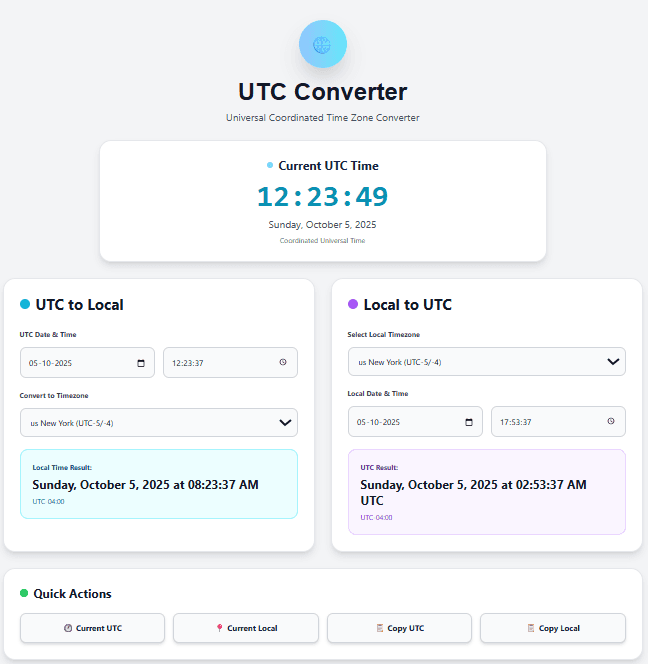
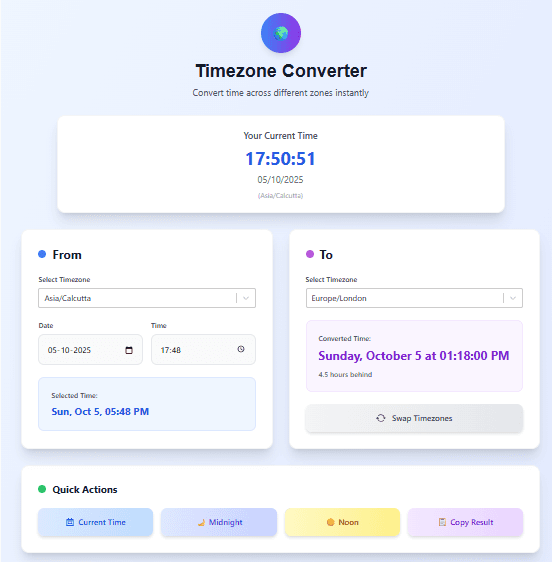
Our timezone converter tool makes time zone conversion instant and accurate.
Step 1: Select the source time zone (where the time is currently)
Step 2: Enter the source time
Step 3: Select the target time zone (where you want to convert to)
Step 4: The tool automatically accounts for DST
Step 5: See the converted time instantly
Step 6: Use swap button to reverse source and target
Step 7: Copy results for sharing
No manual calculations. No worrying about DST. Just select and convert.
Time Zone Conversion Table (Without DST)
Use this table to quickly see what time it is in other cities when you know the time in UTC.
| UTC Time | New York (UTC-5) | London (UTC+0) | India (UTC+5:30) | Tokyo (UTC+9) | Sydney (UTC+10) |
|---|---|---|---|---|---|
| 00:00 | 19:00 (prev) | 00:00 | 05:30 | 09:00 | 10:00 |
| 01:00 | 20:00 (prev) | 01:00 | 06:30 | 10:00 | 11:00 |
| 02:00 | 21:00 (prev) | 02:00 | 07:30 | 11:00 | 12:00 |
| 03:00 | 22:00 (prev) | 03:00 | 08:30 | 12:00 | 13:00 |
| 04:00 | 23:00 (prev) | 04:00 | 09:30 | 13:00 | 14:00 |
| 05:00 | 00:00 | 05:00 | 10:30 | 14:00 | 15:00 |
| 06:00 | 01:00 | 06:00 | 11:30 | 15:00 | 16:00 |
| 07:00 | 02:00 | 07:00 | 12:30 | 16:00 | 17:00 |
| 08:00 | 03:00 | 08:00 | 13:30 | 17:00 | 18:00 |
| 09:00 | 04:00 | 09:00 | 14:30 | 18:00 | 19:00 |
| 10:00 | 05:00 | 10:00 | 15:30 | 19:00 | 20:00 |
| 11:00 | 06:00 | 11:00 | 16:30 | 20:00 | 21:00 |
| 12:00 | 07:00 | 12:00 | 17:30 | 21:00 | 22:00 |
| 13:00 | 08:00 | 13:00 | 18:30 | 22:00 | 23:00 |
| 14:00 | 09:00 | 14:00 | 19:30 | 23:00 | 00:00 (next) |
| 15:00 | 10:00 | 15:00 | 20:30 | 00:00 (next) | 01:00 (next) |
| 16:00 | 11:00 | 16:00 | 21:30 | 01:00 (next) | 02:00 (next) |
| 17:00 | 12:00 | 17:00 | 22:30 | 02:00 (next) | 03:00 (next) |
| 18:00 | 13:00 | 18:00 | 23:30 | 03:00 (next) | 04:00 (next) |
| 19:00 | 14:00 | 19:00 | 00:30 (next) | 04:00 (next) | 05:00 (next) |
| 20:00 | 15:00 | 20:00 | 01:30 (next) | 05:00 (next) | 06:00 (next) |
| 21:00 | 16:00 | 21:00 | 02:30 (next) | 06:00 (next) | 07:00 (next) |
| 22:00 | 17:00 | 22:00 | 03:30 (next) | 07:00 (next) | 08:00 (next) |
| 23:00 | 18:00 | 23:00 | 04:30 (next) | 08:00 (next) | 09:00 (next) |
Common Time Zone Conversion Mistakes
Mistake 1: Forgetting About DST
Problem: Converting New York to London in July using UTC -5 for New York instead of UTC -4
Solution: Always check if DST is active in both locations. Use a tool that handles DST automatically.
Mistake 2: Ignoring Minute Offsets
Problem: Converting to India time but using UTC +5 instead of UTC +5:30
Solution: For countries with half-hour or 45-minute offsets, always include the minutes.
Mistake 3: Confusing AM and PM When Adding Hours
Problem: 10:00 AM + 5 hours = 15:00 (3 PM), but thinking it is 5 PM
Solution: Use 24-hour time (10:00, 15:00, 22:00) to avoid AM/PM confusion.
Mistake 4: Forgetting About Date Changes
Problem: 10:00 PM New York + 5 hours = 3:00 AM next day, not 3:00 PM same day
Solution: When adding hours crosses midnight, the date changes.
Mistake 5: Assuming All of a Country Uses Same Time Zone
Problem: Scheduling a meeting in Australia assuming Sydney and Perth have the same time
Solution: Australia has multiple time zones. Always check the specific city.
Fun Facts About Time Zones
- China is geographically as wide as the United States but uses only one time zone (UTC +8).
- France has the most time zones of any country (12) due to its overseas territories.
- Russia has 11 time zones, the most of any contiguous country.
- Nepal is one of the few countries with a 45-minute offset (UTC +5:45).
- The International Date Line is not straight. It zigzags to keep countries on the same calendar day.
- Antarctica has no official time zones. Research stations use the time zone of their home country.
- UTC never observes daylight saving time. It is constant all year.
- Some towns in Australia use UTC +8:45, a 45-minute offset.
Frequently Asked Questions
Q: How to convert time between time zones?
A: Find the UTC offset for both time zones. Calculate the difference. Add or subtract the difference from the source time. Use our timezone converter for instant results.
Q: What is the best free timezone converter?
A: Our timezone converter is completely free, handles DST automatically, and works on all devices.
Q: How does daylight saving time affect time zone conversion?
A: DST changes UTC offsets by +1 hour during summer months. When converting, you must use the correct offset for the current date.
Q: What is the time difference between New York and London?
A: Standard time: New York is UTC -5, London is UTC +0, difference = 5 hours. During DST: New York is UTC -4, London is UTC +1, difference = 5 hours (but actual times shift).
Q: What is the time difference between India and New York?
A: India is UTC +5:30, New York is UTC -5 (standard). Difference = 10 hours 30 minutes. New York is behind India.
Q: How many time zones are there in the world?
A: There are 40+ time zones when including half-hour and 45-minute offsets. Theoretically there would be 24, but political boundaries create more.
Q: What is UTC offset?
A: UTC offset is the difference between local time and UTC. It tells you how many hours (and minutes) to add or subtract from UTC to get local time.
Q: Does China have multiple time zones?
A: Geographically, China spans 5 time zones. But officially, the entire country uses Beijing Time (UTC +8).
Q: What is the International Date Line?
A: The International Date Line is where the calendar day changes. Crossing it east to west subtracts a day. Crossing west to east adds a day.
Q: How to schedule meetings across time zones?
A: Find the overlap of business hours (typically 9 AM to 5 PM local time) across all time zones. Use a timezone converter to find common available times.
Q: Does the timezone converter account for DST?
A: Yes. Our timezone converter automatically accounts for daylight saving time based on the date.
Q: What is Zulu time?
A: Zulu time is another name for UTC. It is used in aviation and military contexts.
Q: Why is Nepal 45 minutes off?
A: Nepal chose UTC +5:45 to align with local solar time. The sun reaches its zenith at 11:45 AM standard time instead of noon.
Q: Can I use the timezone converter for travel planning?
A: Yes. Convert departure and arrival times to local times to understand flight schedules.
Q: Is the timezone converter free?
A: Yes. Completely free. No signup. No limits.
My Final Advice
After years of working with time zones for remote teams, travel, and international business, here is what I have learned.
Use UTC as your reference. When scheduling international meetings, think in UTC. Find a UTC time that works for everyone, then convert to local times. This eliminates confusion.
Always check DST. The same city can have different UTC offsets in summer and winter. Never assume.
Use a converter for accuracy. Manual conversion is fine for simple cases, but when you have multiple time zones or half-hour offsets, use a reliable tool.
Be careful with date changes. Adding or subtracting hours can change the date. Always check if your conversion crosses midnight or the International Date Line.
Learn common offsets. Memorize the UTC offsets for cities you work with frequently. This makes rough conversions faster.
And finally, use a good timezone converter. Our tool handles all the complexity so you do not have to.
Try Our Free Timezone Converter Now
Have questions about time zone conversion for a specific situation? Leave a comment below. I try to answer every one.
Tags: timezone converter, how to convert time zones, online timezone converter, utc to local time, world clock, convert time zones, time difference calculator, global time converter, time zones explained, convert time between time zones, time zone conversion formula, time zone offset calculator, meeting planner across time zones, travel time zone converter, remote team time coordination, time zone converter for developers, time zone converter for travelers, time zone converter for business, time difference between cities, calculate time difference manually, what is a time zone, why time zones exist, history of time zones, standard time explained, utc offset list, half hour time zones, daylight saving time explained, countries with multiple time zones, time zone converter free online, time zone converter with dst, time zone converter for scheduling