Root Calculator: Finally Understand Square Roots, Cube Roots, and Beyond
Let me tell you about the first time I saw a radical symbol. I was in 8th grade, and my teacher wrote "√16" on the board. I thought it was some kind of weird check mark. Then she said, "This is the square root of 16." I had no idea what that meant.
Then came cube roots. Fourth roots. And suddenly there were little numbers sitting in the crook of the check mark, and I was completely lost.
Here's what I learned after years of teaching: roots aren't complicated. They're just the inverse of exponents. And once you understand that connection, everything clicks.
In this guide, I'll walk you through everything you need to know about roots—from square roots to any nth root—and show you how our root calculator can help you not just get answers, but actually understand what's happening.
Ready to demystify radicals? Try our Root Calculator and watch each calculation unfold step by step.
What Is a Root, Really?
A root asks one simple question: "What number, multiplied by itself n times, gives me this number?"
Let me say that again: a root is just asking for the number that, when raised to a certain power, gives you your original number.
Square Root (√)
√16 asks: "What number times itself equals 16?" Answer: 4 (because 4 × 4 = 16)
√25 asks: "What number times itself equals 25?" Answer: 5 (because 5 × 5 = 25)
Cube Root (∛)
∛8 asks: "What number times itself three times equals 8?" Answer: 2 (because 2 × 2 × 2 = 8)
∛27 asks: "What number times itself three times equals 27?" Answer: 3 (because 3 × 3 × 3 = 27)
nth Root (ⁿ√)
⁴√16 asks: "What number times itself four times equals 16?" Answer: 2 (because 2 × 2 × 2 × 2 = 16)
See the pattern? Every root is just "undoing" an exponent.
The Language of Roots
Let's break down what you're looking at when you see a radical.
ⁿ√x
- n = the index (how many times you multiply)
- √ = the radical symbol
- x = the radicand (the number under the root)
Common Roots You'll See
| Symbol | Name | What It Means |
|---|---|---|
| √x | Square root | Number that squared equals x |
| ∛x | Cube root | Number that cubed equals x |
| ⁴√x | Fourth root | Number to the 4th power equals x |
| ⁿ√x | nth root | Number to the nth power equals x |
Relationship to Exponents
Here's the key connection that changed everything for me:
ⁿ√x = x^(1/n)
That's it. A root is just a fractional exponent.
- √x = x^(1/2)
- ∛x = x^(1/3)
- ⁴√x = x^(1/4)
Once I understood this, roots stopped being scary and became just another type of exponent.
Square Roots: The Ones You'll Use Most
Square roots are everywhere. Geometry, physics, statistics—you name it.
Perfect Squares
These are the ones that give nice, whole number answers:
| Number | Square Root | Because |
|---|---|---|
| 1 | 1 | 1² = 1 |
| 4 | 2 | 2² = 4 |
| 9 | 3 | 3² = 9 |
| 16 | 4 | 4² = 16 |
| 25 | 5 | 5² = 25 |
| 36 | 6 | 6² = 36 |
| 49 | 7 | 7² = 49 |
| 64 | 8 | 8² = 64 |
| 81 | 9 | 9² = 81 |
| 100 | 10 | 10² = 100 |
| 121 | 11 | 11² = 121 |
| 144 | 12 | 12² = 144 |
Non-Perfect Squares
Most numbers aren't perfect squares. √2 ≈ 1.4142, √3 ≈ 1.7321, √5 ≈ 2.2361. These are irrational numbers—they go on forever without repeating.
Square Roots of Fractions
√(1/4) = 1/2 √(9/16) = 3/4
Because (1/2)² = 1/4 and (3/4)² = 9/16.
Cube Roots: When Things Get Three-Dimensional
Cube roots appear in volume calculations, physics, and engineering.
Perfect Cubes
| Number | Cube Root | Because |
|---|---|---|
| 1 | 1 | 1³ = 1 |
| 8 | 2 | 2³ = 8 |
| 27 | 3 | 3³ = 27 |
| 64 | 4 | 4³ = 64 |
| 125 | 5 | 5³ = 125 |
| 216 | 6 | 6³ = 216 |
| 343 | 7 | 7³ = 343 |
| 512 | 8 | 8³ = 512 |
| 729 | 9 | 9³ = 729 |
| 1000 | 10 | 10³ = 1000 |
Negative Cube Roots
Unlike square roots, cube roots of negative numbers are real numbers.
∛(-8) = -2 because (-2)³ = -8 ∛(-27) = -3 because (-3)³ = -27 ∛(-125) = -5 because (-5)³ = -125
This is a key difference: odd roots of negative numbers are real. Even roots of negative numbers are imaginary.
Fourth Roots and Beyond
Fourth roots, fifth roots—any root you can imagine.
Fourth Roots
⁴√16 = 2 (2⁴ = 16) ⁴√81 = 3 (3⁴ = 81) ⁴√256 = 4 (4⁴ = 256) ⁴√625 = 5 (5⁴ = 625)
Fifth Roots
⁵√32 = 2 (2⁵ = 32) ⁵√243 = 3 (3⁵ = 243) ⁵√1024 = 4 (4⁵ = 1024) ⁵√3125 = 5 (5⁵ = 3125)
Higher Roots
For any integer n, ⁿ√x asks: "What number raised to the nth power gives x?"
Even vs. Odd Roots: A Critical Distinction
This is where a lot of students get confused.
Odd Roots (n = 1, 3, 5, 7...)
- Work for any real number (positive or negative)
- Result is real
- Example: ∛(-8) = -2
Even Roots (n = 2, 4, 6, 8...)
- Only work for non-negative numbers (in real numbers)
- Cannot take even root of a negative number
- √(-4) is not a real number (it's imaginary: 2i)
Why? Because any real number squared is non-negative. So no real number squared equals a negative number.
Our calculator will warn you if you try to take an even root of a negative number.
Step-by-Step: How to Calculate a Root
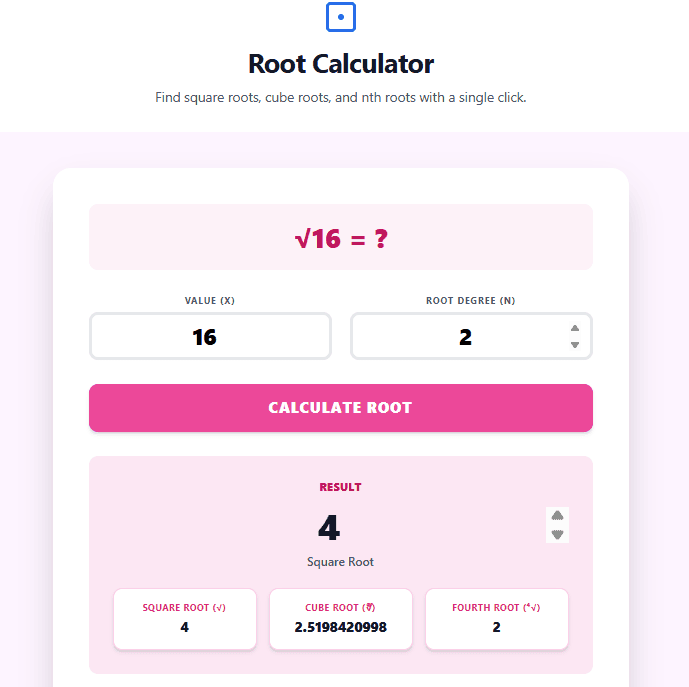
Let me walk you through exactly how to calculate a root, using √16 as our example.
Step 1: Identify the Type of Root
n = 2 (square root) x = 16
Step 2: Ask the Question
"What number, when squared, equals 16?"
Step 3: Find the Answer
4 × 4 = 16 So √16 = 4
For a More Complex Example: ∛64
Step 1: Cube root of 64 Step 2: What number cubed equals 64? Step 3: 4³ = 64, so ∛64 = 4
For a Non-Perfect Square: √20
Step 1: Square root of 20 Step 2: 4² = 16, 5² = 25, so it's between 4 and 5 Step 3: More precise: √20 ≈ 4.4721
With Our Calculator
Here's what our calculator shows:
Step 1: Write the expression √16 = ?
Step 2: Convert to exponential form √16 = 16^(1/2)
Step 3: Calculate the result 16^(0.5) = 4
Step 4: Verification 4² = 16 ✓
Real-World Applications
Geometry
- Square root: Find side length from area of a square
- Area = 25 → side = √25 = 5
- Cube root: Find edge length from volume of a cube
- Volume = 216 → edge = ∛216 = 6
Physics
- Pythagorean theorem: c = √(a² + b²)
- Kinetic energy: v = √(2KE/m)
- Period of a pendulum: T = 2π√(L/g)
Statistics
- Standard deviation: σ = √(variance)
- Root mean square: Used in AC electricity
Engineering
- Root finding: Solving equations
- Signal processing: RMS values
- Fluid dynamics: Flow rates
Everyday Life
- Distance: √(Δx² + Δy²) for diagonal distance
- Screens: Diagonal size of TV = √(width² + height²)
- Photography: Aperture f-stops follow √2 pattern
How to Use Our Root Calculator
Our calculator is designed to be simple and educational.
Step 1: Enter Your Number (x)
Type the number you want to find the root of. Can be positive, negative, decimal—anything.
Step 2: Enter the Root Degree (n)
Enter 2 for square root, 3 for cube root, 4 for fourth root, or any number for nth root.
Step 3: Click Calculate
Or just wait—the calculator updates automatically.
Step 4: Read Your Results
You'll see:
- The result: The root value
- Description: Square root, cube root, etc.
- Common roots: Square, cube, and fourth roots (if applicable)
- Step-by-step: Each calculation explained
What It Handles
| Input | Example | Works? |
|---|---|---|
| Perfect squares | √16 | ✓ (4) |
| Perfect cubes | ∛27 | ✓ (3) |
| Non-perfect roots | √2 | ✓ (≈1.4142) |
| Negative with odd root | ∛(-8) | ✓ (-2) |
| Negative with even root | √(-4) | ⚠️ Complex number warning |
| Decimals | √2.5 | ✓ (≈1.5811) |
| Fractions | √0.25 | ✓ (0.5) |
Understanding the Step-by-Step Solutions
Our calculator doesn't just give you answers—it shows you how to get there.
Example: √16
Step 1: Write the expression √16 = ?
Step 2: Convert to exponential form √16 = 16^(1/2)
Step 3: Calculate 16^(0.5) = 4
Step 4: Verification 4² = 16 ✓
Example: ∛27
Step 1: Write the expression ∛27 = ?
Step 2: Convert to exponential form 27^(1/3)
Step 3: Calculate 27^(0.33333) = 3
Step 4: Verification 3³ = 27 ✓
Example: √20 (non-perfect)
Step 1: Write the expression √20 = ?
Step 2: Convert to exponential form 20^(1/2)
Step 3: Calculate 20^(0.5) ≈ 4.4721
Step 4: Verification 4.4721² ≈ 20 ✓
Example: ∛(-8) (negative with odd root)
Step 1: Write the expression ∛(-8) = ?
Step 2: Handle negative value (odd root) ∛(-8) = -∛8
Step 3: Calculate positive root ∛8 = 2
Step 4: Apply negative -2
Step 5: Verification (-2)³ = -8 ✓
Common Mistakes (I've Made Every Single One)
Mistake 1: Confusing Square Root with Half
Wrong: √16 = 8 Right: √16 = 4
Square root asks for the number that multiplies by itself, not half.
Mistake 2: Thinking √(x²) = x
√(x²) = |x|, not x. Because √((-3)²) = √9 = 3, not -3.
Mistake 3: Even Roots of Negatives
Wrong: √(-4) = -2 Right: √(-4) is not real (it's 2i in complex numbers)
Mistake 4: Cube Roots of Negatives
Wrong: ∛(-8) is not real Right: ∛(-8) = -2 (odd roots work for negatives)
Mistake 5: Adding Roots
Wrong: √a + √b = √(a + b) Right: √4 + √9 = 2 + 3 = 5, not √13
Mistake 6: Multiplying Roots
Wrong: √a × √b = √(a × b) — actually this one IS correct! But only for real numbers.
Mistake 7: Root of a Sum
Wrong: √(a + b) = √a + √b Right: √(9 + 16) = √25 = 5, not 3 + 4 = 7
Simplifying Radicals
Sometimes you can simplify roots by factoring out perfect squares, cubes, etc.
Square Root Simplification
√50 = √(25 × 2) = √25 × √2 = 5√2
√72 = √(36 × 2) = √36 × √2 = 6√2
√48 = √(16 × 3) = √16 × √3 = 4√3
Cube Root Simplification
∛54 = ∛(27 × 2) = ∛27 × ∛2 = 3∛2
∛128 = ∛(64 × 2) = ∛64 × ∛2 = 4∛2
Fourth Root Simplification
⁴√32 = ⁴√(16 × 2) = ⁴√16 × ⁴√2 = 2⁴√2
Our calculator handles these automatically and shows the simplified form when applicable.
Roots vs. Exponents: The Relationship
This is the most important connection to understand:
ⁿ√x = x^(1/n)
Examples
- √x = x^(1/2)
- ∛x = x^(1/3)
- ⁴√x = x^(1/4)
- ⁵√x = x^(1/5)
Why This Matters
Once you see roots as fractional exponents, you can apply all the exponent rules:
- √a × √b = a^(1/2) × b^(1/2) = (ab)^(1/2) = √(ab)
- ∛(a²) = a^(2/3) = (a^(1/3))² = (∛a)²
This connection was the breakthrough moment for me. Hopefully it is for you too.
Teaching Roots (or Learning Yourself)
Start with Perfect Squares
Memorize the perfect squares up to 144. Then square roots become automatic.
Visualize Square Roots
Draw a 4×4 square. It has 16 small squares. The side length is 4. That's √16.
Visualize Cube Roots
Think of a 3×3×3 cube. It has 27 small cubes. The edge length is 3. That's ∛27.
Use the "What Number?" Question
For any root, ask: "What number, raised to the nth power, equals this number?"
Practice with Perfect Powers
- 2² = 4, so √4 = 2
- 2³ = 8, so ∛8 = 2
- 2⁴ = 16, so ⁴√16 = 2
- 2⁵ = 32, so ⁵√32 = 2
Then Try Non-Perfect
√2 ≈ 1.414 (between 1 and 2) ∛10 ≈ 2.154 (between 2 and 3)
Frequently Asked Questions
What's the difference between √16 and √-16?
√16 = 4 (real). √-16 is not real—it's 4i (imaginary). Our calculator warns you about even roots of negatives.
Can I take the cube root of a negative number?
Yes! ∛(-8) = -2 because (-2)³ = -8. Odd roots work for negatives.
What's the fourth root of 16?
⁴√16 = 2 because 2⁴ = 16. Also -2⁴ = 16, but the principal (positive) root is 2.
What does √2 mean?
It's the number that when squared equals 2. It's irrational, about 1.4142.
Why can't I take the square root of a negative number?
Because no real number squared gives a negative. In real numbers, it's undefined. In complex numbers, √(-4) = 2i.
What's the nth root of 1?
ⁿ√1 = 1 for any n. Because 1ⁿ = 1.
What's the nth root of 0?
ⁿ√0 = 0 for any n (except n=0). Because 0ⁿ = 0.
How does your calculator handle large numbers?
It uses JavaScript's Math.pow() function, which handles numbers up to about 1.8×10³⁰⁸. For very large numbers, it uses scientific notation.
What's a radical expression?
An expression containing a root symbol. Like √(x² + y²) or ∛(2x + 1).
Quick Reference: Root Formulas
Definition
ⁿ√x = x^(1/n)
Product Rule
ⁿ√(a × b) = ⁿ√a × ⁿ√b
Quotient Rule
ⁿ√(a / b) = ⁿ√a / ⁿ√b
Power Rule
(ⁿ√a)^m = ⁿ√(a^m)
Root of a Root
ⁿ√(ᵐ√a) = ⁿᵐ√a
Perfect Powers (Quick Reference)
| Square Roots | Cube Roots | Fourth Roots | Fifth Roots |
|---|---|---|---|
| √1 = 1 | ∛1 = 1 | ⁴√1 = 1 | ⁵√1 = 1 |
| √4 = 2 | ∛8 = 2 | ⁴√16 = 2 | ⁵√32 = 2 |
| √9 = 3 | ∛27 = 3 | ⁴√81 = 3 | ⁵√243 = 3 |
| √16 = 4 | ∛64 = 4 | ⁴√256 = 4 | ⁵√1024 = 4 |
| √25 = 5 | ∛125 = 5 | ⁴√625 = 5 | ⁵√3125 = 5 |
| √36 = 6 | ∛216 = 6 | ⁴√1296 = 6 | ⁵√7776 = 6 |
Your Turn: Start Calculating
Roots used to confuse me. Now they're tools I use regularly. The key is understanding they're just asking "what number to the nth power gives me this?"
Here's your practice plan:
- Start with perfect squares: √1, √4, √9, √16, √25
- Move to perfect cubes: ∛8, ∛27, ∛64, ∛125
- Try non-perfect roots: √2, √3, √5 (approximate)
- Try negative with odd roots: ∛(-8), ∛(-27)
- Experiment with your calculator: Try different degrees and numbers
- Read the steps: Understand each calculation
Ready to start? Open up our Root Calculator and try it yourself. Type in √16. Then try ∛27. Then try ⁴√16. Then try something weird like ⁵√100.
You'll get the hang of it faster than you think.
Have questions? Get stuck on a particular root? Drop a comment below or reach out. I've been where you are, and I'm happy to help.
— The Solvezi Team
Disclaimer: This calculator is for educational purposes. While we aim for accuracy, always double-check critical calculations independently. For complex numbers and advanced applications, consult appropriate resources.