Log Calculator: Finally Understand Logarithms Without the Headache
Let me be honest with you—when I first encountered logarithms in high school, I had no idea what was going on. My teacher wrote "log" on the board, and my brain immediately thought "log" as in a piece of wood. Not helpful.
Years later, after tutoring dozens of students who felt exactly the same confusion, I realized something: logarithms aren't actually hard. They're just taught in a way that makes them seem mysterious. In this guide, I'm going to show you what logarithms really are, how they work, and how our log calculator can help you solve them instantly—with step-by-step explanations that actually make sense.
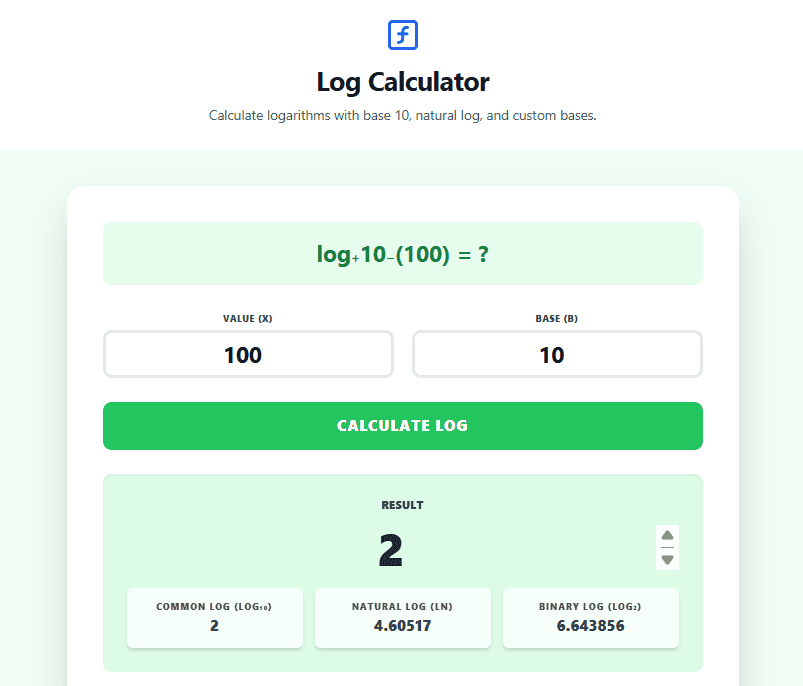
Want to skip straight to solving? Try our Log Calculator right now—just enter any value and base, and watch the magic happen.
So What IS a Logarithm, Really?
At its core, a logarithm answers one simple question: "What exponent do I need to raise this base to, to get this number?"
Let me say that again, because it's the key to everything: a logarithm is just asking for an exponent.
Take log₁₀(100) = 2.
This is asking: "What power do I raise 10 to, to get 100?" The answer is 2, because 10² = 100.
See? That's it. The log is the exponent.
The Anatomy of a Logarithm
When you see log_b(x) = y:
- b is the base (the number you're multiplying)
- x is the argument (the number you want to reach)
- y is the logarithm (the exponent you need)
It's all connected by: b^y = x
So log₃(9) = 2 means 3² = 9. log₂(8) = 3 means 2³ = 8.
Once this clicks, half the battle is won.
The Three Logs You'll See Everywhere
In real life, there are three specific logarithms that pop up all the time. Once you know these, you're equipped for 90% of what you'll encounter.
1. Common Logarithm (log₁₀)
This is just "log" with base 10. Scientists, engineers, and anyone working with big numbers use this constantly.
Examples:
- log(100) = 2 (because 10² = 100)
- log(1,000) = 3 (because 10³ = 1,000)
- log(1) = 0 (because 10⁰ = 1)
- log(0.1) = -1 (because 10⁻¹ = 0.1)
When you see "log" without a base written, it usually means log base 10.
2. Natural Logarithm (ln)
This uses base e, a special number about 2.71828. Natural logs show up everywhere in calculus, physics, and anything involving growth or decay.
Why e? It's nature's growth constant. Compound interest, population growth, radioactive decay—all of these use e.
Examples:
- ln(e) = 1 (because e¹ = e)
- ln(1) = 0 (because e⁰ = 1)
- ln(2) ≈ 0.693
3. Binary Logarithm (log₂)
Base 2 logs are huge in computer science. Everything in computing—bits, bytes, memory, algorithms—runs on powers of 2.
Examples:
- log₂(8) = 3 (because 2³ = 8)
- log₂(16) = 4 (because 2⁴ = 16)
- log₂(1,024) = 10 (because 2¹⁰ = 1,024)
Here's a fun fact: That's why 1 GB is actually 1,024 MB—because computers work in powers of 2.
The One Rule That Unlocks Everything
Here's the thing about logarithms: you can only directly calculate logs for certain bases. Most calculators only have log₁₀ and ln built in.
So what do you do when you need log₅(20)?
Change of base formula saves the day:
log_b(x) = log_c(x) / log_c(b)
Pick any c that works for you (usually 10 or e), and you're good.
Let me show you:
Find log₅(20):
Using natural logs:
log₅(20) = ln(20) / ln(5)
ln(20) ≈ 2.9957
ln(5) ≈ 1.6094
2.9957 / 1.6094 ≈ 1.861
So log₅(20) ≈ 1.861
Check: 5¹·⁸⁶¹ ≈ 20? Yep.
This formula is the workhorse behind every log calculator, including ours.
Other Log Rules Worth Knowing
Once you get comfortable with the basics, these rules make solving log problems much faster.
Product Rule
log_b(x × y) = log_b(x) + log_b(y)
Example: log₂(8 × 4) = log₂(32) = 5 Check: log₂(8) + log₂(4) = 3 + 2 = 5 ✓
Quotient Rule
log_b(x / y) = log_b(x) - log_b(y)
Example: log₃(27 / 3) = log₃(9) = 2 Check: log₃(27) - log₃(3) = 3 - 1 = 2 ✓
Power Rule
log_b(x^k) = k × log_b(x)
Example: log₂(8⁵) = 5 × log₂(8) = 5 × 3 = 15 Check: 8⁵ = 32,768, log₂(32,768) = 15 ✓
Special Values
- log_b(1) = 0 (any base to the 0 power = 1)
- log_b(b) = 1 (any base to the 1st power = itself)
- b^(log_b(x)) = x (they undo each other)
These might look abstract, but they become second nature with practice.
Where Logarithms Show Up in Real Life
I used to think logarithms were just abstract math problems. Then I started noticing them everywhere.
Earthquakes (Richter Scale)
A magnitude 6 earthquake isn't just a little stronger than a magnitude 5. It's 10 times stronger. Because the Richter scale is logarithmic with base 10.
A magnitude 7? 100 times stronger than magnitude 5.
Sound (Decibels)
A 10 dB increase means the sound is 10× more powerful. A 20 dB increase? 100×. That's why a jet engine (140 dB) isn't just "a bit louder" than a conversation (60 dB)—it's 100 million times more intense.
pH Scale (Chemistry)
pH = -log₁₀[H⁺]. Each unit change means 10× change in acidity. A pH of 4 is 10× more acidic than pH 5, and 100× more acidic than pH 6.
Compound Interest
Want to know how long it takes your money to double?
t = ln(2) / ln(1 + r)
At 5% interest: ln(2) / ln(1.05) ≈ 0.693 / 0.0488 ≈ 14.2 years.
Information Theory
The amount of information in bits is measured with log₂. If you have 8 possible outcomes, that's log₂(8) = 3 bits of information.
Music
The notes on a piano are logarithmically spaced. An octave up means doubling the frequency. That's why going up an octave feels the same regardless of where you start—logarithms in action.
Common Mistakes (I've Made Them All)
After years of helping people with logs, I've seen the same mistakes over and over. Here's what to watch for.
Mistake 1: Thinking log(x) means multiply
Wrong: log(10) = 10
Right: log(10) = 1
Log is asking for an exponent, not doing multiplication.
Mistake 2: Forgetting the base
log(100) = 2 only if base is 10. If someone writes log without a base, ask: "log base what?" In computer science, log often means base 2. In calculus, it often means ln. Context matters.
Mistake 3: Trying to take log of zero or negative numbers
log(0) is undefined. Try it—you'll get an error. log(-5) is also undefined for real numbers. You need positive arguments only.
Mistake 4: Forgetting the base can't be 1
log₁(5) makes no sense. 1 raised to any power is 1, so you can never get 5. Not allowed.
Mistake 5: Mixing up log rules
Wrong: log(x + y) = log(x) + log(y)
Right: log(x × y) = log(x) + log(y)
Logs distribute over multiplication, not addition. This is one of the most common traps.
Mistake 6: Confusing ln and log
In many fields, "log" means log₁₀. In others, "log" means ln. When in doubt, check the context or use the change of base formula.
How to Use Our Log Calculator
I designed this calculator to be straightforward—no confusing buttons, no hidden menus. Here's how it works.
Step 1: Enter Your Value (x)
This is the number you're taking the log of. It must be positive.
Examples: 100, 8, 2, 0.5
Step 2: Enter Your Base (b)
This is the base of your logarithm. Must be positive and not equal to 1.
Examples: 10, e (use 2.71828), 2, 5
Step 3: Click Calculate
That's it. You'll see:
- Your result—the logarithm value
- Common conversions—log₁₀, ln, and log₂ for your number
- Step-by-step explanation—showing exactly how we got there
What It Handles
| Input Type | Example | Works? |
|---|---|---|
| Value > 1 | log₁₀(100) | ✓ |
| Value = 1 | log₁₀(1) | ✓ (returns 0) |
| Value between 0 and 1 | log₂(0.5) | ✓ (returns -1) |
| Base 10 | log₁₀(x) | ✓ |
| Base e (natural) | ln(x) | ✓ |
| Base 2 | log₂(x) | ✓ |
| Any positive base | log₅(20) | ✓ (using change of base) |
What It Doesn't Handle
- Value ≤ 0 (log undefined for zero and negatives in real numbers)
- Base ≤ 0 (must be positive)
- Base = 1 (log base 1 is undefined)
Understanding the Step-by-Step Solutions
The calculator shows each step so you're not just getting an answer—you're learning how to solve it yourself.
Example 1: Simple Log (log₁₀(100))
Step 1: Write the expression log₁₀(100) = ?
Step 2: Identify values Value = 100, Base = 10
Step 3: Recognize it's a common log log₁₀(100) = 2
Step 4: Verification 10² = 100 ✓
Example 2: Natural Log (ln(20))
Step 1: Write the expression ln(20) = ?
Step 2: Identify values Value = 20, Base = e
Step 3: Calculate ln(20) ≈ 2.9957
Step 4: Verification e²·⁹⁹⁵⁷ ≈ 20 ✓
Example 3: Any Base (log₅(20))
Step 1: Write the expression log₅(20) = ?
Step 2: Apply change of base formula log₅(20) = ln(20) / ln(5)
Step 3: Calculate natural logs ln(20) ≈ 2.9957, ln(5) ≈ 1.6094
Step 4: Divide 2.9957 / 1.6094 ≈ 1.861
Step 5: Verification 5¹·⁸⁶¹ ≈ 20 ✓
Example 4: Fractional Value (log₂(0.5))
Step 1: Write the expression log₂(0.5) = ?
Step 2: Recognize 0.5 = 1/2 = 2⁻¹
Step 3: Apply log property log₂(2⁻¹) = -1 × log₂(2) = -1
Step 4: Result log₂(0.5) = -1
See? It walks you through the reasoning.
Teaching Logarithms (or Learning Them Yourself)
If you're trying to understand logs (or help someone else), here's what actually works.
Start with the Question
Don't start with definitions. Start with a question: "What exponent do I need?"
Ask:
- "What exponent on 10 gives 100?" → 2
- "What exponent on 2 gives 8?" → 3
- "What exponent on 5 gives 25?" → 2
Once that feels natural, you've got it.
Use the "Arrow Method"
I teach this to students who struggle:
log_b(x) = y → b^y = x
Draw an arrow from the base over the equals sign: "b to the y equals x."
It's simple, but it works.
Memorize These Key Pairs
- log₁₀(10) = 1
- log₁₀(100) = 2
- log₁₀(1,000) = 3
- ln(e) = 1
- ln(1) = 0
- log₂(8) = 3
- log₂(16) = 4
These become anchors you can build from.
Practice with the Calculator
Here's my recommended practice routine:
- Guess first. Before using the calculator, try to estimate the answer.
- Check with calculator. See how close you got.
- Read the steps. This is where the learning happens.
- Try variations. If you did log₁₀(100), try log₁₀(1,000), log₁₀(10), log₁₀(1).
- Mix it up. Try different bases, different values.
Frequently Asked Questions
What's the difference between log and ln?
log usually means base 10 (common log). ln means base e (natural log). Some fields use "log" for natural log, so context matters. Our calculator shows both so you don't have to guess.
Why can't I take the log of zero or negative numbers?
Think about what log means: "What exponent gives me this number?" For base 10, can any exponent give 0? No—10^x is always positive. Can it give a negative? Also no. So logs are only defined for positive arguments in real numbers.
What's the change of base formula?
log_b(x) = log_c(x) / log_c(b). It lets you calculate logs with any base using your calculator's built-in log₁₀ or ln buttons. Our calculator uses this automatically.
What's e?
e ≈ 2.71828 is a special number that shows up in growth and decay problems. It's like π but for exponential functions. Natural logs (ln) use base e.
When would I use log₂?
Any time you're working with computers, binary, or anything that doubles. Bits, bytes, algorithm efficiency, music intervals—log₂ is everywhere in computer science.
What's the answer to log(0)?
Undefined. Try it in our calculator—you'll get an error. In math terms, as x approaches 0 from the positive side, log(x) approaches -∞, but it never actually reaches 0.
How accurate is your calculator?
We use JavaScript's built-in Math.log() function, which is accurate to about 15 decimal places. Results are rounded for display, but the underlying calculation is precise.
Can I solve log equations with this?
This calculator solves individual logarithms. For equations like log(x) + log(x-3) = 1, you'd need an equation solver. But knowing how to evaluate individual logs is the first step.
Your Turn: Start Practicing
Logarithms feel weird at first—I get it. But once you understand they're just asking for an exponent, everything starts to click.
Here's what I'd suggest:
Open the calculator right now. Type in log₁₀(1,000). What do you get? (It's 3.)
Try ln(20). Now you know about 2.9957.
Try something weird like log₇(50). Our calculator will use change of base and show you the steps.
Check your intuition. If you thought log₅(125) = 3, you're right—because 5³ = 125. If you were wrong, read the steps and see where your thinking went off.
Use it for homework. But don't just copy answers—read the steps. That's where the learning happens.
Ready to start? Head over to our Log Calculator and try it out. Type in 100 with base 10. Then try 8 with base 2. Then try something random like 50 with base 7.
You'll get the hang of it faster than you think.
Have questions? Run into something that doesn't make sense? Drop a comment below or reach out. I'm happy to help.
— The Solvezi Team
Disclaimer: This calculator is for educational purposes. While we aim for accuracy, always double-check critical calculations independently. For advanced mathematics involving complex analysis or specialized functions, consult appropriate resources.