Exponent Calculator: Your Complete Guide to Understanding Powers
I still remember sitting in my 8th-grade algebra class when my teacher first introduced exponents. She wrote "2³" on the board and asked what it meant. Half the class thought it was 2 × 3 = 6. The other half just stared blankly. Sound familiar?
Whether you're a student tackling homework, a professional brushing up on math skills, or someone curious about how exponents work in real life, you've come to the right place. In this guide, I'll walk you through everything you need to know about exponents—and show you how our exponent calculator can save you time while helping you actually understand what's happening under the hood.
Ready to jump in? Try our Exponent Calculator and see instant results with step-by-step explanations.
What Exactly Is an Exponent?
Let's start with the basics. An exponent tells you how many times to multiply a number by itself. That's it. Nothing more complicated.
Take 2³. The little 3 up there? That's the exponent. It means: multiply 2 by itself 3 times.
2³ = 2 × 2 × 2 = 8
Here's another one: 5² (often called "5 squared").
5² = 5 × 5 = 25
See the pattern? The exponent (the small number) tells you how many times to write the base number in a multiplication chain.
The Language You'll Need to Know
- Base: The big number (the one being multiplied)
- Exponent: The small number (how many times to multiply)
- Power: The result (or sometimes used interchangeably with exponent)
In 3⁵ = 243:
- Base = 3
- Exponent = 5
- Power = 243
I've seen countless students mix up the base and exponent. Here's a quick test: What's 2⁵? If you said 32, you're right. If you said 25, you're confusing it with 5². Easy mistake—just remember the exponent tells you how many times to multiply the base.
The 5 Rules You'll Actually Use
After teaching math for years, I've realized that most people don't need every obscure exponent rule. They need the ones that come up again and again. Here are the five that matter.
Rule 1: Multiplying Powers with the Same Base
Add the exponents.
2³ × 2⁴ = 2³⁺⁴ = 2⁷ = 128
Check it yourself: 8 × 16 = 128. Works every time.
Rule 2: Dividing Powers with the Same Base
Subtract the exponents.
5⁶ ÷ 5² = 5⁶⁻² = 5⁴ = 625
Again, check: 15,625 ÷ 25 = 625.
Rule 3: Power of a Power
Multiply the exponents.
(3²)⁴ = 3²ˣ⁴ = 3⁸ = 6,561
Rule 4: Power of a Product
Apply the exponent to each factor.
(2 × 3)⁴ = 2⁴ × 3⁴ = 16 × 81 = 1,296
Which equals 6⁴ = 1,296. Same thing.
Rule 5: Power of a Quotient
Apply the exponent to numerator and denominator.
(4 ÷ 2)³ = 4³ ÷ 2³ = 64 ÷ 8 = 8
Or just do 2³ = 8.
I keep these five rules on a sticky note by my desk. They cover 90% of what you'll ever need.
What About Zero? (The Rule That Surprises Everyone)
Here's a question I get all the time: "What's 5 to the power of zero?"
The answer: 1.
Yes, any non-zero number raised to the power of zero equals 1.
5⁰ = 1
100⁰ = 1
(1,000,000)⁰ = 1
(-3)⁰ = 1
I know it feels weird. How can multiplying nothing give you 1?
Here's the logic that helped me: Look at the pattern.
2⁴ = 16
2³ = 8   (divide by 2)
2² = 4   (divide by 2)
2¹ = 2   (divide by 2)
2⁰ = 1   (divide by 2)
Makes sense now, right?
One exception: 0⁰ is undefined. Mathematicians can't agree on what to do with that one, so we leave it alone.
Negative Exponents: Not as Scary as They Sound
When I first saw 2⁻³, I thought it meant -8. Nope. Negative exponents mean something completely different.
Rule: A negative exponent means take the reciprocal (1 divided by the base raised to the positive exponent).
2⁻³ = 1/2³ = 1/8 = 0.125
Think of it this way: The negative sign flips the base to the bottom of a fraction.
More examples:
10⁻¹ = 1/10 = 0.1
10⁻² = 1/100 = 0.01
10⁻³ = 1/1,000 = 0.001
This is how we write tiny numbers like 0.000001 (which is 10⁻⁶).
What About Negative Bases?
This is where it gets interesting.
(-2)⁻² = 1/(-2)² = 1/4 = 0.25
(-2)⁻³ = 1/(-2)³ = 1/(-8) = -0.125
See what happened? When the exponent is odd, the result stays negative. Even exponent? Positive result. The pattern holds.
Fractional Exponents: Roots and Powers Combined
Fractional exponents used to confuse me until someone explained them simply: The bottom number (denominator) is the root, and the top number (numerator) is the power.
bᵐ⁄ⁿ = (ⁿ√b)ᵐ
Let me show you what I mean.
Square Roots (exponent = 1/2)
9¹⁄² = √9 = 3
16¹⁄² = √16 = 4
2¹⁄² = √2 ≈ 1.4142
Cube Roots (exponent = 1/3)
8¹⁄³ = ∛8 = 2
27¹⁄³ = ∛27 = 3
Mixed Examples
8²⁄³ — Here's how to think about it:
Option 1: Take cube root first, then square:
8¹⁄³ = 2, then 2² = 4
Option 2: Square first, then take cube root:
8² = 64, then ∛64 = 4
Either way, you get 4.
16³⁄⁴:
16¹⁄⁴ = 2, then 2³ = 8
Negative Fractional Exponents
Combine the rules:
4⁻¹⁄² = 1/4¹⁄² = 1/2 = 0.5
8⁻²⁄³ = 1/8²⁄³ = 1/4 = 0.25
Scientific Notation: When Numbers Get Big (or Tiny)
Ever wondered how scientists write numbers like 300,000,000? That's 3 × 10⁸. This is scientific notation.
The format: a × 10ⁿ where 1 ≤ a < 10
Large Numbers
- 1,000,000 = 1 × 10⁶
- 93,000,000 = 9.3 × 10⁷ (distance to the sun in miles)
- 300,000,000 = 3 × 10⁸ (speed of light in meters per second)
Tiny Numbers
- 0.001 = 1 × 10⁻³
- 0.000000001 = 1 × 10⁻⁹ (nanometer)
- 0.000000000001 = 1 × 10⁻¹² (picometer)
How to Convert
Large numbers: Move the decimal left until you have a number between 1 and 10. Count the moves—that's your positive exponent.
4,500,000 → move decimal 6 places left → 4.5 × 10⁶
Small numbers: Move the decimal right until you have a number between 1 and 10. Count the moves—that's your negative exponent.
0.00032 → move decimal 4 places right → 3.2 × 10⁻⁴
Where Exponents Show Up in Real Life
I used to think exponents were just homework problems. Then I started noticing them everywhere.
Compound Interest (Your Money Growing)
This is the formula banks use:
A = P(1 + r/n)ⁿᵗ
Say you invest $1,000 at 5% annual interest, compounded monthly for 10 years:
A = 1,000(1 + 0.05/12)¹²⁰ ≈ $1,647
That exponent of 120 is doing all the work.
Population Growth
Bacteria double every hour? That's 2ᵗ after t hours. Start with 100 bacteria, and after 10 hours:
100 × 2¹⁰ = 100 × 1,024 = 102,400 bacteria
Computer Storage
Ever noticed that 1 GB is actually 1,024 MB, not 1,000? That's because computers use powers of 2:
- 1 KB = 2¹⁰ bytes = 1,024 bytes
- 1 MB = 2²⁰ bytes = 1,048,576 bytes
- 1 GB = 2³⁰ bytes ≈ 1.07 billion bytes
Sound (Decibels)
Decibels use a logarithmic scale, which is the inverse of exponents. A 10 dB increase means 10× more powerful sound.
Earthquakes
The Richter scale is logarithmic too. A magnitude 6 earthquake is 10× stronger than a magnitude 5, and about 32× more energy released.
Common Mistakes (I've Made Every Single One)
Over the years, I've messed up exponents in every way possible. Here's what I've learned.
Mistake 1: Confusing 2⁵ with 5²
2⁵ = 32
5² = 25
They're not the same. The exponent tells you how many times to multiply the base, not the other way around.
Mistake 2: Multiplying Instead of Adding
Wrong: 2³ × 2⁴ = 2¹²
Right: 2³ × 2⁴ = 2⁷ = 128
Same base? Add the exponents.
Mistake 3: Thinking Negative Exponent = Negative Number
Wrong: 2⁻³ = -8
Right: 2⁻³ = 1/8 = 0.125
Negative exponent means reciprocal, not negative value.
Mistake 4: Forgetting Parentheses with Negative Bases
-2⁴ means -(2⁴) = -16
(-2)⁴ means (-2) × (-2) × (-2) × (-2) = 16
Those parentheses change everything.
Mistake 5: Distributing Over Addition
Wrong: (2 + 3)² = 2² + 3² = 4 + 9 = 13
Right: (2 + 3)² = 5² = 25
Exponents don't distribute over addition or subtraction. Never have, never will.
Mistake 6: Zero Exponent
Wrong: 5⁰ = 0
Right: 5⁰ = 1
This one trips up almost everyone at some point.
How to Use Our Exponent Calculator
I designed this calculator to be simple—no clutter, no confusing menus. Here's how it works.
Step 1: Enter Your Base
Type any number you want. Examples:
- Whole numbers: 2, 10, 25
- Decimals: 1.5, 0.5, 3.14
- Negative numbers: -2, -0.5
Step 2: Enter Your Exponent
Again, any number works:
- Positive: 2, 5, 10
- Negative: -1, -3, -5
- Fractions: 0.5 (for square root), 0.333 (for cube root)
Step 3: Hit Calculate
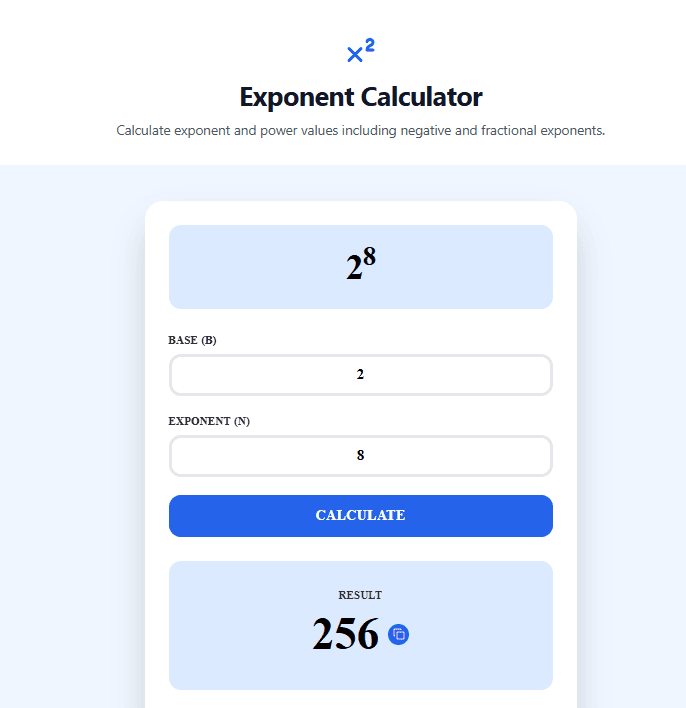
That's it. You'll see:
- The expression displayed clearly
- Your result (formatted nicely)
- Step-by-step breakdown of how we got there
Step 4: Copy Your Result
Click the copy button next to the result, and it's on your clipboard.
What It Handles
| Input Type | Example | Works? |
|---|---|---|
| Positive integers | 2⁸ | ✓ |
| Negative integers | 2⁻³ | ✓ |
| Square roots | 2^0.5 | ✓ |
| Cube roots | 27^(1/3) | ✓ |
| Zero exponent | 5⁰ | ✓ |
| Very large | 2¹⁰⁰ | ✓ (shows scientific) |
What It Doesn't Handle
- 0⁰ (mathematically undefined)
- Even roots of negative numbers (like √-4—that's imaginary numbers)
- Extremely huge exponents (might show overflow if too big)
Understanding the Step-by-Step Solutions
The calculator shows you each step so you're not just getting an answer—you're learning how to solve it yourself.
Example: 2⁸
Step 1: Identify values Base = 2, Exponent = 8
Step 2: Write the expression 2⁸
Step 3: Expand (for small positive integers) 2 × 2 × 2 × 2 × 2 × 2 × 2 × 2
Step 4: Calculate 256
Example: 2⁻³
Step 1: Identify values
Base = 2, Exponent = -3
Step 2: Apply negative exponent rule 2⁻³ = 1 / 2³
Step 3: Calculate positive exponent 2³ = 8
Step 4: Reciprocal 1/8 = 0.125
Example: 8²⁄³
Step 1: Identify values Base = 8, Exponent = 2/3
Step 2: Apply fractional exponent rule 8²⁄³ = (8¹⁄³)²
Step 3: Calculate cube root 8¹⁄³ = 2
Step 4: Square 2² = 4
This step-by-step approach helped me finally understand exponents, and I hope it does the same for you.
Teaching Exponents to Kids (or Yourself)
If you're learning exponents for the first time (or teaching someone who is), here's what works.
Start with Patterns
Have them fill out this table:
2⁴ = 16
2³ = 8
2² = 4
2¹ = 2
2⁰ = ?
2⁻¹ = ?
2⁻² = ?
Once they see the pattern (divide by 2 each time), the rules click.
Use Visuals
- Squares: Draw a 3×3 grid. That's 3² = 9 squares.
- Cubes: Stack blocks to show 2³ = 8 small cubes.
Connect to Real Life
- "If you fold this paper in half 5 times, how many layers?" (2⁵ = 32)
- "If a video goes viral and doubles every day, after 10 days..."
Common Hurdles
When someone gets stuck, it's usually on one of these:
- 2³ vs 3²
- 5⁰ = 1
- Negative exponents
- Fractional exponents
Address these one at a time with lots of examples.
Frequently Asked Questions
What's 2 to the power of 0? It's 1. Any non-zero number to the power of zero equals 1. I know it's weird—but check the pattern: 2³=8, 2²=4, 2¹=2, 2⁰=1. Makes sense now, right?
What does a negative exponent mean? It means take the reciprocal. 2⁻³ = 1/2³ = 1/8. It doesn't make the number negative—it flips it to the bottom of a fraction.
How do fractional exponents work? The bottom number (denominator) is the root. The top number (numerator) is the power. So 8²⁄³ means cube root of 8 (which is 2), then square it (4). Or square first, then cube root. Same result.
What's 0⁰? Mathematically, it's undefined. Different contexts define it differently, but in standard math, we leave it alone.
Can I take the square root of a negative number? In regular math (real numbers), no. That's imaginary numbers territory. √-4 = 2i (where i² = -1). Our calculator sticks to real numbers, so it'll show an error.
Why do exponents grow so fast? Because each time you increase the exponent by 1, you multiply by the base again. For numbers >1, this adds up fast. That's why compound interest works so well.
How often should I use a calculator? I'd say: try it manually first, then use the calculator to check your work. The calculator's step-by-step feature is great for seeing where you went wrong.
Your Turn: Start Practicing
Exponents are one of those math topics that feel confusing at first, but once you get them, they click. And they're everywhere—money, science, computers, even folding paper.
Here's what I'd suggest:
Play with the calculator. Try different combinations. See what happens with big exponents, small exponents, negative ones, fractions.
Check the steps. Don't just look at the answer. Read through the step-by-step breakdown. That's where the learning happens.
Try it yourself first. Before using the calculator, guess the answer. Then check. This builds intuition.
Revisit the rules. The five rules at the start of this guide? They're worth memorizing. They'll save you time forever.
Ready to start? Open up our Exponent Calculator and give it a try. Type in 2¹⁰ and see what happens. Then try 10⁻³. Then try 27^(1/3).
You'll get the hang of it faster than you think.
Need help? Have a question about a specific problem? Drop a comment below or reach out. I'm happy to help.
— The Solvezi Team
Disclaimer: This calculator is for educational purposes. While we aim for accuracy, always double-check important calculations independently. For advanced math involving complex numbers or specialized functions, consult appropriate resources.