Factor Calculator: Finally Understand Factors, Prime Factorization, and Number Properties
Let me tell you about the first time I needed to find all factors of a number. I was in 6th grade, and my teacher asked, "What are all the factors of 36?" I started listing: 1, 36, 2, 18... but I kept missing some. I got 1, 2, 3, 4, 6, 9, 12, 18, 36—wait, did I get them all?
Then I learned the trick: factors come in pairs, and you only need to check up to the square root. Once I understood that, finding factors became easy.
In this guide, I'll walk you through everything you need to know about factors—from basic factor pairs to prime factorization, factor count formulas, and special number classifications like perfect, abundant, and deficient numbers.
Ready to master factors? Try our Factor Calculator and watch each calculation unfold step by step.
What Are Factors, Really?
A factor asks one simple question: "What numbers multiply together to give me this number?"
Simple Example
Factors of 12: All numbers that divide 12 evenly.
- 1 × 12 = 12
- 2 × 6 = 12
- 3 × 4 = 12
So factors of 12 are: 1, 2, 3, 4, 6, 12
Another Example
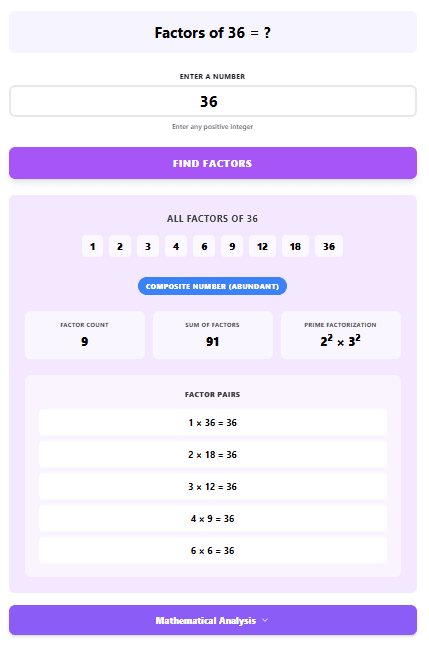
Factors of 36:
- 1 × 36 = 36
- 2 × 18 = 36
- 3 × 12 = 36
- 4 × 9 = 36
- 6 × 6 = 36
So factors: 1, 2, 3, 4, 6, 9, 12, 18, 36
Why Factors Matter
Real-World Applications
| Scenario | How Factors Help |
|---|---|
| Arranging objects | 36 items can be arranged in 9 different rectangular arrays (1×36, 2×18, 3×12, 4×9, 6×6) |
| Dividing groups | 24 students can be divided into equal groups of 1, 2, 3, 4, 6, 8, 12, or 24 |
| Tiling floors | A 12×18 floor can be tiled with squares of size = common factor |
| Cryptography | Prime factorization is the basis of RSA encryption |
| Number theory | Understanding number properties and relationships |
How to Find All Factors: The Square Root Method
Here's the trick I wish someone had taught me earlier: Factors come in pairs, and you only need to check up to the square root.
Step-by-Step: Find Factors of 36
| Step | Calculation |
|---|---|
| 1 | √36 = 6 (check numbers 1 through 6) |
| 2 | 36 ÷ 1 = 36 → factors: 1, 36 |
| 3 | 36 ÷ 2 = 18 → factors: 2, 18 |
| 4 | 36 ÷ 3 = 12 → factors: 3, 12 |
| 5 | 36 ÷ 4 = 9 → factors: 4, 9 |
| 6 | 36 ÷ 5 = not integer → skip |
| 7 | 36 ÷ 6 = 6 → factor: 6 (only once) |
Result: 1, 2, 3, 4, 6, 9, 12, 18, 36
Why This Works
For every factor a less than √n, there's a matching factor b = n/a greater than √n. This means:
- You only need to check up to √n
- Each factor you find gives you another factor for free
- Perfect squares have a "middle" factor where a = b = √n
Factor Pairs
Factor pairs are the two numbers that multiply to give your original number.
Factor Pairs of 36
| Pair | Multiplication |
|---|---|
| 1 × 36 | = 36 |
| 2 × 18 | = 36 |
| 3 × 12 | = 36 |
| 4 × 9 | = 36 |
| 6 × 6 | = 36 |
Factor Pairs of 48
| Pair | Multiplication |
|---|---|
| 1 × 48 | = 48 |
| 2 × 24 | = 48 |
| 3 × 16 | = 48 |
| 4 × 12 | = 48 |
| 6 × 8 | = 48 |
Prime Factorization
Prime factorization breaks a number down into its prime building blocks.
How to Do Prime Factorization (Factor Tree Method)
Example: 36
      36
     /  \
    4    9
   / \  / \
  2  2 3  3
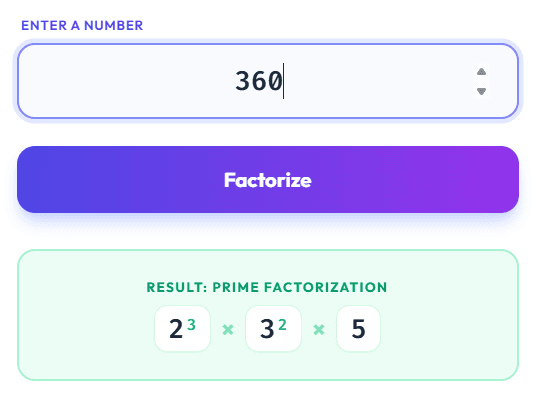
36 = 2 × 2 × 3 × 3 = 2² × 3²
Example: 48
      48
     /  \
    6    8
   / \  / \
  2  3 2  4
        / \
       2  2
48 = 2 × 2 × 2 × 2 × 3 = 2⁴ × 3
Example: 100
     100
    /   \
   10    10
  /  \  /  \
 2   5 2   5
100 = 2 × 2 × 5 × 5 = 2² × 5²
Number Classifications
Prime Numbers
A prime number has exactly two factors: 1 and itself.
| Number | Factors | Prime? |
|---|---|---|
| 2 | 1, 2 | ✓ |
| 3 | 1, 3 | ✓ |
| 5 | 1, 5 | ✓ |
| 7 | 1, 7 | ✓ |
| 11 | 1, 11 | ✓ |
| 4 | 1, 2, 4 | ✗ (composite) |
| 6 | 1, 2, 3, 6 | ✗ (composite) |
First 10 primes: 2, 3, 5, 7, 11, 13, 17, 19, 23, 29
Composite Numbers
A composite number has more than two factors.
| Number | Factor Count |
|---|---|
| 4 | 3 factors (1, 2, 4) |
| 6 | 4 factors (1, 2, 3, 6) |
| 8 | 4 factors (1, 2, 4, 8) |
| 9 | 3 factors (1, 3, 9) |
| 12 | 6 factors |
| 36 | 9 factors |
Perfect Numbers
A perfect number equals the sum of its proper divisors (all divisors except itself).
Example: 6
- Proper divisors: 1, 2, 3
- Sum: 1 + 2 + 3 = 6 ✓
Example: 28
- Proper divisors: 1, 2, 4, 7, 14
- Sum: 1 + 2 + 4 + 7 + 14 = 28 ✓
First 4 perfect numbers: 6, 28, 496, 8128
Abundant Numbers
An abundant number has proper divisor sum greater than the number.
Example: 12
- Proper divisors: 1, 2, 3, 4, 6
- Sum: 1 + 2 + 3 + 4 + 6 = 16
- 16 > 12 → abundant (abundance = 4)
Example: 18
- Proper divisors: 1, 2, 3, 6, 9
- Sum: 21 > 18 → abundant (abundance = 3)
Deficient Numbers
A deficient number has proper divisor sum less than the number.
Example: 8
- Proper divisors: 1, 2, 4
- Sum: 7 < 8 → deficient (deficiency = 1)
Example: 10
- Proper divisors: 1, 2, 5
- Sum: 8 < 10 → deficient (deficiency = 2)
Summary Table
| Classification | Condition | Example |
|---|---|---|
| Prime | Exactly 2 factors | 7 |
| Composite | More than 2 factors | 12 |
| Perfect | Sum of proper divisors = number | 6, 28 |
| Abundant | Sum of proper divisors > number | 12, 18 |
| Deficient | Sum of proper divisors < number | 8, 10 |
Factor Count Formula (Tau Function)
The tau function τ(n) gives the number of positive divisors of n.
Formula
If n = p₁ᵉ¹ × p₂ᵉ² × ... × pₖᵉᵏ
Then τ(n) = (e₁ + 1)(e₂ + 1)...(eₖ + 1)
Examples
n = 36 = 2² × 3²
- τ(36) = (2 + 1)(2 + 1) = 3 × 3 = 9 factors ✓
n = 48 = 2⁴ × 3¹
- τ(48) = (4 + 1)(1 + 1) = 5 × 2 = 10 factors ✓
n = 60 = 2² × 3¹ × 5¹
- τ(60) = (2 + 1)(1 + 1)(1 + 1) = 3 × 2 × 2 = 12 factors
n = 100 = 2² × 5²
- τ(100) = (2 + 1)(2 + 1) = 3 × 3 = 9 factors
How to Use Our Factor Calculator
Our calculator is designed to be simple and educational.
Step 1: Enter Your Number
Type any positive integer. Example: 36
Step 2: Click Calculate
Or just press Enter—the calculator updates automatically.
Step 3: Read Your Results
You'll see:
- All factors: Complete list in ascending order
- Factor pairs: All pairs that multiply to your number
- Prime factorization: Your number broken into primes
- Classification: Prime, composite, perfect, abundant, or deficient
- Statistics: Factor count, sum of factors
- Step-by-step: Detailed mathematical analysis
What It Handles
| Input | Example | Works? |
|---|---|---|
| Small numbers | 12 | ✓ |
| Perfect squares | 36, 100, 144 | ✓ |
| Prime numbers | 17, 23, 31 | ✓ |
| Large numbers | 10,000 | ✓ |
| Very large | 1,000,000 | ✓ (up to 1 billion) |
| 1 | 1 | ✓ (factors: 1) |
| Negative numbers | -12 | ⚠️ Use positive only |
| Decimals | 12.5 | ⚠️ Integers only |
Step-by-Step Examples
Example 1: Factors of 36 (Perfect Square)
Step 1: Input number Number: 36
Step 2: Factor identification method Test divisibility from 1 to √36 = 6
Step 3: Factor pairs 1 × 36 = 36 2 × 18 = 36 3 × 12 = 36 4 × 9 = 36 6 × 6 = 36
Step 4: Prime factorization 36 = 2² × 3²
Step 5: Classification 36 is COMPOSITE (more than 2 factors)
Step 6: Number property Proper divisors sum: 1+2+3+4+6+9+12+18 = 55 55 > 36 → ABUNDANT number Abundance: 19
Step 7: Factor count formula τ(36) = (2+1)(2+1) = 9 factors ✓
Example 2: Factors of 28 (Perfect Number)
Step 1: Input number Number: 28
Step 2: Factor pairs 1 × 28 = 28 2 × 14 = 28 4 × 7 = 28
Step 3: Prime factorization 28 = 2² × 7
Step 4: Classification 28 is COMPOSITE
Step 5: Number property Proper divisors: 1, 2, 4, 7, 14 Sum: 1+2+4+7+14 = 28 28 = 28 → PERFECT number! ✨
Example 3: Factors of 17 (Prime Number)
Step 1: Input number Number: 17
Step 2: Factor pairs 1 × 17 = 17
Step 3: Prime factorization 17 is prime
Step 4: Classification 17 is PRIME (exactly 2 factors: 1 and 17)
Step 5: Number property Proper divisors sum: 1 < 17 → DEFICIENT number Deficiency: 16
Common Mistakes (I've Made Every Single One)
Mistake 1: Missing Factor Pairs
Wrong: Factors of 36: 1, 2, 3, 4, 6, 9, 12, 36 (missing 18) Right: 1, 2, 3, 4, 6, 9, 12, 18, 36
Mistake 2: Forgetting 1 and the Number Itself
Every number has at least two factors: 1 and itself.
Mistake 3: Including the Number in Proper Divisors
Wrong: Sum of proper divisors of 6 = 1+2+3+6 = 12 Right: 1+2+3 = 6 (exclude the number itself)
Mistake 4: Thinking All Odd Numbers Are Prime
Wrong: 9 is prime Right: 9 = 3 × 3, so it's composite
Mistake 5: Confusing Factors with Multiples
Wrong: Factors of 12 are 12, 24, 36... (those are multiples!) Right: Factors divide into 12: 1, 2, 3, 4, 6, 12
Mistake 6: Stopping Too Early
When using the square root method, don't forget to include the matching larger factor for each small factor you find.
Quick Reference: Factor Formulas
Definitions
| Term | Definition |
|---|---|
| Factor | A number that divides another number evenly |
| Proper divisor | All factors except the number itself |
| Prime factor | A factor that is also a prime number |
| Factor pair | Two numbers that multiply to give the original |
Formulas
| Formula | Purpose |
|---|---|
| If a × b = n | a and b are factor pairs |
| τ(n) = ∏(eᵢ + 1) | Factor count (Tau function) |
| σ(n) = ∏(pᵢ^(eᵢ+1) - 1)/(pᵢ - 1) | Sum of all factors |
| s(n) = σ(n) - n | Sum of proper divisors |
Special Number Conditions
| Type | Condition |
|---|---|
| Prime | τ(n) = 2 |
| Perfect | s(n) = n |
| Abundant | s(n) > n |
| Deficient | s(n) < n |
Common Factor Lists (Memorize These)
| Number | Factors | Count |
|---|---|---|
| 1 | 1 | 1 |
| 2 | 1, 2 | 2 (prime) |
| 3 | 1, 3 | 2 (prime) |
| 4 | 1, 2, 4 | 3 |
| 5 | 1, 5 | 2 (prime) |
| 6 | 1, 2, 3, 6 | 4 (perfect) |
| 7 | 1, 7 | 2 (prime) |
| 8 | 1, 2, 4, 8 | 4 |
| 9 | 1, 3, 9 | 3 |
| 10 | 1, 2, 5, 10 | 4 |
| 11 | 1, 11 | 2 (prime) |
| 12 | 1, 2, 3, 4, 6, 12 | 6 (abundant) |
| 16 | 1, 2, 4, 8, 16 | 5 |
| 18 | 1, 2, 3, 6, 9, 18 | 6 (abundant) |
| 20 | 1, 2, 4, 5, 10, 20 | 6 |
| 24 | 1, 2, 3, 4, 6, 8, 12, 24 | 8 (abundant) |
| 28 | 1, 2, 4, 7, 14, 28 | 6 (perfect) |
| 30 | 1, 2, 3, 5, 6, 10, 15, 30 | 8 (abundant) |
| 36 | 1, 2, 3, 4, 6, 9, 12, 18, 36 | 9 (abundant) |
Teaching Factors (or Learning Yourself)
Start with Small Numbers
Practice with numbers under 50 first:
- 12 (6 factors)
- 16 (5 factors)
- 24 (8 factors)
Use Arrays
Draw rectangles to visualize factor pairs:
- 12 items can be arranged as 1×12, 2×6, 3×4
Practice Prime Factorization
Start with numbers that are products of small primes:
- 12 = 2² × 3
- 18 = 2 × 3²
- 20 = 2² × 5
Identify Special Numbers
Learn to recognize:
- Primes: 2, 3, 5, 7, 11, 13, 17, 19, 23, 29
- Perfect numbers: 6, 28, 496, 8128
- Squares: 4, 9, 16, 25, 36, 49, 64, 81, 100
Use the Square Root Trick
Remember: only check up to √n. Each factor you find gives you its partner.
Frequently Asked Questions
What's the difference between factors and multiples?
Factors divide INTO a number. Multiples are numbers you GET BY multiplying. Example for 6:
- Factors: 1, 2, 3, 6
- Multiples: 6, 12, 18, 24, 30...
What are proper divisors?
All factors except the number itself. Used to determine if a number is perfect, abundant, or deficient.
Is 1 a prime number?
No. 1 has only one factor (itself), not two. Primes must have exactly two factors.
What's the only even prime number?
- All other even numbers are divisible by 2, so they're composite.
How many factors does a prime number have?
Exactly 2: 1 and itself.
How do I find factors of a large number?
Use the square root method. Check divisibility from 1 up to √n. For each divisor you find, you automatically get its pair.
What's the factor count formula?
τ(n) = (e₁ + 1)(e₂ + 1)...(eₖ + 1) where eᵢ are exponents in prime factorization.
Why can't 0 be factored?
Every number divides 0, so 0 has infinitely many "factors." Factor calculators typically work with positive integers only.
How does your calculator handle large numbers?
It works up to 1 billion (1,000,000,000). For very large results, it uses scientific notation.
What's a deficient number?
A number where the sum of proper divisors is less than the number itself. Most numbers are deficient.
Your Turn: Start Calculating
Factors used to confuse me. Now they're a fundamental tool I use in number theory, algebra, and everyday problem-solving. The key is understanding the square root method and factor pairs.
Here's your practice plan:
- Start with small numbers: 12, 16, 18, 20, 24
- Find factor pairs: List all pairs that multiply to the number
- Practice prime factorization: Break down 36, 48, 60, 72, 100
- Classify numbers: Prime, composite, perfect, abundant, deficient
- Use the factor count formula: Verify τ(n) matches your factor list
- Try perfect numbers: 6, 28, 496
- Experiment with our calculator: Try different numbers
- Read the steps: Understand each calculation
Ready to start? Open up our Factor Calculator and try it yourself. Type in 36 and see all factors. Then try 28 to see a perfect number. Then try 12 to see an abundant number.
You'll get the hang of it faster than you think.
Have questions? Stuck on a particular factorization? Drop a comment below or reach out. I've been where you are, and I'm happy to help.
— The Solvezi Team
Disclaimer: This calculator is for educational purposes. While we aim for accuracy, always double-check critical calculations independently.