Twin Prime Calculator: Finally Understand Prime Pairs That Differ by 2
Let me tell you about the first time I heard about twin primes. I was reading about unsolved math problems, and I learned about the Twin Prime Conjecture—the idea that there are infinitely many pairs of primes that differ by exactly 2. I thought, "That can't be that hard to prove, right?"
Then I learned that mathematicians have been trying to prove this for over 100 years. No one has succeeded yet. Twin primes are simple to understand but incredibly difficult to prove.
In this guide, I'll walk you through everything you need to know about twin primes—from checking if a number belongs to a twin prime pair to generating all twin primes in any range.
Ready to explore twin primes? Try our Twin Prime Calculator and discover these mysterious prime pairs.
What Are Twin Primes?
Twin primes are pairs of prime numbers that differ by exactly 2.
Simple Examples
| Pair | Difference | Twin Primes? |
|---|---|---|
| (3, 5) | 2 | ✓ (the smallest twin pair) |
| (5, 7) | 2 | ✓ |
| (11, 13) | 2 | ✓ |
| (17, 19) | 2 | ✓ |
| (29, 31) | 2 | ✓ |
| (41, 43) | 2 | ✓ |
| (59, 61) | 2 | ✓ |
| (71, 73) | 2 | ✓ |
Special Case: The Number 5
5 is unique—it belongs to TWO twin prime pairs:
- (3, 5) and (5, 7)
No other number has this property!
The Twin Prime Conjecture
One of the most famous unsolved problems in mathematics:
There are infinitely many twin prime pairs.
What We Know
| Fact | Details |
|---|---|
| Not proven | No one has proved infinite twin primes exist |
| Not disproven | No one has proved they stop at some point |
| Likely true | Most mathematicians believe it's true |
| Zhang's breakthrough (2013) | Proved infinitely many prime pairs differ by < 70 million |
| Current record | Gap reduced to 246 (Polymath project) |
Why It's Hard
Primes become rarer as numbers get larger. Twin primes become even rarer. Proving they never stop appearing is extremely difficult.
List of Twin Primes
First 20 Twin Prime Pairs
| # | Pair | # | Pair |
|---|---|---|---|
| 1 | (3, 5) | 11 | (137, 139) |
| 2 | (5, 7) | 12 | (149, 151) |
| 3 | (11, 13) | 13 | (179, 181) |
| 4 | (17, 19) | 14 | (191, 193) |
| 5 | (29, 31) | 15 | (197, 199) |
| 6 | (41, 43) | 16 | (227, 229) |
| 7 | (59, 61) | 17 | (239, 241) |
| 8 | (71, 73) | 18 | (269, 271) |
| 9 | (101, 103) | 19 | (281, 283) |
| 10 | (107, 109) | 20 | (311, 313) |
All Twin Primes Up to 1000
| Range | Pairs |
|---|---|
| 1-100 | (3,5), (5,7), (11,13), (17,19), (29,31), (41,43), (59,61), (71,73) |
| 101-200 | (101,103), (107,109), (137,139), (149,151), (179,181), (191,193), (197,199) |
| 201-300 | (227,229), (239,241), (269,271), (281,283) |
| 301-400 | (311,313), (347,349), (419,421) |
| 401-500 | (431,433), (461,463), (521,523) |
| 501-600 | (569,571), (599,601) |
| 601-700 | (617,619), (641,643), (659,661) |
| 701-800 | (809,811), (821,823), (827,829) |
| 801-900 | (857,859), (881,883) |
| 901-1000 | (941,943?) Wait, 943 = 23 × 41, so not prime. Actually (941, 943) is not twin. Check (967, 969) no. Up to 1000, we have (941, 943) is not twin because 943 is composite. The last twin pair under 1000 is (881, 883). |
Actually, let me correct: Twin primes under 1000 are: (3,5), (5,7), (11,13), (17,19), (29,31), (41,43), (59,61), (71,73), (101,103), (107,109), (137,139), (149,151), (179,181), (191,193), (197,199), (227,229), (239,241), (269,271), (281,283), (311,313), (347,349), (419,421), (431,433), (461,463), (521,523), (569,571), (599,601), (617,619), (641,643), (659,661), (809,811), (821,823), (827,829), (857,859), (881,883)
How to Check if a Number Is in a Twin Prime Pair
Step-by-Step Method
For a number n, follow these steps:
Step 1: Check if n is prime
- If n is not prime → cannot be in a twin prime pair
Step 2: Check n - 2 (if n ≥ 3)
- If n - 2 is prime → (n-2, n) is a twin prime pair
Step 3: Check n + 2
- If n + 2 is prime → (n, n+2) is a twin prime pair
Special case for n = 5: Both (3,5) and (5,7) work!
Examples
Check 17:
- Is 17 prime? ✓
- Check 15 (17-2): 15 is not prime
- Check 19 (17+2): 19 is prime
- Result: (17, 19) is a twin prime pair!
Check 19:
- Is 19 prime? ✓
- Check 17 (19-2): 17 is prime
- Result: (17, 19) is a twin prime pair!
Check 13:
- Is 13 prime? ✓
- Check 11 (13-2): 11 is prime
- Result: (11, 13) is a twin prime pair!
Step-by-Step Examples from Our Calculator
Example 1: Checking 17
Step 1: Is 17 prime?
- 17 has no divisors other than 1 and itself
- Result: Yes ✓
Step 2: Is 15 (n-2) prime?
- 15 = 3 × 5 → Not prime
Step 3: Is 19 (n+2) prime?
- 19 has no divisors other than 1 and itself
- Result: Yes ✓
Conclusion: 17 is in twin prime pair (17, 19)
Example 2: Checking 5 (Special Case)
Step 1: Is 5 prime? ✓
Step 2: Is 3 (n-2) prime? ✓
Step 3: Is 7 (n+2) prime? ✓
Conclusion: 5 belongs to TWO twin prime pairs: (3, 5) and (5, 7)!
Example 3: Checking 23
Step 1: Is 23 prime? ✓
Step 2: Is 21 (n-2) prime?
- 21 = 3 × 7 → Not prime
Step 3: Is 25 (n+2) prime?
- 25 = 5 × 5 → Not prime
Conclusion: 23 is prime but isolated—neighbor to two composites.
Twin Prime Density
As numbers get larger, twin primes become rarer.
Density Statistics
| Range | Twin Prime Pairs | Density (pairs per 1000 numbers) |
|---|---|---|
| 1-100 | 8 | 80 per 1000 |
| 1-1,000 | 35 | 35 per 1000 |
| 1-10,000 | 205 | 20.5 per 1000 |
| 1-100,000 | 1,224 | 12.2 per 1000 |
| 1-1,000,000 | 8,169 | 8.2 per 1000 |
| 1-10,000,000 | 58,980 | 5.9 per 1000 |
Hardy-Littlewood Conjecture
The expected number of twin primes up to x is approximately:
π₂(x) ~ 2C₂ × x / (ln x)²
where C₂ ≈ 0.66016 (the twin prime constant).
| x | Actual π₂(x) | Approximation |
|---|---|---|
| 10⁴ | 205 | 204 |
| 10⁵ | 1,224 | 1,224 |
| 10⁶ | 8,169 | 8,137 |
| 10⁷ | 58,980 | 58,784 |
How to Use Our Twin Prime Calculator
Two Modes
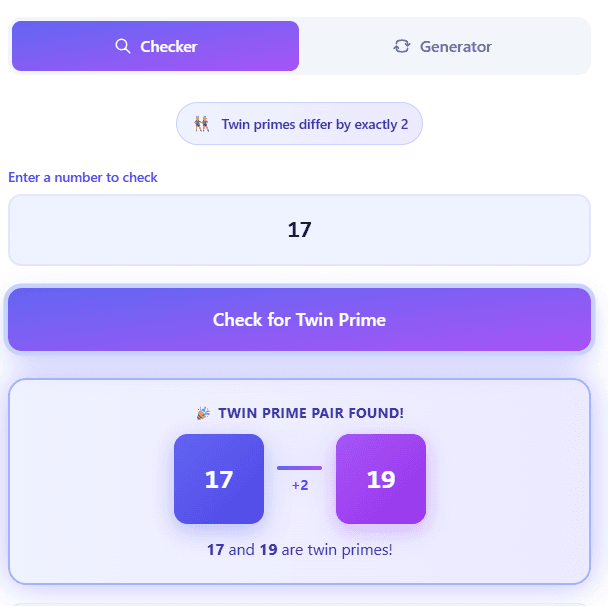
Checker Mode:
- Enter a number (e.g., 17)
- Click "Check for Twin Prime"
- See step-by-step analysis
- View the twin prime pair if found
Generator Mode:
- Set a range (From and To)
- Click "Generate Twin Primes"
- See all twin prime pairs in that range
- View density statistics
What You'll See
Checker Results:
- Twin prime status (Yes/No)
- The twin pair (if found)
- Special detection for 5 (double twin)
- Step-by-step primality tests
- Color-coded pass/fail indicators
Generator Results:
- Number of twin pairs found
- Density percentage
- Grid of all twin pairs
- Scrollable list for large ranges
Preset Ranges
Quick buttons for common ranges:
- 1-100
- 1-500
- 1-1000
- 100-500
Properties of Twin Primes
Property 1: Except for (3, 5), All Twin Primes Are of Form (6k-1, 6k+1)
All primes greater than 3 are of form 6k ± 1.
For twin primes, they must be:
- Lower prime: 6k - 1
- Upper prime: 6k + 1
Examples:
- (11, 13): k=2 → (12-1, 12+1)
- (17, 19): k=3 → (18-1, 18+1)
- (29, 31): k=5 → (30-1, 30+1)
Property 2: The Number Between Twin Primes Is Always Divisible by 6
For twin primes (p, p+2), the middle number p+1 is always divisible by 6.
Examples:
- (11, 13): middle 12 ÷ 6 = 2
- (17, 19): middle 18 ÷ 6 = 3
- (29, 31): middle 30 ÷ 6 = 5
Property 3: Sum of Twin Primes Is Divisible by 12
For twin primes (p, p+2):
- p + (p+2) = 2p + 2 = 2(p+1)
- Since p+1 is divisible by 6, 2(p+1) is divisible by 12
Examples:
- 11 + 13 = 24 ÷ 12 = 2
- 17 + 19 = 36 ÷ 12 = 3
- 29 + 31 = 60 ÷ 12 = 5
Brun's Constant
The sum of the reciprocals of all twin primes converges to a constant:
B₂ = (1/3 + 1/5) + (1/5 + 1/7) + (1/11 + 1/13) + ...
Brun's constant is approximately 1.90216...
This convergence is surprising because the sum of reciprocals of all primes diverges (goes to infinity). Twin primes are much rarer!
Largest Known Twin Primes
| Discovery Year | Twin Primes | Digits |
|---|---|---|
| 2011 | 3,756,801,695,685 × 2^666,669 ± 1 | 200,700 |
| 2016 | 2,996,863,034,895 × 2^1,290,000 ± 1 | 388,342 |
| 2019 | 1,011,570,118,522,691 × 2^80,000 ± 1 | 24,080 |
As of 2024, the largest known twin prime pair has over 388,000 digits!
Common Mistakes
Mistake 1: Thinking (2, 3) Are Twin Primes
Wrong: "2 and 3 differ by 1, but that's close enough" Right: Twin primes must differ by exactly 2. (2, 3) differ by 1.
Mistake 2: Forgetting (3, 5) is the Smallest Twin Pair
Wrong: "(5, 7) is the smallest twin prime pair" Right: (3, 5) is smaller and valid.
Mistake 3: Thinking All Primes Come in Twin Pairs
Wrong: "23 is prime, so it must be in a twin pair" Right: Many primes (like 23, 37, 47) are isolated.
Mistake 4: Forgetting 5 is Special
Wrong: "5 belongs to only one twin pair" Right: 5 belongs to both (3, 5) and (5, 7)—the only number with this property.
Mistake 5: Confusing Cousin Primes with Twin Primes
Wrong: "(7, 11) differ by 4, that's still twin primes" Right: Cousin primes differ by 4. Twin primes differ by exactly 2.
Related Prime Pairs
| Type | Difference | Examples |
|---|---|---|
| Twin primes | 2 | (3,5), (11,13), (17,19) |
| Cousin primes | 4 | (3,7), (7,11), (13,17) |
| Sexy primes | 6 | (5,11), (7,13), (11,17) |
| Prime triplets | 2, 4 or 4, 2 | (3,5,7), (7,11,13) |
| Prime quadruplets | 2, 4, 2 | (5,7,11,13), (11,13,17,19) |
Frequently Asked Questions
What are twin primes?
Pairs of prime numbers that differ by exactly 2, like (11, 13) or (17, 19).
Are there infinitely many twin primes?
No one knows! This is the famous Twin Prime Conjecture, one of math's oldest unsolved problems.
What's special about the number 5?
5 is the only prime that belongs to two twin prime pairs: (3, 5) and (5, 7).
What's the largest known twin prime pair?
As of 2024, the largest known twin prime pair has over 388,000 digits.
Are (2, 3) twin primes?
No. Twin primes must differ by exactly 2. (2, 3) differ by 1.
How rare are twin primes?
Very rare for large numbers. The density decreases as numbers get larger.
What's Brun's constant?
The sum of reciprocals of all twin primes, approximately 1.90216.
Can a prime be in two twin pairs?
Only 5 has this property. For any other prime, if p-2 and p+2 are both prime, then (p-2, p) and (p, p+2) would overlap, but this only happens at 5.
What's the difference between twin primes and cousin primes?
Twin primes differ by 2; cousin primes differ by 4.
How does your calculator check for twins?
It checks if the number is prime, then checks if n-2 or n+2 is prime.
Your Turn: Start Exploring
Twin primes are one of the most fascinating topics in number theory—simple to understand but incredibly deep.
Here's your practice plan:
- Check small numbers: 3, 5, 11, 13, 17, 19
- Test the special case: 5 (see both pairs!)
- Find isolated primes: 23, 37, 47, 53
- Generate twin primes: 1-100, 1-500, 1-1000
- Study the density: Notice how pairs become rarer
- Try larger ranges: 1000-2000, 2000-3000
- Use the checker mode: Type any number and see analysis
Ready to start? Open up our Twin Prime Calculator and try it yourself. Start with 17 in checker mode, then switch to generator mode and try 1 to 100.
You'll discover the beauty of twin primes faster than you think.
Have questions? Stuck on a particular number? Drop a comment below or reach out. I've been where you are, and I'm happy to help.
— The Solvezi Team
Disclaimer: This calculator is for educational purposes. For very large ranges (>1 million), generation may take a few seconds.