Geometry Calculator – Volume, Surface Area & 3D Shape Solver
Have you ever needed to find the volume of a sphere and realized you forgot the formula? I have. Many times.
I remember standing in my garage, trying to figure out how much concrete I needed for a cylindrical post. I had the radius. I had the height. But I could not remember if the formula was πr²h or 2πrh. I guessed wrong. I ended up with way too much concrete and a very annoyed neighbor who had to help me haul it back.
That experience taught me something important. Geometry formulas are easy to forget. And when you forget them, you waste time, money, and materials.
Over the years, I have helped hundreds of students, DIY enthusiasts, and professionals with geometry calculations. I have seen people struggle with the same problems again and again. They know what they need to calculate. They just cannot remember how.
That is why I created this guide and the accompanying calculator. No more formula hunting. No more guessing. Just clear explanations and a tool that does the math for you.
Quick access: Use our free geometry calculator here
What is a Geometry Calculator? Simple Answer
A geometry calculator is a tool that calculates properties of geometric shapes – like volume, surface area, perimeter, and more – based on the measurements you enter.
Instead of manually searching for formulas and doing long calculations by hand, you enter your dimensions, and the calculator gives you instant results.
Here is how it works:
You select a shape – like a cube, sphere, or cylinder. You enter the measurements you have – like radius, height, or side length. The calculator does the rest.
Simple example:
You have a sphere with a radius of 3 units. You enter 3 into the radius field. The calculator tells you:
- Volume: 113.10 cubic units
- Surface area: 113.10 square units
It even shows you the formulas and steps so you can understand how the answer was found.
No formula hunting. No manual calculations. Just instant answers.
Why Most People Struggle with Geometry Calculations
After helping thousands of people with geometry problems, I have seen the same struggles again and again.
Struggle 1: Forgetting the formulas
This is the most common problem. There are dozens of geometry formulas. Volume of a sphere. Surface area of a cylinder. Volume of a cone. It is impossible to remember all of them. Even math teachers look up formulas sometimes.
Struggle 2: Confusing similar formulas
Is the volume of a sphere 4/3πr³ or 4πr²? Is the surface area of a cylinder 2πrh or 2πr² + 2πrh? These formulas look similar but give completely different answers. One small mistake changes everything.
Struggle 3: Using the wrong units
Volume is measured in cubic units. Surface area is measured in square units. Mixing them up is a common mistake. You might calculate volume but expect a surface area answer, or vice versa.
Struggle 4: Not knowing which shape you have
Is that water tank a cylinder or a cone? Is that storage box a cube or a rectangular prism? Identifying the correct shape is the first step. Get it wrong, and everything else is wrong too.
Struggle 5: Making calculation errors
Even if you have the right formula and the right values, manual calculations are prone to errors. A misplaced decimal. A forgotten multiplication. A wrong order of operations. These mistakes happen to everyone.
Struggle 6: Not understanding the steps
Many people just want the answer. But knowing how the answer was found is important too. It helps you verify the result and learn for future problems.
What Can a Geometry Calculator Do?
A good geometry calculator can solve almost any 3D shape problem. Here is what our calculator does:
Calculate Volume and Surface Area for 8 Shapes
Cube: Enter side length. Get volume and surface area.
Sphere: Enter radius. Get volume and surface area.
Cylinder: Enter radius and height. Get volume and surface area.
Cone: Enter radius and height. Get volume and surface area.
Rectangular Prism: Enter length, width, and height. Get volume and surface area.
Square Pyramid: Enter base side and height. Get volume and surface area.
Hemisphere: Enter radius. Get volume and surface area.
Torus: Enter major and minor radius. Get volume and surface area.
Find Everything You Need
- Volume in cubic units
- Surface area in square units
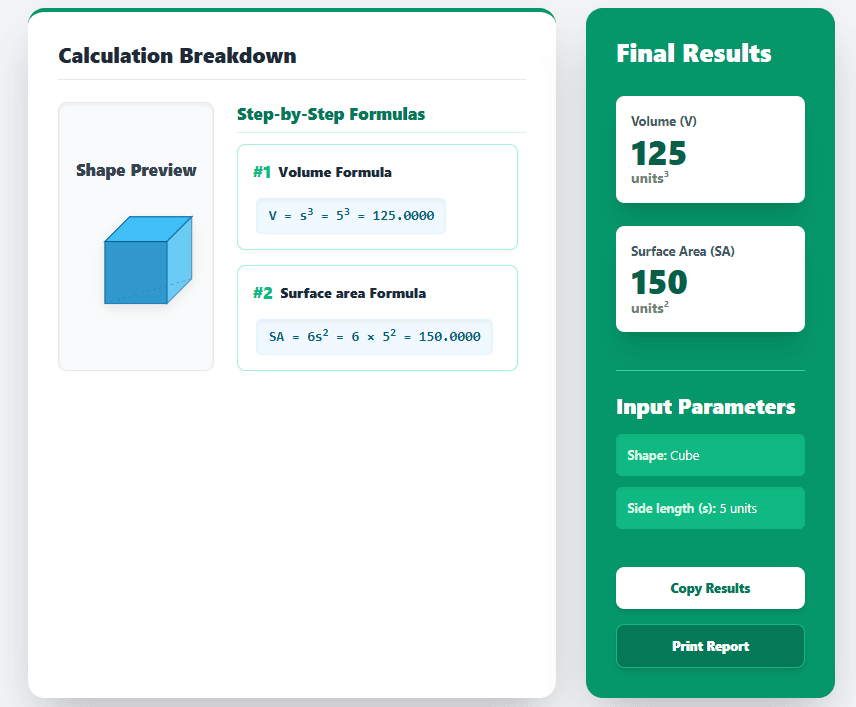
- Step-by-step formula breakdown for each calculation
- Visual representation of the shape with dimensions
- Input parameters summary for verification
See Step-by-Step Solutions
The best calculators do not just give you the answer. They show you how the answer was found. Our calculator displays detailed steps for every calculation:
- Formula display – Shows the formula being used
- Value substitution – Shows your values plugged into the formula
- Calculation result – Shows the final calculated value
This helps you learn, verify, and understand the process.
How to Use a Geometry Calculator – Step by Step
Let me walk you through using our geometry calculator. These steps work for any shape.
Step 1: Select Your Shape
Our calculator supports 8 different 3D shapes. Here is how to choose:
- Choose Cube if all sides are equal
- Choose Sphere if it is perfectly round
- Choose Cylinder if it has circular bases and straight sides
- Choose Cone if it has a circular base and tapers to a point
- Choose Rectangular Prism if it has rectangular faces
- Choose Square Pyramid if it has a square base and triangular sides
- Choose Hemisphere if it is half a sphere
- Choose Torus if it is donut-shaped
Example: You want to find the volume of a water tank. It is a cylinder. Choose Cylinder.
Step 2: Enter Your Dimensions
Enter the measurements you have.
For Cube: Enter side length For Sphere: Enter radius For Cylinder: Enter radius and height For Cone: Enter radius and height For Rectangular Prism: Enter length, width, and height For Pyramid: Enter base side and height For Hemisphere: Enter radius For Torus: Enter major and minor radius
Example for Cylinder: Radius = 2 units, Height = 5 units
Step 3: Click Calculate
The calculator processes your inputs and displays all results instantly.
Results for cylinder with radius 2 and height 5:
- Volume: 62.83 cubic units
- Surface Area: 87.96 square units
Step 4: Review the Steps
Scroll down to see the detailed calculation steps. These show you exactly how the calculator arrived at each answer.
What you will see:
- The formula being used
- Your values substituted into the formula
- The final calculated result
Step 5: Use the Results
You can copy the results to your clipboard or print them for reference. The calculator makes it easy to use your answers in real-world applications.
Shape-by-Shape Geometry Guide
Cube
A cube has six equal square faces. All edges are the same length.
Formulas:
- Volume: V = s³ (s = side length)
- Surface Area: SA = 6s²
Example: s = 3 units
- Volume = 27 cubic units
- Surface Area = 54 square units
Real-world use: Storage boxes, dice, shipping containers, building blocks
Sphere
A sphere is perfectly round – like a ball or a globe.
Formulas:
- Volume: V = (4/3)πr³ (r = radius)
- Surface Area: SA = 4πr²
Example: r = 2 units
- Volume = 33.51 cubic units
- Surface Area = 50.27 square units
Real-world use: Balls, planets, bubbles, water tanks, sports equipment
Cylinder
A cylinder has two circular bases and a curved side – like a soup can or a pipe.
Formulas:
- Volume: V = πr²h (r = radius, h = height)
- Surface Area: SA = 2πr² + 2πrh
Example: r = 2, h = 5
- Volume = 62.83 cubic units
- Surface Area = 87.96 square units
Real-world use: Pipes, cans, columns, water tanks, concrete forms
Cone
A cone has a circular base and tapers to a point – like an ice cream cone or a traffic cone.
Formulas:
- Slant Height: l = √(r² + h²)
- Volume: V = (1/3)πr²h
- Surface Area: SA = πr² + πrl
Example: r = 2, h = 6
- Slant Height = 6.32 units
- Volume = 25.13 cubic units
- Surface Area = 52.31 square units
Real-world use: Ice cream cones, traffic cones, funnels, construction piles
Rectangular Prism
A rectangular prism has six rectangular faces – like a brick or a shoe box.
Formulas:
- Volume: V = l × w × h (l = length, w = width, h = height)
- Surface Area: SA = 2(lw + lh + wh)
Example: l = 4, w = 3, h = 2
- Volume = 24 cubic units
- Surface Area = 52 square units
Real-world use: Boxes, rooms, bricks, shipping containers, furniture
Square Pyramid
A square pyramid has a square base and triangular sides that meet at a point – like the Egyptian pyramids.
Formulas:
- Slant Height: l = √(h² + (b/2)²) (b = base side, h = height)
- Volume: V = (1/3)b²h
- Surface Area: SA = b² + 2bl
Example: b = 4, h = 6
- Slant Height = 6.32 units
- Volume = 32 cubic units
- Surface Area = 66.56 square units
Real-world use: Pyramid structures, tents, packaging, architectural elements
Hemisphere
A hemisphere is half a sphere – like a dome or a half-ball.
Formulas:
- Volume: V = (2/3)πr³
- Surface Area: SA = 3πr²
Example: r = 3
- Volume = 56.55 cubic units
- Surface Area = 84.82 square units
Real-world use: Domes, half-spheres, bowls, architectural features
Torus
A torus is donut-shaped – like a ring or a tire.
Formulas:
- Volume: V = 2π²Rr² (R = major radius, r = minor radius)
- Surface Area: SA = 4π²Rr
Example: R = 6, r = 2
- Volume = 473.74 cubic units
- Surface Area = 473.74 square units
Real-world use: Tires, donuts, rings, tubes, pipe bends
Quick Reference Table
| Shape | Variables | Volume Formula | Surface Area Formula |
|---|---|---|---|
| Cube | s = side | V = s³ | SA = 6s² |
| Sphere | r = radius | V = (4/3)πr³ | SA = 4πr² |
| Cylinder | r = radius, h = height | V = πr²h | SA = 2πr² + 2πrh |
| Cone | r = radius, h = height | V = (1/3)πr²h | SA = πr² + πrl |
| Rectangular Prism | l = length, w = width, h = height | V = lwh | SA = 2(lw + lh + wh) |
| Square Pyramid | b = base, h = height | V = (1/3)b²h | SA = b² + 2bl |
| Hemisphere | r = radius | V = (2/3)πr³ | SA = 3πr² |
| Torus | R = major, r = minor | V = 2π²Rr² | SA = 4π²Rr |
How to Use a Geometry Calculator for Different Needs
For Students
- Homework help: Check your manual calculations
- Study aid: See step-by-step solutions to learn the process
- Exam prep: Practice with different shapes and dimensions
- Understanding concepts: Visualize shapes and formulas
Example: You have a geometry homework problem asking for the volume of a cylinder. Enter the radius and height into the calculator and see the full solution.
For Teachers
- Demonstration tool: Show students how formulas work
- Problem verification: Check student answers quickly
- Lesson planning: Generate examples for classroom use
- Visual aid: Use the shape preview to explain concepts
Example: During a lesson on volume, you show students how entering different dimensions changes the result instantly.
For DIY Projects
- Construction: Calculate concrete needed for posts and footings
- Woodworking: Determine material volumes for projects
- Gardening: Calculate soil needed for raised beds
- Home improvement: Estimate paint for spherical or cylindrical objects
Example: You need concrete for a cylindrical post. Enter the radius and height to find the exact volume.
For Professionals
- Engineering: Calculate volumes for design and manufacturing
- Architecture: Determine material quantities for projects
- Manufacturing: Calculate surface area for coatings and materials
- Construction: Estimate concrete, soil, or material volumes
Example: An architect needs to calculate the volume of a dome. Use the hemisphere calculator.
For Everyday Use
- Cooking: Calculate volume of pots and pans
- Storage: Determine volume of containers
- Moving: Estimate box volumes
- Sports: Calculate ball volumes
Example: You are moving and need to know how many boxes you need. Calculate the volume of your storage space.
Geometry Formulas Explained
Volume Formulas
Volume measures the space inside a 3D shape. It is measured in cubic units (units³).
- Cube: s³ – The side length multiplied by itself three times
- Sphere: (4/3)πr³ – Four-thirds times pi times the radius cubed
- Cylinder: πr²h – Pi times the radius squared times the height
- Cone: (1/3)πr²h – One-third of the cylinder volume with the same dimensions
- Rectangular Prism: lwh – Length times width times height
- Pyramid: (1/3)b²h – One-third of the base area times the height
- Hemisphere: (2/3)πr³ – Two-thirds the volume of a sphere with the same radius
- Torus: 2π²Rr² – Two times pi squared times major radius times minor radius squared
Surface Area Formulas
Surface area measures the total area of all surfaces of a 3D shape. It is measured in square units (units²).
- Cube: 6s² – Six times the side length squared
- Sphere: 4πr² – Four times pi times the radius squared
- Cylinder: 2πr² + 2πrh – Two circles plus the curved surface
- Cone: πr² + πrl – The circular base plus the curved surface
- Rectangular Prism: 2(lw + lh + wh) – All six faces summed
- Pyramid: b² + 2bl – The square base plus four triangular faces
- Hemisphere: 3πr² – Three times the surface area of a circle with the same radius
- Torus: 4π²Rr – Four times pi squared times major radius times minor radius
How to Convert Between Units
Sometimes you need to convert between different units of measurement. Here is a quick guide:
Volume Conversions
- 1 cubic meter = 1,000,000 cubic centimeters
- 1 cubic meter = 1,000 liters
- 1 cubic foot = 1,728 cubic inches
- 1 cubic foot ≈ 28.32 liters
Surface Area Conversions
- 1 square meter = 10,764 square feet
- 1 square foot = 144 square inches
- 1 square meter = 1,000,000 square millimeters
Pro tip: Always use consistent units. If you enter radius in centimeters, your volume will be in cubic centimeters and surface area in square centimeters.
Common Geometry Questions Answered
Q: How do I calculate the volume of a sphere?
A: Use the formula V = (4/3)πr³. Enter the radius into our geometry calculator and it will do the math instantly.
Q: How do I calculate the surface area of a cylinder?
A: Use the formula SA = 2πr² + 2πrh. Enter the radius and height into our calculator for the answer.
Q: What is the difference between volume and surface area?
A: Volume measures the space inside a shape (cubic units). Surface area measures the total area of the outside surface (square units).
Q: Why does my geometry calculator show errors?
A: Make sure you have entered positive numbers. All dimensions must be greater than zero. Also check that you have entered values for all required fields.
Q: What is the most common geometry formula?
A: The most commonly used formula is probably the volume of a cylinder (V = πr²h) or the volume of a rectangular prism (V = lwh).
Q: Can I use this for 2D shapes too?
A: This calculator is designed for 3D shapes. For 2D shapes like triangles, circles, and rectangles, you would need a different tool.
Q: How do I know which shape I have?
A: Look at the shape carefully. If it is round like a ball, it is a sphere. If it has circular ends and straight sides, it is a cylinder. If it has all square faces, it is a cube.
Q: What is a torus used for in real life?
A: Tori appear in many places: tires, donuts, rings, pipe bends, and even in physics and engineering applications.
Q: How do I check if my geometry answer is correct?
A: Use a different method or formula to verify. Or use our calculator and compare your manual calculation with the calculator's result.
Q: Why do I need to learn geometry formulas?
A: Understanding formulas helps you verify results, adapt to new problems, and understand the math behind the calculations. But you do not need to memorize them all – that is what calculators are for.
Practical Examples
Example 1: How Much Water Fits in a Cylindrical Tank?
You have a cylindrical water tank with radius 3 feet and height 8 feet.
- Volume = π × 3² × 8 = π × 9 × 8 = 226.19 cubic feet
- 1 cubic foot ≈ 7.48 gallons
- 226.19 × 7.48 ≈ 1,691 gallons
Answer: The tank holds approximately 1,691 gallons.
Example 2: How Much Concrete for a Sphere?
You need to make a concrete sphere with radius 2 feet.
- Volume = (4/3) × π × 2³ = (4/3) × π × 8 = 33.51 cubic feet
Answer: You need 33.51 cubic feet of concrete.
Example 3: How Much Paint for a Cube?
You have a cube-shaped room with side length 10 feet. You want to paint all surfaces.
- Surface Area = 6 × 10² = 6 × 100 = 600 square feet
Answer: You need enough paint for 600 square feet.
Example 4: How Much Soil for a Cone-Shaped Pile?
You have a cone-shaped pile of soil with radius 4 feet and height 6 feet.
- Volume = (1/3) × π × 4² × 6 = (1/3) × π × 16 × 6 = 100.53 cubic feet
Answer: The pile contains 100.53 cubic feet of soil.
How to Get the Best Results from a Geometry Calculator
After years of using and developing geometry calculators, here is what I have learned:
Always double-check your inputs. One wrong number changes everything. Read each value before clicking calculate.
Use consistent units. If you enter radius in inches, your volume will be in cubic inches. If you want cubic feet, convert first.
Start with the simplest shape. If you are not sure which shape you have, choose the simplest one that matches your object.
Verify with a second method. If possible, calculate using a different formula or method and compare results.
Understand the output. Do not just look at the number. Understand what it means. Volume is cubic units. Surface area is square units.
Learn the formulas. Even though the calculator does the work, understanding the formulas helps you know what is happening behind the scenes.
Save your results. Use the copy or print features to keep a record of your calculations.
Practice with different dimensions. Try different values to see how volume and surface area change. This builds intuition.
Do not be afraid to ask for help. If you are stuck, leave a comment or contact support. There is no shame in not knowing.
And finally, remember that geometry calculators are tools to help you, not replace your understanding. Use them to verify, learn, and save time.
Calculate Volume and Surface Area Now – Free Tool
Have questions about geometry calculations for a specific project? Leave a comment below. I read every one.
Tags: geometry calculator, volume calculator, surface area calculator, 3D shape calculator, math calculator, scientific calculator, cube calculator, sphere calculator, cylinder calculator, cone calculator, pyramid volume calculator, rectangular prism volume calculator, hemisphere calculator, torus calculator, solid geometry calculator, geometry solver, online geometry calculator, geometry calculator online, 3D geometry calculator, volume of a sphere, surface area of a cylinder, volume of a cube, geometry formulas, math solver, calculator for geometry, geometry calculator free, shape volume calculator, surface area formula, geometry problem solver, 3D shapes volume, geometry math calculator, online math calculator, geometry tool, calculate volume, calculate surface area