ROI Calculator – How to Calculate Return on Investment (With Real Examples)
Have you ever invested money and wondered whether you made a good decision? Or maybe you are thinking about investing and want to know what return you can expect before putting your money in?
I remember my first real investment. I put $5,000 into a friend's small business. Two years later, I got back $6,500. I was happy to make $1,500, but I had no idea if that was actually a good return. Was 30% over two years good? Bad? Average? I had nothing to compare it to.
Later, I invested the same amount in an index fund. After two years, I had $6,200. That was only $1,200 profit. But when I calculated the actual percentages, the index fund had a slightly better annual return because the timing was different. I learned that total profit does not tell the whole story.
After making these mistakes, I finally understood ROI and CAGR. Now I can look at any investment and quickly tell if it performed well or not. This guide will teach you the same thing.
Quick access: Use our free ROI calculator here
What is ROI? Simple Answer (No Jargon)
ROI stands for Return on Investment. It is just a percentage that tells you how much profit you made compared to what you put in.
The simple formula: ROI = (Profit ÷ Investment) × 100
Let me give you a real example from my own experience:
- I invested $1,000 in a stock
- I sold it later for $1,300
- My profit was $300
- My ROI was ($300 ÷ $1,000) × 100 = 30%
That is it. Nothing complicated.
What the number means:
- ROI is positive = You made money
- ROI is negative = You lost money
- Higher ROI = Better investment (usually)
- Lower ROI = Worse investment
Why Should You Care About ROI?
I did not understand ROI for years, and it cost me. Here is why you should care.
To compare different investments: If you are choosing between stocks, real estate, or a business, ROI helps you compare them. A stock that gave you 15% is better than a rental property that gave you 8% (assuming similar risk).
To know if you are doing well: The stock market average is about 10% per year over long periods. If your investments are making 6%, you are underperforming. If they are making 15%, you are doing great.
To decide when to sell: If an investment has not performed well for several years, maybe it is time to sell and put the money somewhere else. ROI helps you make that decision.
To plan for retirement: If you know your average ROI, you can calculate how much your money will grow. This helps you know if you are saving enough.
How to Calculate ROI – Step by Step (With Real Numbers)
Let me walk you through actual calculations from my investments.
Example 1: Stock Investment (My First Stock)
What happened:
- I bought 50 shares of a company at $100 each = $5,000
- I paid a $10 trading fee
- I sold the shares 2 years later at $130 each = $6,500
- I paid another $10 trading fee to sell
Step by step calculation:
- Total money I put in: $5,000 + $10 = $5,010
- Total money I got back: $6,500 - $10 = $6,490
- My profit: $6,490 - $5,010 = $1,480
- ROI: ($1,480 ÷ $5,010) × 100 = 29.54%
What I learned: The fees ate into my profit. Without fees, my ROI would have been 30%. It seems small, but over many trades, fees add up.
Example 2: Rental Property (My Friend's Experience)
What happened:
- My friend bought a house for $200,000
- He spent $30,000 on renovations
- He paid $5,000 in closing costs
- He sold the house 2 years later for $260,000
- He paid $15,000 in agent fees
Step by step calculation:
- Total investment: $200,000 + $30,000 + $5,000 = $235,000
- Money from sale: $260,000 - $15,000 = $245,000
- Profit: $245,000 - $235,000 = $10,000
- ROI: ($10,000 ÷ $235,000) × 100 = 4.25%
What he learned: He thought he made $30,000 profit ($260k sale - $200k purchase - $30k renovations). But after all fees, his actual profit was only $10,000. His ROI was only 4.25% over 2 years, which is worse than a savings account.
Example 3: Mutual Fund SIP (What I Do Now)
What happened:
- I invested $500 every month for 3 years
- Total invested: $500 × 36 = $18,000
- After 3 years, my account showed $22,500
- I paid $0 in fees (direct plan)
Calculation:
- Profit: $22,500 - $18,000 = $4,500
- ROI: ($4,500 ÷ $18,000) × 100 = 25%
- Time period: 3 years
Is 25% over 3 years good? That is about 7.7% per year. Not amazing, but better than a bank fixed deposit.
What is CAGR and Why Do You Need It?
Here is something that confused me for a long time.
ROI tells you your total return. But what if you want to compare a 2-year investment with a 5-year investment? You cannot just compare the ROI percentages because the time periods are different.
Example that confused me:
- Investment A: 30% ROI over 2 years
- Investment B: 40% ROI over 5 years
Which one is better? I thought 40% is bigger than 30%, so Investment B must be better. But I was wrong.
Let me calculate the annual return (CAGR):
- Investment A: 30% over 2 years = about 14% per year
- Investment B: 40% over 5 years = about 7% per year
Investment A is actually much better even though the total ROI is smaller. It achieved a good return in less time.
The Simple CAGR Formula
CAGR = [(Final Value ÷ Initial Investment) ^ (1 ÷ Years)] - 1] × 100
I know that looks scary, but let me show you with real numbers.
Example: My $1,000 that became $1,300 in 2 years
- Final value = $1,300
- Initial = $1,000
- Ratio = 1,300 ÷ 1,000 = 1.30
- 1.30 ^ (1 ÷ 2) = 1.30 ^ 0.5 = about 1.14
- 1.14 - 1 = 0.14
- 0.14 × 100 = 14%
So my 30% ROI over 2 years is actually 14% per year.
The easy way: Use our calculator. It does this math for you automatically.
Historical ROI vs Future ROI – What is the Difference?
I use ROI in two different ways, and you should too.
Historical ROI (Looking Back)
This tells you how a past investment performed. You already made the investment, and you want to know if it was good or bad.
What you need:
- How much you invested
- How much you got back
- When you started and ended
- Any fees you paid
Example from my portfolio: I invested $10,000 in a mutual fund in 2020. Today it is worth $14,000. My historical ROI is 40% over 4 years, which is about 8.8% per year.
Future ROI (Looking Forward)
This helps you decide if an investment is worth making. You estimate what return you might get.
What you need:
- How much you plan to invest
- What annual return you expect
- How many years you will stay invested
- Estimated fees
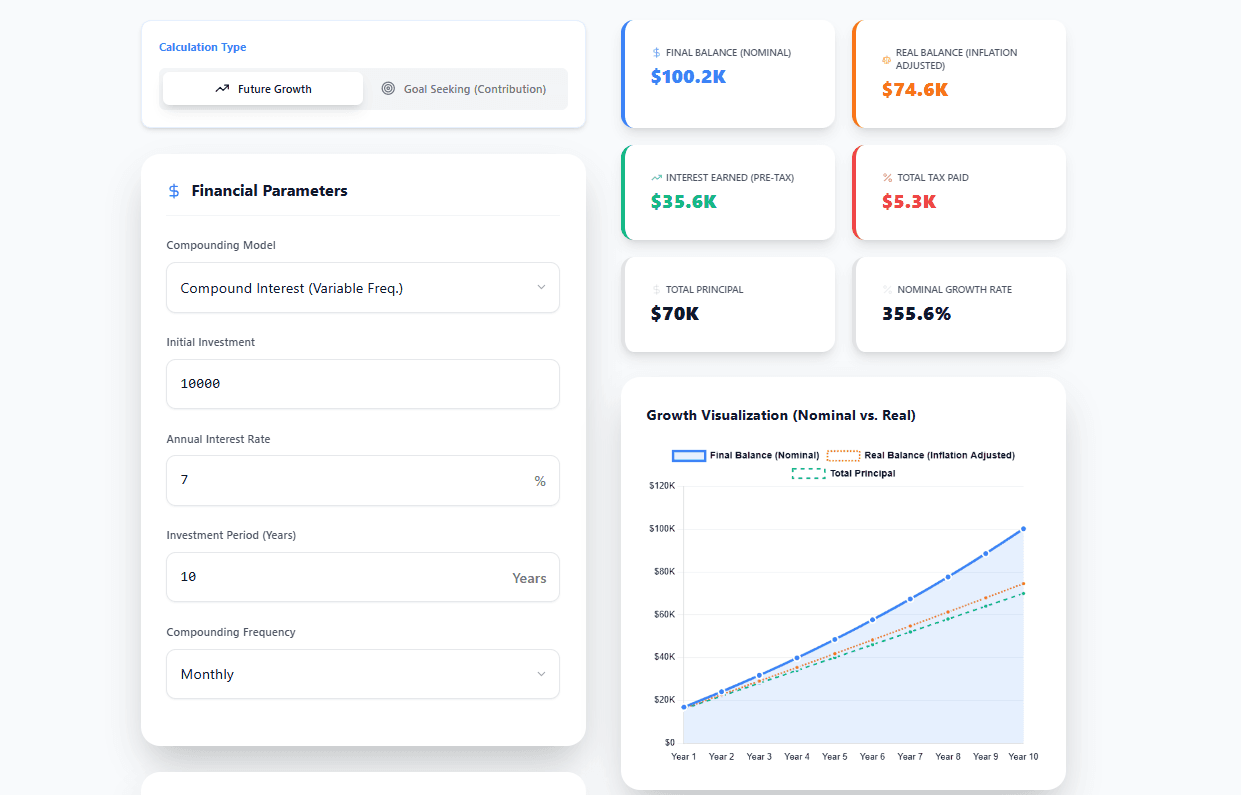
Example: I am thinking of investing $5,000 in an index fund. I expect 10% returns per year. I will hold for 10 years.
Our calculator tells me:
- After 10 years, it will be worth about $12,968
- My profit would be about $7,968
- That is about 159% total return
This helps me decide if it is worth it.
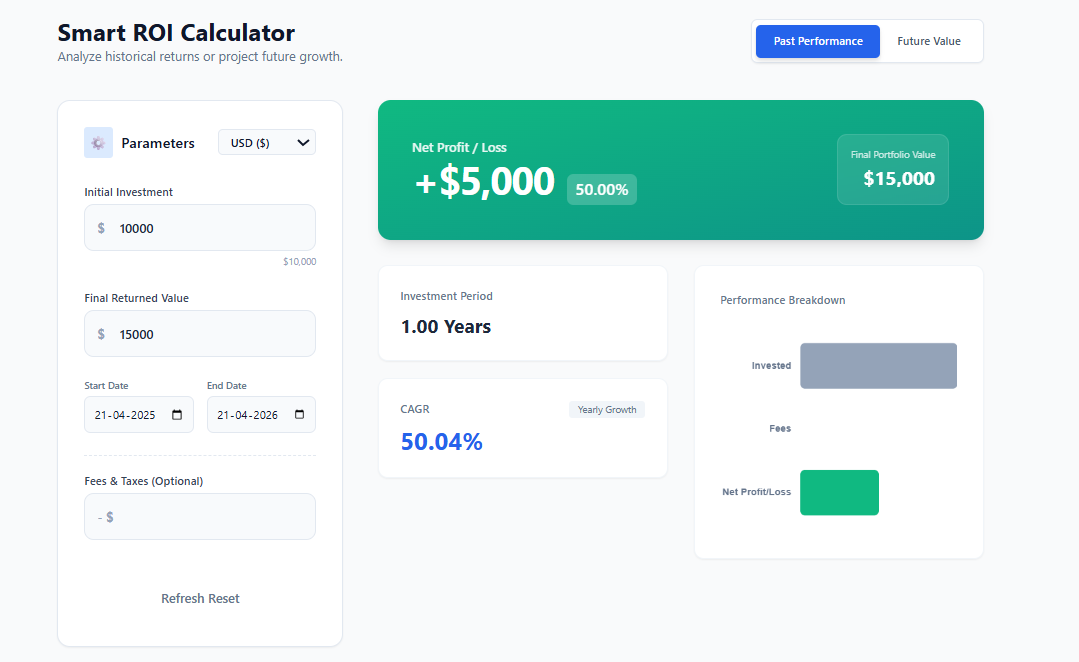
How to Use Our ROI Calculator (Simple Steps)
Our ROI calculator does all the hard work for you.
Step 1: Choose what you want to do
- Past Performance (for investments you already made)
- Future Value (for investments you are planning)
Step 2: Pick your currency (USD, INR, EUR, GBP, or AED)
Step 3: Enter your numbers
- For past investments: Initial amount, final amount, start date, end date
- For future investments: Initial amount, expected return %, how many years
Step 4: Add any fees or taxes (be honest, they matter)
Step 5: Click calculate and see:
- Your net profit or loss (in real money)
- Your total ROI percentage
- Your CAGR (annual return)
- How your money grew over time
I use this tool before every major investment decision now.
Real ROI Examples from Different Investments
Example 1: Stock Market (My Experience)
What I did: Bought $10,000 of an S&P 500 index fund in January 2020 What happened: By January 2025, it was worth $16,500
Calculations:
- Profit: $6,500
- Total ROI: 65%
- Time period: 5 years
- Annual return (CAGR): About 10.5%
My take: This matched the historical average. I was happy.
Example 2: Real Estate (My Cousin's Experience)
What he did: Bought a condo for $150,000. Spent $20,000 on updates. Sold for $190,000 after 3 years.
Calculations:
- Total invested: $170,000
- Sale price: $190,000
- After agent fees (6%): $178,600
- Profit: $8,600
- Total ROI: 5.05%
- Annual return (CAGR): About 1.65%
His take: He would have been better off leaving the money in a savings account. He learned to calculate ROI before investing, not after.
Example 3: Small Business (My Friend's Experience)
What she did: Invested $25,000 in a friend's coffee shop. Got $30,000 back after 2 years.
Calculations:
- Profit: $5,000
- Total ROI: 20%
- Annual return (CAGR): About 9.5%
Her take: Not amazing, but decent. The coffee shop is still running, so she kept her ownership and gets yearly profits.
Example 4: Cryptocurrency (What I Wish I Did)
What could have happened: Invest $1,000 in Bitcoin in 2020 ($10,000 per coin). By 2021, it was $60,000 per coin.
Calculations:
- Your $1,000 would buy 0.1 Bitcoin
- At $60,000, that 0.1 Bitcoin is worth $6,000
- Profit: $5,000
- Total ROI: 500%
- Annual return (CAGR): About 500% (in 1 year)
My take: I did not do this. I was too scared. But it shows how high risk can lead to high returns (or big losses).
What is a Good ROI? (Honest Answer)
People always ask me this. Here is my honest answer based on real data.
By Investment Type
| Investment Type | Typical Yearly Return | Risk Level |
|---|---|---|
| Savings account | 0.5% - 4% | Very low |
| Government bonds | 3% - 5% | Low |
| Fixed deposit (India) | 6% - 8% | Very low |
| Corporate bonds | 4% - 6% | Low to medium |
| S&P 500 index fund | 7% - 10% (long term) | Medium |
| Rental property | 8% - 12% (if you buy right) | Medium |
| Individual stocks | -20% to +30% | High |
| Small business | -50% to +100% | Very high |
| Cryptocurrency | -80% to +200% | Extreme |
My Personal Benchmarks
After years of investing, here is what I consider good:
For low-risk investments (bonds, FDs):
- Good ROI: 6-8% per year
- Excellent ROI: 9%+ per year (rare for low risk)
For medium-risk investments (index funds, rental property):
- Good ROI: 8-12% per year
- Excellent ROI: 13-15% per year
For high-risk investments (stocks, business):
- Good ROI: 15-20% per year
- Excellent ROI: 25%+ per year
The important thing: Do not compare a low-risk investment's ROI to a high-risk one. A savings account giving 4% is good for its risk level. A stock giving 4% is terrible.
Why Fees and Taxes Destroy Your ROI (Real Example)
I learned this lesson the hard way. Fees and taxes eat into your returns more than you think.
Example Without Fees
- I invest $10,000
- It grows to $15,000 over 5 years
- Profit: $5,000
- ROI: 50%
- CAGR: About 8.45%
Looks good, right?
Example With Fees and Taxes
Same investment, but:
- 1% annual management fee: About $650 total over 5 years
- 15% capital gains tax on $5,000 profit: $750
- Total costs: $1,400
New numbers:
- Profit after costs: $5,000 - $1,400 = $3,600
- ROI after costs: 36%
- CAGR after costs: About 6.3%
What happened: My 8.45% annual return became 6.3% after fees and taxes. That is a huge difference over 20-30 years.
My rule now: Always calculate ROI after fees and taxes. Your actual return is what you keep, not what the investment earned.
Common ROI Mistakes I Have Made (So You Do Not Have To)
Mistake 1: Forgetting to Include All Costs
What I did wrong: I calculated ROI on a stock trade using only the buy and sell prices. I forgot the trading fees.
The result: My actual ROI was 1% lower than I thought.
What I learned: Every fee matters. Include everything.
Mistake 2: Comparing ROI Across Different Time Periods
What I did wrong: I thought a 50% ROI over 5 years was worse than a 40% ROI over 3 years because 40 is less than 50.
The result: I chose the wrong investment. The 50% over 5 years was actually about 8.4% per year. The 40% over 3 years was about 11.8% per year. The second one was better.
What I learned: Always use CAGR to compare different time periods.
Mistake 3: Ignoring Inflation
What I did wrong: I was happy with a 6% return from a bond.
The result: Inflation was 5% that year. My real return was only 1%.
What I learned: For long-term planning, consider real returns (ROI minus inflation).
Mistake 4: Not Calculating ROI Before Investing
What I did wrong: I invested in a friend's business without running the numbers first.
The result: The business failed. I lost most of my money.
What I learned: Always calculate projected ROI before investing. If the numbers do not make sense, do not invest.
Frequently Asked Questions (From Real People)
Q: How to calculate ROI on a rental property?
A: Include purchase price, renovation costs, closing costs, property taxes, insurance, maintenance, and agent fees when you sell. (Sale price - all costs) ÷ (total investment) × 100 = ROI.
Q: What is a good ROI percentage for stocks?
A: The S&P 500 averages about 10% per year over long periods. If your stocks are doing 10-12% per year, you are doing well. If they are doing 15%+ per year, you are doing great.
Q: How to calculate ROI for a small business?
A: (Total profit from business - total money you put in) ÷ total money you put in × 100. Include everything you spent to start and run the business.
Q: What is the difference between ROI and CAGR?
A: ROI is total return over the whole period. CAGR is the average return per year. Use CAGR when comparing investments held for different lengths of time.
Q: How to calculate ROI including taxes?
A: First calculate your profit. Then subtract the taxes you will pay on that profit. Then divide by your investment. Our calculator does this for you.
Q: What is a negative ROI?
A: Negative ROI means you lost money. For example, if you invested $1,000 and only got back $800, your ROI is -20%.
Q: How to calculate ROI for a SIP investment?
A: For SIP (monthly investments), you need the total amount invested and the final value. Our calculator handles this. The math is more complex than a lump sum.
Q: What is the average ROI for the stock market?
A: About 10% per year on average over the last 100 years. But individual years can be -30% or +30%.
Q: How to calculate annualized ROI?
A: Use the CAGR formula: [(Final Value ÷ Initial) ^ (1 ÷ Years) - 1] × 100. Or just use our calculator.
Q: Is 7% ROI good?
A: For a low-risk investment like bonds or fixed deposits, 7% is good. For stocks, 7% is below average.
Q: How to calculate ROI on an investment with multiple cash flows?
A: For simple ROI, add up all money you put in and all money you got back. For precise calculation, you need an XIRR calculator (for irregular cash flows).
Q: Should I use ROI or CAGR for comparing mutual funds?
A: Use CAGR for comparing funds with different time periods. Use total ROI if you held them for the same length of time.
Q: How to calculate ROI if I reinvested dividends?
A: Include reinvested dividends as part of your total return. Your final value should include all reinvested amounts.
Q: Can ROI be more than 100%?
A: Yes. If you double your money, ROI is 100%. If you triple it, ROI is 200%.
Q: Is the ROI calculator free?
A: Yes. Completely free. No signup. No limits. Use it as much as you want.
My Final Advice (From 10+ Years of Investing)
After investing for over a decade, here is what I have learned about ROI.
Always calculate ROI before you invest, not after. I have made this mistake too many times. Running the numbers first would have saved me from bad investments.
Include every cost. Fees, taxes, maintenance, insurance, agent commissions. Everything. If you ignore them, your ROI calculation will be wrong.
Use CAGR for comparing different time periods. Total ROI can be misleading. A 20% return over 1 year is much better than a 30% return over 5 years.
Do not chase high ROI without understanding risk. If someone promises 30% returns, ask why. If it sounds too good to be true, it probably is.
Compare your ROI to benchmarks. If your stock portfolio is making 6% but the S&P 500 made 10%, you are underperforming. Maybe you need a different strategy.
Be realistic about future projections. Do not assume 15% returns every year. Use 8-10% for stocks and 5-7% for bonds. If the actual returns are higher, you will be happy.
Keep good records. Every investment, every fee, every date. Good records mean accurate ROI calculations.
And finally, use a good ROI calculator. Our tool handles historical analysis, future projections, fees, taxes, and CAGR automatically. It saves time and prevents mistakes.
Calculate Your ROI Now – Free Tool
Have questions about calculating ROI for your specific investment? Leave a comment below. I try to answer every one.
Tags: roi calculator, how to calculate roi, return on investment formula, cagr calculator, investment return calculator, roi formula explained, calculate investment profit, net profit calculator, roi percentage, annualized return calculator, historical roi calculator, future roi projection, roi with fees and taxes, investment performance analysis, roi for stocks, roi for real estate, roi for business, roi for mutual funds, roi calculation example, good roi percentage, average roi by investment type, roi vs cagr difference, roi calculator online free, investment growth calculator, compound annual growth rate formula, roi calculation with start and end dates, roi calculation with expected returns, roi calculator for beginners, financial metrics explained, investment analysis tool, how to calculate roi on rental property, how to calculate roi on stock investment, how to calculate roi on business investment, what is a good roi percentage, roi calculator including fees, roi calculator including taxes, roi for sip investment, roi for lump sum investment, roi calculation for 1 year, roi calculation for 5 years, roi calculation for 10 years, roi calculation for 20 years, what is cagr and how to calculate it, cagr formula explained, cagr vs roi difference, investment profit calculator online free