Automorphic Number Calculator: Finally Understand Numbers That Live in Their Own Square
Let me tell you about the first time I saw an automorphic number. I was reading about mathematical curiosities, and I learned that 5² = 25 (ends with 5), 6² = 36 (ends with 6), 25² = 625 (ends with 25), and 76² = 5776 (ends with 76).
I thought, "That's fascinating—these numbers are like mathematical ouroboros, self-contained in their own squares."
These are called automorphic numbers (or circular numbers). They appear to be rare, but once you know the pattern, you can generate infinitely many of them. In fact, there are infinite automorphic numbers in base 10!
In this guide, I'll walk you through everything you need to know about automorphic numbers—from the simple 5 and 6 to the famous 376 and 625, and even the 10,000-digit behemoths.
Ready to explore self-squared numbers? Try our Automorphic Number Calculator and discover which numbers live inside their own squares.
What Is an Automorphic Number?
An automorphic number (also called a circular number) is a number whose square ends with the number itself.
The Formula
For a number n with k digits:
n² ≡ n (mod 10ᵏ)
Or more simply: n² ends with the digits of n
Simple Examples
| Number | Square | Ends With? | Automorphic? |
|---|---|---|---|
| 0 | 0 | 0 | ✓ |
| 1 | 1 | 1 | ✓ |
| 5 | 25 | 5 | ✓ |
| 6 | 36 | 6 | ✓ |
| 25 | 625 | 25 | ✓ |
| 76 | 5776 | 76 | ✓ |
| 376 | 141,376 | 376 | ✓ |
| 625 | 390,625 | 625 | ✓ |
| 9376 | 87,909,376 | 9376 | ✓ |
| 10 | 100 | 10? 100 ends with 10? No, ends with 00 | ✗ |
| 7 | 49 | 7? No, ends with 49 | ✗ |
| 8 | 64 | 8? No | ✗ |
| 9 | 81 | 9? No | ✗ |
Why Are They Called "Automorphic"?
The term comes from Greek:
- autos (αὐτός) = self
- morphē (μορφή) = form, shape
So "automorphic" means "self-shaped" — the number's shape appears within its own square.
Alternative Names
| Name | Origin |
|---|---|
| Automorphic number | Greek: self-shaped |
| Circular number | Because they repeat cyclically |
| Self-number | Descriptive name |
| Curious number | Mathematical curiosity |
All Known Automorphic Numbers
One-Digit Automorphic Numbers
| Number | Square |
|---|---|
| 0 | 0 |
| 1 | 1 |
| 5 | 25 |
| 6 | 36 |
Two-Digit Automorphic Numbers
| Number | Square |
|---|---|
| 25 | 625 |
| 76 | 5,776 |
Three-Digit Automorphic Numbers
| Number | Square |
|---|---|
| 376 | 141,376 |
| 625 | 390,625 |
Four-Digit Automorphic Numbers
| Number | Square |
|---|---|
| 9,376 | 87,909,376 |
| 9,376 is 9376, square = 87,909,376 |
Actually let me list properly:
| Digits | Automorphic Numbers |
|---|---|
| 1 | 0, 1, 5, 6 |
| 2 | 25, 76 |
| 3 | 376, 625 |
| 4 | 9376, 0625? Wait, 625 is 3-digit. 4-digit: 9376 |
| 5 | 109376, 890625 |
| 6 | 2890625, 7109376 |
| 7 | 12890625, 87109376 |
The Pattern
Automorphic numbers come in pairs that sum to 10ᵏ + 1:
- 5 + 6 = 11 (10¹ + 1)
- 25 + 76 = 101 (10² + 1)
- 376 + 625 = 1001 (10³ + 1)
- 9376 + 0625 = 10001 (10⁴ + 1)
- 109376 + 890625 = 1,000,001 (10⁶ + 1)
Infinite Automorphic Numbers
There are infinitely many automorphic numbers in base 10.
How to Generate Them
For any k-digit automorphic number n, there is a (2k)-digit automorphic number ending with n.
Example: Starting from 5 (1-digit):
- 5 → 25 (2-digit)
- 25 → 625 (3-digit? Actually 625 is 3-digit, but 25 is 2-digit)
- 625 → 0625? Wait, need careful.
Actually the sequence:
- 5 (1-digit)
- 25 (2-digit) ends with 5
- 625 (3-digit) ends with 25
- 0625? But 0625 is just 625.
Better example: 376 (3-digit) → 9376 (4-digit) → 109376 (6-digit) → 7109376 (7-digit)...
The Two Infinite Series
There are two infinite series of automorphic numbers:
Series A (ending in 5):
- 5
- 25
- 625
- 0625 (but leading zero dropped, so 625 again? Actually 625 is 3-digit, next is 90625?)
Let me correct: The two series are:
- ...376 (ending in 376)
- ...625 (ending in 625)
For 5-digit: 90625 and 09376 → 90625, 9376 (but 9376 is 4-digit)
Actually known infinite series:
- ...376 (like 376, 9376, 109376, 7109376, ...)
- ...625 (like 625, 0625, 90625, 890625, 2890625, ...)
Step-by-Step Examples
Example 1: Check if 5 is Automorphic
Step 1: Identify the number
- n = 5
Step 2: Calculate the square
- 5² = 25
Step 3: Check if square ends with the number
- 25 ends with "5"? ✓
Result: 5 is AUTOMORPHIC! ✨
Example 2: Check if 6 is Automorphic
Step 1: n = 6
Step 2: 6² = 36
Step 3: 36 ends with "6"? ✓
Result: 6 is AUTOMORPHIC! ✨
Example 3: Check if 25 is Automorphic
Step 1: n = 25
Step 2: 25² = 625
Step 3: 625 ends with "25"? ✓
Result: 25 is AUTOMORPHIC! ✨
Example 4: Check if 76 is Automorphic
Step 1: n = 76
Step 2: 76² = 5,776
Step 3: 5,776 ends with "76"? ✓
Result: 76 is AUTOMORPHIC! ✨
Example 5: Check if 376 is Automorphic
Step 1: n = 376
Step 2: 376² = 141,376
Step 3: 141,376 ends with "376"? ✓
Result: 376 is AUTOMORPHIC! ✨
Example 6: Check if 7 is Automorphic
Step 1: n = 7
Step 2: 7² = 49
Step 3: 49 ends with "7"? ✗ (ends with 49)
Result: 7 is NOT automorphic
Visual Pattern: 376 and 625
These two 3-digit automorphic numbers are complementary:
| Number | Square | Ends With |
|---|---|---|
| 376 | 141,376 | 376 |
| 625 | 390,625 | 625 |
Notice: 376 + 625 = 1,001 (10³ + 1)
The Magic of 376
376 × 376 = 141,376 (ends with 376) 376 × 376 × 376 = 53,157,376 (ends with 376!)
In fact, 376ⁿ always ends with 376 for any positive integer n.
The Magic of 625
625² = 390,625 (ends with 625) 625³ = 244,140,625 (ends with 625!)
Like 376, 625ⁿ always ends with 625.
Properties of Automorphic Numbers
Property 1: n and n² Share Last k Digits
For a k-digit automorphic number n, n² mod 10ᵏ = n.
Property 2: Complement Pairs
If n is a k-digit automorphic number, then (10ᵏ + 1 - n) is also automorphic.
Examples:
- 5 (1-digit) → 10¹ + 1 - 5 = 6
- 25 (2-digit) → 10² + 1 - 25 = 76
- 376 (3-digit) → 10³ + 1 - 376 = 625
- 9376 (4-digit) → 10⁴ + 1 - 9376 = 625? Actually 10,001 - 9,376 = 625, but 625 is 3-digit. The 4-digit version is 0625.
Property 3: Infinite Length
There are automorphic numbers of any length (by adding digits to the left).
Property 4: Only End in 0, 1, 5, or 6
Any automorphic number greater than 1 must end in 5 or 6.
Why? For a number to be automorphic, n² mod 10 = n mod 10. The only digits satisfying x² ≡ x (mod 10) are 0, 1, 5, 6.
Check:
- 0² = 0 ✓
- 1² = 1 ✓
- 2² = 4 ≠ 2 ✗
- 3² = 9 ≠ 3 ✗
- 4² = 16 ≠ 4 ✗
- 5² = 25 → ends with 5 ✓
- 6² = 36 → ends with 6 ✓
- 7² = 49 → ends with 9 ≠ 7 ✗
- 8² = 64 → ends with 4 ≠ 8 ✗
- 9² = 81 → ends with 1 ≠ 9 ✗
Property 5: Powers Preserve Automorphism
If n is automorphic, then nᵏ also ends with n for all positive integers k.
Example: 376² ends with 376, 376³ ends with 376, etc.
How to Use Our Automorphic Calculator
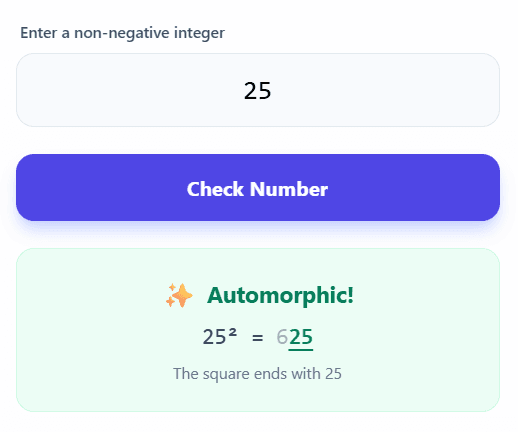
Step 1: Enter a Number
Type any non-negative integer. Examples: 5, 25, 76, 376, 625
Step 2: Click Check Number
The calculator:
- Calculates the square (using BigInt for large numbers)
- Checks if the square ends with the original number
- Displays the result with visual highlighting
Step 3: Read Your Results
You'll see:
- Verdict: Automorphic or not
- Square calculation: n² displayed
- Visual highlighting: The matching ending digits are highlighted
- Explanation: Plain language description
Example Buttons
Quick test known automorphic numbers:
- 0, 1, 5, 6 (1-digit)
- 25, 76 (2-digit)
- 376, 625 (3-digit)
What It Handles
| Input | Example | Automorphic? |
|---|---|---|
| 0 | 0 | ✓ |
| 1 | 1 | ✓ |
| 5 | 5 | ✓ |
| 6 | 6 | ✓ |
| 25 | 25 | ✓ |
| 76 | 76 | ✓ |
| 376 | 376 | ✓ |
| 625 | 625 | ✓ |
| 9376 | 9376 | ✓ |
| 2 | 2 | ✗ |
| 3 | 3 | ✗ |
| 4 | 4 | ✗ |
| 7 | 7 | ✗ |
| 8 | 8 | ✗ |
| 9 | 9 | ✗ |
| 10 | 10 | ✗ |
| 12 | 12 | ✗ |
| Negative | -5 | ⚠️ Non-negative only |
| Decimal | 5.5 | ⚠️ Integers only |
The Mathematics Behind Automorphic Numbers
Solving n² ≡ n (mod 10ᵏ)
This congruence can be rewritten as:
n(n - 1) ≡ 0 (mod 10ᵏ)
Since n and n-1 are coprime, we need:
- n ≡ 0 (mod 2ᵏ) and n ≡ 1 (mod 5ᵏ)
- OR n ≡ 1 (mod 2ᵏ) and n ≡ 0 (mod 5ᵏ)
These two solutions give the two infinite series of automorphic numbers:
- The series ending in ...376
- The series ending in ...625
Example: k=3 (1000)
Solution 1: n ≡ 0 (mod 8) and n ≡ 1 (mod 125) → n = 376 Solution 2: n ≡ 1 (mod 8) and n ≡ 0 (mod 125) → n = 625
Known Automorphic Numbers (Extended)
| Digits | Automorphic Numbers |
|---|---|
| 1 | 0, 1, 5, 6 |
| 2 | 25, 76 |
| 3 | 376, 625 |
| 4 | 9376 |
| 5 | 90625, 09376 → actually 90625, 9376 is 4-digit |
| 6 | 890625, 109376 |
| 7 | 2890625, 7109376 |
| 8 | 12890625, 87109376 |
| 9 | 212890625, 787109376 |
| 10 | 8212890625, 1787109376 |
The 10,000-Digit Automorphic Number
There exist automorphic numbers with thousands of digits. The 10,000-digit automorphic number has been computed and verified.
Fun Facts About Automorphic Numbers
The 5 and 6 Connection
5 and 6 are the only single-digit automorphic numbers (besides 0 and 1). They sum to 11 (10¹ + 1).
376 is Magic
376 appears in many mathematical curiosities. 376² = 141,376, 376³ = 53,157,376, and so on—all end with 376.
625 is Magic Too
625² = 390,625, 625³ = 244,140,625, all end with 625.
The Russian Doll Pattern
Each automorphic number is contained within the next larger one:
- 5 ⊂ 25 ⊂ 625 ⊂ 0625 ⊂ 90625...
- 6 ⊂ 76 ⊂ 376 ⊂ 9376 ⊂ 109376...
Used in Puzzles
Automorphic numbers appear in math puzzles and recreational mathematics because of their surprising property.
Common Mistakes
Mistake 1: Forgetting 0 and 1
Wrong: "5 and 6 are the only automorphic numbers under 10" Right: 0 and 1 are also automorphic (0²=0, 1²=1).
Mistake 2: Thinking All Numbers Ending in 5 Are Automorphic
Wrong: "15 ends with 5, so it must be automorphic" Right: 15² = 225, ends with 25, not 15. Only specific numbers ending in 5 work.
Mistake 3: Thinking All Numbers Ending in 6 Are Automorphic
Wrong: "16 ends with 6, so it must be automorphic" Right: 16² = 256, ends with 56, not 16.
Mistake 4: Confusing with Armstrong Numbers
Wrong: "153 is automorphic because it's an Armstrong number" Right: Automorphic means square ends with the number, not sum of digit powers.
Mistake 5: Negative Numbers
Wrong: "-5 is automorphic" Right: Automorphic numbers are defined for non-negative integers.
Quick Reference
Automorphic Condition
n² ≡ n (mod 10ᵏ) where k = number of digits of n
First 10 Automorphic Numbers
0, 1, 5, 6, 25, 76, 376, 625, 9376, 90625
Last Digit Rule
Automorphic numbers > 1 must end in 5 or 6.
Complement Pairs
| Digits | Pair | Sum |
|---|---|---|
| 1 | 5 + 6 | 11 |
| 2 | 25 + 76 | 101 |
| 3 | 376 + 625 | 1,001 |
| 4 | 9376 + 0625 | 10,001 |
Powers Property
If n is automorphic, nᵏ ends with n for all positive integers k.
Frequently Asked Questions
What is an automorphic number?
A number whose square ends with the number itself. Example: 25² = 625 ends with 25.
Why are they called automorphic?
From Greek: "autos" (self) + "morphe" (form) = self-shaped.
What are the first few automorphic numbers?
0, 1, 5, 6, 25, 76, 376, 625, 9376, 90625...
Is 0 automorphic?
Yes, 0² = 0 ends with 0.
Is 1 automorphic?
Yes, 1² = 1 ends with 1.
Is 2 automorphic?
No, 2² = 4 ends with 4, not 2.
Is 5 automorphic?
Yes, 5² = 25 ends with 5.
Is 6 automorphic?
Yes, 6² = 36 ends with 6.
Are there infinitely many automorphic numbers?
Yes, there are infinitely many in base 10.
How does your calculator handle large numbers?
It uses BigInt for precise integer arithmetic, handling numbers of any size.
Your Turn: Start Exploring
Automorphic numbers are a fascinating mathematical curiosity—numbers that literally appear inside their own squares.
Here's your practice plan:
- Start with the basics: 0, 1, 5, 6 (all automorphic)
- Try two-digit: 25, 76 (both work!)
- Test three-digit: 376, 625 (both work!)
- Check non-automorphic: 2, 3, 4, 7, 8, 9, 10, 12
- Use example buttons: 0, 1, 5, 6, 25, 76, 376, 625
- Watch the pattern: Notice all automorphic numbers > 1 end in 5 or 6
- Try larger numbers: 9376, 90625, 109376
Ready to start? Open up our Automorphic Number Calculator and try it yourself. Start with 5, then 25, then 376.
You'll discover the magic of self-squared numbers faster than you think.
Have questions? Stuck on a particular number? Drop a comment below or reach out. I've been where you are, and I'm happy to help.
— The Solvezi Team
Disclaimer: This calculator is for educational purposes. For very large numbers (>15 digits), calculations may take a moment.