How to Convert Units – Simple Guide for Length, Weight, Volume, Temperature & Speed
Have you ever been following a recipe and gotten confused because it uses cups but your measuring cup shows milliliters? Or maybe you are traveling to the United States and want to understand the weather forecast in Fahrenheit, but you only understand Celsius?
I remember my first trip to the US. I kept checking the weather app and had no idea if 80 degrees Fahrenheit was hot or cold. I had to learn temperature conversion the hard way. After that experience, I started collecting all the common conversion formulas that people actually use in daily life.
This guide is for anyone who just wants to convert units without getting into complicated math. I will show you simple formulas, real examples, and when to use our free converter tool.
Quick access: Use our free unit converter here
What is Unit Conversion? Simple Answer
Unit conversion means changing a measurement from one unit to another. For example, converting 1 kilogram to 2.2 pounds, or 1 liter to 4.2 cups.
You need unit conversion when:
- Following a recipe from another country
- Understanding weather temperatures abroad
- Buying materials for a home project
- Reading product specifications online
- Traveling to countries that use different measurement systems
Most countries use the metric system (kilometers, kilograms, liters, Celsius). The United States, Liberia, and Myanmar use the imperial system (miles, pounds, gallons, Fahrenheit). So if you are traveling, shopping online, or reading international content, you will need to convert units.
Two Main Measurement Systems You Need to Know
Metric System (Used by 95% of the world)
The metric system is simple because everything is based on multiples of 10.
Basic metric units:
- Length: meter (m), kilometer (km), centimeter (cm), millimeter (mm)
- Weight: kilogram (kg), gram (g), milligram (mg)
- Volume: liter (L), milliliter (mL)
- Temperature: Celsius (°C)
Metric prefixes (easy to remember):
- Kilo = 1000 times (1 km = 1000 m)
- Centi = 100 times smaller (1 m = 100 cm)
- Milli = 1000 times smaller (1 L = 1000 mL)
Imperial System (Used mainly in USA)
The imperial system has random relationships between units. This is why people find it harder.
Basic imperial units:
- Length: inch (in), foot (ft), yard (yd), mile (mi)
- Weight: ounce (oz), pound (lb), ton
- Volume: teaspoon (tsp), tablespoon (tbsp), cup (c), pint (pt), quart (qt), gallon (gal)
- Temperature: Fahrenheit (°F)
Imperial relationships (memorize these):
- 1 foot = 12 inches
- 1 yard = 3 feet
- 1 mile = 5280 feet
- 1 pound = 16 ounces
- 1 cup = 16 tablespoons
- 1 pint = 2 cups
- 1 quart = 2 pints
- 1 gallon = 4 quarts
How to Convert Length Units (Meters, Feet, Inches, Miles, Kilometers)
Length conversion is the most common type of unit conversion. You need it for measuring rooms, understanding distances, buying furniture, and many other daily tasks.
Metric to Metric Length Conversions (Easy)
Since metric uses multiples of 10, these conversions are simple.
Basic formulas:
- 1 kilometer (km) = 1000 meters (m)
- 1 meter (m) = 100 centimeters (cm)
- 1 meter (m) = 1000 millimeters (mm)
- 1 centimeter (cm) = 10 millimeters (mm)
Examples:
- 5 km to meters = 5 × 1000 = 5000 meters
- 250 cm to meters = 250 ÷ 100 = 2.5 meters
- 3000 mm to meters = 3000 ÷ 1000 = 3 meters
Imperial to Imperial Length Conversions
These are not as simple because the relationships are random.
Basic formulas:
- 1 foot (ft) = 12 inches (in)
- 1 yard (yd) = 3 feet (ft)
- 1 mile (mi) = 5280 feet (ft)
- 1 mile (mi) = 1760 yards (yd)
Examples:
- 5 feet to inches = 5 × 12 = 60 inches
- 36 inches to feet = 36 ÷ 12 = 3 feet
- 2 miles to feet = 2 × 5280 = 10,560 feet
How to Convert cm to inches (Metric to Imperial)
This is one of the most searched conversions online. People need it for clothing sizes, screen measurements, and furniture dimensions.
The formula:
- 1 inch = 2.54 centimeters
- To convert cm to inches: divide by 2.54
- To convert inches to cm: multiply by 2.54
Examples:
- Convert 10 cm to inches: 10 ÷ 2.54 = 3.94 inches
- Convert 20 inches to cm: 20 × 2.54 = 50.8 cm
- Convert 170 cm (person's height) to feet: 170 ÷ 2.54 = 66.9 inches, then 66.9 ÷ 12 = 5.58 feet (about 5 feet 7 inches)
How to Convert km to miles (Distance Conversion)
When traveling or driving in different countries, you need to convert between kilometers and miles.
The formula:
- 1 mile = 1.609 kilometers
- To convert km to miles: divide by 1.609
- To convert miles to km: multiply by 1.609
Quick approximation (for mental math):
- Miles to km: multiply by 1.6 (close enough)
- Km to miles: multiply by 0.6
Examples:
- Convert 100 km to miles: 100 ÷ 1.609 = 62.1 miles
- Convert 60 miles to km: 60 × 1.609 = 96.5 km
- Driving distance 50 miles in km: 50 × 1.609 = 80.5 km
Quick Length Conversion Reference Table
| Convert From | To | Multiply By |
|---|---|---|
| km | miles | 0.6214 |
| miles | km | 1.609 |
| meters | feet | 3.281 |
| feet | meters | 0.3048 |
| cm | inches | 0.3937 |
| inches | cm | 2.54 |
| mm | inches | 0.03937 |
| inches | mm | 25.4 |
How to Convert Weight Units (Kilograms, Pounds, Grams, Ounces)
Weight conversion is essential for cooking, shipping packages, tracking body weight, and buying food products.
Metric to Metric Weight Conversions
Basic formulas:
- 1 kilogram (kg) = 1000 grams (g)
- 1 gram (g) = 1000 milligrams (mg)
- 1 metric ton = 1000 kilograms
Examples:
- 3 kg to grams = 3 × 1000 = 3000 grams
- 500 g to kg = 500 ÷ 1000 = 0.5 kg
- 2500 mg to g = 2500 ÷ 1000 = 2.5 g
Imperial to Imperial Weight Conversions
Basic formulas:
- 1 pound (lb) = 16 ounces (oz)
- 1 ton (US) = 2000 pounds
Examples:
- 5 lb to ounces = 5 × 16 = 80 oz
- 32 oz to pounds = 32 ÷ 16 = 2 lb
How to Convert kg to pounds (Most Common Weight Conversion)
This is the most searched weight conversion. People need it for body weight, gym equipment, and shipping.
The formula:
- 1 kilogram (kg) = 2.2046 pounds (lb)
- To convert kg to lb: multiply by 2.2046
- To convert lb to kg: divide by 2.2046
Quick approximation (for mental math):
- Kg to lb: multiply by 2.2
- Lb to kg: divide by 2.2
Examples:
- Convert 70 kg (average adult weight) to pounds: 70 × 2.2046 = 154.3 lb
- Convert 150 lb to kg: 150 ÷ 2.2046 = 68 kg
- Convert 5 kg (grocery bag) to pounds: 5 × 2.2046 = 11 lb
How to Convert grams to ounces (Cooking & Baking)
Recipes from the US use ounces, while most other countries use grams.
The formula:
- 1 ounce (oz) = 28.35 grams (g)
- To convert g to oz: divide by 28.35
- To convert oz to g: multiply by 28.35
Examples:
- Convert 100 g of flour to ounces: 100 ÷ 28.35 = 3.53 oz
- Convert 8 oz of cheese to grams: 8 × 28.35 = 226.8 g
Quick Weight Conversion Reference Table
| Convert From | To | Multiply By |
|---|---|---|
| kg | pounds | 2.2046 |
| pounds | kg | 0.4536 |
| grams | ounces | 0.03527 |
| ounces | grams | 28.35 |
| kg | grams | 1000 |
| pounds | ounces | 16 |
How to Convert Volume Units (Liters, Gallons, Cups, Milliliters)
Volume conversion is very common in cooking, baking, fueling vehicles, and measuring liquids.
Metric to Metric Volume Conversions
Basic formulas:
- 1 liter (L) = 1000 milliliters (mL)
- 1 milliliter (mL) = 1 cubic centimeter (cm³)
Examples:
- 2.5 L to mL = 2.5 × 1000 = 2500 mL
- 750 mL to L = 750 ÷ 1000 = 0.75 L
Imperial to Imperial Volume Conversions (Cooking Measurements)
This is where it gets tricky. US cooking measurements have many different units.
Basic formulas:
- 1 tablespoon (tbsp) = 3 teaspoons (tsp)
- 1 cup (c) = 16 tablespoons (tbsp)
- 1 pint (pt) = 2 cups (c)
- 1 quart (qt) = 2 pints (pt)
- 1 gallon (gal) = 4 quarts (qt)
Examples:
- 4 tbsp to teaspoons = 4 × 3 = 12 tsp
- 2 cups to tablespoons = 2 × 16 = 32 tbsp
- 1 gallon to cups = 4 quarts × 2 pints × 2 cups = 16 cups
How to Convert liters to gallons (Fuel & Liquid)
When traveling or buying products internationally, you need to convert between liters and gallons.
The formula:
- 1 US gallon = 3.785 liters
- To convert liters to gallons: divide by 3.785
- To convert gallons to liters: multiply by 3.785
Examples:
- Convert 10 liters of fuel to gallons: 10 ÷ 3.785 = 2.64 gallons
- Convert 5 gallons of water to liters: 5 × 3.785 = 18.93 liters
How to Convert ml to cups (Cooking & Baking)
This is essential for following recipes from different countries.
The formula:
- 1 US cup = 236.59 milliliters (mL)
- To convert mL to cups: divide by 236.59
- To convert cups to mL: multiply by 236.59
Quick approximation (for cooking):
- 1 cup ≈ 240 mL (close enough for most recipes)
- 1/2 cup ≈ 120 mL
- 1/4 cup ≈ 60 mL
Examples:
- Convert 500 mL of milk to cups: 500 ÷ 236.59 = 2.11 cups
- Convert 2 cups of flour to mL: 2 × 236.59 = 473 mL
Quick Volume Conversion Reference Table
| Convert From | To | Multiply By |
|---|---|---|
| liters | gallons | 0.2642 |
| gallons | liters | 3.785 |
| liters | quarts | 1.057 |
| quarts | liters | 0.946 |
| mL | cups | 0.004227 |
| cups | mL | 236.59 |
| mL | tablespoons | 0.06763 |
| tablespoons | mL | 14.79 |
How to Convert Celsius to Fahrenheit (Temperature)
Temperature conversion confused me the most when I started traveling. Unlike other conversions, temperature does not use simple multiplication. There is a formula with addition and subtraction.
Celsius to Fahrenheit Formula
The formula: °F = (°C × 9/5) + 32
Step by step:
- Multiply the Celsius temperature by 9
- Divide by 5
- Add 32
Example: Convert 25°C to Fahrenheit
- Step 1: 25 × 9 = 225
- Step 2: 225 ÷ 5 = 45
- Step 3: 45 + 32 = 77°F
Common Celsius to Fahrenheit values to remember:
- 0°C = 32°F (water freezes)
- 10°C = 50°F (cool day)
- 20°C = 68°F (room temperature)
- 25°C = 77°F (warm day)
- 30°C = 86°F (hot day)
- 37°C = 98.6°F (body temperature)
- 100°C = 212°F (water boils)
Fahrenheit to Celsius Formula
The formula: °C = (°F - 32) × 5/9
Step by step:
- Subtract 32 from the Fahrenheit temperature
- Multiply by 5
- Divide by 9
Example: Convert 68°F to Celsius
- Step 1: 68 - 32 = 36
- Step 2: 36 × 5 = 180
- Step 3: 180 ÷ 9 = 20°C
Quick Approximation (Mental Math)
If you need a rough estimate without a calculator:
- Celsius to Fahrenheit: multiply by 2, then add 30
- Example: 25°C × 2 = 50, +30 = 80°F (actual is 77°F - close enough)
- Fahrenheit to Celsius: subtract 30, then divide by 2
- Example: 80°F - 30 = 50, ÷2 = 25°C (actual is 27°C - close enough)
How to Convert Speed Units (km/h to mph)
Speed conversion is useful when driving in different countries or watching international sports.
How to Convert km/h to mph
The formula:
- 1 mile per hour (mph) = 1.609 kilometers per hour (km/h)
- To convert km/h to mph: divide by 1.609
- To convert mph to km/h: multiply by 1.609
Quick approximation (for driving):
- 100 km/h ≈ 62 mph
- 50 km/h ≈ 31 mph
- 30 km/h ≈ 19 mph
Examples:
- Convert 100 km/h (highway speed) to mph: 100 ÷ 1.609 = 62.1 mph
- Convert 60 mph to km/h: 60 × 1.609 = 96.5 km/h
Common Speed Limits in Different Countries
| km/h | mph | Where common |
|---|---|---|
| 30 | 19 | School zones, residential |
| 50 | 31 | City streets |
| 80 | 50 | Rural roads |
| 100 | 62 | Typical highway |
| 120 | 75 | Fast highway |
| 130 | 81 | German Autobahn (advisory) |
How to Use Our Unit Converter Tool
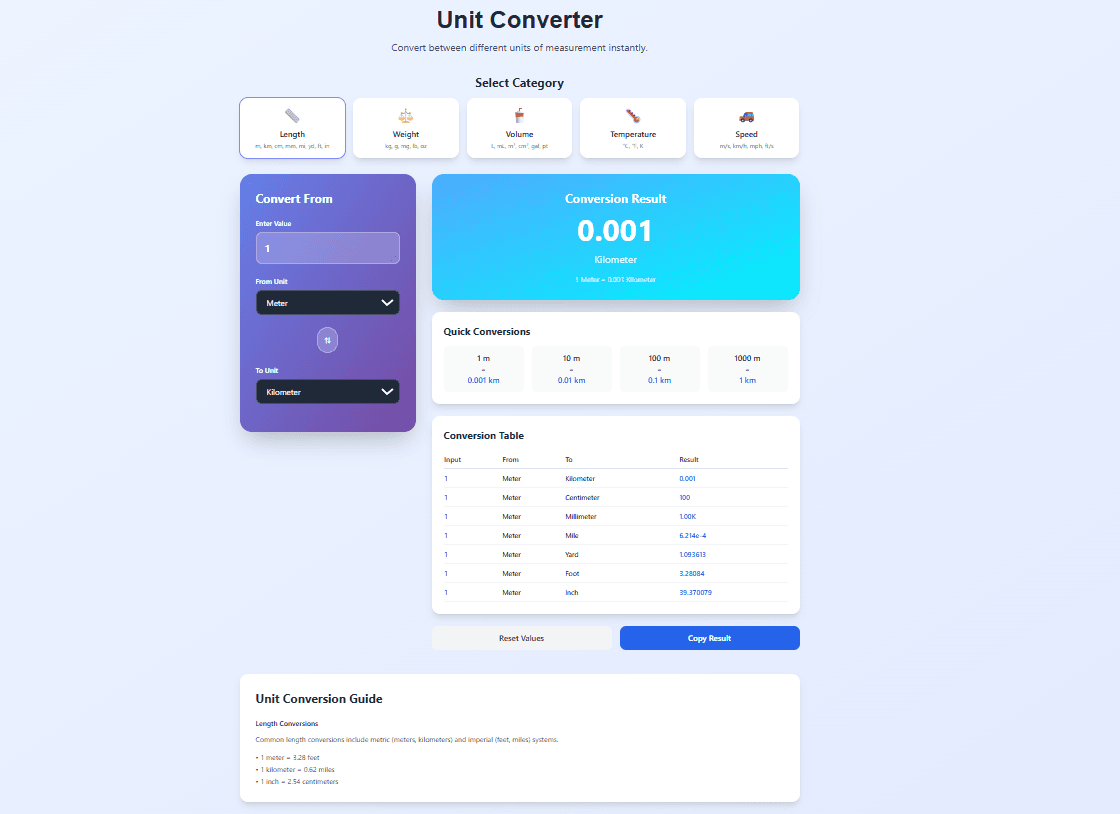
Our unit converter tool makes all these conversions instant. Here is how to use it:
Step 1: Select the category (length, weight, volume, temperature, or speed)
Step 2: Enter the value you want to convert
Step 3: Select the unit you are converting from
Step 4: Select the unit you want to convert to
Step 5: See the result instantly
No math required. No formulas to remember. Just enter and get the answer.
Real-Life Examples of Unit Conversion
Example 1: Following a US Recipe Outside the US
You find a great cookie recipe online. It calls for 2 cups of flour, 1 cup of butter, and 350°F oven temperature.
Conversions needed:
- 2 cups flour = 2 × 236.59 = 473 mL of flour
- 1 cup butter = 236.59 mL of butter
- 350°F to Celsius = (350 - 32) × 5/9 = 177°C
Now you can bake the cookies with your metric measuring tools.
Example 2: Buying a TV Online from the US
You see a 55-inch TV on a US website. Your entertainment unit has 140 cm of space. Will it fit?
Conversion needed:
- 55 inches to cm = 55 × 2.54 = 139.7 cm
- Yes, it will fit (just barely)
Example 3: Traveling to the United States
You are from Europe and driving in the US. The speed limit sign says 65 mph. Your car shows km/h. How fast should you drive?
Conversion needed:
- 65 mph to km/h = 65 × 1.609 = 104.6 km/h
- Set your cruise control to 105 km/h
Example 4: Tracking Your Weight Loss
Your scale shows kilograms but your fitness app expects pounds. You weigh 80 kg.
Conversion needed:
- 80 kg to pounds = 80 × 2.2046 = 176.4 lb
- Enter 176 lb in your app
Unit Conversion Formulas Summary
Here is a quick reference of all the formulas I use most often:
Length Formulas
- cm to inches: divide by 2.54
- inches to cm: multiply by 2.54
- km to miles: divide by 1.609
- miles to km: multiply by 1.609
- meters to feet: multiply by 3.281
- feet to meters: divide by 3.281
Weight Formulas
- kg to pounds: multiply by 2.2046
- pounds to kg: divide by 2.2046
- grams to ounces: divide by 28.35
- ounces to grams: multiply by 28.35
Volume Formulas
- liters to gallons: divide by 3.785
- gallons to liters: multiply by 3.785
- mL to cups: divide by 236.59
- cups to mL: multiply by 236.59
Temperature Formulas
- Celsius to Fahrenheit: (°C × 9/5) + 32
- Fahrenheit to Celsius: (°F - 32) × 5/9
Speed Formulas
- km/h to mph: divide by 1.609
- mph to km/h: multiply by 1.609
Frequently Asked Questions
Q: How to convert cm to inches?
A: Divide the centimeter value by 2.54. For example, 10 cm ÷ 2.54 = 3.94 inches.
Q: How to convert kg to pounds?
A: Multiply the kilogram value by 2.2046. For example, 70 kg × 2.2046 = 154.3 pounds.
Q: How to convert Celsius to Fahrenheit?
A: Use the formula (°C × 9/5) + 32. For example, 25°C × 9/5 = 45, +32 = 77°F.
Q: How to convert km to miles?
A: Divide the kilometer value by 1.609. For example, 100 km ÷ 1.609 = 62.1 miles.
Q: How to convert liters to gallons?
A: Divide the liter value by 3.785. For example, 10 L ÷ 3.785 = 2.64 gallons.
Q: How to convert meters to feet?
A: Multiply the meter value by 3.281. For example, 5 m × 3.281 = 16.4 feet.
Q: What is the easiest way to convert units?
A: Use our free unit converter tool. Enter your value and units, get instant results.
Q: Does the US use metric or imperial?
A: The US primarily uses the imperial system (miles, pounds, gallons, Fahrenheit) for daily life. However, science, medicine, and many industries use metric.
Q: How to convert cooking measurements between metric and imperial?
A: 1 cup = 236.59 mL, 1 tablespoon = 14.79 mL, 1 teaspoon = 4.93 mL. For most recipes, rounding is fine.
Q: Is there a simple way to remember temperature conversion?
A: For a quick estimate, Celsius to Fahrenheit: multiply by 2 and add 30. Fahrenheit to Celsius: subtract 30 and divide by 2.
Q: How to convert square feet to square meters?
A: Multiply square feet by 0.0929. For example, 100 sq ft × 0.0929 = 9.29 sq m.
Q: How to convert miles per gallon to liters per 100 km?
A: Divide 235.21 by the mpg value. For example, 30 mpg = 235.21 ÷ 30 = 7.84 L/100km.
My Final Advice
After years of traveling and cooking with recipes from different countries, I have learned that unit conversion does not have to be hard.
For quick mental math: Use the approximation formulas I shared. They are close enough for most daily situations.
For precise work (cooking, engineering, science): Use a reliable conversion tool like ours. It saves time and prevents mistakes.
Memorize the most common conversions:
- 1 inch = 2.54 cm
- 1 kg = 2.2 lb
- 1 liter = 4.2 cups
- 0°C = 32°F, 100°C = 212°F
- 100 km/h = 62 mph
When in doubt, use the tool. Our unit converter handles all these conversions instantly. No need to remember formulas.
Try Our Free Unit Converter Now
Have questions about a specific conversion? Leave a comment below. I try to answer every one.
Tags: unit converter, how to convert units, length converter, weight converter, volume converter, temperature converter, speed converter, metric to imperial, conversion calculator, unit conversion tool, how to convert cm to inches, how to convert kg to pounds, how to convert celsius to fahrenheit, how to convert km to miles, how to convert liters to gallons, unit conversion formula, measurement conversion guide, convert metric to imperial, unit conversion examples, cooking unit converter, engineering unit converter, distance converter, mass converter, volume conversion table, temperature conversion formula, speed conversion calculator, unit converter online free, unit conversion for beginners, how to do unit conversions easily