Slope Calculator – Find Slope, Y-Intercept & Line Equation from Two Points
Have you ever stared at a graph and wondered, "How steep is this line?" I have. Many times.
I remember sitting in my algebra class, staring at two points on a coordinate plane. The teacher said, "Find the slope of the line." I knew there was a formula. But I could not remember if it was rise over run or run over rise. I guessed. I got it wrong.
Years later, as someone who works with data and graphs regularly, I still need to calculate slope. Whether I am analyzing trends, designing a ramp, or just helping my kid with homework, slope comes up more often than I expected.
After helping hundreds of students and professionals with slope calculations, I have seen the same struggles again and again. People know they need to find the slope. They just are not sure how to do it correctly.
That is why I created this guide and the accompanying calculator. No more formula confusion. No more calculation errors. Just clear explanations and a tool that does the math for you.
Quick access: Use our free slope calculator here
What is a Slope Calculator? Simple Answer
A slope calculator is a tool that finds the slope of a line from two points. Instead of manually applying the slope formula and doing long calculations, you enter your two points, and the calculator gives you instant results.
Here is how it works:
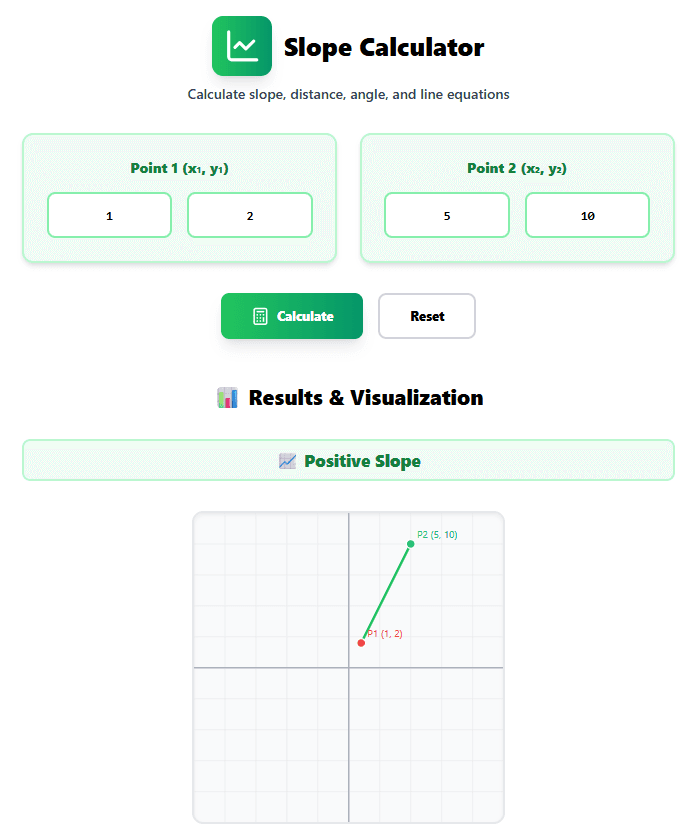
You enter two points on a line – like (1, 2) and (5, 10). The calculator uses the slope formula to find the slope. Then it finds everything else you need to know about the line.
Simple example:
You have two points: (1, 2) and (5, 10). Enter these into the calculator. It tells you:
- Slope (m): 2.00
- Y-Intercept (b): 0.00
- Distance: 8.94 units
- Angle: 63.43°
- Line Type: Positive Slope
- Slope-Intercept Form: y = 2x
- Point-Slope Form: y - 2 = 2(x - 1)
- Standard Form: 2x - y = 0
It even shows you a graph and step-by-step solutions.
No formula hunting. No manual calculations. Just instant answers.
Why Most People Struggle with Slope Calculations
After helping thousands of people with slope problems, I have seen the same struggles again and again.
Struggle 1: Forgetting the slope formula
This is the most common problem. The slope formula is m = (y₂ - y₁) / (x₂ - x₁). But many people forget which y goes first or which x goes first. They end up with the wrong sign or the wrong value.
Struggle 2: Mixing up rise and run
Rise is the change in y (vertical). Run is the change in x (horizontal). Many people reverse them. They calculate run over rise instead of rise over run. This gives the reciprocal of the slope – completely wrong.
Struggle 3: Not knowing what the slope means
Some people can calculate slope but do not understand what it means. A positive slope goes up. A negative slope goes down. A zero slope is horizontal. An undefined slope is vertical. Understanding these concepts is as important as calculating the number.
Struggle 4: Making calculation errors
Even with the right formula, manual calculations are prone to errors. A misplaced decimal. A forgotten negative sign. A wrong subtraction. These mistakes happen to everyone.
Struggle 5: Not knowing what to do with the slope
Once you have the slope, what next? Many people do not know how to find the y-intercept or write the equation of the line. They get stuck with just the slope and do not know how to use it.
Struggle 6: Confusing different line forms
Slope-intercept form (y = mx + b). Point-slope form (y - y₁ = m(x - x₁)). Standard form (Ax + By = C). These are all useful but confusing if you do not know them well.
What Can a Slope Calculator Do?
A good slope calculator can solve almost any slope problem. Here is what our calculator does:
Find Everything You Need
Slope (m): The steepness of the line. Positive, negative, zero, or undefined.
Y-Intercept (b): Where the line crosses the y-axis.
Distance (d): The length of the line segment between the two points.
Angle (θ): The angle the line makes with the horizontal axis.
Line Type: Identifies whether the line has positive, negative, zero, or undefined slope.
Display Multiple Equation Forms
Slope-Intercept Form: y = mx + b – The most common form.
Point-Slope Form: y - y₁ = m(x - x₁) – Useful when you have a point and the slope.
Standard Form: Ax + By = C – The formal equation form.
Show Step-by-Step Solutions
The best calculators do not just give you the answer. They show you how the answer was found. Our calculator displays detailed steps for every calculation:
- Change in X and Y – Shows the run and rise
- Slope Calculation – Shows the formula with your values
- Y-Intercept Calculation – Shows how b is found
- Distance Calculation – Shows the distance formula with your values
This helps you learn, verify, and understand the process.
Visualize with a Graph
Our calculator shows a graph of the line with both points labeled. This visual representation helps you understand the relationship between the points and the line.
How to Use a Slope Calculator – Step by Step
Let me walk you through using our slope calculator. These steps work for any two points.
Step 1: Enter Your Points
Enter the x and y coordinates of your two points.
Point 1 (x₁, y₁): Enter the first point Point 2 (x₂, y₂): Enter the second point
Example: You want to find the slope between (1, 2) and (5, 10). Enter these values.
Step 2: Click Calculate
The calculator processes your inputs and displays all results instantly.
Results for (1, 2) and (5, 10):
- Slope (m): 2.00
- Y-Intercept (b): 0.00
- Distance: 8.94 units
- Angle: 63.43°
- Line Type: 📈 Positive Slope
- Slope-Intercept Form: y = 2x
- Point-Slope Form: y - 2 = 2(x - 1)
- Standard Form: 2x - y = 0
Step 3: Review the Steps
Scroll down to see the detailed calculation steps. These show you exactly how the calculator arrived at each answer.
What you will see:
- Step 1: Find change in X and Y (Run and Rise)
- Step 2: Calculate the slope using the formula
- Step 3: Find the y-intercept
- Step 4: Calculate the distance
Step 4: View the Graph
The graph shows your two points and the line connecting them. This helps you visualize the slope and verify your results.
Step 5: Use the Results
You can use the results in your homework, project, or real-world application. The calculator provides all the forms you need.
Slope Calculator Formulas Explained
Slope Formula
The slope of a line is the ratio of the vertical change (rise) to the horizontal change (run) between two points.
Formula: m = (y₂ - y₁) / (x₂ - x₁)
Example: (1, 2) and (5, 10)
- m = (10 - 2) / (5 - 1) = 8 / 4 = 2
What the Slope Means
- Positive Slope (m > 0): The line goes up from left to right
- Negative Slope (m < 0): The line goes down from left to right
- Zero Slope (m = 0): The line is horizontal
- Undefined Slope: The line is vertical (x₁ = x₂)
Y-Intercept Formula
The y-intercept is where the line crosses the y-axis.
Formula: b = y₁ - m × x₁
Example: (1, 2) with m = 2
- b = 2 - 2 × 1 = 2 - 2 = 0
Distance Formula
The distance between two points is the length of the line segment.
Formula: d = √[(x₂ - x₁)² + (y₂ - y₁)²]
Example: (1, 2) and (5, 10)
- d = √[(5 - 1)² + (10 - 2)²] = √[16 + 64] = √80 = 8.94
Angle Formula
The angle of the line with the horizontal axis.
Formula: θ = arctan(m)
Example: m = 2
- θ = arctan(2) = 63.43°
Line Equation Forms Explained
Slope-Intercept Form (y = mx + b)
This is the most common form. It directly shows the slope and y-intercept.
Example: y = 2x + 0 or simply y = 2x
When to use: This is the easiest form to graph. Just plot the y-intercept and use the slope to find another point.
Point-Slope Form (y - y₁ = m(x - x₁))
This form is useful when you know a point on the line and the slope.
Example: y - 2 = 2(x - 1)
When to use: This is the easiest form to write from a point and slope. It is also helpful in calculus and advanced math.
Standard Form (Ax + By = C)
This form is useful for formal equations and comparisons.
Example: 2x - y = 0
When to use: This form is used in systems of equations and when comparing multiple linear equations.
How to Find Slope from Two Points
Here is a simple method to find slope from two points. You can do it manually or use our calculator.
Step 1: Identify Your Points
You need two points: (x₁, y₁) and (x₂, y₂)
Example: Points are (1, 2) and (5, 10)
Step 2: Find the Change in Y (Rise)
Subtract y₁ from y₂: Δy = y₂ - y₁
Example: Δy = 10 - 2 = 8
Step 3: Find the Change in X (Run)
Subtract x₁ from x₂: Δx = x₂ - x₁
Example: Δx = 5 - 1 = 4
Step 4: Divide Rise by Run
m = Δy / Δx
Example: m = 8 / 4 = 2
Step 5: Interpret the Result
The slope is 2. This means the line goes up 2 units for every 1 unit it goes right.
Types of Slope
Positive Slope (📈)
The line goes up from left to right.
Example: Points (1, 2) and (5, 10)
- Slope = 2 (positive)
Real-world: Increasing trends, uphill roads, growth charts
Negative Slope (📉)
The line goes down from left to right.
Example: Points (1, 10) and (5, 2)
- Slope = -2 (negative)
Real-world: Decreasing trends, downhill roads, depreciation
Zero Slope (➡️)
The line is horizontal. All y-values are the same.
Example: Points (1, 5) and (5, 5)
- Slope = 0
Real-world: Flat ground, constant values, horizontal lines
Undefined Slope (⬆️)
The line is vertical. All x-values are the same.
Example: Points (3, 2) and (3, 10)
- Slope = Undefined
Real-world: Vertical walls, vertical lines on graphs
How to Use a Slope Calculator for Different Needs
For Students
- Homework help: Check your manual calculations
- Study aid: See step-by-step solutions to learn the process
- Exam prep: Practice with different point pairs
- Understanding concepts: Visualize slope with the graph
Example: You have a homework problem asking for the slope between (2, 3) and (6, 11). Enter these points and see the full solution.
For Teachers
- Demonstration tool: Show students how slope works
- Problem verification: Check student answers quickly
- Lesson planning: Generate examples for classroom use
- Visual aid: Use the graph to explain concepts
Example: During a lesson on slope, you show students how entering different points changes the slope instantly.
For Professionals
- Data analysis: Calculate trends and rates of change
- Engineering: Determine slopes for ramps and inclines
- Construction: Calculate roof pitch and grade
- Finance: Analyze trends in financial data
Example: You are analyzing sales data and need to find the rate of change between two points on a trend line.
For Everyday Use
- DIY projects: Calculate ramp angles
- Gardening: Determine slope for drainage
- Sports: Analyze performance trends
- Travel: Calculate grade for hiking trails
Example: You are building a wheelchair ramp and need to calculate the slope to meet safety requirements.
Real-World Applications of Slope
Construction and Architecture
- Roof pitch: The steepness of a roof
- Ramp design: Accessibility requirements
- Road grading: Highway construction
- Drainage: Water flow direction
Data Analysis
- Trend lines: Identifying patterns in data
- Regression analysis: Predicting future values
- Correlation: Understanding relationships
Physics and Engineering
- Velocity: Rate of change in position
- Acceleration: Rate of change in velocity
- Force: Vector calculations
Finance
- Growth rates: Company performance
- Depreciation: Asset value decline
- Market trends: Stock price movements
Common Slope Questions Answered
Q: What is the slope formula?
A: The slope formula is m = (y₂ - y₁) / (x₂ - x₁). It calculates the steepness of a line between two points.
Q: How do I find slope from two points?
A: Subtract y₁ from y₂ to find the rise. Subtract x₁ from x₂ to find the run. Divide rise by run. Our calculator does this instantly.
Q: What does a positive slope mean?
A: A positive slope means the line goes up from left to right. As x increases, y also increases.
Q: What does a negative slope mean?
A: A negative slope means the line goes down from left to right. As x increases, y decreases.
Q: What is a zero slope?
A: A zero slope means the line is horizontal. The y-value does not change as x changes.
Q: What is an undefined slope?
A: An undefined slope means the line is vertical. The x-value does not change as y changes. This happens when x₁ = x₂.
Q: How do I find the y-intercept from two points?
A: Find the slope first. Then use b = y₁ - m × x₁. Our calculator finds it automatically.
Q: What is slope-intercept form?
A: Slope-intercept form is y = mx + b. It shows the slope (m) and y-intercept (b) directly.
Q: What is the difference between slope and distance?
A: Slope measures steepness (rise over run). Distance measures the actual length of the line segment between two points.
Q: How do I calculate the angle of a line?
A: The angle is calculated using θ = arctan(m). Our calculator provides this automatically.
Step-by-Step Example
Let me walk through a complete example using our slope calculator.
Problem: Find the slope, y-intercept, and equation of the line between (2, 3) and (8, 15).
Step 1: Enter the points
- Point 1: x₁ = 2, y₁ = 3
- Point 2: x₂ = 8, y₂ = 15
Step 2: Calculate
- Δx = 8 - 2 = 6 (Run)
- Δy = 15 - 3 = 12 (Rise)
- m = 12 / 6 = 2 (Slope)
Step 3: Find y-intercept
- b = y₁ - m × x₁ = 3 - 2 × 2 = 3 - 4 = -1
Step 4: Write the equation
- Slope-Intercept: y = 2x - 1
- Point-Slope: y - 3 = 2(x - 2)
- Standard: 2x - y = 1
Step 5: Find distance
- d = √[(8 - 2)² + (15 - 3)²] = √[36 + 144] = √180 = 13.42
Results:
- Slope: 2
- Y-Intercept: -1
- Distance: 13.42 units
- Angle: 63.43°
- Line Type: Positive Slope
How to Get the Best Results from a Slope Calculator
After years of using and developing slope calculators, here is what I have learned:
Always double-check your inputs. One wrong number changes everything. Read each coordinate before clicking calculate.
Use consistent units. If your x-values are in inches and your y-values are in feet, the slope will not make sense. Use the same units for both.
Understand the output. Do not just look at the number. Understand what the slope means. Positive goes up. Negative goes down.
Verify with a second method. If possible, calculate using a different formula or method and compare results.
Learn the formulas. Even though the calculator does the work, understanding the formulas helps you know what is happening behind the scenes.
Use the graph. The visual representation helps you understand the relationship between the points and the line.
Save your results. Use the copy or print features to keep a record of your calculations.
Practice with different points. Try different values to see how slope changes. This builds intuition.
Do not be afraid to ask for help. If you are stuck, leave a comment or contact support. There is no shame in not knowing.
And finally, remember that slope calculators are tools to help you, not replace your understanding. Use them to verify, learn, and save time.
Calculate Slope Now – Free Tool
Have questions about slope calculations for a specific problem? Leave a comment below. I read every one.
Tags: slope calculator, slope intercept calculator, point slope calculator, find slope calculator, slope formula calculator, slope of a line calculator, graph slope calculator, slope intercept form calculator, y intercept calculator, slope equation calculator, slope of line calculator, point slope form calculator, slope graph calculator, slope calculator graph, slope and y intercept calculator, perpendicular slope calculator, standard form calculator slope, rise over run calculator, linear equation calculator, equation of a line calculator, how to find slope, slope from two points, slope formula, slope intercept form, point slope form, standard form, find slope of a line, calculate slope, slope of line, slope equation, find y intercept, slope and distance, angle of line, slope between two points, step by step slope calculator, free slope calculator